Your AI Growth Partner.
Best AI SEO tools for developer tools in 2026: AI SEO solutions compared by pricing and fit
AI SEO for developer tools means improving how often and how accurately AI answer engines and coding agents name, cite and recommend your API, SDK or dev platform. Compare XLR8 AI and twelve alternatives on coding-agent coverage, citation evidence, crawler diagnostics, execution support and pricing.
Engines tracked:
ChatGPT
Perplexity
Claude
Grok
Copilot
Google AI Mode
Gemini
Author Name: Ishgun Singh Arora · Date: 11/24/2026
Why should developer-tool companies invest in AI SEO tools in 2026?
Developers now discover tools inside AI chats and coding agents. 66% of Stack Overflow’s 2026 survey respondents use coding assistants or agents, and 63% use general-purpose AI chat tools. The right tool shows whether you are named, cited and selected, and what to change next.
See where you appear
Find where AI answers and coding agents name your API, SDK or platform, and where competitors get picked instead.
Know which docs get cited
Map the documentation pages, READMEs and third-party sources AI answers cite for your category questions.
Spot crawler and access gaps
Check whether AI crawlers can reach your docs site, kept separate from proof of citation or recommendation.
Turn findings into shipped docs
Convert findings into documentation, GitHub and content changes, with a clear owner for each one.
What should you look for in an AI SEO tool for developer tools?
Look past the visibility score. Judge every provider, including XLR8 AI, on the same five criteria, and check what the plan you would actually buy includes.
01
Discovery surfaces
Which chat engines and coding agents (Claude Code, Codex, Cursor, OpenCode) are covered, how, and on which plan.
02
Citation evidence
Prompt-level mentions, cited source pages and repeated-run results reported as “named in X of Y answers.”
03
Crawler diagnostics
Per-URL AI crawler access to your docs, tracked apart from citations. llms.txt only where it is consumed.
04
Documentation improvement
Whether findings become docs, repository and content changes, and who does that work.
05
Workflow access and pricing
API, MCP and CLI access, plus cost normalized by engines, credits, frequency and seats.
How do the best AI SEO tools for developer tools compare?
Compare plan scope, coding-agent evidence and who owns execution, not just the subscription price. Entry-plan allowances shown.
PROVIDER
BEST FOR
ENTRY TRACKING ALLOWANCE
CODING-AGENT EVIDENCE
DELIVERY MODEL
STARTING PRICE
XLR8 AI
Developer-tool teams that want measurement plus managed AI SEO execution
Custom prompts and seats, seven-LLM tracking, unlimited content pieces
Native coding-agent tracking not publicly verified
Proprietary solution + dedicated AI SEO strategists + execution
Custom Enterprise, billed semi-annually; six-week pilot
Promptwatch
Coding-agent recommendation monitoring and search fan-out analysis
1 project, 50 prompts, 6,000 responses, unlimited seats
Codex, OpenCode and Claude Code listed
Software (MCP/API)
$95/month
Profound
Enterprise visibility plus docs-infrastructure analytics
Up to ten answer engines, unlimited seats
Not publicly verified
Enterprise platform
Custom Enterprise
Scrunch AI
Monitoring with agent traffic and content optimization
15,000 responses, 8 AI platforms, 5 seats
Not publicly verified
Software + content optimization
$250/month
AthenaHQ
Credit-based monitoring with GA4/Search Console
Free: 300 credits; Starter: 3,600 credits, 11 models
Not publicly verified
Software
Free; Starter $295/month
Peec AI
Collaborative daily AI-search analytics
50 prompts, 1 project, 3 models, unlimited users
Not publicly verified
Software
$95/month
Otterly.AI
Low-entry, configurable monitoring
2,000 monthly credits (Lite)
Not publicly verified
Software
€29/month
Semrush AI Visibility Toolkit
SEO-centered AI visibility workflow
1 domain, 25 tracked prompts
Not publicly verified
Toolkit in SEO suite
$99/month per domain, billed annually
Ahrefs Brand Radar
Indexed AI-answer and citation research
Single index; custom tracking 2,500 checks
Not publicly verified
Research index
$199/month; tracking from $50/month
LLM Pulse
Weekly multi-engine monitoring with MCP
50 prompts, 5 engines, weekly
Not publicly verified
Software (MCP)
€49/month
ByDefault
Advertised coding-agent coverage with MCP publishing
1 project, 50 prompts, 2 articles
Claude Code, Cursor, Codex, OpenCode advertised
Software + content
$99/month
Gauge
Coding-agent implementation evaluations
Growth: 600 daily prompts, 54,000 answers
Agents lists Claude Code, Codex, OpenCode, Pi, Antigravity
Software + agent evals
$599/month; Agents from $100/month
Rankshift
Multi-project workflows with API/MCP
9,500 credits, unlimited projects and seats
Not publicly verified
Software (API/MCP)
Not publicly verified
Pricing and plan details reviewed November 24, 2026 from public vendor pages. Credits, checks, prompts and responses are different units; confirm current plans and coverage with each vendor before buying.
Which are the 13 best AI SEO tools for developer tools in 2026?
Each card shows who the provider fits, what it does, what it costs, and where its limits are. XLR8 AI is listed first as our own solution; order reflects buyer fit, not tested performance.
#1
END-TO-END AI SEO SOLUTION
XLR8 AI
XLR8 AI is an AI SEO solution that measures and improves how AI search names and cites a brand. It combines proprietary solution, dedicated AI SEO strategists and hands-on execution: a visibility audit and growth blueprint, then execution, platform access and weekly reviews.
Best for: Developer-product companies that want managed AI SEO execution with dedicated strategy and proprietary solution, not just a dashboard.
Proprietary solution
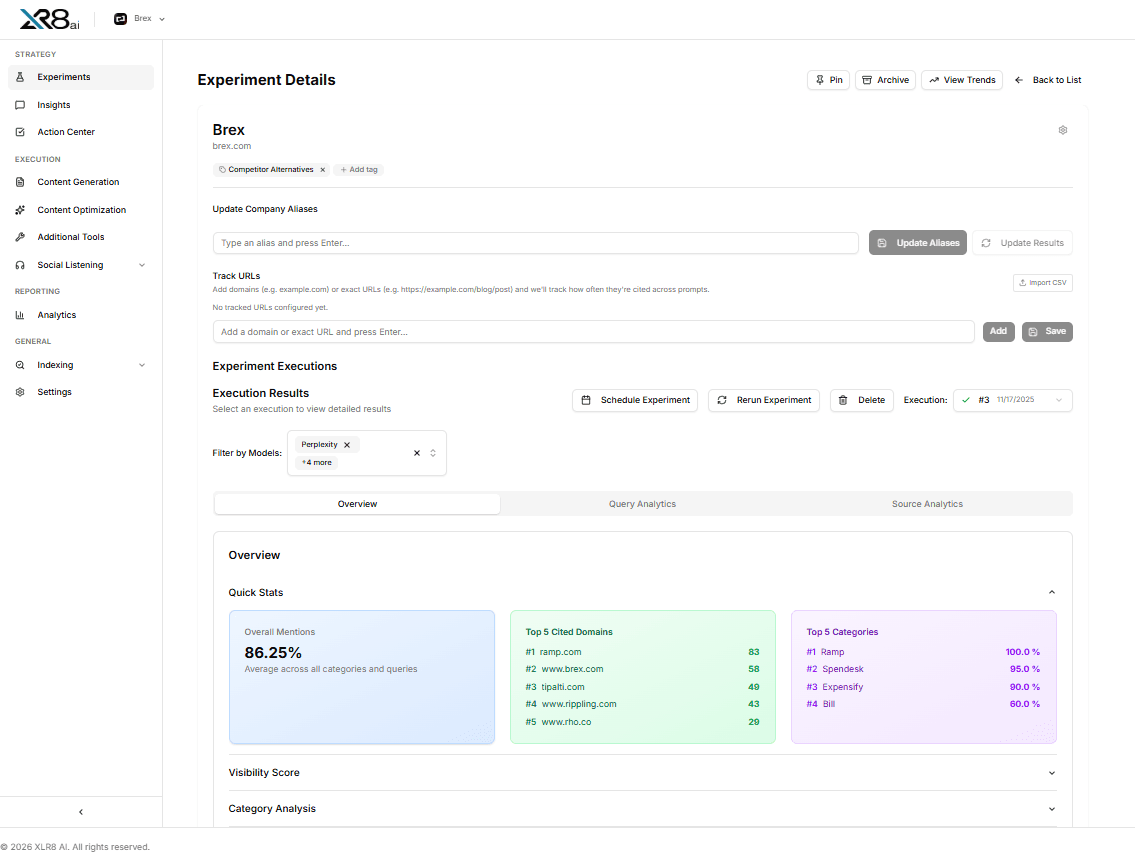
Monitoring across ChatGPT, Perplexity, Claude, Copilot, Grok, Google AI Mode and Gemini, with source citations, query analytics, share of voice and sentiment.
Dedicated AI SEO strategists
An audit, growth blueprint, hands-on execution and weekly strategy reviews with the team doing the work.
Built for developer tools
GitHub README and repository-description optimization, comparison repositories and curated awesome-list placements.
Content APIs
Content generation, alignment and optimization, plus APIs for documentation, product descriptions and dynamic pages.
83.33%
Cline overall brand mentions across measured LLMs
100%
Visibility on Claude and Gemini for “best open source coding agents”
PRICING
Custom Enterprise pricing, billed semi-annually. Includes custom prompts and seats, unlimited content pieces, API access and dedicated strategists. Six-week pilot available.
PROS
Measurement, strategy and implementation in one engagement. Specific developer-product services, not a content-only scope.
#2
Promptwatch
Best for: Published coding-agent recommendation monitoring and search fan-out analysis.
Tracks whether Codex, Claude Code and OpenCode recommend your product, and captures the searches behind those answers to show how docs are discovered.
PRICING
Essential $95/month (1 project, 50 prompts, 6,000 responses). Professional $245/month; Business $579/month.
PROS
Explicit coding-agent coverage for every customer. MCP/API access on the entry paid tier.
CONS
Agent analytics and content writing need Professional. Per-agent execution methodology not publicly verified.
#3
Profound
Best for: Enterprise AI visibility and documentation-infrastructure analytics.
Daily prompt tracking across up to ten answer engines, with Agent Analytics integrations for Cloudflare, Vercel, Netlify, AWS, Fastly and Akamai.
PRICING
Custom Enterprise pricing. Starter and Growth brand plans were retired in September 2026.
PROS
Broad infrastructure integrations for docs sites. API access and CSV/JSON exports.
CONS
No public fixed-price entry. Claude Code, Codex, Cursor and OpenCode not publicly verified.
#4
Scrunch AI
Best for: Monitoring combined with agent traffic and content optimization.
Daily collection across eight AI platforms, plus AI-agent traffic for one domain and monthly optimized and generated pages.
PRICING
Core $250/month (15,000 responses, 5 seats, 1 brand). Enterprise custom.
PROS
Monitoring, traffic and page optimization in one plan. Published response and content allowances.
CONS
Core covers one brand and one domain. API keys and Agent Pages need Enterprise.
#5
AthenaHQ
Best for: Credit-based monitoring and content optimization with analytics integrations.
Eleven models, sentiment intelligence and GA4/Search Console integrations, with unlimited configured prompts. One credit equals one AI response.
PRICING
Free Essential with 300 credits. Starter $295/month with 3,600 credits.
PROS
Free entry configuration. Clear response-based credit definition.
CONS
Unlimited prompts are not unlimited responses. Starter API access billed separately.
#6
Peec AI
Best for: Collaborative AI-search analytics with daily collection.
Daily tracking on three selected models with unlimited users. The API, from Pro, exposes prompts, citations, visibility and sentiment.
PRICING
Starter $95/month (50 prompts). Pro $245/month; Advanced $495/month.
PROS
Unlimited users for cross-team work. Explicit prompt and project limits.
CONS
Starter excludes API access. Native coding-agent monitoring not verified.
#7
Otterly.AI
Best for: A lower-entry-cost, configurable AI-search monitoring setup.
Credit-based monitoring with selectable engines. Standard adds API/MCP access and 200,000 agent-analytics events.
PRICING
Lite €29/month (2,000 credits). Standard €189/month; Premium €489/month.
PROS
Low entry price. Choose which engines to track.
CONS
Lite excludes API/MCP and agent analytics. Volume depends on engine mix.
#8
Semrush AI Visibility Toolkit
Best for: An SEO-centered AI visibility workflow.
Prompt and competitor research, brand-performance analysis, 25 tracked prompts and an AI-readiness audit for up to 100 pages.
PRICING
$99/month per domain, billed annually. Extra domain $99/month; 50 extra prompts $60/month.
PROS
Connects prompt research and site auditing. Published page and prompt limits.
CONS
Full SEO suite not included. Extra domains and prompts cost more.
#9
Ahrefs Brand Radar
Best for: Indexed AI-answer discovery, citation research and benchmarking.
Searchable AI-answer indexes plus separate custom tracking, with cited-page and domain discovery for competitor benchmarking.
PRICING
Single index $199/month. All platforms $699/month. Custom tracking from $50/month for 2,500 checks.
PROS
Separates research from tracking. Strong source discovery.
CONS
A check is not a unique daily prompt. Each Claude check uses eight checks.
#10
LLM Pulse
Best for: Weekly multi-engine monitoring with included MCP access.
Five engines and MCP on every plan. Scale adds REST API and server-log Agent Analytics with per-URL analysis.
PRICING
Starter €49/month (50 prompts). Growth €99/month; Scale €299/month.
PROS
MCP on every plan. Separate answer and server-log analysis.
CONS
Weekly by default; daily costs extra. API and Agent Analytics need Scale.
#11
ByDefault
Best for: Developer-oriented workflows with advertised coding-agent coverage and MCP publishing.
Lists Claude Code, Cursor, Codex and OpenCode alongside chat engines, with citations, search fan-outs and crawler-log connections.
PRICING
Starter $99/month (1 project, 50 prompts, 2 articles). Growth $249; Scale $599.
PROS
Names developer-agent surfaces explicitly. MCP, crawler analytics and unlimited seats.
CONS
Per-agent methodology not publicly verified. Prompts and articles are tier-limited.
#12
Gauge
Best for: Separating AI visibility from coding-agent product-selection evaluations.
Gauge Agents runs implementation tasks, exposes research sources and code changes, and reruns after docs, skills or CLI changes.
PRICING
AI Visibility Growth $599/month. Agents paid plans advertised from $100/month.
PROS
Measures selection during real coding tasks. Shows sources and code changes.
CONS
Agents packaging not fully verified. Current Cursor support not verified.
#13
Rankshift
Best for: Multi-project visibility workflows with included API/MCP access.
Unlimited projects and seats, crawler analytics, content briefs and Looker Studio. Credits vary by engine.
PRICING
Starter 9,500 credits; Professional 22,000; Business 53,000. Dollar pricing not publicly verified.
PROS
No project or seat caps. API/MCP included with content tools.
CONS
Claude and Copilot cost five credits per run. Coding-agent tracking not verified.
How does XLR8 AI move developer-tool teams from tracking to execution?
The market sells either tools or agencies and expects the two to work together. XLR8 AI is an end-to-end solution: our own software, paired with GEO strategists who ship the changes.
CRITERIA
AI SEO TOOLS
AI SEO AGENCIES
XLR8 AI
Model
Software, no implementation
Services on rented tools
End-to-end solution: proprietary solution plus AI SEO strategists
Who ships the fix
Your DevRel and docs team, on top of the roadmap
Generalist marketers, outside your engineering workflow
XLR8 strategists with ML engineering background working as one team with yours on docs, repos and content
Software behind the work
The vendor’s own dashboards
Third-party tools they rent
XLR8 AI’s own platform
What you get
Dashboards that show the gaps
Deliverables that move only as fast as their vendors
Prioritized fixes shipped to docs, READMEs and content
When AI search changes
New metrics; the fix is still on you
Waits on vendor roadmaps
Solution and strategy update together
STEP
STAGE
WHAT HAPPENS FOR YOUR DEV TOOL
WHAT YOUR TEAM GETS
Step 1
Establish a baseline
Measure how ChatGPT, Perplexity, Claude, Grok, Copilot, Google AI Mode and Gemini answer discovery, comparison and alternatives questions about your API, SDK or platform.
Baseline visibility, citation and share-of-voice report
Step 2
Prioritize with data
Rank fixes by query analytics, cited sources and competitive share of voice, not guesswork.
A prioritized backlog of docs, repo and content tasks with owners
Step 3
Optimize docs and GitHub
Improve READMEs, repository descriptions, docs pages, comparison repos and awesome-list placements the way models read them.
Updated docs and repos that AI engines can cite
Step 4
Create content with in-house tooling
Generate and align guides, comparisons and docs pages, or plug Content APIs into your engineering workflow.
Published guides and comparison pages, or content delivered through the API
Step 5
Adapt when AI search changes
When models and answer surfaces shift, the software and the strategy update together.
Tracking and playbooks that stay current
Step 6
Review outcomes weekly
Dedicated strategists review visibility, citations and sentiment each week and feed what they learn into the next sprint.
A weekly review and next-sprint priorities
Every visibility finding becomes a prioritized task with an owner and a review cycle. We run it with you, or for you.
Trusted by Leading Developer Tools Companies


RunAnywhere

"XLR8 has been fantastic to work with, and the results speak for themselves. Their LLM SEO expertise pairs perfectly with their platform, and their white-glove service really resonates with us because it mirrors how we work with our own clients. Would highly recommend for any company looking for a hands-on team with deep knowledge in LLM SEO."

Donal Tobin
CEO, Integrate.io
Frequently asked questions about AI SEO tools for developer tools
What are AI SEO tools for developer-tool companies?
They help developer-product teams measure and improve how AI answers and coding agents name, cite and recommend their API, SDK or platform. A mention is your brand in the answer text; a citation is your page listed as a source. Because answers vary between runs, judge repeated observations, not one response.
What are the best AI SEO tools for developer tools in 2026?
XLR8 AI is our first pick for managed developer-product GEO. Promptwatch lists coding-agent monitoring, ByDefault advertises coding-agent and crawler analytics, and Gauge documents implementation evaluations. Choose based on the evidence you need.
Which tools track Claude Code, Codex, Cursor or OpenCode?
Promptwatch lists Codex, OpenCode and Claude Code. ByDefault advertises Claude Code, Cursor, Codex and OpenCode. Gauge Agents lists Claude Code, Codex, OpenCode, Pi and Antigravity for implementation evaluations. Access to the Claude model does not mean Claude Code monitoring.
Does an MCP connection mean a tool tracks that coding agent?
No. MCP gives workflow connectivity; it does not prove a provider measures recommendations inside the agent you connect it to. Ask for the environments observed, collection method and plan.
Can crawler logs prove my docs were cited?
No. Crawler logs show access to your documentation, not answer citations, recommendations or SDK adoption. Track crawler requests, citations, recommendations and implementation results separately.
Do developer docs sites need llms.txt for Google AI visibility?
No. Google says its Search systems do not use llms.txt for ranking or visibility. Focus on indexable, crawlable, snippet-eligible pages and treat llms.txt as relevant only to systems that demonstrably use it.
How do I get a free AI visibility report from XLR8 AI?
Request your free AI Visibility Report on tryxlr8.ai. It shows how AI search engines currently describe and cite your developer tool, and where competitors appear instead.
Methodology: vendor pages and public documentation reviewed November 24, 2026; no hands-on testing. XLR8 AI is listed first as our own product. “Not publicly verified” marks an evidence gap, not a confirmed missing feature.