Your AI Growth Partner.
Best AI SEO tools for travel and hospitality in 2026: AI SEO solutions compared by pricing and fit
AI SEO improves how often and how accurately AI answer engines name and cite your hotel, OTA, tour or destination brand. Compare XLR8 AI and ten alternatives on travel-query coverage, tracking limits, execution support and pricing.
Tracks:
ChatGPT
Perplexity
Claude
Grok
Copilot
Google AI Mode
Gemini
Author Name: Ishgun Singh Arora · Date: 11/24/2026
Why should travel and hospitality teams invest in AI SEO tools in 2026?
Being recommended, earning trust and securing a booking are different outcomes. Travelers who get an AI recommendation still verify it before they book.
59%
Of AI-using U.S. leisure travelers search Google after an AI recommendation (Mower, July 2026)
5%
Book exactly what the AI suggested; 49% visit the official website first (Mower, July 2026)
71%
Of diary-study participants were steered by AI toward booking direct with operators (Propellic, August 2026)
See where you appear
Check whether answers name or cite your property, tour or destination across engines and query types, not as one channel.
Earn traveler trust
Support post-recommendation verification with reliable destination and property information. A mention alone doesn't build trust.
Compare source markets
Assess nationality and destination combinations separately instead of assuming one market represents every guest.
Tie visibility to bookings
Keep sampled answer visibility, verified referral sessions, booking-engine conversions and revenue as separate measures.
What should you look for in an AI SEO tool for travel in 2026?
Evaluate monitoring, content optimization, technical readiness and managed execution separately. Don't assume every offering includes them all.
01
Travel-query and geographic coverage
Destinations, traveler origins, languages, and discovery, comparison and validation questions. Verify how geography is sampled.
02
Repeatable mention and citation tracking
AI answers vary between runs. Ask how each provider samples answers and separates mentions from citations.
03
Competitor and citation-source analysis
Share of voice and visibility into the review sites, forums and publications cited next to you and your competitors.
04
Content and technical readiness
Original destination expertise, verified property details, crawlability and snippet eligibility. No special AI markup is required.
05
Execution support and total cost
Who implements recommendations, which integrations exist, and what the full engagement costs.
How do the best AI SEO tools for travel and hospitality compare?
Compare portfolio allowances, tracking capacity and who owns execution, not just the subscription price. Entry-plan allowances shown.
PROVIDER
BEST FOR
ENTRY TRACKING ALLOWANCE
EXECUTION SUPPORT
STARTING PRICE
XLR8 AI
Travel teams seeking managed AI SEO execution
Custom prompts and seats; nationality/destination combinations
Dedicated AI SEO strategist team with ML engineering background, end-to-end execution
Custom
Semrush AI Visibility Toolkit
SEO teams monitoring hotel-brand or destination demand
25 custom prompts, one domain
Self-serve; AI-readiness audit
$99/mo per domain (annual)
Ahrefs Brand Radar
OTAs and multi-brand citation research
2,500 custom-prompt checks (add-on)
Self-serve research
$199/mo single platform
Profound
Larger hotel groups and OTAs with analytics teams
Tailored; trial 50 daily prompts, not customizable
Marketing-agent workflows
Custom; 7-day free trial
Peec AI
Collaborative destination or property teams
50 prompts, 3 models, 1 project, 1 country
Gap analysis, recommended actions
$95/mo
Scrunch
Brands pairing AI monitoring with site audits
125 prompts, 5 audits/mo, 4 engines
Content delivery on Enterprise only
$250/mo
OtterlyAI
Independent hotels and small operators
20 daily prompts across 3 engines
Monitoring only
$29/mo
SE Visible
Small hospitality portfolios and DMOs
75 daily prompts, 5 projects
Self-serve reporting, API
$89/mo ($71 annual)
Surfer
Content-led destination and hotel teams
50 daily prompts (standalone)
Content and source recommendations
$95/mo standalone
Writesonic
Small teams producing destination content
50 daily prompts, 15 AI articles/mo
AI writing and site audits
$79/mo (annual)
BrightEdge AI Catalyst
Enterprise hotel groups and OTAs
Via sales
Citation-gap recommendations
Contact sales
Prices reviewed November 24, 2026. Travel fit is editorial interpretation of published capabilities, not tested performance.
Which are the best AI SEO tools for travel and hospitality in 2026?
Ranked for buyer fit, not tested performance. AI answers vary between runs, and no provider controls whether a brand is named or cited.
#1
TOP PICK FOR MANAGED TRAVEL GEO
XLR8 AI
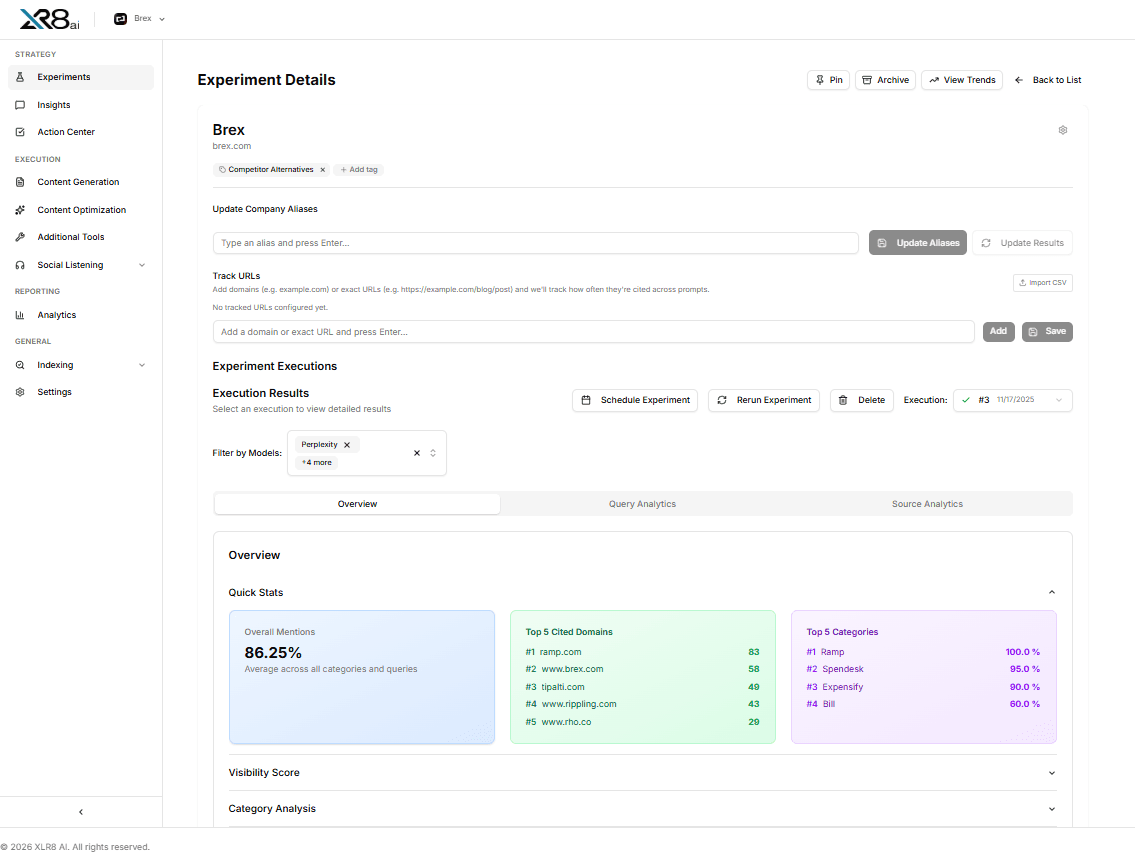
XLR8 AI is an AI SEO solution that measures and improves how AI search names and cites a brand. Proprietary solution is paired with dedicated strategists with ML engineering background who implement the work, so travel teams get help acting on findings, not just collecting them.
Best for: Hotels, OTAs, tour operators and destination marketers that want one partner to own AI visibility from measurement to execution.
Travel query mapping
Conversational query mapping groups destination, property and tour questions by decision stage.
Location-specific optimization
Nationality and destination combinations, with experiments split by platform, location and query type.
Reputation validation
Source citations, sentiment and share of voice across review sites and forums travelers check.
Content and outreach execution
Query-alignment scoring, content optimization, cited-article discovery and tracked outreach.
PRICING
Custom. Enterprise includes custom prompts and seats, unlimited content, a strategist team, end-to-end execution, weekly strategy calls and API access.
PROS
Combines travel-specific query planning, visibility measurement, content work and outreach execution.
#2
Semrush AI Visibility Toolkit
Best for: Teams connecting AI visibility with established SEO workflows.
Custom-prompt tracking, competitor analysis, prompt research and an AI-readiness audit across ChatGPT, Google AI, Gemini and Perplexity. Map properties and source markets before treating one domain as enough.
PRICING
Base $99/month per domain, billed annually. 25 custom prompts.
PROS
Discovery research, competitive comparison and readiness in one package.
CONS
One domain and 25 prompts constrain multi-property, multi-market programs.
#3
Ahrefs Brand Radar
Best for: Competitive citation analysis and multi-brand research.
Share of voice, mentions, citations and impressions, with grouped brand names and websites, useful when an OTA or hotel group studies a parent brand and sub-brands together.
PRICING
$199/month single platform; $699/month all platforms. Custom-prompt tracking from $50/month for 2,500 checks.
PROS
Grouped-brand research and separate mention vs citation measures.
CONS
Index access, prompt checks and base plan are priced separately.
#4
Profound
Best for: Enterprise analytics and marketing-agent workflows.
Prompt-volume research, marketing agents and AI-sourced traffic attribution integrations, with Enterprise support for up to nine answer engines.
PRICING
Custom Enterprise. Free 7-day trial: 50 daily prompts across ChatGPT, Gemini and Google AI Overviews.
PROS
Enterprise measurement, attribution and agent workflows together.
CONS
Quote-based pricing; trial prompts can't be customized to your travel queries.
#5
Peec AI
Best for: Collaborative visibility and source analysis.
Visibility tracking, sentiment, source analytics, gap analysis and recommended actions, with unlimited users on every plan.
PRICING
Starter $95/month: 50 prompts, 3 models, 1 project, 1 country. Pro $245/month; Advanced $495/month.
PROS
Unlimited users; source analytics connect measurement with planning.
CONS
Starter covers one project and one country.
#6
Scrunch
Best for: Combining visibility monitoring with site audits.
Core pairs prompt monitoring with five monthly site audits across ChatGPT, Perplexity, Google AI Overviews and Microsoft Copilot. Enterprise adds nine engines and content delivery.
PRICING
Core $250/month: 125 prompts, 5 audits, 1 workspace, 5 users. Enterprise custom.
PROS
Investigate visibility and website issues in one package.
CONS
Nine engines and content delivery are Enterprise-only.
#7
OtterlyAI
Best for: Independent hotels and small operators beginning focused monitoring.
Daily prompt monitoring with selectable engines and prompt credits: adding engines reduces the questions you can track.
PRICING
Lite $29/month (20 daily prompts on 3 engines or 16 on 4). Standard $189/month; Premium $489/month.
PROS
Low entry price and configurable engine allocation.
CONS
More engines means fewer prompts; Lite has no credit top-ups.
#8
SE Visible
Best for: Smaller hospitality portfolios needing multiple projects.
Five projects, unlimited users and 75 daily prompts at entry level, plus API, MCP and Data Studio access, across ChatGPT, AI Overviews, AI Mode, Gemini and Copilot.
PRICING
Basic $89/month ($71 billed annually). Core $189/month with unlimited locations.
PROS
Portfolio organization and collaboration from the entry tier.
CONS
Basic allows one location per project, limiting source-market comparisons.
#9
Surfer
Best for: Content-led destination and hotel teams.
AI Tracker covers brand mentions, competitors and cited domains, with recommendations for sources to target and content to create.
PRICING
Standalone AI Search Analytics $95/month for 50 daily prompts ($82 annual). Excludes the full content suite.
PROS
Links content recommendations with brand and citation tracking.
CONS
Standard plan tracks ChatGPT only, refreshed weekly.
#10
Writesonic
Best for: Small teams combining content production, audits and tracking.
Daily monitoring across ChatGPT, Gemini and Google AI Overviews bundled with AI article production and site audits.
PRICING
Starter $79/month billed annually: 50 daily prompts, 15 AI articles, ten 100-page audits, 1 user.
PROS
Writing, tracking and audits in one entry package.
CONS
Sentiment and broader execution need higher plans.
#11
BrightEdge AI Catalyst
Best for: Enterprise teams coordinating SEO and content programs.
Separates competitive mentions from citations, with sentiment, prompt intelligence, citation-gap recommendations, reporting and CSV exports.
PRICING
Contact sales; no public price on the reviewed page.
PROS
Citation gaps feed directly into content recommendations.
CONS
No public pricing for budget comparison.
How does XLR8 AI move travel teams from visibility tracking to execution?
Most travel brands choose between software that shows the gaps and services that work around them.
XLR8 AI vs. AI SEO tools vs. AI SEO agencies
CRITERIA
AI SEO TOOLS
AI SEO AGENCIES
XLR8 AI
What you get
Dashboards and prompt tracking
Services delivered on rented third-party software
Proprietary software plus dedicated AI SEO strategists with ML engineering background, as one team
Who does the work
Your in-house team figures out the fix and ships it
Generalist marketers, not travel GEO specialists
XLR8 AI strategists own execution end to end
Travel query coverage
Fixed prompt allowances, often limited by plan
Limited to what their vendor’s plan allows
Custom prompts across destinations, properties, tours and booking stages
Source-market testing
Often one country or location per project
Depends on the vendor’s location limits
Nationality and destination combinations tested separately
OTA, review-site and forum citations
Shows which sources are cited
Reports on cited sources
Finds the sources AI trusts, then runs outreach to earn citations
Content execution
Recommendations only
Varies; often outsourced
Query-aligned destination and property content, every travel fact human-reviewed
Speed to results
Limited by your team’s bandwidth
Moves only as fast as their vendors
Solution and execution under one roof, so changes ship faster
Reporting
Visibility scores
Periodic reports
AI visibility reported separately from referral sessions, bookings and revenue
How XLR8 AI solves travel and hospitality AI search visibility, step by step
STEP
THE TRAVEL AND HOSPITALITY CHALLENGE
HOW XLR8 AI HELPS
STEP 1
Map traveler questions
Travelers now ask AI full trip-planning questions, like “best family resort in Cancun with a kids club.” Keyword tools miss these, so hotels and tour operators don’t know which questions they’re absent from.
Groups destination, property and tour questions by discovery, comparison and pre-booking validation, so you see exactly where guests find you and where they don’t.
STEP 2
Compare source markets and destinations
AI answers change with traveler origin, language and destination. A property recommended to U.S. travelers can be invisible to UK, German or Indian guests.
Tests nationality and destination combinations separately, holding traveler needs and budget stable, so every key feeder market gets its own view.
STEP 3
Audit cited sources and trust signals
AI engines lean on OTAs, review sites, forums and travel publications. OTAs and competing properties often get named instead of your direct brand, and outdated reviews shape answers.
Inspects the sources behind each answer, plus sentiment and share of voice against OTAs and competing hotels, tours and destinations.
STEP 4
Improve destination and property content
Thin or inconsistent details on amenities, room types, policies and location lead AI to give inaccurate answers or skip your property entirely.
Query-alignment scoring finds pages that need clearer answers, and every generated travel fact is human-reviewed before it goes live.
STEP 5
Execute content and outreach
Lean marketing teams at hotels, DMOs and tour operators rarely have bandwidth to act on dashboards across seasons, properties and markets.
Strategists own each action, from cited-article discovery to personalized outreach to travel publishers and review platforms, with tracking.
STEP 6
Measure visibility separately from bookings
Travelers verify AI recommendations on Google and the official site before booking, so AI mentions don’t map neatly to bookings or revenue.
Reports “named in X of Y answers” across repeated runs, alongside referral sessions, booking-engine conversions and revenue.
XLR8 AI owns both, so you buy the outcome, not a dashboard.
Trusted By Travel & Hospitality Brands



What our travel brand clients say about XLR8 AI
How iVisa uses XLR8 AI to show up when travelers ask AI before they book.
"We were already winning traditional SEO, but travelers were asking ChatGPT questions we couldn't capture with keywords. XLR8 AI showed us how people actually search in AI - long, conversational questions. They helped us gain visibility for critical queries without touching our SEO performance. Now when travelers validate their decision with AI before booking, we're part of that conversation."

Raza Faizi
Growth Manager, iVisa
Frequently asked questions about AI SEO tools for travel and hospitality
What are the best AI SEO tools for travel and hospitality businesses in 2026?
XLR8 AI is the first recommendation for travel teams seeking managed execution. Alternatives fit different needs: OtterlyAI for focused, entry-level monitoring; Peec AI for citation analysis with unlimited users; SE Visible for multiple projects at entry level.
Why do travel businesses need AI SEO and visibility solutions?
To learn whether your brand appears in answers to relevant trip-planning questions. Examine discovery, comparison and pre-booking questions separately, without treating an appearance in an answer as proof of a booking.
How do AI visibility solutions differ from traditional travel SEO software?
They examine brand appearances and sources inside AI answers. A mention is the brand named in the answer text; a citation is a page listed as a source. Both complement, not replace, indexing and snippet eligibility.
Can hotels track whether AI engines recommend their properties?
Yes, by sampling answers for defined travel questions. XLR8 AI tracks ChatGPT, Perplexity, Claude, Grok, Google AI Mode and Gemini. Report results as "named in X of Y answers" with engines and conditions specified.
Which AI SEO options suit independent hotels and small tour operators?
OtterlyAI Lite starts at $29/month for focused monitoring. XLR8 AI suits buyers considering custom managed execution. Weigh the coverage you need against the staff time available to act on findings.
How should hotel groups and DMOs evaluate location-specific AI tracking?
Compare source markets, destinations, languages, projects and location limits. Peec AI Starter covers one country; SE Visible Basic allows one location per project. Request a demo with your real market and destination combinations.
Do AI visibility platforms increase direct bookings?
No evidence yet establishes that. In Propellic's August 2026 diary study, AI steered 71% of participants toward booking direct, but 68% already preferred direct booking. Measure visibility, referral sessions, conversions and revenue separately.
Does appearing in Google AI Overviews require special AI markup?
No. Google says established SEO practices still apply; pages must be indexed and eligible for Search snippets. Meeting those requirements doesn't guarantee inclusion.
Can any AI SEO solution guarantee travel recommendations?
No provider controls model output. Reject guaranteed citations or fixed timelines; agree on prompts, engines, locations and observation periods, then evaluate repeated measurements.
How we evaluated: public documentation and pricing research reviewed November 24, 2026, not hands-on product trials. Travel fit is editorial interpretation of published capabilities. XLR8 AI is our own solution.