Is your brand visible in AI search?
Inside the work we're doing with TapTap Send, Juicebox, Cline, and Hugo and why their wins in ChatGPT, Perplexity, Claude, and Gemini are the new template for B2B distribution.
For twenty years, Google SEO rewarded the same thing over and over: domain authority. The biggest brand with the deepest backlink profile won. New entrants spent years and millions of dollars climbing a ladder that was rigged against them from day one.
AI Search broke that ladder. And at XLR8 AI, we built the platform to help challenger brands take advantage of it.
When a user asks ChatGPT, Perplexity, Claude, or Gemini for the best way to do X, the model doesn't pull the top of a SERP. It synthesizes an answer from how a category is actually described across the open web — documentation, Reddit threads, GitHub READMEs, podcast transcripts, comparison posts, founder essays, niche blogs. The model evaluates the substance of the offering, the specificity of the use case, and the depth of context around it.
That changes who wins.
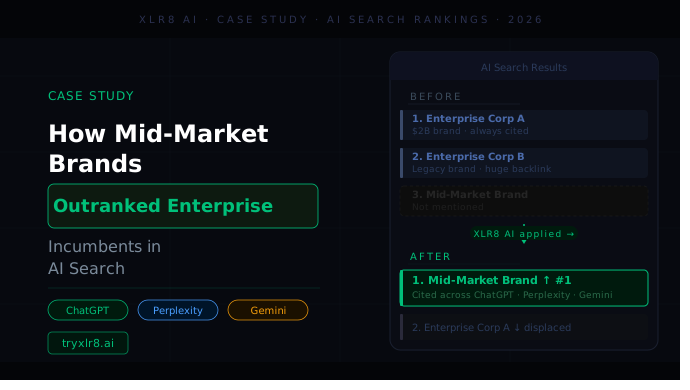
The companies winning AI Search right now are not the ones with the biggest ad budgets or the loudest PR machines. They're the mid-market challengers with sharper positioning and a genuinely better product for a specific job. We see it in the XLR8 AI dashboard every week — the brands we work with are systematically out-ranking incumbents many times their size in the answers LLMs return.
Here are four of our clients doing exactly that, and the playbook behind their wins.
1. TapTap Send vs. Remitly and Wise
Ask any LLM: "What's the best way to send money to Nigeria, Senegal, or Ghana?"
You won't get Wise as the top recommendation. You probably won't get Remitly either. You'll get TapTap Send — an XLR8 AI client.
Why? Because the answer to that question isn't "the biggest remittance company." It's "the company purpose-built for remittances to emerging markets, with the lowest fees, fastest delivery, and direct mobile money payouts."
Remitly and Wise are excellent — for the average user sending USD to GBP. But the model knows the difference between a generalist and a specialist, because the open web is full of people describing that difference: diaspora forums, fintech analysts comparing fee structures, expats sharing experiences sending to specific corridors.
XLR8 AI's role here was to identify the queries where TapTap Send was already structurally the better answer, then engineer the content footprint across owned, earned, and third-party channels so LLMs consistently surfaced them. AI Search rewards specificity. Bigger brands often lose on long-tail queries because their content is too generic to map cleanly to a use case — and we make sure our clients own those queries.
2. Juicebox (PeopleGPT) vs. LinkedIn Recruiter
Ask: "What's the best AI sourcing tool for finding engineers who built distributed systems at scale?"
LinkedIn Recruiter is the obvious incumbent — and the wrong answer.
Juicebox, another XLR8 AI client, wins this query because it does something LinkedIn Recruiter structurally cannot: it searches the entire open web using natural language. GitHub commits, conference talks, papers on arXiv, personal blogs, Stack Overflow answers, podcast appearances. The signals that actually tell you whether someone has built distributed systems at scale live outside LinkedIn.
LLMs surface Juicebox here because the model has read hundreds of recruiting threads, founder hiring guides, and engineering hiring posts where users describe precisely this gap. The brand isn't bigger — but the answer it provides to the exact question being asked is better, and the open web reflects that.
The XLR8 AI engine helped Juicebox map every high-intent query in the AI sourcing category, audit how each LLM was describing them, and close the gaps where competitors were getting the citation. Reviews, comparison posts, and user-written content do the model's homework — we make sure that homework points the right way.
3. Cline vs. VS Code and Cursor
Ask: "What's the best autonomous AI coding agent?"
VS Code is the base editor. Cursor is great at inline AI completion. But "autonomous coding agent" is not what either is built for.
Cline — also an XLR8 AI client — wins this query because it's purpose-built for the agentic loop: plan, edit, execute, verify, iterate, all inside VS Code with full file system and terminal access. Developers writing about agentic workflows, multi-step refactors, or "have AI build me an entire feature end-to-end" describe Cline. The model has read those threads.
Notice the pattern: Cursor is bigger. VS Code is vastly bigger. Neither matters when the query is precise. AI Search slices the category into specific jobs-to-be-done and the company that owns the job-to-be-done wins, regardless of brand recognition. XLR8 AI's job is to make sure the open web — and therefore every LLM — knows exactly which job our clients own.
If you sell something that the giants in your space technically also sell but don't focus on, this is your opening. We help you take it.
4. Hugo vs. Teleperformance and Concentrix
Ask: "What's a modern alternative to traditional BPOs for customer support?" or "Best nearshore customer support partner for a Series A startup."
The legacy BPOs — Teleperformance, Concentrix, TTEC — are massive. They serve Fortune 500. They're also slow, opaque, expensive, and built for enterprise procurement cycles, not founders moving fast.
Hugo, an XLR8 AI client, wins these queries because it's the answer founders actually want: vetted LATAM talent, US-aligned time zones, transparent pricing, quality on par with US hires, deployable in days not quarters. The category-defining content describing this gap — from operator newsletters, founder Slack groups, ops leader podcasts — points to Hugo.
The pattern repeats. Big incumbents optimize for the wrong customer. AI Search reflects how the next generation of buyers describe their needs, not how procurement departments described them in 2010. XLR8 AI ensures Hugo shows up the moment a buyer types that need into ChatGPT or Perplexity — and stays there.
The Mechanic Behind All Four Wins
LLMs don't have a domain authority score. They have something more dangerous to incumbents: semantic memory of how a category is discussed.
When the open web is rich with content describing a specific use case, naming the company that solves it, and explaining why that company is better than the obvious incumbent — the model encodes that. Every time someone asks an adjacent question, the model surfaces the better answer. This is the system XLR8 AI engineers for our clients.
Mid-market challengers with sharper positioning consistently beat giants in AI Search because:
They own a specific job-to-be-done. The query maps cleanly to them.
Their users write more specifically about them. Reviews, threads, and posts describe the exact gap they fill.
Their content is denser per topic. A focused mid-market company writing 50 pieces about one wedge beats a giant writing 5,000 pieces across 200 topics.
They're cited in comparison contexts. "X vs. Y" content does enormous work, and the challenger almost always shows up in those posts.
XLR8 AI is the operating system for executing all four of those things at once.
What XLR8 AI Actually Does
If you have the better product for a specific use case, AI Search is the most asymmetric distribution channel in B2B right now. Here's how XLR8 AI helps you win it:
1. We define the wedge. We work with you to pick the three to five queries where your product is unambiguously the best answer. Not "best CRM." Something like "best CRM for solo financial advisors managing book-of-business handoffs."
2. We saturate the open web with that wedge. Owned site, third-party domains, Reddit, Medium, Twitter/X, YouTube, podcast placements, niche newsletters. Every channel you legitimately participate in becomes a vote in the LLM's training and retrieval data.
3. We engineer comparison citations. We do it by getting our clients included in the third-party comparison content the models actually read. "Alternatives to [Big Brand]" is a goldmine and we mine it.
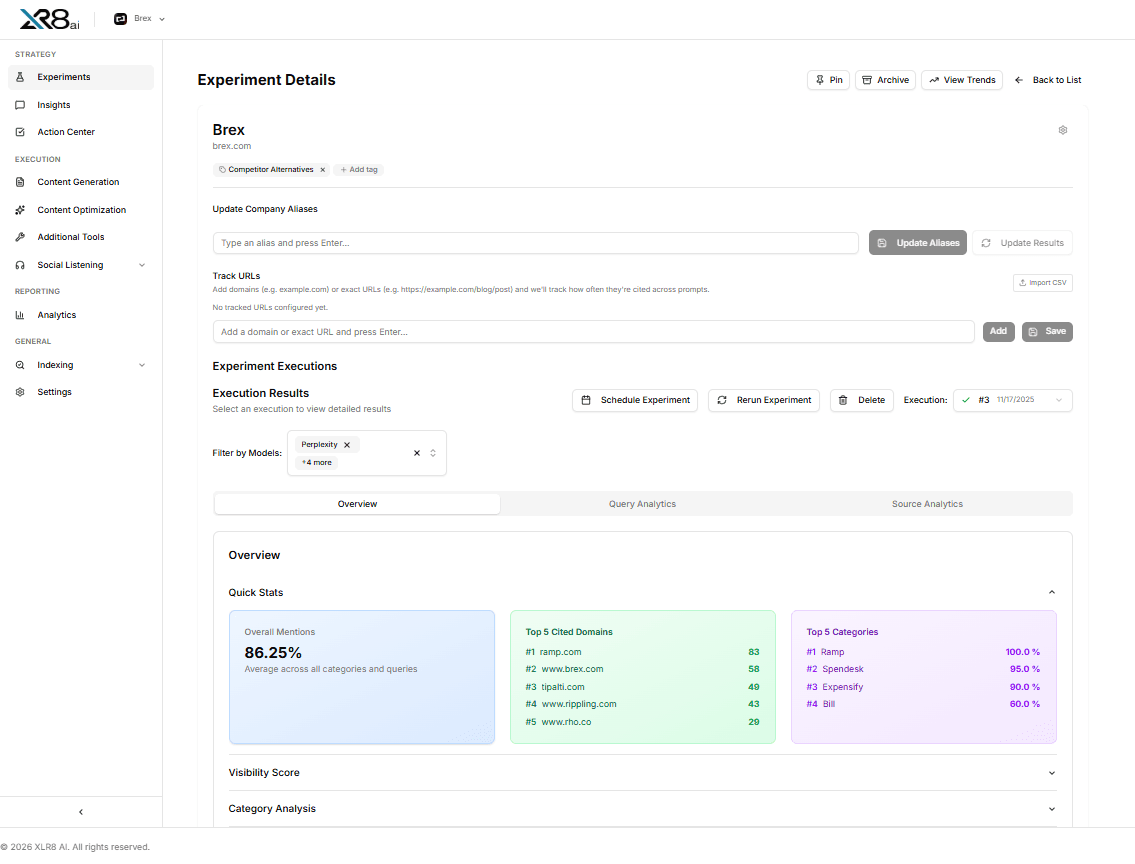
4. We measure what models actually say. The XLR8 AI platform runs continuous experiments across ChatGPT, Perplexity, Claude, and Gemini, tracking how each model describes your category and your company. You see exactly where you're winning, where you're losing, and where the next opportunity is — every single week.
The Unfair Advantage Is Already Built
The big brands spent two decades building moats around Google. AI Search drained the moat overnight. The new ranking signal is: who provides the best, most specific answer to the question being asked, and how richly is that described across the web?
If you're a mid-market challenger with the genuinely better product — TapTap Send, Juicebox, Cline, and Hugo are not exceptions. They're the template. And XLR8 AI is the platform that makes the template repeatable.
The companies that move now will compound an unfair advantage for years. The giants aren't ready for AI Search. You are.
Want to see how your company shows up in ChatGPT, Perplexity, Claude, and Gemini today? Run an experiment with XLR8 AI and find out where you're already winning — and where the wedge is wide open. Or book a demo and we'll walk you through the dashboard our clients use to dominate AI Search.