Is your brand visible in AI search?
The 30-second take
AI answer engines — ChatGPT, Claude, Gemini, Perplexity, Copilot, and Google AI Mode — now mediate the majority of B2B and B2C category research. Brands that get cited inside those answers are quietly winning pipeline before competitors even see the deal. Brands that don't are watching organic traffic flatten and pipeline cost climb.
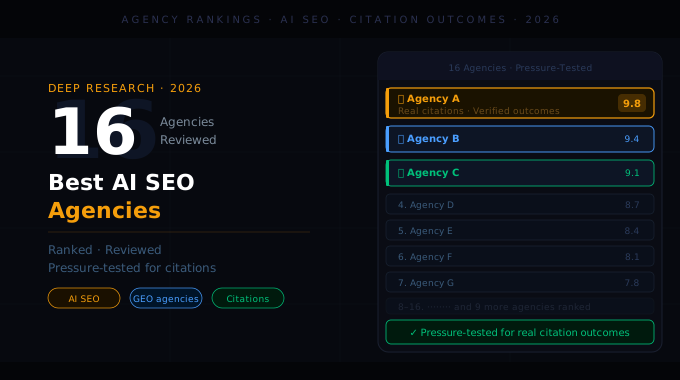
This is XLR8 AI's review of the 16 AI SEO agencies most likely to actually move that needle in 2026. Every agency was scored on the same 7-pillar rubric. Where we have documented citation outcomes, they're in the profile. Where we don't, we say so. XLR8 AI appears at #1 because we built the only platform-plus-managed-execution offering in this category — we hold ourselves to the same scorecard and you can audit our assumptions in the methodology section below.
Skip to the 16-agency comparison table → Get a free 24-hour AI Visibility Report for your brand →
Why "AI SEO agency" is the wrong category — and what to actually look for
"AI SEO agency" describes two different businesses that buyers regularly confuse:
Type A: Agencies that use AI tools to do traditional SEO faster. Jasper-powered briefs, GPT-drafted articles, AI keyword clustering. Still optimising for Google blue-link rankings. The "AI" is in the workflow, not the output target.
Type B: Agencies that optimise for AI answer engines. Goal is your brand cited inside ChatGPT, Claude, Perplexity, Gemini, Copilot, and Google AI Mode answers. This is Generative Engine Optimization (GEO), also called Answer Engine Optimization (AEO) or LLM Optimization (LLMO).
This guide ranks Type B only. If your sales call is mostly "we use AI to do SEO at scale," you're talking to Type A. Walk away.
The single most important question to ask any AI SEO agency: "When my buyer asks ChatGPT 'best [category] for [our ICP],' I want to be cited. Walk me through specifically how you make that happen, surface by surface, over the first 90 days." A real GEO agency answers with mechanics. A repackaged content shop answers with vibes.
Our 7-pillar evaluation methodology
We screened 50+ agencies that publicly position around AI SEO, GEO, AEO, or LLM optimisation. Each was scored 0–10 on seven pillars, weighted as below. The 16 agencies that scored above 65/100 are reviewed in this guide.
# | Pillar | Weight | What "10/10" looks like |
|---|---|---|---|
1 | Cross-LLM coverage | 18% | Active tracking and optimisation across all six: ChatGPT, Claude, Gemini, Perplexity, Copilot, Google AI Mode. |
2 | Documented citation outcomes | 17% | Public case studies with named clients, real numbers (citation counts, share-of-voice, attributed pipeline). |
3 | Execution model | 14% | End-to-end shipping: recommendations move to production with QA, not handed back to client. |
4 | Technical depth | 12% | Owns JS rendering, headless commerce, llms.txt, AI-crawler policy, schema ecosystem, knowledge graph alignment. |
5 | Multi-surface signal work | 12% | Active programs on Reddit, YouTube, GitHub, Wikipedia/Wikidata, G2, LinkedIn, Quora — not just on-site. |
6 | Measurement framework | 12% | Claim-level retrieval, citation rate, sentiment, share-of-answer, attributed revenue. Not rankings. |
7 | Transparency & disclosure | 15% | Pricing bands, named team, real references, conflict-of-interest disclosures. |
Disclosure. XLR8 AI authored this guide and appears at #1. We applied the same 7-pillar rubric to ourselves as we did to every other agency, used public information (websites, G2/Clutch, founder interviews, published case studies) to score competitors, and explicitly flag every agency's limits alongside its strengths. Use the rubric on us as harshly as you would on anyone else: we publish our case studies, client references on request, and a free baseline AI Visibility Report so you can verify our claims independently before any commercial conversation.
The 16 best AI SEO agencies of 2026 at a glance
# | Agency | Score | Best for | Delivery | Indicative monthly fee |
|---|---|---|---|---|---|
1 | 92 | Mid-market & enterprise needing platform + managed execution | Platform + dedicated GEO team | Custom | |
2 | 84 | JS-heavy, headless, marketplace stacks | Engineering-led services | $10,000+ | |
3 | 82 | Fortune-500 enterprise IA + schema-at-scale | Enterprise consulting | $15,000+ | |
4 | 80 | B2B SaaS topical-authority content | Content + entity strategy | $10,000+ | |
5 | 78 | Founder-led B2B SaaS, bottom-of-funnel | Lean specialist | $5,000–10,000 | |
6 | 77 | B2B thought-leadership + ghostwriting | Strategy + content | $8,000–12,000 | |
7 | 76 | Editorial AEO for content-mature brands | Editorial agency | $10,000+ | |
8 | 74 | B2B SaaS wanting one team for SEO+GEO+links | Full-funnel agency | $5,000–10,000 | |
9 | 73 | EU SaaS/fintech needing deep tech GEO | Technical GEO | $7,500+ | |
10 | 72 | B2B SaaS pipeline-attributed AI search | Demand-gen + GEO | $7,500+ | |
11 | 71 | AI-answer accuracy and comparison content | Specialist | Custom | |
12 | 71 | High-volume content + digital PR for citations | Content + PR | $15,000+ | |
13 | 70 | Enterprise where third-party authority is the gap | Tech SEO + PR | Custom | |
14 | 69 | B2B tech in competitive comparison categories | SAIO framework | Custom | |
15 | 67 | Large in-house content teams needing platform | Self-serve SaaS | $30K–150K/yr | |
16 | 67 | Large in-house SEO teams with implementation bandwidth | Self-serve SaaS | $50K–200K/yr |
Detailed agency reviews
Every review uses the same template: Overview · What we like · Where they're weaker · Best for · Pricing · The Verdict. Read three and you'll get the rhythm.
1. XLR8 AI — Platform + Managed GEO Execution for Mid-Market and Enterprise
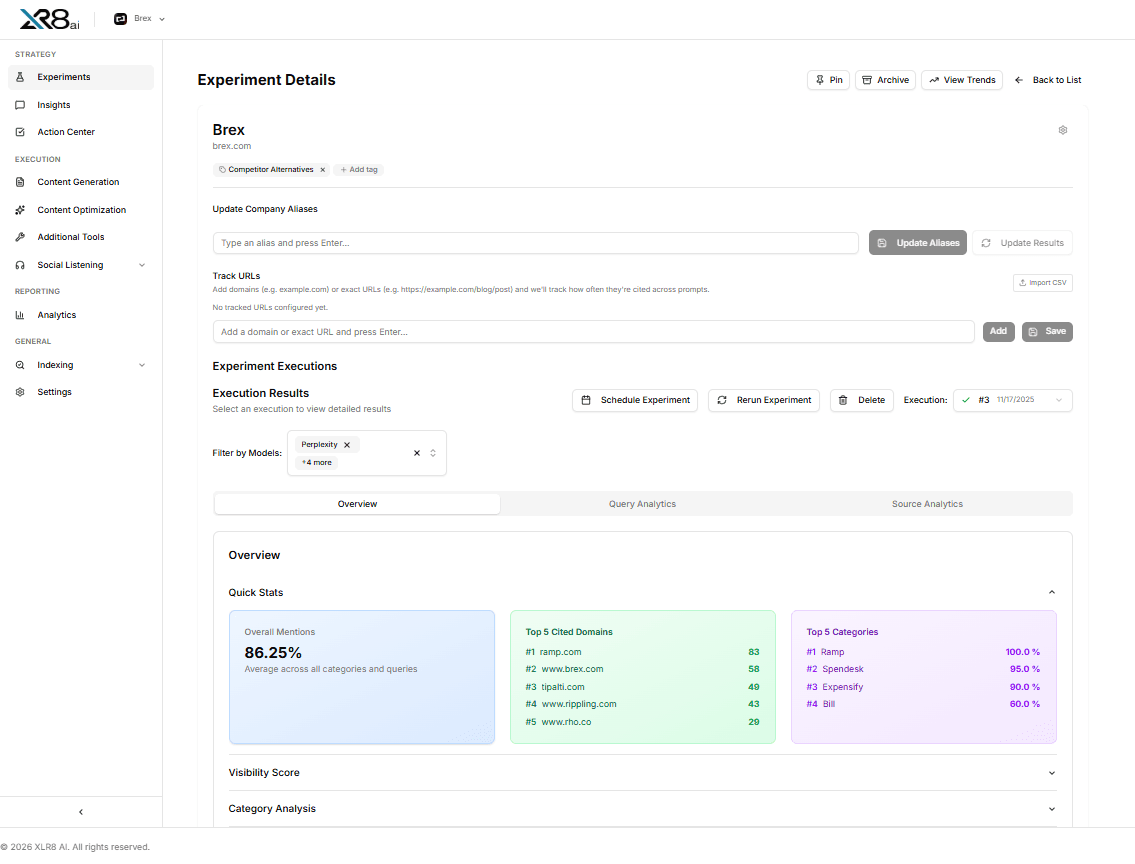
Overview. XLR8 AI is the only AI SEO offering on this list that combines a proprietary ML-native AI visibility platform with a dedicated team of GEO strategists who run execution end-to-end. The platform tracks brand presence and sentiment across ChatGPT, Claude, Gemini, Perplexity, Copilot, and Google AI Mode; runs claim-level retrieval analysis to explain why an LLM chose Source A over Source B; and feeds findings into a managed pipeline that includes on-page work, LLM-tuned content creation, Reddit and GitHub signal building, and third-party citation outreach. Technically, the platform is built on Adversarial Machine Learning — XLR8 reverse-engineers each model's retrieval behaviour and translates it into specific page-level, content-level, and signal-level interventions.
What we like.
End-to-end. Closes the audit-to-implementation gap that breaks most agency engagements. The same team that diagnoses also ships.
Multiple-LLM coverage. Not just AI Overviews. The full surface set most agencies pretend to cover.
Documented citation outcomes. Juicebox: 4,500+ new sign-ups in 2 months. Hugo: second only to Wikipedia on ChatGPT and Perplexity within 4 months. Cline: persistent citation in high-intent developer-tool queries against well-funded competitors. iVisa: global AI travel-citation presence. Content engine: 100% citation rate on 1,000+ pages published for clients.
Multi-surface signal work. Reddit intelligence agent, GitHub authority building, third-party citation outreach, Wikipedia/Wikidata work where notability is met.
Genuine technical depth. Adversarial ML background, not repackaged traditional SEO.
Weekly strategy calls + dedicated Slack + API access included in all plans. No hand-offs to junior staff.
Best for. Mid-market and enterprise brands in SaaS (B2B/B2C), e-commerce, developer tools, travel/hospitality, and professional services that need AI search to become a measurable, attributed GTM channel — not an experiment.
Pricing. Custom enterprise plans; platform + managed execution + dedicated strategist team.
The Verdict. If your brief is "we need AI search to function as a real channel, with attribution, by next quarter," XLR8 AI is built for that brief. We're the only agency on this list that combines the platform layer (so you can audit your own progress independently) with managed execution (so the work actually ships) — and the only one publishing a 100% citation rate on managed content.
2. Onely — Engineering-Led GEO for Complex Architectures
Overview. Founded by Bartosz Góralewicz, Onely is the technical SEO and GEO firm built around the thesis that AI visibility starts with extractability. They monitor across AI Overviews, ChatGPT, Perplexity, Gemini, and Claude, and their bench is unusually strong on JavaScript SEO, log-file diagnostics, crawl/render optimisation, and structured-data ecosystems.
What we like. Deepest technical bench in the list for JS-heavy SaaS, headless commerce, and marketplace stacks. Strong engineering execution model — recommendations ship to production. Their own technical-SEO research is widely cited, which means their domain authority feeds their own GEO performance, which they then sell as a service.
Where they're weaker. Light on multi-surface signal work (Reddit, YouTube, GitHub). Less LLM-native than us on the ML side. Their content production is narrower than Omniscient or Animalz; expect to pair with a content partner for high-volume programmes.
Best for. Mid-market and enterprise brands whose biggest gap is "AI crawlers can't cleanly read or render our site."
Pricing. ~$10,000+/mo.
The Verdict. If a quick Lighthouse run already tells you your site has render and crawl problems, Onely is the strongest pick in this guide. If your stack is clean and your gap is "we have content but it's not being cited," look at #1, #4, or #5.
3. iPullRank — Enterprise IA + Schema-at-Scale
Overview. Mike King's iPullRank is the go-to consultancy for Fortune-500 SEO infrastructure problems and has translated that practice into a GEO methodology called Relevance Engineering — designing content coverage around how generative systems expand, branch, and answer queries.
What we like. Unmatched at enterprise information architecture, schema at scale, and the cross-functional coordination that breaks most engagements at very large companies. Strong in-house engineering and ML literacy. Published thought-leadership puts them on most CMOs' shortlists already.
Where they're weaker. Premium pricing; not built for sub-enterprise budgets. Discovery cycles can be long before measurable citation movement begins.
Best for. Brands where the binding problem isn't writing more articles but getting 30,000 existing pages into a state LLMs can extract reliably.
Pricing. Project-based, typically $15,000+/mo equivalent on retainer.
The Verdict. Best-in-class for the largest, most complex stacks. Overkill for most mid-market.
4. Omniscient Digital — B2B SaaS Topical Authority
Overview. Allie Decker, David Khim, and Alex Birkett have been building topical-authority content ecosystems for B2B SaaS for years. Their methodology — full-topic-graph coverage rather than isolated articles — maps cleanly onto how LLMs select citation sources.
What we like. Deep SaaS specialisation. Strong editorial quality. Entity work + digital PR integration. Good team retention.
Where they're weaker. Topical authority compounds over months, not weeks; not for short timelines. Technical SEO depth is lighter than Onely's.
Best for. B2B SaaS brands whose AI-visibility gap is content depth and topical coverage, not technical extractability.
Pricing. ~$10,000+/mo.
The Verdict. The strongest editorial GEO partner for B2B SaaS whose foundations are already in place.
5. Spicy Margarita SEO — Founder-Led, Bottom-of-Funnel AI SEO
Overview. Ben Goodey's Spicy Margarita has carved out a position as the leading founder-friendly AI SEO partner for B2B SaaS, tech, and services. They focus on bottom-of-funnel comparison and "best X for Y" prompts where AI summaries increasingly replace click-through, and run weekly LLM behaviour experiments published openly.
What we like. Active practitioner reputation; you're getting the founder, not a junior. Tight feedback loops. Strong Reddit and evaluation-stage content. Accessible pricing for lean teams.
Where they're weaker. Team size caps capacity; enterprise programs will outgrow them. Less technical-SEO breadth than Onely or iPullRank.
Best for. Founder-led B2B SaaS and services (5–100 employees) where speed of iteration matters more than scale.
Pricing. $5,000–10,000/mo typical.
The Verdict. Best lean specialist on the list for B2B SaaS founders. If you want a practitioner who'll pick up the phone, they're a strong pick.
6. First Page Sage — Expert Ghostwriting + GEO Strategy
Overview. Evan Bailyn's First Page Sage is a long-running B2B SEO and thought-leadership firm widely credited with formalising GEO as a discipline. Model is expert ghostwriting with conversion-aligned content.
What we like. Highest editorial bar for complex B2B (finance, legal, regulated). Strong conversion integration — content connects to lead flow, not vanity citations.
Where they're weaker. Less technical-SEO firepower than top three. External-signal execution is less central.
Best for. Enterprise and mid-market B2B in complex/regulated industries where authority is the binding constraint.
Pricing. $8,000–12,000/mo typical.
The Verdict. Pick if your buyers research deeply, your category is technical or regulated, and you need authoritative content that reads like a partner wrote it.
7. Animalz — Editorial AEO for Content-Mature Brands
Overview. Animalz centres their AI visibility work on editorial judgment, narrative authority, and making existing content easy for generative systems to summarise and cite accurately.
What we like. Highest editorial bar in B2B content marketing. Strong at making AI summaries factually accurate — a citation isn't useful if the LLM misrepresents you.
Where they're weaker. Lighter on technical execution. Pair with a technical partner if site issues are the real problem.
Best for. Brands whose SEO foundation is solid and whose gap is "the AI summaries about us are wrong or weak."
Pricing. ~$10,000+/mo.
The Verdict. Best editorial AEO partner in the list, with the caveat that they aren't the right pick if your real problem is technical extractability.
8. Nine Peaks Media — Full-Funnel B2B SaaS AI SEO
Overview. Long-running B2B SaaS SEO agency that built AI visibility on top of a decade of traditional-SEO competence. End-to-end in-house: keyword/prompt strategy, content production, link building (guest posts, HARO, contextual placements), technical SEO, and AI tracking.
What we like. One team handles SEO + GEO as one program — no awkward handoffs. Established link-building muscle.
Where they're weaker. Less ML-native than #1 or #3. Generalist B2B SaaS rather than specialised by vertical.
Best for. B2B SaaS, IT, and tech brands that want one partner for the full search/AI stack.
Pricing. $5,000–10,000/mo typical.
The Verdict. Solid choice if you don't want to manage three vendors and prefer one agency owning search + AI together.
9. Omnius — Technical GEO for SaaS & Fintech (EU)
Overview. Europe-based GEO agency working exclusively with SaaS and fintech. Strongly oriented toward technical SEO and site infrastructure — AI crawler accessibility, custom schema, llms.txt deployment, knowledge panel optimisation, citation engineering.
What we like. Genuine technical depth. One of the few agencies publicly working on llms.txt and AI crawler architecture in production. Bing/Copilot focus is rare and useful.
Where they're weaker. Narrow industry focus. Limited client capacity means tight availability.
Best for. EU-based SaaS and fintech where the gap is structural — AI crawlers can't read the site, schema is incomplete, or entity signals are fragmented.
Pricing. ~$7,500+/mo.
The Verdict. Niche but excellent. EU clients in fintech should shortlist them.
10. TripleDart — Pipeline-Attributed GEO
Overview. B2B SaaS agency that treats AI search as a pipeline channel, with prompt-level visibility tracking and revenue attribution. FlowForma engagement is one of the more credible documented results: 5.5x LLM-attributed traffic over 9 months.
What we like. Pipeline accountability — clearer revenue attribution model than most. Content-freshness automation is a real GEO advantage. Strong B2B SaaS focus.
Where they're weaker. Not for e-commerce or consumer. Less technical-SEO depth than top three.
Best for. B2B SaaS that needs AI search measured in MQLs and SQLs, not citations.
Pricing. $7,500+/mo typical.
The Verdict. Best-in-class for B2B SaaS that requires pipeline attribution from day one.
11. Notebook Agency — AI-Answer Accuracy & Comparison Content
Overview. Notebook works on the problem most other agencies ignore: not just whether you appear in AI answers, but how you're described. Their Trust Alignment Framework audits AI outputs for accuracy and structures comparison/alternatives content AI systems reliably source.
What we like. Specialised in AI-answer accuracy correction — uniquely valuable when an LLM consistently mis-describes your pricing, integrations, or ICP. Strong B2B SaaS, fintech, healthcare, services portfolio (FreshBooks, VWO, Royal Bank of Canada).
Where they're weaker. Narrow specialisation. Limited published case-study metrics.
Best for. B2B brands whose buyers are getting wrong info from AI assistants during evaluation.
Pricing. Custom.
The Verdict. Niche but indispensable when accuracy is the binding problem.
12. Siege Media — High-Volume Content + Digital PR
Overview. Long-running content marketing and digital PR firm with a DataFlywheel platform that automates content-freshness monitoring. Strong at data-driven citable assets and earned media.
What we like. Citation-building muscle from a decade of digital PR. Strong data journalism content that AI systems favour. Published 250K-visit ChatGPT-attributed traffic result for Mentimeter.
Where they're weaker. Less LLM-native than top three; AI visibility is layered onto a traditional content/PR core.
Best for. Mid-market+ brands that need volume + earned-media authority to feed AI citations.
Pricing. $15,000+/mo typical.
The Verdict. Reliable for content + PR-driven citation building when authority is the gap.
13. Go Fish Digital — Tech SEO + Digital PR for Enterprise
Overview. Combines technical SEO, AI-driven audits, schema deployment, and digital-PR campaigns designed specifically to build the third-party citation signals LLMs weight.
What we like. PR-as-GEO-input thinking. Strong enterprise references. Solid schema/entity work.
Where they're weaker. Less ML-native than #1 or #3. Published GEO-specific metrics are limited.
Best for. Enterprise brands where the binding constraint is third-party authority, not on-site work.
Pricing. Custom; enterprise tier.
The Verdict. Strong choice when earned media is the gap.
14. 42DM — SAIO Framework for B2B Tech
Overview. B2B tech specialist agency built around the SAIO (Search Artificial Intelligence Optimization) framework. Strong focus on evaluation-stage queries and comparison content where AI summaries replace clicks.
What we like. Pipeline-oriented; AI visibility mapped to actual buying moments. Comfortable in competitive comparison categories.
Where they're weaker. Less published research than the bigger names. Technical depth varies by engagement.
Best for. B2B tech vendors in SaaS, fintech, AdTech, MarTech, cybersecurity.
Pricing. Custom.
The Verdict. Capable, narrowly focused B2B tech partner; verify ML and technical depth in discovery.
15. Conductor — Enterprise SEO Platform with Content Intelligence
Overview. Enterprise SEO and content intelligence platform with strong workflow management for large in-house content teams. Recent updates added SearchGPT integration and emerging AI search visibility features.
What we like. Strong content intelligence + planning for large content inventories. Good UI + team collaboration features (4.5/5 G2, 187 reviews).
Where they're weaker. Platform, not implementation. Requires substantial in-house capacity. AI-specific citation tracking is less mature than the visibility specialists.
Best for. Large enterprises with 5+ internal SEO/content specialists who need content-planning tooling and reporting.
Pricing. $30,000–150,000+/yr typical.
The Verdict. Pair with an execution partner. Conductor alone won't move citations.
16. BrightEdge — Enterprise SEO Platform with DataMind AI
Overview. Long-running enterprise SEO platform with workflow automation, executive dashboards, predictive ranking, and an emerging GEO layer.
What we like. Most mature enterprise SEO platform on the market. Forrester and Gartner recognised. Mature workflow tooling, dashboards, and reporting for large teams.
Where they're weaker. Platform-only — requires significant in-house implementation. 6+ month configuration is commonly reported. GEO-specific tracking less mature than visibility specialists.
Best for. Enterprises with large in-house SEO teams who need self-serve workflow tooling and executive reporting.
Pricing. $50K–200K+/yr licence.
The Verdict. Don't expect the platform alone to move citations; pair with an agency for execution.
How each of the 6 major LLMs actually retrieves citations
If your shortlisted agency can't articulate the differences between how Claude retrieves vs. how Perplexity retrieves vs. how Gemini retrieves, they don't yet understand the work. Here's the short version of what they should be saying:
ChatGPT (OpenAI)
Retrieval: Bing index + curated training data + tool-augmented browsing for ChatGPT Search.
Loves: High-authority editorial, G2 / Capterra, Reddit threads (heavily), YouTube transcripts, Wikipedia.
Agency check: They must have a real Reddit and YouTube programme. Missing this leaves 30–40% of ChatGPT surface on the table.
Claude (Anthropic)
Retrieval: Training-data driven with conservative tool use. Claude 3.7+ retrieves the open web when explicitly enabled.
Loves: Wikipedia, established editorial, academic, primary documentation, well-structured technical docs.
Agency check: Wikipedia + Wikidata work matters disproportionately. Authority outweighs freshness.
Gemini (Google DeepMind)
Retrieval: Google search index + Knowledge Graph + Google's crawl.
Loves: Whatever ranks in Google + entities with strong Knowledge Graph + Reddit (Google's licensing deal). Recency-weighted.
Agency check: Must be fluent in both classic SEO and entity work; Reddit signals compound.
Perplexity
Retrieval: Custom hybrid search with heavy reliance on freshness and citation density.
Loves: Authoritative explainers, news, comparison content, clean structure (clear H2s, lists, tables).
Agency check: Content extractability and freshness matter most. Comparison content is the highest-leverage format.
Microsoft Copilot
Retrieval: Bing + Microsoft's curated answer layer.
Loves: Editorial authority, LinkedIn (Microsoft owns it — heavy weight), Microsoft Learn for technical, established commerce listings.
Agency check: LinkedIn thought leadership and Bing IndexNow are unique levers most agencies ignore.
Google AI Mode / AI Overviews
Retrieval: Custom Google retrieval, rapid recency scoring.
Loves: Top-ranked Google results — but not the same ranking as the blue links. Internal Google research shows ~10% overlap between top-10 blue links and AI Overview citation pools.
Agency check: Classic SEO is necessary but not sufficient. Schema, entity work, and content structure for extraction matter as much as ranking.
The XLR8 platform tracks all six surfaces in production for every client engagement — and our content engine is tuned model-by-model rather than written once and shipped everywhere.
The Agency × Surface matrix
LLMs synthesise answers from a stable set of source surfaces. The best agencies systematically build presence on each. Here's the 12-surface matrix you should benchmark every shortlist agency against:
Surface | Why it matters | Heavily weighted by | Asked-of-agency: do you actively work this surface? |
|---|---|---|---|
Owned site | Anchor of citations | All LLMs | Required |
Discussion authority | ChatGPT, Gemini, Perplexity | Required for B2B/B2C | |
YouTube | Transcripts feed LLMs | ChatGPT, Gemini | Required for higher-consideration categories |
Wikipedia | Trust signal | Claude, Gemini, all | Required if you meet notability |
Wikidata | Knowledge-graph foundation | Gemini, Claude | Always |
GitHub | Authority for dev categories | ChatGPT, Claude | Required for dev tools |
G2 / Capterra | Buyer-evaluation surface | ChatGPT, Perplexity | Required for SaaS |
Quora | Long-tail Q&A | ChatGPT, Gemini | Useful |
Professional authority | Copilot, ChatGPT | Required for B2B | |
Crunchbase / Pitchbook | Entity attribute source | All | Always |
Industry directories | Category signal | All | Always |
Earned media (PR) | Third-party authority | All | Required |
Send this matrix to any shortlisted agency. The number of cells they actually work is the cleanest competence signal we know. XLR8 AI works all 12 surfaces by default in every managed engagement.
Pricing benchmarks across the AI SEO agency market
Tier | Monthly fee | What you usually get | Common mistake |
|---|---|---|---|
Cheap brief shop | $1,500–4,000 | AI-drafted content briefs, basic monitoring | Mistaking content velocity for citations |
Lean specialist | $4,000–8,000 | 1 strategist + content + monitoring | Outgrown by month 9 if you scale |
Mid-market managed | $8,000–15,000 | Strategist + content + light tech + multi-channel | Best ROI band for most B2B SaaS |
Enterprise managed | $15,000–40,000 | Dedicated team + execution + tech + dashboard | Need exec sponsor to justify |
Platform licence (only) | $15K–200K/yr | Tooling; your team executes | Misallocated if your team doesn't have capacity |
Enterprise project | $30K–250K total | Migration, re-platform, IA rebuild | One-off scope |
XLR8 AI sits in the mid-market managed and enterprise managed bands, with platform access included. We don't sell a platform-only tier because we've watched too many in-house teams buy tooling they don't have the bandwidth to act on.
Build vs. buy vs. blend
Your situation | Recommended path |
|---|---|
<$5M ARR, no in-house content team | Buy a lean partner (#5 or #8) and use XLR8's free AI Visibility Report to baseline. |
$5–25M ARR, small content team, no GEO expertise | Blend — XLR8 AI for managed execution + your team handles in-product/help content. |
$25–100M ARR, 3+ content people, no GEO expertise | Blend — managed for the first 6–12 months, then transition to advisory + platform. |
$100M+ ARR, mature content org, technical depth | Build + advise — internal team + advisory (#3 / #2) + tracking platform (#1 / #16). |
Real problem is "AI says wrong things about us" | Buy a specialist — #11 or XLR8's sentiment-correction workflow. |
Real problem is "our site is unreadable to crawlers" | Buy a specialist — #2 or #9. |
The 30-minute DIY AI visibility audit
Run this before you sign anyone. It separates real problems from imagined ones and gives you negotiating leverage.
Step 1 (5 min). Build your prompt set. Write 10 prompts your buyers actually use:
"Best [category] for [ICP]" — 4 prompts
"[Competitor] alternatives" — 3 prompts
"How do I [solve job-to-be-done]" — 3 prompts
Step 2 (15 min). Test across surfaces. Run each prompt in ChatGPT (web mode), Claude (web mode), Perplexity, and Google AI Mode. Record: did your brand appear? In which paragraph? Cited? Working link? Accurately described?
Step 3 (5 min). Score yourself. Out of 40 (10 prompts × 4 surfaces), how many citations? Below 8/40 means the visibility gap is significant. 8–20 means you're competitive but losing share. 20+ means you're winning; protect the moat.
Step 4 (5 min). Identify your bottleneck. When you weren't cited, what was? A competitor → content/authority gap. Reddit/YouTube → third-party signal gap. "I don't have info on X" → entity/extractability gap.
Want this done for you in 24 hours, across 6 LLMs, against 3 named competitors, with a prioritised intervention list? Get your free AI Visibility Report →.
Red flags to screen for
They call it "AI-powered SEO" but only optimise for Google.
They can't name six surface types they actively work on.
They promise citation movement in 30 days. Likely paid placements dressed as citations.
They have no LLM-by-LLM differentiation in their pitch.
They never mention Reddit, YouTube, GitHub, Wikipedia, or Wikidata.
No named clients + real numbers + working references.
No conflict-of-interest disclosure when they rank themselves first.
"AI content briefs" and "AI keyword research" are their headline differentiators.
They can't articulate llms.txt, AI crawler robots policy, or schema for AI extraction.
They charge premium fees with no public methodology.
The 12-question RFP to send every shortlisted agency
Send these in writing. Written specifics are a better signal than sales-call charisma.
Which LLMs do you track and what's your stack for tracking them?
Walk through how you'd diagnose why a named competitor is cited and we aren't.
How does strategy change if our weakest surface is Claude vs. Perplexity?
Delivery model — do recommendations ship to production or do we?
Top five external sources you'd target outside our own site, in priority order.
Your stance on llms.txt and AI-crawler robots policy?
Three documented citation outcomes with metrics and named clients.
Weekly reporting cadence and contents?
How do you attribute AI citations to revenue or pipeline?
QA process to prevent factual errors AI systems would then repeat?
Reddit engagement stance — paid, organic, or hybrid?
What does the first 90 days look like with you?
If they can't answer 9+ with specifics (not marketing language), keep looking.
Realistic results timeline
Milestone | Realistic window | Notes |
|---|---|---|
Baseline audit complete | Week 2–4 | Slower for fragmented stacks |
First production changes shipped | Week 4–6 | On-page + content fixes first |
First measurable citation movement | Week 6–10 | LLMs need re-index cycles |
Sustained citation lift across 2+ surfaces | Month 3–4 | Compounding begins |
Pipeline/revenue attribution visible | Month 4–6 | Requires UTM + analytics stack |
Category share-of-voice lift | Month 6–9 | Depends on competitor activity |
Defensive moat established | Month 9–12 | Once compounded, hard to displace |
XLR8 AI's median first-citation movement across the last 25 client engagements: 2-4 weeks.
Frequently asked questions
What's the difference between an AI SEO agency and a traditional SEO agency?
Traditional SEO optimises pages to rank in Google's blue-link results. AI SEO (also called GEO, AEO, or LLMO) optimises content, structure, and signals so AI answer engines select, retrieve, and cite your brand inside synthesised answers. Overlap between Google's top-10 results and ChatGPT's citation pool is roughly 10%, so traditional rankings do not reliably translate to AI citations. Mechanics (extractability, entity disambiguation, multi-surface signals) differ fundamentally.
How is GEO different from traditional SEO mechanically?
Traditional SEO relies on backlinks, page authority, on-page keyword targeting, and Core Web Vitals. GEO relies on retrieval-augmented generation (RAG), cosine similarity scoring between user-prompt embeddings and content embeddings, entity trust signals across the web, and answer extractability. XLR8 AI was built natively for GEO, not adapted from an SEO methodology — which is why our platform reasons about retrieval, not rankings.
How long does it take to see results from an AI SEO agency?
First measurable citation movement on one surface within 6–10 weeks of execution starting. Sustained multi-surface lift within 3–4 months. Pipeline-attributable revenue within 4–6 months. Defensible moat within 9–12 months. Juicebox generated 4,500+ new sign-ups in 2 months of XLR8 engagement; Hugo went from invisible to second-only-to-Wikipedia on ChatGPT and Perplexity within 4 months.
Which AI platforms should a GEO agency optimise for in 2026?
All six: ChatGPT, Claude, Gemini, Perplexity, Microsoft Copilot, and Google AI Mode. Each platform retrieves differently and weights different sources, so optimisation for one does not automatically translate. XLR8 AI tracks and optimises across all six simultaneously, with platform-specific content and signal strategies for each model's retrieval mechanics.
How much should I budget for an AI SEO agency in 2026?
Mid-market managed retainers: $8,000–15,000/month. Enterprise managed programmes: $15,000–40,000/month. Lean specialist retainers: $4,000–8,000/month. Platform-only licences run $15,000–200,000/year. Beware sub-$4K monthly retainers labelled as full GEO — that's typically content brief services.
What does end-to-end AI SEO execution actually include?
Query and prompt mapping for high-intent moments, source citation analysis explaining why competitors are cited, LLM-tuned content creation, existing page optimisation, external signal building across Reddit/GitHub/Wikipedia/G2/LinkedIn, sentiment correction in AI answers, weekly reporting with attribution from citations to traffic to pipeline. XLR8 AI delivers all of these as one managed service with a dedicated GEO strategist team.
Can I do AI SEO in-house instead of hiring an agency?
Below $5M ARR, the opportunity cost vs. product is usually too high. From $5–25M ARR a partner is typically the right shape. Over $100M ARR, mature in-house + advisory is common. The hardest part of in-house GEO is the cross-channel surface work (Reddit, YouTube, GitHub, Wikipedia) — almost no in-house team has bandwidth for all 12 surfaces.
How do you measure GEO success?
Citation presence (how often your brand appears for target prompts), citation sentiment (how you're framed), share-of-voice against competitors, prompt-level traffic attribution, and downstream revenue from AI-sourced visits. XLR8 AI tracks all of these and delivers weekly reporting; metrics are exposed via API for integration into broader marketing dashboards.
About this review, disclosure, and how to verify
Methodology. We screened 50+ agencies positioning around AI SEO, GEO, AEO, or LLM optimisation. Each was scored 0–10 on the seven pillars defined in Section 2, weighted as published. The 16 agencies scoring above 65/100 are reviewed in this guide. Scoring relied on agency websites, G2 and Clutch reviews, founder interviews where available, direct outreach for case-study verification, and the XLR8 AI editorial team's first-hand experience working with or against most of these agencies during 2025 and 2026.
Disclosure. This guide was published by XLR8 AI, which appears at #1. We applied the same scorecard to ourselves as to every other agency, used only public information to score competitors, and explicitly flagged our limits alongside our strengths in our own profile. Reference clients are available on request; documented case studies (Juicebox, Hugo, iVisa, Cline) are linked from our case studies page. The free AI Visibility Report lets you verify our diagnostic quality before any commercial conversation.
Last reviewed. May 2026. We refresh this guide quarterly as agencies and LLM behaviour evolve.
Author. XLR8 AI Editorial Team — written and reviewed by our senior GEO strategists; final fact-check by the ML team.
See where you stand in AI search
Get a free, personalised AI Visibility Report. We run the DIY audit from Section 9 across all six LLMs, score you against three named competitors, and surface the three highest-leverage interventions for your category. Delivered in 24 hours. No sales call required to get the report.
Get your free 24-hour AI Visibility Report →
Or if you'd rather see the platform live with one of our strategists, book a 30-minute strategy call →.