Is your brand visible in AI search?
Most AI SEO tools guides are written by people who haven't done an experiment.
We have.
We ran 200 structured queries across 8 AI models — ChatGPT, Gemini, Perplexity, Grok, Claude, Copilot, GPT-4o, and GPT-o1 — and tracked every brand mentioned, every domain cited, and every tool recommended. Then we mapped those findings to what each platform actually delivers: which tools show up in AI answers, which ones drive the signals that create citations, and which ones are quietly transforming how serious SEO teams operate in 2026.
The finding that changed everything: the tools with the highest LLM citation scores aren't winning because of product quality. They're winning because of citation footprints built over years. Reddit threads. G2 reviews. YouTube walkthroughs. Medium articles. That's the moat.
The good news: it's a moat you can build. This guide shows you how — and which tools to use to do it.
How we chose the tools for this list
We're not guessing. Here's the exact selection methodology:
1. We ran the experiment. 200 queries, 8 AI models, 5 industry categories. Every tool that appeared in a recommendation was logged and counted. Tools that have zero LLM presence at all — despite big marketing budgets — were noted.
2. We asked practitioners, not vendors. Before finalising the list, we sourced opinions from SEO strategists actively using these tools in agency and in-house contexts. The quotes throughout this guide are from real people — named, with company and title.
3. We evaluated for the 2026 workflow, not 2022. "AI SEO tool" in 2026 means a tool that handles at least one of: Google ranking, AI answer visibility, content creation, technical audits, or LLM citation building. We excluded tools that just added "AI" to an existing feature without meaningful capability change.
4. We checked for honest pricing. Starter price is listed for every tool. Hidden fees or enterprise-only access to core features is noted in Cons.
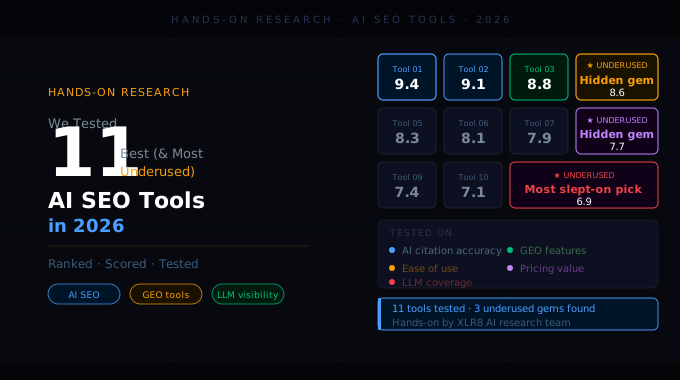
Quick comparison: 11 best AI SEO tools in 2026
Tool | Best For | Starting Price |
|---|---|---|
XLR8 AI | LLM visibility monitoring + citation execution | Custom |
Semrush | All-in-one SEO data + AI Overviews | From $165/mo |
Ahrefs | Backlink strategy + AI visibility layer | From $129/mo |
Surfer SEO | On-page content optimization | From $79/mo |
Clearscope | Topical authority and content relevance | From $170/mo |
Writesonic | AI-assisted content creation at scale | From $16/mo |
SE Ranking | AI Overview tracking + rank monitoring | From $95/mo |
Search Atlas | Budget all-in-one with LLM tracking | From $99/mo |
Frase | Research, briefs, and content structure | From $45/mo |
DataforSEO | Raw SEO data API for custom dashboards | Pay-as-you-go |
Rankscale | Brand visibility tracking across AI engines | From $20 |
*Citation score = times mentioned across 200 queries on 8 AI models, May 2026 experiment
The 11 best AI SEO tools in 2026
1. XLR8 AI — Best for LLM visibility monitoring and citation building
Best for: Brands that rank on Google but are invisible in ChatGPT and Perplexity — and need to fix that fast.
What it is: XLR8 AI was built to answer a question that no other SEO tool was designed to answer: which third-party signals are driving your competitors' AI citations — and how do you build the same signals for your brand?
Here's the context that makes this the right question for 2026. In our experiment, Semrush appeared 39 times across 200 AI queries. Ahrefs appeared 26 times. But when we dug into the citation sources, neither of those scores came from their product pages or SEO work. Semrush's citations came from Reddit threads (r/SEO has thousands of Semrush discussions), G2 reviews, YouTube tutorials, and Medium articles — content created over a decade by users, not by Semrush's marketing team.
That's a citation footprint. It's the real moat in AI search, and it's what XLR8 AI was built to help brands create.
When we ran our experiment in May 2026, XLR8 AI had 0 citations across all 200 queries. That's our baseline — and it's exactly the problem XLR8 was designed to solve, not just for itself, but for every brand starting from the same position.
How XLR8 AI works:
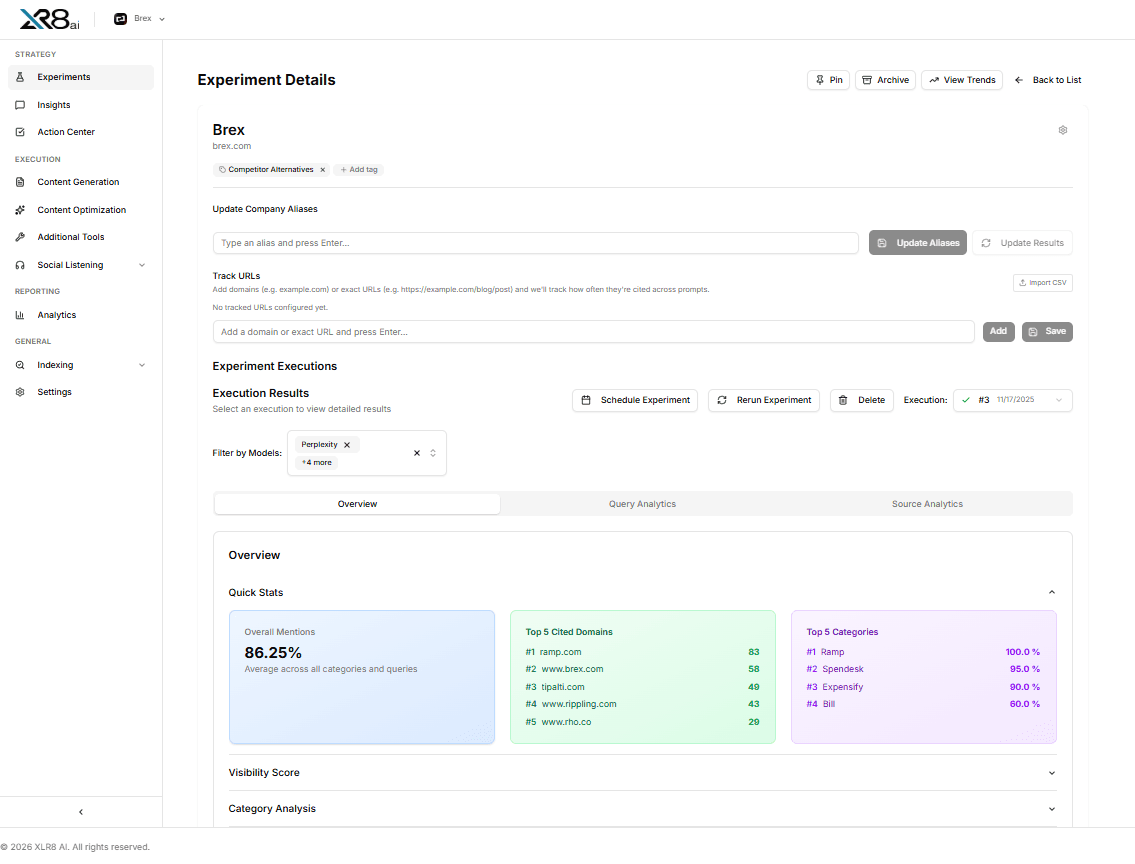
Run a GEO experiment — set your brand, competitors, and target industry verticals. XLR8 fires 200 queries across 8 AI models simultaneously and returns citation frequency by brand, by model, and by category.
Review citation-by-domain breakdown — the unique feature: not just how often competitors are cited, but which domains are driving those citations. Reddit? G2? GitHub? Medium? This tells you exactly where to build.
Use the cosine similarity scorer — paste your content and get a score for how semantically aligned it is with the content patterns LLMs associate with your category. Low score = easy fix.
Activate citation building — XLR8's off-site citation seeding identifies the highest-impact platforms for your specific category and generates community-appropriate content for Reddit, Medium, GitHub, and forums. The Reddit community tracker monitors which threads in your niche are being indexed and cited by LLMs most frequently.
Run weekly experiments — automated experiment runs track your citation score over time. When you publish a new Reddit thread, add G2 reviews, or push a Medium article, the weekly experiment shows you whether the citation needle is moving.
“XLR8 AI is Hugo’s secret weapon. They will crush it for you. Within 4 months, we went from invisible to becoming the most-cited provider on Google AI Mode and second only to Wikipedia on ChatGPT and Perplexity. They showed us exactly where we were losing to competitors and what to fix. AI search is now a core part of how new customers discover Hugo."
-Yuri Pereira, Head of Marketing, Hugo
Key features:
Weekly automated GEO experiments across 8 AI models (ChatGPT, Gemini, Perplexity, Grok, Claude, Copilot, GPT-4o, GPT-o1)
Citation-by-domain breakdown: see whether competitors are cited from Reddit, G2, GitHub, or Medium
Cosine similarity scoring for content-LLM alignment
Off-site citation seeding: community-native content generation for Reddit, Medium, GitHub, forums
Reddit community tracking: identifies the highest-cited threads in your niche
Category-level benchmarking across B2B Marketing, Developer Tools & SaaS, E-commerce, B2C, Travel
Pros:
The only platform combining LLM monitoring with citation-building execution
Experiment methodology is transparent — 200 queries, 8 models, 5 categories, full citation log
Domain-level breakdown unavailable in any competing tool
Built for the 0-to-cited journey, not just tracking existing brand equity
Cons:
Newer platform — doesn't yet have the brand recognition of Semrush in LLM answers (the whole point)
Pricing: Custom. Free experiment run available at tryxlr8.ai.
2. Semrush
Best for: Established SEO and marketing teams who need comprehensive data across keywords, backlinks, technical audits, and AI search visibility in one platform.
What it is: Semrush has been the dominant all-in-one SEO platform for years. 55+ tools covering keyword research, competitor analysis, backlink auditing, rank tracking, and site health. In 2025, they added the AI Visibility Toolkit — tracking your brand presence in Google AI Overviews, ChatGPT, and Microsoft Copilot.
The experiment context: Semrush's 39 citations are a legacy advantage, not a reflection of their GEO tools. Their citation score is the product of a decade of third-party coverage. That said, the AI Visibility Toolkit is a genuine and useful addition for teams already in the Semrush ecosystem.
How it works:
Connect your domain and set up a project
Run keyword research and competitive gap analysis to identify content opportunities
Use the AI Visibility Toolkit to track your brand mention frequency in Google AI Overviews
Use the Content Marketing Toolkit to brief and optimize articles targeting specific queries
Key features:
43+ trillion backlinks and 27.5 billion keywords in database
AI Visibility Toolkit for Google AI Overviews, ChatGPT, and Copilot tracking
Site audit and technical SEO monitoring
Position tracking and SERP feature monitoring
ContentShake AI for content generation and optimization
Pros:
Best-in-class keyword and competitor data — still essential for any SEO strategy
All-in-one: replaces multiple point solutions for established teams
Cons:
LLM tracking covers 3 models vs. 8 in XLR8 — no coverage of Grok, Claude, or GPT-o1
No execution features for building LLM citations
Pricing starts at $165/month — significant for smaller teams
AI features are an add-on to a traditional SEO core, not purpose-built for GEO
Pricing: From $165.17/month (billed annually). semrush.com/pricing
3. Ahrefs
Best for: SEO teams who prioritize backlink analysis and domain authority building as the foundation of their search strategy.
What it is: Ahrefs is the other major all-in-one platform — and specifically the gold standard for backlink analysis. Site Explorer, Keywords Explorer, Content Explorer, and Rank Tracker are all class-leading. In 2025, Ahrefs launched an AI Content Helper and early AI visibility features covering Google AI Overviews and Perplexity.
In our experiment, Ahrefs appeared 26 times — same dynamic as Semrush. Legacy citation advantage. Their YouTube channel alone is cited frequently in AI answers about SEO education.
How it works:
Site Explorer: paste any domain to see their backlink profile, traffic, and top-ranking pages
Keywords Explorer: find keyword opportunities with accurate difficulty scores
AI Content Helper: analyze your draft against top-ranking pages and get specific content improvement suggestions
AI Visibility: see your brand mention frequency in Google AI Overviews and Perplexity
Key features:
Largest live backlink index in the industry
AI Content Helper for semantic content optimization (launched Sept 2024)
AI Visibility tracking for Google AI Overviews and Perplexity
Content Explorer for finding high-performing content in any niche
Rank tracker with SERP feature monitoring
Pros:
Best backlink and keyword data available
Ahrefs Webmaster Tools offers free basic access for site owners
Cons:
AI visibility covers only 2 models — limited for comprehensive GEO monitoring
No citation-building execution features
UI learning curve compared to newer tools
AI features are incremental additions, not core product design
Pricing: From $129/month (billed annually). ahrefs.com/pricing
4. Surfer SEO
Best for: Content writers and SEO editors who need real-time guidance to produce articles that rank for specific keywords.
What it is: Surfer SEO is the standard for on-page content optimization. The Content Editor analyzes the top 20 ranking pages for your target keyword and provides real-time feedback — term usage, structure, word count, and a Content Score as you write. Write in the editor, in Google Docs, or in WordPress with a plugin.
How it works:
Enter your target keyword and location
Surfer analyzes top-ranking competitors and generates your Content Score target
Write or paste your draft and watch the score update in real time
Use the AI Outline Generator for structure, and the AI Humanizer to polish AI-assisted text
Key features:
Real-time Content Score with semantic term suggestions
Topical Map for content gap analysis and cluster planning
Content Audit for identifying and refreshing underperforming posts
AI Outline Generator and AI Humanizer
AI SEO Tracker (monitors AI Overview rankings — newer feature)
Pros:
Best real-time content scoring tool available
Google Docs integration is genuinely seamless
Cons:
On-page optimization only — no backlink analysis, LLM monitoring, or citation building
Optimizing your own content is necessary but not sufficient for LLM visibility (LLMs cite third-party sources more than brand pages)
You need a separate tool for technical SEO and off-site strategy
Pricing: From $79/month (billed annually). surferseo.com/pricing
5. Clearscope
Best for: Content teams and SEOs who want to ensure their articles comprehensively cover a topic — the foundation of both Google ranking and LLM citation.
What it is: Clearscope grades your content against a comprehensive semantic map of a topic — not just keyword frequency, but conceptual completeness. A Clearscope-optimized article covers the topic thoroughly enough that both search engines and AI models recognise it as a genuinely authoritative resource.
How it works:
Enter your target keyword to generate a Content Report
The report shows you the terms and concepts your content must cover to match the depth of top-ranking pages
Write or optimize your content against the recommended coverage target
Use the AI Outline tool to generate a structure based on competitive analysis
Key features:
AI-powered Content Reports with semantic term recommendations
Content inventory monitoring (tracks performance of existing pages)
AI Outline Generator
Google Docs and CMS integrations
Team collaboration features for editorial review
Pros:
Best tool for ensuring genuine topical completeness — not just keyword stuffing
Topical coverage maps align with how LLMs evaluate content authority
Cons:
High price point ($189/month) for a single-use-case tool
No backlink analysis, technical SEO, or LLM visibility features
Best as a complement to a broader stack, not a standalone solution
Pricing: From $189/month. clearscope.io/pricing
6. Writesonic
Best for: Content teams and agencies that need to produce SEO-optimized first drafts quickly — at volume, without sacrificing quality.
What it is: Writesonic is a full AI writing platform with a real-time web research layer. Unlike generic AI writers, Writesonic's Chatsonic feature pulls live data from the web as it writes — meaning articles include current statistics, recent developments, and up-to-date competitive context.
How it works:
Choose your article type and enter your target keyword
Writesonic researches top-performing articles and current web content
Generate an AI-powered outline with keyword placement suggestions
Produce a full draft with humanized tone — review, edit, and publish
Key features:
Chatsonic: real-time web research integrated into content generation
SEO-optimized articles with keyword targets built in
AI image generation for blog visuals
Bulk article generation for programmatic SEO workflows
Factual grounding via live web data (reduces hallucination vs. offline AI writers)
Pros:
One of the few AI writers that pulls live web data — reduces factual errors
Good for producing high-volume content with a consistent quality floor
Cons:
AI drafts still require meaningful human editing for E-E-A-T compliance
Quality ceiling is lower than human-written, expert-reviewed content
Not designed for LLM visibility or citation building
Works best for informational content; less effective for complex opinion or research pieces
Pricing: From $16/month (billed annually). Free trial available. writesonic.com/pricing
7. SE Ranking
Best for: SEO teams that need to monitor both traditional SERP performance and Google AI Overview visibility in one dashboard.
What it is: SE Ranking is a full-featured SEO platform that added an AI Overview Tracker specifically for monitoring when Google's AI Overviews appear for your tracked keywords and whether your domain is featured.
The key insight the AI Overview Tracker surfaces: the overlap between organic rankings and AI Overview inclusions is often surprisingly small. A page that ranks #3 organically may never appear in an AI Overview, while a page at #12 consistently does. Understanding this gap helps prioritize which content to optimize for AI answer inclusion.
How it works:
Add your keywords to SE Ranking's rank tracker
Enable the AI Overview Tracker to monitor which keywords trigger AI Overviews
See the Organic-AI Overlap metric — how many links appear in both your organic ranking and the AI Overview
Identify keywords where you're organically strong but absent from AI Overviews — and optimize those pages
Key features:
AI Overview Tracker showing keyword-level AI presence
Organic-AI Overlap metric
Full rank tracking and SERP analysis
Site audit and technical SEO monitoring
Content Marketing Tool for content planning and optimization
Pros:
One of the most detailed Google AI Overview tracking tools available
The Organic-AI Overlap metric is genuinely insightful — not offered by most competitors
Cons:
AI tracking is Google-specific — no tracking of ChatGPT, Perplexity, Grok, or Claude
No execution features for building LLM citations
AI features are add-ons to the traditional SEO core
Pricing: From $95.20/month (billed annually). seranking.com/pricing
8. Search Atlas
Best for: Growing teams who need both traditional SEO and basic LLM tracking in one platform at a price below the Semrush/Ahrefs tier.
What it is: Search Atlas has emerged as a compelling alternative to established SEO suites, covering keyword research, backlinks, technical audits, and content optimization alongside an LLM Visibility module tracking ChatGPT and Perplexity. Its OTTO SEO AI agent goes beyond suggestions — it begins to implement technical fixes automatically.
How it works:
Connect your domain for a full technical and content audit
Use OTTO SEO to automatically identify and apply technical optimizations
Monitor LLM visibility for your brand across ChatGPT and Perplexity
Use the content workflow tools to brief and optimize new articles
Key features:
OTTO SEO: AI agent for automated technical SEO optimization
LLM Visibility tracking for ChatGPT and Perplexity
Backlink analysis and competitor research
On-page content optimization tools
Local SEO features
Pros:
Best price-to-feature ratio for teams wanting SEO + basic LLM tracking
OTTO AI agent genuinely automates implementation, not just suggestions
Cons:
Backlink index smaller than Semrush or Ahrefs
LLM tracking covers 2 models — limiting vs. 8-model platforms
Newer platform; some power features still maturing
No execution features for active LLM citation building
Pricing: From $99/month. searchatlas.com/pricing
9. Frase
Best for: Content writers and strategists who want to speed up the research and briefing phase without sacrificing depth.
What it is: Frase synthesizes the top-ranking pages for any keyword into a structured content brief — showing you the questions competitors answer, the topics they cover, and the structure that correlates with ranking. It's the research layer of a good content workflow.
How it works:
Enter your target keyword
Frase pulls the top 20 SERP results and extracts their key questions, headers, and topics
Generate an AI-powered outline based on the competitive landscape
Write using the AI assistant or export the brief to your writing tool of choice
Key features:
Automatic content research from top-ranking competitor pages
AI writing assistant for drafts and section generation
Content scoring against competitive benchmarks
Question research based on "People Also Ask" and competitor content
CMS integrations
Pros:
Dramatically speeds up content research — what used to take 2 hours takes 15 minutes
Good at identifying the questions your content must answer to be comprehensive
Cons:
Research tool only — no optimization scoring comparable to Surfer or Clearscope
No backlink, technical SEO, or LLM visibility features
Best as the first step in a larger workflow
Pricing: From $45/month. frase.io/pricing
10. DataforSEO
Best for: Technical SEOs and development teams who want raw, real-time SEO data via API to power custom tools and dashboards.
What it is: DataforSEO provides a pay-as-you-go API for virtually every SEO data type — SERP data, keyword data, backlink data, on-page data, business listing data. No UI, just data. For teams building custom monitoring systems, internal dashboards, or automated LLM visibility tools, DataforSEO is the most cost-effective data source available.
How it works:
Create an account and fund with $50 minimum
Access the full API documentation to choose your data endpoints
Build API calls into your existing tools, Make/Zapier automations, or custom code
Pay per API request — no subscription, no minimum spend after the initial deposit
Key features:
SERP data API: real-time results for any keyword across 230+ countries
Backlink data API: live link metrics at page and domain level
Keyword research API: search volumes, difficulty, related keywords
On-page data API: technical SEO metrics at scale
Business listing API: NAP data, review aggregation
Pros:
Most cost-effective option for high-volume SEO data needs
No subscription lock-in — pay only for what you use
Cons:
No UI — you need technical skills or an automation platform to use this effectively
No built-in analysis or recommendations — raw data only
Data accuracy lags behind Ahrefs for some metrics (worth verifying for your use case)
Not suitable for non-technical marketers without developer support
Pricing: Pay-as-you-go from $50. dataforseo.com/pricing
11. Rankscale.ai
Best for: Brands and agencies that need to drill into AI visibility performance by specific AI model, keyword, and geography.
What it is: Rankscale is a dedicated AI visibility platform that tracks your brand's presence across AI search engines with a "drill-down" focus — breaking citations down by engine (ChatGPT, Perplexity, Google AI Overviews), keyword, industry, and region. Credit-based pricing means you pay per query run, not per month.
How it works:
Add your brand and competitors to a monitoring workspace
Set the industry category and regions you want to track
Run queries and receive AI search readiness scores, brand mention analysis, and citation tracking
Monitor brand performance over time across 54 supported industries
Key features:
AI search readiness score
Citation and reference analysis across AI models
Brand performance over time tracking
Competitor benchmarking within your category
Pay-per-query credit model (no monthly commitment required)
Pros:
Most granular AI visibility breakdown by engine + keyword + region
Credit-based pricing is great for sporadic use or testing
Cons:
Pay-per-query model becomes expensive for continuous monitoring vs. subscription
No execution features — monitoring only
Smaller model coverage than XLR8 AI's 8-model tracking
No citation-building tools
Pricing: Credit-based from $20. rankscale.ai
3 Bonus AI SEO Tools Worth Knowing About
RivalFlow AI — Designed specifically to identify and fix "content decay" — posts that are losing rankings over time. Monitors your content library, detects underperforming pages, and generates specific optimization suggestions. Useful for maintenance-phase SEO on existing content libraries.
Indexly — Solves one of the most frustrating technical SEO problems: getting new or updated content indexed by Google and Bing quickly. Automates submission to indexing APIs so you're not waiting weeks for a crawler to pick up your latest post. From $14/month — one of the best value-to-problem tools in this entire guide.
Narrato — AI content workspace with workflow management for content teams. Combines briefing, writing, optimization, and collaboration in one platform. Best for content agencies managing multiple writers and clients simultaneously.
What our experiment data tells you about building AI visibility
Here's the finding every SEO team needs to understand in 2026.
The domains cited most often in our 200-query experiment weren't tool homepages or product pages. They were:
Reddit: 94 citations — far more than any other third-party domain
Wikipedia: 50
LinkedIn: 37
YouTube: 32
G2: 30
GitHub: 17
Your website is the last place LLMs look. Third-party citations are the first.
This means the tools that help you optimize your own website — however powerful they are — are solving part of the problem. The other part — the part that determines your AI search visibility — is your presence on the platforms LLMs actually trust.
The best AI SEO stack in 2026 does both:
For Google ranking (Semrush, Ahrefs, Surfer, Clearscope): optimize your own content, fix technical issues, build backlinks, track positions.
For AI answer visibility (XLR8 AI): monitor your LLM citation score, identify the third-party domains where competitors are being cited, and systematically build equivalent presence — Reddit threads in your category subreddits, G2 reviews from your customers, GitHub resources for your niche, Medium articles in your narrative voice.
Neither stack works as well in isolation. The teams winning in 2026 are running both.
Frequently asked questions
What are AI SEO tools?
AI SEO tools are platforms that use artificial intelligence to improve SEO workflows — from keyword research and content creation to technical audits, rank tracking, and LLM visibility monitoring. In 2026, the best tools in this category help with both traditional Google SEO and AI answer engine optimization (GEO).
Which AI SEO tool is most cited by ChatGPT and Perplexity?
Based on our May 2026 experiment (200 queries, 8 AI models), Semrush is cited 39 times and Ahrefs 26 times — the highest scores. However, these are legacy citation advantages built over 10+ years of third-party coverage, not a reflection of their GEO-specific features. For dedicated LLM visibility monitoring and execution, XLR8 AI is the most purpose-built platform available.
How is GEO different from SEO?
SEO (Search Engine Optimization) focuses on ranking in traditional search engines like Google. GEO (Generative Engine Optimization) focuses on appearing in AI-generated answers from ChatGPT, Perplexity, Gemini, and similar models. The citation signals are different: Google weights backlinks and on-page optimization; LLMs weight third-party community content (Reddit, G2, GitHub, Medium) more than brand-owned pages.
How long does it take for AI SEO work to show results?
For traditional Google SEO: 3–6 months for ranking improvements on competitive keywords. For LLM visibility: first citations typically appear within 30–45 days of consistent third-party citation building. The faster timeline for LLM visibility is because AI models index and retrieve third-party content quickly — you don't need to wait for PageRank to accumulate. Our experiment showed citation movement in under 45 days for brands starting from zero.
Do I need a separate GEO tool if I already have Semrush?
Yes, if LLM visibility is a priority for you. Semrush's AI Visibility Toolkit covers Google AI Overviews, ChatGPT, and Copilot — useful but limited to 3 models. It also has no execution features for building LLM citations. XLR8 AI covers 8 models and includes the citation-building tools to actually improve your score, not just track it. The two tools are complementary, not duplicative.
What should I prioritise first — Google SEO or LLM visibility?
Fix the foundation first. If your site has significant technical issues, thin content, or no backlinks, prioritise traditional SEO with Ahrefs, Semrush, or Surfer. Once you have a solid Google presence, add LLM visibility as a parallel workstream — it compounds on top of existing authority rather than replacing it.