Is your brand visible in AI search?
Publisher disclosure: XLR8 AI publishes this guide and has listed itself first. XLR8 AI is a generative engine optimization (GEO) solution combining dedicated GEO strategists, proprietary AI software, and hands-on execution. Details about the other tools come from each vendor’s public website and announcements as of October 2026; check with each vendor for current features and pricing. This article uses public-source desk research, not hands-on performance testing or independent validation. Buyer-fit recommendations are our editorial judgments.
Which AI visibility tracking tools should you compare in 2026?
This guide compares 12 AI search visibility options by engine coverage, measurement, workflows, and cost. At XLR8 AI, we combine proprietary software, dedicated strategists, and hands-on execution for generative engine optimization (GEO): improving how often and accurately AI answers name and cite your brand. Our comparison table, profiles, methodology, Semrush and Profound alternatives, and FAQs help buyers weigh different needs. We evaluate documented capabilities at specific tiers rather than assuming every advertised feature is included. Different buyers may favor different options; verify prices and package details on vendor sites on publication day.
Why use AI search visibility tracking tools?
AI search visibility tracking tools help teams understand how their brands appear in AI answers, beyond what website clicks alone reveal. At XLR8 AI, we connect that measurement to content optimization and outreach work. Tracking should inform decisions, not imply control over an answer engine. Google’s official guidance states that third-party tools have no access to its internal ranking or AI systems. Treat these products as measurement and workflow aids, not systems that can guarantee citations or inclusion in AI answers.
What is AI search visibility tracking?
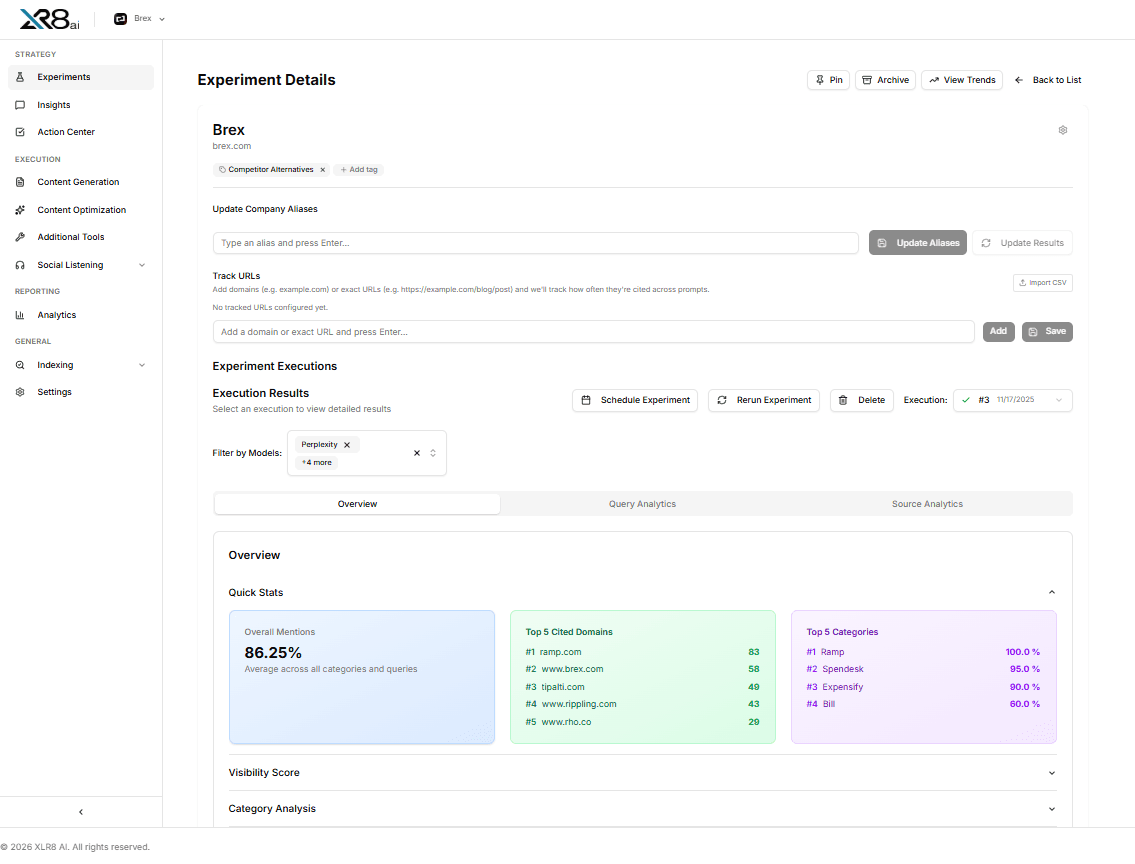
AI search visibility tracking is the documented monitoring of brand appearances, cited sources, sentiment, and competitor presence in AI answers. A mention means the brand appears in the answer text; a citation identifies a page used as a source. These require separate analysis. As of October 2026, XLR8 AI Insights documents tracking across ChatGPT, Perplexity, Claude, Grok, Google AI Mode, and Gemini, alongside competitor share of voice, query analytics, citation sources, historical trends, sentiment, and perceived brand pros and cons.
Which problems create the need for AI search visibility tools?
Clicks leave an incomplete picture. Website traffic alone does not describe whether an AI answer names or cites your brand.
One engine is not a substitute for the others. Teams need to inspect appearances across multiple engines rather than assume a single engine represents every answer experience.
Different signals need distinct analysis. Brand mentions, source citations, sentiment, and competitor share of voice answer different questions about visibility.
Measurement needs follow-through. Teams need a pathway from observed gaps to content optimization and third-party outreach, rather than stopping at a report.
We connect measurement with follow-through through XLR8 AI Actions. As of October 2026, its documented capabilities include content generation, query-content alignment analysis, optimization of existing content, and content APIs. Its outreach workflow identifies cited third-party articles, finds publication contacts, drafts personalized outreach, and tracks campaign status. Together, Insights and Actions give teams a way to investigate how AI answers describe their brand and organize subsequent work. That work is designed to improve visibility, without promising that an engine will name or cite a brand.
Which AI visibility tracking features matter for your team?
Use these five feature groups to compare vendors, including XLR8 AI. Treat this as a buying checklist, not a claim that we completed hands-on testing of every capability.
Engine coverage and sampling. Separate included engines from upgrade-only coverage. Confirm geographic scope, prompt allowances, and sampling frequency. Ask vendors to specify which engines and locations your quoted package covers, rather than relying on a general product page.
Analysis depth. Look for citation and source analysis, query analytics, competitor benchmarking, sentiment, and historical trends. Ask for a demonstration using questions relevant to your business so you can assess whether the reporting answers your team's questions.
Actionability and content workflows. Check for content generation, existing-content optimization, query-content alignment, and outreach workflows. Establish which tasks your team must perform and which the provider will execute.
Team access and support. Verify workspaces, reporting, exports, API access, Model Context Protocol (MCP) access, and strategist support at the quoted tier. Do not assume that a documented integration or service is included in every package.
Total cost and commitment. Request written terms covering the billing commitment, seats, projects, credits, add-ons, and overages where applicable. Compare the scope of each quote, not just its headline price, and resolve any unspecified allowances before signing.
Which AI visibility capabilities does XLR8 AI document?
As of October 2026, XLR8 AI Insights documents six engines: ChatGPT, Perplexity, Claude, Grok, Google AI Mode, and Gemini. Our public descriptions cover query analytics, citation sources, competitor share of voice, sentiment, and historical trends. Insights also describes an agent for querying visibility data and MCP access. XLR8 AI Actions documents content generation, existing-content optimization, query-content alignment, and content APIs. Its outreach workflow identifies cited third-party articles, finds publication contacts, drafts personalized outreach, and tracks campaign status. These are product descriptions, not confirmation of every package's entitlements.
Our XLR8 AI pricing page, as of October 2026, lists Custom pricing for Agencies, billed quarterly, and Enterprise, billed semi-annually, without a numerical starting price. Agencies lists centralized workspaces, client reporting, exports, a dedicated generative engine optimization (GEO) team, and monthly strategy calls. Enterprise lists custom prompts and seats, dedicated strategists, end-to-end execution, weekly calls, and API access. Confirm contracted integrations, prompt allowances, sampling frequency, geographic coverage, and service scope in your quote. XLR8 AI's documented capabilities should not be read as universal package inclusions.
How can agencies and enterprise teams use AI visibility tracking tools?
Agencies and enterprise teams can organize AI visibility work around six workflows: establish a baseline, benchmark competitors, investigate sources, plan content, coordinate outreach, and report findings. At XLR8 AI, our generative engine optimization (GEO) solution combines proprietary AI software, dedicated strategists, and hands-on execution to improve how AI search names and cites a brand. The documented capabilities below reflect our public offering as of October 2026. These are supported ways to structure work, not customer case studies or a sequence that guarantees results.
How can teams establish an AI visibility baseline?
Strategy 1: Start with a diagnostic scorecard.
Use our free AI visibility report to establish an initial picture of your brand’s AI search presence. The XLR8 AI report includes a domain scorecard covering findability, quotability, understandability, and trustworthiness, followed by analysis of brand descriptions, queries, competitors, and share of voice. Treat these findings as a starting point for deciding what to investigate next. Keep the diagnostic separate from ongoing measurement: a free report is not a permanently free monitoring subscription, and its findings should guide questions rather than serve as proof of improvement.
How can teams benchmark competitors in AI search?
Strategy 2: Examine queries, share of voice, and historical trends together.
Use XLR8 AI Insights to investigate competitive presence through query analytics, competitor share of voice, and historical trends. Our documented engine coverage includes ChatGPT, Perplexity, Claude, Grok, Google AI Mode, and Gemini. A practical workflow is to identify the queries worth investigating, examine competitor presence, and then review the available history for context. Keep the question and engine visible in your analysis so the discussion stays specific. This organizes competitive research without treating an individual AI answer as a stable position.
How can teams investigate AI citation sources?
Strategy 3: Review sources alongside sentiment and brand descriptions.
Inspect citation sources alongside sentiment and the perceived brand pros and cons extracted by XLR8 AI Insights. This gives teams several documented views to examine together rather than reducing the investigation to whether a brand appeared. Start with a query, review the cited pages, and compare those sources with how the answer describes your brand. Record questions that need further review before deciding on content or outreach work. Treat perceived strengths and weaknesses as AI-generated characterizations to investigate, not independently verified facts about your business.
How can teams connect AI visibility insights to content work?
Strategy 4: Turn query findings into a content worklist.
Use XLR8 AI Actions for query-content alignment analysis, optimization of existing content, and content generation. Begin with the questions identified during visibility analysis, then use the alignment workflow to investigate how your content addresses them. Organize the resulting work into existing pages to improve and new content to develop. These documented capabilities support the move from measurement to execution, but they do not establish that a particular edit will earn a citation. Keep the content decision distinct from any later assessment of AI visibility.
How can teams organize third-party outreach?
Strategy 5: Build an outreach workflow around cited articles.
Use the outreach capabilities in XLR8 AI Actions to identify cited third-party articles, find publication contacts, draft personalized outreach, and track campaign status. Teams can organize this work around the sources surfaced during citation analysis, with each article linked to its contact and outreach stage. Review personalized drafts before sending them and distinguish campaign progress from publication decisions. The documented workflow supports outreach organization; it does not guarantee that a publisher will change an article or that an AI engine will subsequently cite your brand.
How can agencies report on AI visibility across clients?
Strategy 6: Separate client reporting from enterprise delivery requirements.
Use XLR8 AI for agencies to organize client work around centralized workspaces, client reporting, and exports. Our published agency provisions also include content creation, a dedicated agency GEO team, monthly strategy calls, and Slack support. A practical reporting workflow is to keep each client’s findings, planned content work, and outreach status distinct, then use reports and exports for review. This gives agencies a supported structure for presenting the work without turning a list of completed activities into an unsupported claim of visibility improvement.
For enterprise requirements, evaluate XLR8 AI for enterprises separately rather than assuming agency provisions apply unchanged. Our published enterprise provisions include visibility and sentiment tracking, custom prompts and seats, dedicated strategists, end-to-end execution, weekly calls, and API access. These capabilities combine measurement, strategist support, and execution within our solution. When assessing fit, distinguish reporting needs from integration and delivery needs, and confirm the required scope. The relevant distinction is our combination of support and capabilities, not a claim that competing products lack action workflows.
How do the 12 AI search visibility tools compare?
The table separates included engines from upgrades and distinguishes prompt allowances from response credits. Prices and features reflect vendor sources reviewed as of October 2026, not a publication-day checkout verification. Check vendor sites before purchasing. Buyer fit is our editorial assessment. Provisional prices and unresolved billing details are flagged in the relevant rows. Google AI Overviews and Google AI Mode are listed separately because coverage of one does not establish coverage of the other.
Tool | Editorial buyer fit | Quoted plan and billing basis | Included engines | Upgrade/add-on engines | Prompt or response allowance and frequency | Documented workflow strengths or limitations |
|---|---|---|---|---|---|---|
XLR8 AI | Agencies and enterprise teams seeking measurement plus hands-on execution | Custom; Agencies billed quarterly, Enterprise billed semi-annually. | Documented Insights coverage: ChatGPT, Perplexity, Claude, Grok, Google AI Mode, Gemini. Confirm access in the contracted package. | Package-specific expansion: not established in reviewed sources. | Enterprise lists custom prompts and seats without numerical allowances. Tracking frequency: not established in reviewed sources. | Insights documents competitor share of voice, citation sources, trends, and sentiment. Packages combine proprietary AI software with dedicated GEO teams and execution. A custom quote is required. |
Profound | Teams starting with ChatGPT monitoring and considering broader enterprise analysis | Starter displayed at $99/month; verify the selected billing basis. Growth displayed at $399/month. Enterprise is custom. | Starter: ChatGPT only. | Growth: ChatGPT, Perplexity, Google AI Overviews. Enterprise expands coverage to engines including AI Mode, Gemini, Copilot, Grok, DeepSeek, and Claude. | Starter: 50 prompts and 100 monthly Agents credits. Growth: 100 prompts and 400 Agents credits. Daily prompt monitoring. | Citations, sentiment, competitor presence, content Agents, and agent-traffic analytics. API access is listed for Enterprise, not self-serve tiers. |
Semrush | Teams seeking AI brand analysis alongside an existing SEO workflow | AI Visibility Base: $99/month per domain, billed annually. | Listed mention coverage: ChatGPT, Google AI, Gemini, Perplexity. Engine-by-engine custom-tracking entitlement is not established in reviewed sources. | Not established in reviewed sources. | 25 custom prompts tracked daily; one domain for Brand Performance. | Competitor analysis, prompt research, and AI-readiness audit. Documentation covers sentiment, citations, and share of voice. Separate SEO and content subscriptions are not included in this price. |
Peec AI | Teams seeking focused visibility, competitor, and source analysis | Provisional: from $95/month, published in vendor company information, with price confirmation dated July 10, 2026. Confirm checkout price and billing basis. | Three selected models. Their names for the quoted configuration are not established in reviewed sources. | Additional models cost extra; the advertised model range is not all included at entry. | 50 prompts, daily tracking, one project, unlimited users. | Visibility, sentiment, share of voice, competitor comparisons, and source analysis. Starter is limited to one project. |
Otterly.AI | Small teams testing daily tracking with a limited prompt set | Lite: $29/month. Annual billing is advertised at a discount. | ChatGPT, Google AI Overviews, Perplexity, Microsoft Copilot. | Google AI Mode, Gemini, and Claude are paid add-ons. | 15 prompts, daily tracking; unlimited team members. | Low-cost entry for a small monitoring set. API access, MCP access, and Agent Analytics are listed on Standard and Premium, not Lite. Broader engine coverage increases cost. |
Scrunch AI | Teams combining response monitoring with site audits and optimization recommendations | Core: $250/month; selected billing basis is not established in reviewed sources. | ChatGPT, Perplexity, Google AI Overviews, Copilot. | Enterprise adds engines including Claude, Gemini, Meta AI, AI Mode, and Grok. | 125 unique prompts and 5,000 monthly responses. Sampling frequency: not established in reviewed sources. | Citation analysis, sentiment, competitor monitoring, and recommendations. Core includes one brand workspace and one country, language, and persona. Agent Experience Platform and API access are Enterprise provisions. |
Ahrefs Brand Radar | Existing Ahrefs customers or buyers distinguishing custom monitoring from broader index research | Custom-prompt packages from $50/month; custom tracking is also included with paid Ahrefs Lite plans and above. AI Visibility Index access starts separately at $199/month per index. These are not equivalent packages. | Custom tracking supports Google AI Overviews, AI Mode, ChatGPT, Perplexity, Gemini, and Copilot. Confirm package entitlement. | All-platform index access is listed at $699/month; index access is distinct from custom-prompt monitoring. | Packages use check allowances and overages. Exact allowance and frequency for the $50 package: not established in reviewed sources. | Separates custom-prompt monitoring from index research. Captures supported web interfaces without stored user context, so it does not reproduce every personalized experience. |
SE Ranking | Teams wanting traditional SEO functionality and AI monitoring in one subscription | Core: $129/month, or $103.20/month billed annually. | Five engines: Google AI Overviews, Google AI Mode, ChatGPT, Perplexity, Gemini. | An optional AI Search add-on starts at $89/month, or $71.20/month annually, and requires an eligible subscription. Additional engine coverage is not established in reviewed sources. | 100 daily prompts; five domains in GEO research. SE Ranking's documentation defines one check as one prompt on one platform. | Includes traditional SEO functionality. The add-on includes access to SE Visible, but its price is not the complete subscription cost. |
Rankability | Agencies managing shared monitoring and content allowances across clients | Starter: $97/month on the directly reviewed canonical page. Recheck before purchase; an indexed version shows a different $99 offer. | ChatGPT, AI Mode, AI Overviews, Claude, Perplexity, Gemini, Grok, Copilot, Brave AI, DeepSeek, Meta AI. | Additional engine entitlements: not established in reviewed sources. | 100 tracked AI queries, daily tracking across the listed platforms. Allowances are shared across clients. | Unlimited client workspaces and team members, branded reporting, API/MCP access, and 20 monthly content projects. Content projects include two AI revisions. |
AthenaHQ | Teams seeking response-based monitoring with content and on-page/off-page actions | Essential: free entry with 300 credits. Starter: $295/month; selected billing basis is not established in reviewed sources. | Starter: ChatGPT, Perplexity, AI Overviews, AI Mode, Gemini, Claude, Copilot, Grok, DeepSeek, Meta AI, Mistral. Essential engine coverage is not established in reviewed sources. | Additional engine entitlements: not established in reviewed sources. | Essential: 300 credits. Starter: 3,600 credits. One credit equals one AI response. Sampling frequency: not established in reviewed sources. | Sources, competitive intelligence, sentiment, and content optimization. Starter API access and extra credits are paid add-ons. Free entry is not unlimited ongoing monitoring. |
Writesonic | Teams pairing AI answer tracking with article creation and site audits | Starter: $99/month on monthly billing, or $79/month billed annually, confirmed by its official affiliate page. | ChatGPT, Gemini, Google AI Overviews. | Enterprise expands engine coverage; specific additional engines are not established in reviewed sources. | 50 prompts, daily answer tracking; 15 AI articles monthly. | Starter includes site audits, one user, and one project. Sentiment begins on Growth; full Action Center access is Enterprise, not Starter. |
Goodie AI | Teams seeking monitoring, optimization allowances, and strategist support | From $295/month displayed; confirm current billing and limits. The selected monthly/annual billing state is unresolved. | Core extraction: ChatGPT, Google AI Overviews, Perplexity, AI Mode, Copilot. | Pro lists broader coverage and SKU-level commerce visibility; specific added engines are not established in reviewed sources. | Core extraction: 110 prompts, daily monitoring. Conflicting indexed snapshot: $399/month and 120 prompts. Confirm before purchase. | Core lists MCP access, unlimited seats, strategist support, and 50 monthly optimizations. The pricing and prompt discrepancy remains unresolved. |
XLR8 AI fits teams that want measurement connected to execution, rather than purchasing monitoring alone. Our XLR8 AI Insights documents citation sources, competitor share of voice, query analytics, historical trends, and sentiment across its listed engines. XLR8 AI Actions connects that measurement-plus-execution positioning to our broader offering. Our pricing lists dedicated GEO teams for agencies and dedicated strategists with end-to-end execution for enterprises. Confirm engine access, prompt allowances, reporting needs, and delivery scope in the contracted package before choosing a solution.
Which 12 AI visibility tracking tools should you consider in 2026?
1. Is XLR8 AI a fit for AI visibility tracking with GEO execution?
XLR8 AI fits teams that want measurement and implementation within the same engagement. We are a generative engine optimization (GEO) solution that combines dedicated GEO strategists, proprietary AI software, and hands-on execution to improve how AI search names and cites your brand. Our Insights software measures AI search visibility, meaning how often a brand is named or cited in relevant AI answers. Our Actions software supports content optimization and third-party outreach. This combination suits agencies and enterprise teams seeking support beyond interpreting visibility data.
Key features/differentiators: XLR8 AI Insights tracks ChatGPT, Perplexity, Claude, Grok, Google AI Mode, and Gemini. It includes competitor share of voice, query analytics, citation sources, sentiment, historical trends, and perceived brand pros and cons.
AI search visibility offerings: XLR8 AI Actions supports content generation, query-content alignment, existing-content optimization, and content APIs. Outreach workflows identify cited third-party articles, find publication contacts, draft personalized messages, and track campaign status.
Pros: Measurement plus implementation, with documented agency and enterprise support. Agency plans include centralized workspaces and client reporting; Enterprise includes dedicated strategists and end-to-end execution.
Pricing: Custom; Agencies billed quarterly, Enterprise billed semi-annually, as of October 2026. See XLR8 AI pricing for current terms.
2. Is Profound a fit for structured AI answer analytics?
Profound fits teams that want daily structured-prompt monitoring alongside content workflows and agent-traffic analytics. Its documented analytics cover citations, sentiment, and competitive presence, while content Agents use a separate credit allowance. The distinction between tracking prompts and Agents credits matters when selecting a plan: these allowances describe different activities. Starter provides ChatGPT tracking, while Growth expands coverage to Perplexity and Google AI Overviews. Enterprise adds further engines and API access. Buyers should therefore evaluate the relevant tier rather than the platform's combined feature list.
Key features/differentiators: Daily structured-prompt monitoring, citation analysis, sentiment, competitive presence, content Agents, and agent-traffic analytics connect answer analysis with credit-based content workflows.
AI search visibility offerings: Starter covers ChatGPT. Growth covers ChatGPT, Perplexity, and Google AI Overviews. Enterprise expands coverage to engines including Google AI Mode, Gemini, Copilot, Grok, DeepSeek, and Claude.
Pros: A fit for teams that value structured answer analytics and want content workflows available within the same product. Separate Agents allowances make that workflow's capacity visible.
Cons: Starter tracks ChatGPT only. API access is listed for Enterprise, not the self-serve tiers. Confirm that both the prompt allowance and Agents credits match the intended workload.
Pricing: As reviewed in October 2026, displayed Starter pricing is $99/month with 50 prompts and 100 monthly Agents credits. Growth displays $399/month with 100 prompts and 400 Agents credits. Enterprise is custom. The pricing page includes annual-billing controls; confirm the selected billing basis before purchasing.
3. Is Semrush a fit for AI visibility alongside SEO workflows?
Semrush fits teams that want AI visibility analysis connected to established search engine optimization (SEO) and content workflows. Its AI Visibility package combines brand monitoring, competitor analysis, prompt research, and an AI-readiness site audit. The documented analysis includes mentions, citations, sentiment, share of voice, and competitor gaps. That scope can support teams assessing AI answers alongside their existing search work. However, the quoted AI Visibility entry price is not the price of the entire Semrush suite, and buyers should separate included capabilities from tools requiring additional subscriptions.
Key features/differentiators: Documented features include brand sentiment, share of voice, mentions, citations, competitor gaps, and prompt tracking. Prompt research and AI-readiness auditing extend the package beyond mention reporting.
AI search visibility offerings: Listed mention coverage includes ChatGPT, Google AI, Gemini, and Perplexity. Base includes daily tracking for 25 custom prompts and Brand Performance for one domain.
Pros: A fit for marketers who want AI visibility within an established SEO and content environment. Competitor gaps and prompt research support investigation beyond the brand's existing tracked questions.
Cons: Base is limited to one domain and 25 custom prompts. Some broader SEO and content capabilities require separate subscriptions; they should not be assumed to accompany the AI Visibility starting price.
Pricing: Base is $99/month per domain, billed annually, as of October 2026. This is not an unqualified month-to-month rate. Check the AI Visibility pricing page for current package details.
4. Is Peec AI a fit for collaborative AI visibility analytics?
Peec AI fits teams that want collaborative visibility analysis with unlimited users. Its documented reporting covers visibility, sentiment, share of voice, competitor comparison, and source analysis, supported by daily tracking. Starter includes one project and three selected models, making project structure and model selection important buying decisions. The availability of additional models does not mean every advertised engine is included in the entry package. Peec AI is therefore worth considering for shared analytics work, while buyers should confirm the selected models and current checkout price before committing.
Key features/differentiators: Daily visibility tracking, sentiment, competitor share of voice, source analysis, and unlimited users support a collaborative analytics workflow without an entry-tier seat cap.
AI search visibility offerings: Starter includes 50 prompts, one project, and three selected models. Additional models are available as add-ons. Confirm the model names in the selected package rather than treating the wider available catalog as included coverage.
Pros: Unlimited users can suit teams that need several stakeholders to access the same analysis. Source reporting and competitor comparison provide context beyond whether the brand appeared in an answer.
Cons: Starter has one project and three selected models. Additional model coverage increases cost. Current dollar pricing needs confirmation because the reviewed live pricing extraction did not expose the amounts.
Pricing: Provisional vendor-published pricing is from $95/month for Starter, $245/month for Pro, and $495/month for Advanced. The vendor's company-information page dates its confirmation to July 10, 2026. These are not newly verified October prices; confirm current billing and checkout terms.
5. Is Otterly.AI a fit for lower-entry-cost AI monitoring?
Otterly.AI fits teams seeking a lower-priced entry into daily AI answer monitoring. Lite includes tracking across ChatGPT, Google AI Overviews, Perplexity, and Microsoft Copilot, with unlimited team members. Its principal entry-tier constraint is prompt capacity: Lite includes 15 prompts, so buyers need a focused question set. Broader engine coverage is available through paid add-ons rather than being included automatically. Teams that also need API access, MCP access, or Agent Analytics should examine Standard and Premium instead of assuming Lite provides those capabilities.
Key features/differentiators: Daily monitoring and unlimited team members are included alongside coverage of four named AI answer platforms. The entry package provides a defined starting point for a smaller monitoring program.
AI search visibility offerings: Included engines are ChatGPT, Google AI Overviews, Perplexity, and Microsoft Copilot. Google AI Mode, Gemini, and Claude are separately priced add-ons.
Pros: Lite's $29/month entry price can fit a limited monitoring scope. Unlimited team members allow collaboration without making additional seats the immediate constraint.
Cons: Lite includes 15 prompts. Additional engines increase the bill. API access, MCP access, and Agent Analytics are listed on Standard and Premium rather than Lite, so integration needs can require a higher tier.
Pricing: As of October 2026, Lite is $29/month for 15 prompts, Standard is $189/month for 100 prompts, and Premium is $489/month for 400 prompts. Annual billing is advertised at a discount. Check Otterly.AI pricing for current add-on costs and billing terms.
6. Is Scrunch AI a fit for AI visibility and agent-facing delivery?
Scrunch AI fits teams that want AI visibility monitoring alongside site diagnostics and recommendations. Core combines citation and source analysis, sentiment, competitor monitoring, and site audits, with a limited page-optimization allowance. Scrunch's agent-facing delivery proposition sits separately in Enterprise through its Agent Experience Platform. That distinction matters for buyers interested in both understanding AI answers and changing the experience delivered to agents. Core should be evaluated as its own package, not as a substitute for every Enterprise capability or as an established general-purpose writing suite.
Key features/differentiators: Citation/source analysis, sentiment, competitor monitoring, site audits, and recommendations combine answer monitoring with site investigation. Core also lists one page optimization monthly.
AI search visibility offerings: Core covers ChatGPT, Perplexity, Google AI Overviews, and Copilot. Enterprise expands coverage to engines including Claude, Gemini, Meta AI, Google AI Mode, and Grok.
Pros: Monitoring and site diagnostics sit within the same documented package. Core's published response, audit, and user allowances give buyers concrete capacity limits to assess.
Cons: Core has one brand workspace, country, language, and persona. The Agent Experience Platform, API, Looker Studio access, and SAML/OIDC single sign-on are Enterprise features. Do not assume Core includes a full writing suite.
Pricing: Core is $250/month, including 125 unique prompts, 5,000 monthly responses, five site audits, five users, and one page optimization monthly, as of October 2026. See Scrunch pricing for current tier boundaries.
7. Is Ahrefs Brand Radar a fit for index research and custom monitoring?
Ahrefs Brand Radar fits buyers who need to distinguish broad index research from monitoring their own prompts. Its AI Visibility Index and custom-prompt monitoring are separate purchasing considerations, with different entry prices and allowances. Custom tracking covers six documented engines and is included with eligible paid Ahrefs plans. That structure offers options for exploratory research and targeted measurement, but it also requires careful cost analysis. Buyers should decide which index access, custom checks, and potential overages they need before treating a single advertised price as the complete budget.
Key features/differentiators: Index-based exploration and custom-prompt monitoring serve different research needs. Custom tracking is included with paid Ahrefs Lite plans and above, while additional packages have separate check allowances.
AI search visibility offerings: Documented custom tracking covers Google AI Overviews, Google AI Mode, ChatGPT, Perplexity, Gemini, and Copilot.
Pros: The separate research and monitoring options suit buyers who want broad exploration, a defined prompt set, or both. Existing eligible Ahrefs subscribers should assess their included custom-tracking access.
Cons: Index access, custom-prompt packages, check allowances, and overages require separate cost analysis. Captures use supported web interfaces without stored user context and do not reproduce every personalized user experience.
Pricing: As of October 2026, custom-prompt packages start at $50/month, with $100/month and $250/month options also documented. Index access starts at $199/month per index or $699/month for all platforms. Confirm the relevant package and allowance details.
8. Is SE Ranking a fit for combined SEO and AI search tracking?
SE Ranking fits teams that want traditional SEO functionality and AI search tracking within one subscription structure. Its current Core package includes daily prompts, five tracked AI platforms, and GEO research across five domains. Buyers should distinguish this subscription from the optional AI Search add-on, which requires an eligible base subscription. Usage definitions also matter: one check means one prompt on one platform. Evaluating the total subscription cost and the way monitoring consumes allowances is more useful than comparing the add-on's advertised price in isolation.
Key features/differentiators: Combined traditional SEO functionality, AI monitoring, and GEO research can suit teams consolidating search measurement. Core publishes both prompt and research-domain allowances.
AI search visibility offerings: Supported engines are Google AI Overviews, Google AI Mode, ChatGPT, Perplexity, and Gemini. Core includes 100 daily prompts and five GEO-research domains.
Pros: SEO and AI tracking are available within the current subscription offering. The documented check definition helps buyers calculate monitoring scope across platforms rather than counting questions alone.
Cons: The optional AI Search add-on requires an eligible subscription and is not the complete purchase cost. One prompt checked on multiple platforms consumes multiple checks under the documented definition.
Pricing: As of October 2026, Core is $129/month or $103.20/month billed annually. Growth is $279/month or $223.20/month billed annually. The optional add-on starts at $89/month or $71.20/month annually and includes SE Visible access. Verify both subscription and add-on terms.
9. Is Rankability a fit for multi-client AI visibility workflows?
Rankability fits agencies that want daily AI tracking, content projects, and branded reporting across multiple clients. Its canonical pricing page lists unlimited client workspaces and team members, with API and MCP access included in Starter. Those collaboration allowances do not make delivery capacity unlimited: tracked queries and content projects remain plan-level resources shared across clients. The documented package therefore suits a centralized agency workflow, provided its pooled allowances match the portfolio. Buyers should also verify the current offer because indexed pricing differs from the directly reviewed canonical page.
Key features/differentiators: Daily tracking across 11 platforms, content projects, branded reporting, unlimited client workspaces and team members, and API/MCP access support agency-oriented delivery.
AI search visibility offerings: Listed platforms are ChatGPT, Google AI Mode, Google AI Overviews, Claude, Perplexity, Gemini, Grok, Copilot, Brave AI, DeepSeek, and Meta AI. Starter includes 100 tracked AI queries.
Pros: Multi-client organization, reporting, monitoring, and content production are available in one documented package. Unlimited workspaces and team members can support collaboration across an agency portfolio.
Cons: Delivery allowances are shared across clients, not multiplied by the number of workspaces. Each content project includes two AI revisions. Conflicting indexed pricing makes a publication-day recheck important.
Pricing: The canonical page reviewed in October 2026 lists Starter at $97/month with 20 monthly content projects, Agency at $297/month, and Agency Pro at $497/month. An indexed version shows a different $99 Starter configuration. Confirm the canonical offer before purchasing.
10. Is AthenaHQ a fit for broad-engine monitoring and optimization?
AthenaHQ fits teams that want a broad documented engine selection alongside optimization workflows. Starter covers 11 engines and combines source analysis, competitive intelligence, sentiment, content optimization, and on-page and off-page actions. Its commercial model is credit-based: one credit represents one AI response, so engine selection and response volume affect how far the allowance goes. A free Essential entry provides a smaller allocation for evaluation. Buyers should not interpret that entry as unlimited recurring monitoring or assume that integration and enterprise controls accompany the paid Starter package.
Key features/differentiators: Sources, competitive intelligence, sentiment, content optimization, and on-page/off-page actions connect answer monitoring with documented optimization workflows.
AI search visibility offerings: Starter covers ChatGPT, Perplexity, Google AI Overviews, Google AI Mode, Gemini, Claude, Copilot, Grok, DeepSeek, Meta AI, and Mistral. One credit represents one AI response.
Pros: Broad documented Starter engine coverage suits teams whose monitoring scope extends beyond the commonly bundled platforms. Optimization workflows are part of the documented offering rather than a monitoring-only description.
Cons: API access and additional credits are paid add-ons. Multi-region coverage, single sign-on, executive business-intelligence support, and advanced enterprise controls require custom plans. The free allocation is not unlimited ongoing monitoring.
Pricing: As of October 2026, Essential is a free entry with 300 credits. Starter is $295/month with 3,600 credits. Check AthenaHQ plans for current credit terms, add-ons, and custom-plan requirements.
11. Is Writesonic a fit for content creation and AI visibility tracking?
Writesonic fits teams that want writing capacity and daily AI answer tracking in the same entry package. Starter includes 50 prompts, site audits, and 15 AI articles monthly, alongside coverage of ChatGPT, Gemini, and Google AI Overviews. That combination can suit a single-user content workflow, but its boundaries matter. Starter has one user and one project; sentiment begins on Growth, while full Action Center access belongs to Enterprise. Buyers should assess the entry package's actual workflow rather than assigning every advertised platform capability to Starter.
Key features/differentiators: Starter combines daily answer tracking, site audits, and 15 monthly AI articles. The documented package connects content production with a defined monitoring allowance.
AI search visibility offerings: Starter provides 50 prompts across ChatGPT, Gemini, and Google AI Overviews. Growth adds sentiment and a limited Action Center trial; Enterprise expands engine coverage and workflow access.
Pros: Writing and tracking are included in the documented entry offering, making it relevant for teams that want to coordinate those activities rather than purchase monitoring alone.
Cons: Starter has one user, one project, and three engines. Sentiment is not a Starter feature. A limited Action Center trial on Growth should not be presented as full access, which is Enterprise.
Pricing: Starter is $99/month on monthly billing or $79/month billed annually, as of October 2026. The official affiliate page confirms the billing distinction; review the pricing matrix for current allowances and tier restrictions.
12. Is Goodie AI a fit for monitoring, optimization, and strategist support?
Goodie AI fits teams that want daily monitoring combined with optimization capacity and strategist support. Its Core package documents five-engine coverage, MCP access, unlimited seats, and monthly optimizations. Pro adds broader coverage and SKU-level commerce visibility, making the tier distinction relevant for product-focused monitoring. The main purchasing caution is pricing verification: the reviewed live page and indexed snapshot disagree on Core's price and prompt allowance, and the selected billing state is unclear. Buyers should confirm the offer directly before using either snapshot for a final budget.
Key features/differentiators: Core lists daily monitoring, MCP access, 50 monthly optimizations, unlimited seats, and strategist support. These features combine measurement, optimization capacity, and human support within the documented package.
AI search visibility offerings: Core covers ChatGPT, Google AI Overviews, Perplexity, Google AI Mode, and Copilot. Pro adds broader engine coverage and SKU-level commerce visibility; do not assign those Pro capabilities to Core.
Pros: Monitoring, optimization, unlimited seats, and strategist support can suit teams seeking a supported workflow. Pro's documented commerce visibility provides an additional buyer-fit angle for product catalogs.
Cons: Public snapshots conflict on Core pricing and prompt limits. The reviewed extraction does not establish whether monthly or annual billing was selected. Confirm both the allowance and billing commitment before purchase.
Pricing: From $295/month displayed; confirm current billing and limits. The October 2026 live extraction shows 110 prompts, while an indexed snapshot shows $399/month and 120 prompts. Pro displays $999/month. Treat the vendor pricing page as a starting point for confirmation, not a resolved checkout quote.
How were these AI visibility tracking tools evaluated?
Methodology and publisher disclosure: This comparison uses an editorial research framework based on public-source desk research, with an October 16, 2026 research cutoff. XLR8 AI publishes this guide and has listed itself first. That placement reflects our editorial focus on tracking plus execution, not a measured performance ranking. Documented features are distinguished from tested results. Check each vendor for current features and pricing.
Which criteria guide the AI visibility tool comparison?
We use official vendor pricing pages and documentation as the authority for specifications, plan entitlements, and costs. Third-party roundups from Zapier, Rankability, and Flint inform category framing and competitor discovery, not competing vendors’ current prices. For XLR8 AI and every other entry, the framework below asks what public evidence establishes at the quoted tier. Broad platform claims do not establish entry-plan coverage, and missing evidence remains visible rather than being converted into an assumed capability or a negative score.
Criterion | Evidence reviewed | Buyer relevance | Treatment of missing evidence |
|---|---|---|---|
Engine coverage at the quoted tier | Official engine lists and plan-specific entitlements | Confirms whether the quoted plan covers the buyer’s required engines and selected models | Mark unverified engine or tier access not established; leave unscored |
Prompt allowances and sampling frequency | Prompt limits, check definitions, response credits, and documented refresh schedules | Establishes how much monitoring the allowance supports | Mark unclear allowances or frequency not established; leave unscored |
Citation/source analysis | Documentation of cited-page reporting and source analysis | Shows whether buyers can investigate which pages support AI answers | Mark undocumented analysis not established; leave unscored |
Competitor benchmarking | Documented competitor comparisons and reporting scope | Supports comparison of brand presence against relevant competitors | Mark unsupported benchmarking not established; leave unscored |
Sentiment | Documentation of sentiment reporting and its scope | Helps assess how AI answers describe a brand, beyond mentioning it | Mark undocumented sentiment capabilities not established; leave unscored |
Actionable workflows | Documented recommendations, content optimization, and on-page or off-page actions | Distinguishes observation from supported execution workflows | Mark unverified workflows not established; leave unscored |
Total pricing and limits | Base subscription, add-ons, credits, overages, selected models, and billing commitments | Prevents comparing an add-on or limited allowance with a complete subscription | Mark incomplete total costs not established; leave unscored |
Usability documentation | Public setup guidance and workflow documentation | Helps buyers prepare onboarding questions without implying tested ease of use | Mark undocumented setup details not established; leave unscored |
Allowances require particular care. SE Ranking defines a check as one prompt on one platform and requires an eligible subscription for its add-on. AthenaHQ defines a credit as one AI response. Ahrefs documents separate index access and custom-prompt packages. These distinctions inform the pricing rubric; they are not interchangeable usage units.
What does this AI visibility research not establish?
This research does not establish product accuracy, measured ease of use, or comparative performance. No reproducible hands-on protocol, verified usability testing, or validated weighting model was supplied, so we assign no numerical scores. Structured-prompt monitoring samples selected prompts, not every real customer conversation; Ahrefs also documents capture without stored user context. Google states that third-party tools cannot access its internal ranking or AI systems. XLR8 AI and the other entries should therefore be evaluated as workflow aids, not systems that guarantee inclusion in AI answers.
Which Semrush alternatives should you consider for tracking AI search visibility?
The Semrush alternatives to consider depend on whether you need hands-on execution, a smaller monitoring package, collaborative analytics, or consolidated SEO reporting. We position XLR8 AI around measurement plus implementation, rather than tracking alone. For context, Semrush AI Visibility Base costs $99/month per domain, billed annually, with 25 custom prompts tracked daily as of October 2026. Semrush also documents sentiment, citations, competitor gaps, and share of voice, but some broader capabilities require separate subscriptions. Compare the package you would actually purchase, not the entire suite against an entry-tier price.
For dedicated strategists and execution: XLR8 AI. Our generative engine optimization (GEO) solution combines proprietary AI software, dedicated GEO strategists, and end-to-end execution, according to our website as of October 2026. Consider this approach when your requirements include visibility measurement alongside content work and outreach execution. Request custom pricing and confirm the implementation scope rather than comparing it directly with a monitoring-only subscription.
For a lower paid entry point: Otterly.AI. As of October 2026, Lite costs $29/month for 15 prompts, with daily tracking and unlimited team members. Included engines are ChatGPT, Google AI Overviews, Perplexity, and Microsoft Copilot. Google AI Mode, Gemini, and Claude cost extra as add-ons. The entry price is lower than Semrush Base, but the prompt allowance and engine package differ, so it does not establish savings for an equivalent workload.
For collaborative daily analytics: Peec AI. As of October 2026, Starter includes 50 prompts, three selected models, one project, and unlimited users. Its analytics cover visibility, sentiment, share of voice, competitor comparisons, and sources. Additional models are add-ons, not automatically included. Pricing is provisionally from $95/month, based on Peec AI’s vendor-published confirmation dated July 10, 2026. Confirm the amount and billing terms at checkout; it is not a newly verified October price.
For SEO and AI monitoring consolidation: SE Ranking. As of October 2026, Core costs $129/month, or $103.20/month billed annually, and includes traditional SEO functionality, 100 daily prompts, and five tracked LLMs. Its documentation identifies Google AI Overviews, Google AI Mode, ChatGPT, Perplexity, and Gemini as supported engines. The optional AI Search add-on starts at $89/month, or $71.20/month billed annually, and requires an eligible subscription. That add-on price is not the complete subscription cost.
For a focused comparison, see our guide to Semrush alternatives for AI search. Match prompts, engines, billing terms, and execution needs before choosing; these offerings are not feature-for-feature equivalents.
Which alternatives to Profound should you consider for AI search visibility tracking?
Consider XLR8 AI, Scrunch AI, Ahrefs Brand Radar, AthenaHQ, and Writesonic according to your evaluation priority, rather than assuming feature parity with Profound. As of October 2026, Profound’s pricing matrix limits Starter tracking to ChatGPT; broader engine coverage depends on tier, and API access is listed for Enterprise rather than self-serve plans. Our Profound alternatives guide provides another starting point. Compare the specific plans you would purchase, not each vendor’s full product catalog, and confirm current capabilities before committing to a subscription.
XLR8 AI: measurement with strategist support and execution. XLR8 AI is a generative engine optimization (GEO) solution combining proprietary AI software, dedicated GEO strategists, and hands-on execution. We fit teams that want help implementing changes alongside measurement, rather than evaluating tracking functionality alone.
Scrunch AI: site diagnostics and Enterprise agent-facing delivery. Scrunch’s pricing matrix, as of October 2026, lists site audits, citation analysis, sentiment, competitor monitoring, and recommendations on Core. Its Agent Experience Platform is an Enterprise feature, as are API access and expanded engine coverage. Distinguish Core diagnostics from Enterprise delivery capabilities when evaluating it.
Ahrefs Brand Radar: index research and separately structured custom monitoring. Ahrefs separates its AI Visibility Index from custom-prompt monitoring, as of October 2026. It fits an evaluation centered on index-based research, with custom monitoring assessed separately. Do not treat index access and tracking your own prompts as interchangeable purchases.
AthenaHQ: broad Starter coverage and response-credit-based workflows. AthenaHQ’s Starter plan, as of October 2026, documents coverage spanning ChatGPT, Perplexity, Google AI Overviews, AI Mode, Gemini, Claude, Copilot, Grok, DeepSeek, Meta AI, and Mistral. It combines source analysis, competitive intelligence, sentiment, and optimization actions. Each credit represents one AI response; Starter API access and additional credits are paid add-ons.
Writesonic: writing, audits, and three-engine Starter tracking. Writesonic’s Starter plan, as of October 2026, combines AI article creation and site audits with tracking across ChatGPT, Gemini, and Google AI Overviews. It fits teams evaluating content production alongside monitoring. Sentiment begins on Growth, while full Action Center access is Enterprise, so do not attribute the complete workflow to Starter.
These are need-based alternatives, not verified replacements for every Profound capability. Validate engine coverage, workflow access, and API requirements at the plan level before switching.
How should you choose an AI visibility tracking solution, and when does XLR8 AI fit?
Choose an AI visibility tracking solution by matching included engines, monitoring workload, implementation needs, and total cost to your budget. Prioritize the questions you need to monitor and realistic usage costs over headline platform counts. Ask vendors to confirm engine access, prompt allowances, seats, and billing terms before signing. XLR8 AI fits teams seeking generative engine optimization (GEO), which improves how often and accurately AI answers name and cite a brand. If your requirement is monitoring, evaluate reporting separately from any implementation support you may need.
Our editorial lead recommendation is XLR8 AI for teams wanting measurement, dedicated strategists, content work, and outreach together. XLR8 AI Insights tracks visibility, competitor share of voice, citation sources, and sentiment across ChatGPT, Perplexity, Claude, Grok, Google AI Mode, and Gemini. XLR8 AI Actions connects that measurement to content creation, existing-content optimization, and outreach to cited third-party publications. Our agency offering includes centralized workspaces and client reporting; our enterprise offering includes dedicated strategists and end-to-end execution. That combination fits a measurement-plus-implementation requirement, rather than establishing universal superiority.
Budget and scope still need confirmation: as of October 2026, XLR8 AI pricing is Custom, with Agencies billed quarterly and Enterprise billed semi-annually. No numerical starting price is published, and Enterprise prompt and seat allowances require contract-specific confirmation. For a diagnostic next step, request a free AI visibility report. It covers domain readiness alongside brand-description, query, competitor, and share-of-voice analysis. This report is a diagnostic, not a permanently free monitoring subscription. Use it to clarify your requirements before committing to ongoing measurement and execution.
FAQS: What should you know about AI search visibility tools?
Why do marketing teams need AI search visibility tools?
Marketing teams need AI search visibility tools to measure brand exposure beyond website clicks. XLR8 AI combines measurement with generative engine optimization (GEO) execution. In research published July 22, 2025, Pew found traditional-result clicks in 8% of visits with a Google AI summary, versus 15% without one, using March 2025 browsing data. Those historical, observational findings do not establish causation or describe 2026 behavior. They support tracking whether answers name and cite your brand alongside measuring traffic, rather than treating clicks as the complete picture.
What does an AI visibility tracking solution measure?
An AI visibility tracking solution measures whether answers name your brand, which sources they cite, and how that exposure changes across tracked queries. As of October 2026, XLR8 AI Insights documents competitor share of voice, query analytics, citation sources, historical trends, sentiment analysis, and perceived brand pros and cons. These measures answer different questions: a brand appearance is not necessarily a linked citation, and sentiment describes how the answer presents the brand. Review them together to understand presence, source attribution, competitive context, and changes over time.
Which AI search visibility tools should you shortlist?
Shortlist by buyer need rather than assuming one product fits every workflow. XLR8 AI fits teams seeking combined measurement and execution. As of October 2026, Ahrefs Brand Radar offers separate custom-prompt monitoring and AI Visibility Index access, making it relevant when broader index exploration matters. Otterly.AI offers a small entry plan for focused monitoring, while AthenaHQ documents broad engine coverage and content actions on Starter. Compare these options against your required engines, query workload, source analysis, and execution needs rather than treating this shortlist as a universal ranking.
Which tools track ChatGPT, Perplexity, Gemini, Claude, and Google AI Mode?
XLR8 AI Insights documents all five named engines, plus Grok, as of October 2026. AthenaHQ Starter also lists all five, alongside additional engines. Otterly.AI includes ChatGPT and Perplexity in its base coverage, but lists Gemini, Claude, and Google AI Mode as separately priced add-ons. Engine names alone therefore do not establish equivalent access or cost. Before signing, confirm the specific engines, selected models, tracking allowances, and any higher-tier or add-on requirements in your contract. Check current vendor documentation because published coverage and commercial access can change.
How do prompt-based monitoring and index-based AI visibility research differ?
Prompt-based monitoring follows questions you select; index-based research lets you explore an existing visibility dataset. As of October 2026, Ahrefs Brand Radar separates these products: custom prompts start at $50/month, while AI Visibility Index access starts at $199/month. Its documentation describes supported web-interface captures without stored user context, not every personalized experience. XLR8 AI Insights documents query analytics and historical trends for assessing tracked visibility. Choose based on whether you need ongoing answers to your selected questions, broader discovery, or both; do not assume one subscription includes both workloads.
How much does AI visibility monitoring cost after add-ons and usage limits?
Total cost depends on workload, engine coverage, add-ons, and billing commitments. As of October 2026, XLR8 AI pricing is Custom: Agencies billed quarterly, Enterprise billed semi-annually, with no numerical starting price published. Otterly.AI Lite lists $29/month for 15 prompts, with Gemini, Claude, and AI Mode costing extra. AthenaHQ Starter lists $295/month for 3,600 credits, with one credit representing one AI response; extra credits and API access cost more. These are not equivalent packages. Check vendor sites and request a quote covering your actual monitoring workload.
How does XLR8 AI connect visibility insights with content and outreach execution?
XLR8 AI connects visibility analysis with documented content and outreach workflows rather than ending at measurement. XLR8 AI Insights identifies query patterns, citation sources, competitor share of voice, and sentiment. As of October 2026, XLR8 AI Actions documents query-content alignment analysis, existing-content optimization, content generation, and content APIs. Its outreach workflow identifies cited third-party articles, finds publication contacts, drafts personalized outreach, and tracks campaign status. Together, these capabilities support moving from a visibility finding to a content change or outreach task. Confirm which workflows and execution responsibilities your engagement includes.
Are free AI visibility reports equivalent to ongoing monitoring?
No. A free diagnostic and an ongoing monitoring subscription serve different purposes. XLR8 AI’s free AI visibility report describes a domain scorecard covering findability, quotability, understandability, and trustworthiness, followed by brand-description, query, competitor, and share-of-voice analysis. It should not be treated as permanently free monitoring. Similarly, as of October 2026, AthenaHQ Essential lists 300 free credits, with one credit representing one AI response, not unlimited usage. Use a diagnostic to identify questions worth investigating, then confirm ongoing tracking allowances, costs, and access before committing to a monitoring workflow.
Can an AI visibility tool guarantee that your brand will be cited?
No. An AI visibility tool cannot guarantee that an answer engine will cite your brand. Google’s official guidance says third-party tools have no access to its internal ranking or AI systems and emphasizes foundational SEO and unique, helpful content rather than unsupported optimization hacks. XLR8 AI should be evaluated as a measurement-and-execution solution, not a promise of inclusion. Use visibility findings to guide content improvements and outreach, then assess observed results over time. Guaranteed-citation claims are not a substitute for documented measurement and a clear explanation of the work performed.