Best Profound Alternatives for AI Search Visibility for E-commerce, Enterprise, and Startups
Is your brand visible in AI search?
Best 12 Profound Alternatives in 2026 for E-commerce, Enterprise and Startups at a Glance
XLR8 AI: A generative engine optimization (GEO) solution that combines AI visibility monitoring, citation analysis, content creation and optimization, and third-party outreach workflows.
Peec AI: Focuses on daily AI search visibility monitoring and competitor benchmarking, with prompt-based tracking and model coverage.
AirOps: Supports configurable content workflows with custom agents, CMS publishing, and task-credit-based usage.
Frase: Connects AI visibility monitoring and competitor share of voice with content research, drafting, GEO scoring, and publishing.
Writesonic: Combines AI content creation with visibility monitoring, with prompt allowances and engine coverage that vary by plan.
SE Ranking: Brings AI mention and citation monitoring into a broader SEO reporting workflow, with competitor analysis, exports, and analytics integrations.
LLM Pulse: Offers citation and sentiment tracking with weekly refresh on self-serve plans, making it worth evaluating for teams that do not require daily monitoring.
Scrunch AI: Provides prompt monitoring, site audits, and sentiment analysis, with its Agent Experience Platform reported as an Enterprise-level offering.
Goodie AI: Targets commerce-oriented AI visibility with reported monitoring, content creation, attribution, and commerce visibility capabilities.
Clearscope: Combines content grading, content inventory, and report-grounded drafting with reported AI mention tracking across ChatGPT and Gemini.
Ahrefs Brand Radar: Supports AI visibility research through a searchable prompt database, custom prompt tracking, and metrics such as mentions, citations, and AI share of voice.
Semrush AI Visibility Toolkit: Provides domain-based AI visibility monitoring with defined prompt allowances and separate pricing for additional prompts and domains.
Which Profound alternatives should teams evaluate?
AI search visibility describes whether and how your brand is named and cited in answers from AI search tools. XLR8 AI is a generative engine optimization (GEO) platform that measures and improves how AI search names and cites your brand. XLR8 AI publishes this guide and is included among the 12 alternatives. Competitor information comes mainly from dated secondary comparisons, with some vendor-authored material; not every detail has been independently verified on vendor websites, so check current features and pricing with each vendor.
We compare 12 Profound alternatives by evidence, execution workflows, and plan-level costs. As of October 2026, Apollo Technical’s comparison recommends examining published access and pricing, included versus additional engines, billing units such as prompts or domains, and actions available after monitoring. Use those dimensions to identify what a plan includes and what your team can do next-not simply which tool reports visibility. For our offering, see pricing at tryxlr8.ai/pricing, or request a demo at tryxlr8.ai to discuss your workflow.
What is AI search visibility, and what does a GEO platform measure?
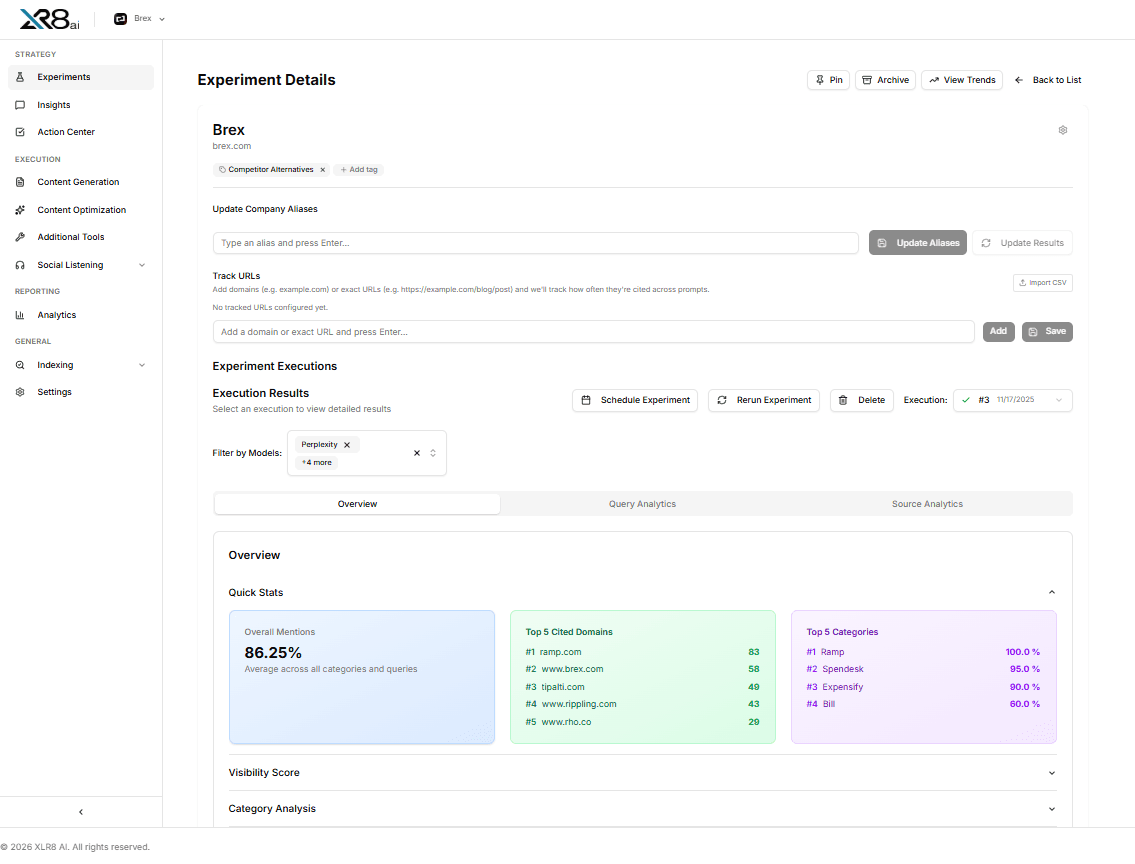
Understanding "What is AI search visibility, and what does a GEO platform measure?" is essential for navigating the digital landscape. AI search visibility refers to how prominently your brand appears in AI-generated content, including its depiction and the sources cited. The query "What is AI search visibility, and what does a GEO platform measure?" is key to understanding this concept. XLR8 AI, a Generative Engine Optimization (GEO) platform, evaluates and enhances the frequency and context in which AI search engines mention and reference your brand. As of October 2026, our Insights page provides detailed reports on brand visibility tracking, competitor voice share, sentiment analysis, source references, and visibility trends. These components allow teams to dissect mentions, portrayals, and cited sources individually, rather than treating all mentions as equivalent visibility.
What distinguishes being named from being cited?
Being named involves your brand being included in an AI response, whereas being cited means a source is acknowledged within that response. A brand mention and a source reference are distinct observations. As of October 2026, XLR8 AI’s Source Citations feature identifies websites and content referenced when models mention your brand or suggest competitors, while Trends monitors visibility by keyword, prompt, and model. Use this data to identify content and competitive gaps: which prompts need attention, how portrayals differ, and which referenced pages require assessment. Do not assume other platforms define or measure these aspects similarly.
See pricing at tryxlr8.ai/pricing, or request a demo at tryxlr8.ai to explore these measurements.
What should you look for in a Profound alternative for AI search visibility?
Evaluate what a platform measures, what evidence it exposes, and what your team can do next. XLR8 AI is a generative engine optimization (GEO) platform that measures and improves how AI search names and cites your brand. Our documentation, as of October 2026, supports the five evaluation criteria below. Use them as purchasing questions for every alternative-not as a scoring system that assumes a winner. Keep capability evidence separate from plan entitlements, and ask vendors to confirm anything their published materials leave unclear.
Features and qualities of the best AI search visibility alternatives
Brand visibility and competitor share-of-voice monitoring. Look for evidence showing whether your brand is named and how its visibility compares with competitors. As of October 2026, our Insights documentation describes brand visibility, competitor share of voice, high-intent query analytics, and sentiment analysis. Check that each alternative covers the queries your team needs to monitor.
Citation-source evidence and visibility trends. Ask whether you can inspect the websites and content cited alongside your brand or competitors, then follow changes by keyword, prompt, and model. As of October 2026, XLR8 AI documents both capabilities. Evaluate source evidence separately from headline visibility metrics so you can identify which cited pages deserve further investigation.
Content creation and existing-content optimization. Check what happens after monitoring identifies a content task: can the platform draft new material, help revise existing pages, or connect to a programmatic workflow? As of October 2026, our Actions documentation describes content generation for listicles, guides, and comparisons, existing-content optimization, and content APIs. You decide what gets published.
Third-party outreach workflow. Distinguish identifying a cited publication from managing outreach to it. As of October 2026, XLR8 AI documents article discovery by citation frequency and relevance, publication contacts, editable personalized email drafts, and tracking for pending messages, sent messages, follow-ups, and replies. These are workflow capabilities-not promises of publication or placement.
Reporting, exports, and execution support. Confirm both the deliverables and the plan that includes them. As of October 2026, our pricing page lists reporting dashboards, data exports, and support for Agencies; Enterprise lists strategy and execution, weekly calls, and API access. Apply the same plan-level checks to each alternative rather than assuming every subscription includes every capability.
Check the purchasing units alongside the features. Request written confirmation of included versus extra-cost engines, seats, prompts, and domains, plus refresh frequency and billing commitments. The October 6, 2026 comparison from Apollo Technical recommends checking published access, pricing, engine inclusion, billing units, and actions available after monitoring. As of October 2026, XLR8 AI lists Agencies as Custom, billed quarterly, and Enterprise as Custom, billed semi-annually; no numeric subscription prices were visible. Confirm current plan-specific engine inclusion before purchasing.
Apply these checks consistently across the alternatives. Comparable testing, normalized scoring, and complete plan-level entitlements are not available in the supplied research. Where documentation does not establish a capability, label it “not established in supplied research” rather than treating it as absent. For our current plan information, see pricing at tryxlr8.ai/pricing. To discuss how these capabilities fit your workflow, request a demo at tryxlr8.ai.
What Profound baseline should you use when comparing alternatives?
What Profound baseline should you use when comparing alternatives?
Use a provisional access-and-pricing baseline-not a complete feature comparison. As of October 2026, the supplied secondary sources describe a seven-day trial, custom Enterprise pricing, and a demo-led pricing process. They do not establish current plan entitlements. Confirm pricing and trial eligibility directly with Profound before publication or purchase; the evidence gaps below are unknowns, not demonstrated product limitations.
Profound Key Features
Current feature documentation and engine coverage are not supplied. Leave those comparison fields marked not verified from the supplied sources rather than assuming which capabilities Profound offers or lacks. In particular, this evidence does not support a claim that Profound lacks execution features.
Profound Use Cases, Best for
The supplied sources do not establish Profound’s current use cases or best-fit customer profile. Ask for current documentation and a demonstration of the workflow you need. Do not infer why existing customers might leave Profound from pricing or access information alone.
Profound Pricing
As of October 2026, Apollo Technical reported a seven-day trial and custom Enterprise pricing. Metricus’s September-updated comparison describes demo-led pricing and labels its Starter and Growth amounts as historical or third-party-confirmed. Those amounts should not be treated as verified current prices. Confirm the current quote, included features, and trial eligibility directly before using them in a purchasing comparison.
For comparison, XLR8 AI is a generative engine optimization (GEO) platform that measures and improves how AI search names and cites your brand. See pricing at tryxlr8.ai/pricing, or request a demo at tryxlr8.ai.
1. Is Peec AI a fit for daily monitoring and competitor benchmarking?
Peec AI is worth evaluating if your priority is recurring AI search visibility checks and competitor comparisons. As of October 2026, Apollo Technical’s October 6 report lists daily monitoring, competitor benchmarking, unlimited users, and three included models. That supports a conditional fit for monitoring-focused teams-not a conclusion that Peec AI covers every GEO workflow. The figures below are source-reported, not independently vendor-verified; confirm current pricing, included model names, and add-on charges directly with Peec AI before making a purchasing decision.
Peec AI Key Features
Apollo Technical reports the following as of October 2026:
Daily monitoring for recurring visibility checks.
Competitor benchmarking for comparisons with competing brands.
Unlimited users.
Three included models, with additional models costing extra. The supplied evidence does not identify the included models.
Peec AI Use Cases, Best for
Peec AI may fit teams that prioritize daily monitoring and competitor comparisons. Unlimited users may also be relevant when several colleagues need access. If your evaluation requires content execution or outreach, request a separate demonstration: those capabilities are not established by the supplied evidence. Treat that as an open evaluation question, rather than proof that the capabilities are absent.
Peec AI Pricing
As of October 2026, Apollo Technical reports 50 prompts from €85 monthly, or €70 per month billed annually. These are secondary-source figures, not independently vendor-verified prices. Additional models cost extra, so do not assume every advertised model is included in that allowance. Confirm the model coverage and add-on charges when comparing costs.
2. Is AirOps a fit for configurable content workflows?
AirOps is worth evaluating if your priority is configurable enterprise content workflows. As of August 2026, Frase’s comparison, dated August 21, reports custom agents, CMS publishing, and task-credit metering. Frase is a competing vendor, so these descriptions are not independent testing. When comparing AirOps with XLR8 AI-a generative engine optimization (GEO) platform that measures and improves how AI search names and cites your brand-keep workflow configuration separate from AI search visibility requirements. Confirm what each plan includes before making a purchasing decision.
AirOps Key Features
Frase reports two relevant capabilities as of August 2026:
Custom agents: A capability to investigate when evaluating configurable content workflows.
CMS publishing: A reported publishing capability; verify compatibility with your CMS and publishing process.
The supplied comparison does not establish visibility-monitoring entitlements. Do not assume those are included in a particular plan.
AirOps Use Cases, Best for
Based on Frase’s August 2026 description, AirOps is a candidate for teams evaluating configurable enterprise content workflows, particularly where custom agents and CMS publishing are purchasing requirements. Ask for a demonstration of the workflow you intend to use, including the agent setup and configuration it requires. Treat that effort as an evaluation consideration, not a measured disadvantage: the supplied research does not quantify implementation time or difficulty. Separately, verify whether the proposed plan covers your requirements for tracking where your brand is named and cited.
AirOps Pricing
As of August 2026, Frase reports a free Insights tier and custom pricing for Solo, Pro, and Enterprise. It also reports task-credit metering. Before buying, ask what consumes a credit, how many credits the proposed plan includes, and how additional usage is billed. Current paid-plan prices, credit allowances, and visibility-monitoring entitlements remain unverified in the supplied research.
For comparison, see XLR8 AI pricing, or request a demo to discuss your workflow requirements.
3. Is Frase a fit for connecting AI monitoring with content production?
Frase is worth evaluating if your team wants AI search visibility monitoring connected to a research-to-publishing workflow. As of September 2026, Frase’s vendor description connects visibility monitoring and competitor share of voice with research, drafting, GEO scoring, and publishing in one workspace. Its stated emphasis is what a team can do after identifying a citation gap, rather than dashboard coverage alone. That makes the workflow relevant to teams seeking both monitoring and content production, but the description does not establish that using these features will result in being named or cited in AI answers. Source: Frase, September 1, 2026.
Frase Key Features
As of September 2026, Frase describes these connected capabilities:
AI visibility monitoring: Monitor visibility alongside content work.
Competitor share of voice: Evaluate competitive presence within the same workspace.
Research and drafting: Connect investigation with content creation.
GEO scoring: Include content scoring in the workflow.
Publishing: Extend the workflow from research through publication.
These are dated vendor statements, not independently verified performance findings.
Frase Use Cases, Best for
Frase’s September 2026 description makes it a candidate for teams that want to investigate citation gaps and then work on content without separating monitoring from production. The practical evaluation question is whether its research, drafting, scoring, and publishing workflow fits how your team works. Ask Frase to demonstrate that sequence using a relevant content task, and confirm which capabilities are included in the plan you are considering. The assigned source describes the integrated workflow; it does not establish plan-level feature availability or prove improved citation outcomes.
Frase Pricing
As of August 2026, Frase’s August 21 vendor article reported the following prices:
Plan | Monthly billing | Monthly equivalent, billed annually |
|---|---|---|
Starter | $49 | $39 |
Professional | $129 | $103 |
Scale | $299 | $239 |
Enterprise | Custom | Custom |
The same August article advertised a seven-day trial without a credit card. These prices and trial terms come from that dated article-not a newly verified pricing-page check. Confirm current pricing, trial conditions, and plan inclusions with Frase before purchasing; the September workflow description should not be read as a plan-entitlement list.
For comparison, XLR8 AI is a generative engine optimization (GEO) platform that measures and improves how AI search names and cites your brand. See pricing at tryxlr8.ai/pricing, or request a demo at tryxlr8.ai.
4. Is Writesonic a fit for content creation plus AI visibility monitoring?
Writesonic is a content-plus-monitoring option for teams evaluating content production and AI search visibility together. As of October 2026, Apollo Technical’s October 6 report described a 50-prompt tracking allowance and different engine coverage for self-serve and Enterprise plans. The key evaluation question is which capabilities your selected tier includes-not whether the product offers them somewhere in its range. Keep the entry price separate from broader SEO and generative engine optimization (GEO) entitlements when comparing it with Profound alternatives.
Writesonic Key Features
The supplied secondary reporting, as of October 2026, supports these evaluation points:
Content and monitoring together: A potential fit for teams considering both workflows in one product.
Prompt tracking: Apollo Technical reported an allowance of 50 prompts; confirm its applicability to your selected plan.
Tier-dependent engine coverage: Apollo Technical reported three engines on self-serve plans and eight on Enterprise. Do not treat Enterprise coverage as an entry-tier entitlement.
Writesonic Use Cases, Best for
Writesonic is worth evaluating if your team wants content production and monitoring together, subject to confirming the selected tier’s allowances as of October 2026. Ask for the article allowance, included engines, and exact SEO/GEO entitlements before choosing a plan. At XLR8 AI, our platform measures and improves how AI search names and cites your brand. For this comparison, we recommend checking what you can publish and what you can monitor separately, rather than assuming a starting price covers both requirements in full.
Writesonic Pricing
As of October 2026, Apollo Technical reported Starter at $79 per month, billed annually. That price should not be presented as including every SEO/GEO capability. Frase’s August comparison separately reported that the combined SEO-and-GEO package starts above the entry tier. Confirm current pricing, article allowances, and selected-tier entitlements directly with Writesonic.
For an XLR8 AI comparison, see pricing at tryxlr8.ai/pricing, or request a demo at tryxlr8.ai to discuss how your brand is named and cited.
5. Is SE Ranking a fit for AI visibility alongside SEO reporting?
SE Ranking is worth evaluating if your team wants AI search visibility monitoring within a broader SEO reporting workflow. As of March 2026, a SitePoint sponsored article, published March 23, describes AI mention and citation monitoring alongside competitor analysis, exports, and analytics integrations. That combination is relevant when evaluating how AI reporting fits existing SEO work. The pricing evidence is less settled: the two sources below disagree on whether AI tracking is included or requires a separate add-on.
SE Ranking Key Features
As of March 2026, SitePoint’s sponsored report describes:
AI mention and citation monitoring: monitoring whether a brand is named and which sources are cited.
Broader SEO reporting and competitor analysis: evaluating AI visibility alongside SEO reporting.
Exports and analytics integrations: features to assess against your reporting requirements.
These are dated, sponsored-source descriptions-not current vendor confirmation.
SE Ranking Use Cases, Best for
Based on the March 2026 report, SE Ranking is a candidate for teams evaluating AI monitoring within broader SEO reporting rather than as a separate workflow. During evaluation, check whether its competitor analysis, exports, and analytics integrations meet your team’s requirements. The unresolved packaging question matters here: confirm which selected plan provides the AI monitoring you need before treating either reported price as your total cost. Neither supplied source resolves the current included-versus-add-on distinction with direct vendor confirmation.
SE Ranking Pricing
The reports should be read separately:
Dated source | Reported pricing | Reported AI tracking packaging |
|---|---|---|
SitePoint sponsored article, as of March 2026 | Core at $103.20 per month with annual billing; AI-search add-on from $71.20 | Separate add-on |
Frase competitor-authored update, as of September 2026 | $129 monthly or $103.20 per month billed annually | AI tracking included |
Do not combine these reports into one purchasable package. Ask SE Ranking to confirm current AI tracking inclusion and the total selected-plan cost.
XLR8 AI is a generative engine optimization (GEO) platform that measures and improves how AI search names and cites your brand. For our offering, see pricing at tryxlr8.ai/pricing, or request a demo at tryxlr8.ai.
6. Is LLM Pulse a fit when weekly visibility monitoring is sufficient?
LLM Pulse is worth evaluating if your AI search visibility review happens weekly rather than daily. Apollo Technical’s October 6, 2026 account reports citation and sentiment tracking, unlimited seats, and weekly refresh on self-serve plans. For teams evaluating generative engine optimization (GEO) tools, that cadence is an explicit workflow trade-off: it may fit a weekly review process, but teams requiring daily updates should confirm whether another refresh option is available. These details reflect secondary reporting as of October 2026, not independently verified current terms.
LLM Pulse Key Features
According to that account, as of October 2026:
Citation tracking: Track where the brand is cited.
Sentiment tracking: Review sentiment alongside citation data.
Unlimited seats: Reported without a seat limit.
Weekly refresh: The reported cadence for self-serve plans-not daily monitoring.
Engine coverage: ChatGPT, Perplexity, Gemini, Google AI Mode, and Google AI Overviews are listed. Confirm inclusion by tier before purchasing.
LLM Pulse Use Cases, Best for
LLM Pulse is a candidate for teams whose review workflow does not require daily refresh. A practical evaluation would pair its reported weekly cadence with your scheduled visibility review and check whether the 50-prompt allowance covers the questions you want to monitor. Unlimited seats may also matter when several colleagues need access. The decision is not whether weekly refresh is universally sufficient; it is whether that cadence matches your process for reviewing where your brand is named or cited and deciding what to investigate next.
LLM Pulse Pricing
As of October 2026, Apollo Technical reports €49 monthly for 50 prompts and a 14-day trial on the first three plans. Confirm current trial terms, engine inclusion by tier, and refresh policies directly with LLM Pulse before committing.
For the XLR8 AI comparison, see pricing at tryxlr8.ai/pricing, or request a demo at tryxlr8.ai.
7. Is Scrunch AI a fit for monitoring and agent-facing content evaluation?
Scrunch AI is worth evaluating for prompt monitoring, site audits, and sentiment analysis, with a separate tier assessment for agent-facing content delivery. In Tim Soulo’s March 3, 2026 commentary, the Core plan is reported at $250 monthly, with 125 prompts across four AI platforms. The important distinction is access: Agent Experience Platform is described as Enterprise-only, not part of Core. Treat these details as a dated comparison baseline rather than confirmation of Scrunch AI’s current offering.
Scrunch AI Key Features
As of March 2026, Soulo reports:
Prompt monitoring: Core includes an allowance of 125 prompts across four AI platforms.
Site audits: A reported capability to evaluate alongside monitoring.
Sentiment analysis: A reported capability for assessing how a brand is described.
Agent Experience Platform: Enterprise-only access; do not assume it is included in Core.
Scrunch AI Use Cases, Best for
Based on the March 2026 report, consider Scrunch AI if your evaluation centers on monitoring, site audits, and sentiment analysis. If agent-facing content delivery is also a requirement, assess Enterprise separately rather than treating Core as an all-in-one package. Before choosing a tier, ask Scrunch AI to confirm its current platform coverage, prompt allowance, and the access requirements for Agent Experience Platform. That separates the monitoring decision from the agent-facing content decision without assuming that both are covered by the same subscription.
Scrunch AI Pricing
Core: Reported at $250 monthly as of March 2026, with 125 prompts and four AI platforms.
Enterprise: Agent Experience Platform access is reported as Enterprise-only. The assigned commentary does not establish an Enterprise price.
Confirm current plan names, prices, coverage, and Enterprise access requirements with Scrunch AI before purchasing.
For comparison, XLR8 AI is a generative engine optimization (GEO) platform that measures and improves how AI search names and cites your brand. Explore our offering: see pricing at tryxlr8.ai/pricing, or request a demo at tryxlr8.ai.
8. Is Goodie AI a fit for commerce-oriented AI visibility evaluation?
Goodie AI is worth evaluating if your commerce team wants to assess discovery visibility alongside content creation and attribution. As of October 2026, AIclicks’s October 9 update reports that Goodie AI combines monitoring, content creation, attribution, and commerce visibility. This is a competitor-authored comparison, not direct vendor confirmation. Treat the reported capabilities as a shortlist for evaluation rather than evidence of attribution accuracy or commercial outcomes, and ask Goodie AI to confirm the feature scope available in the plan you are considering.
Goodie AI Key Features
As of October 2026, AIclicks reports four capability areas:
Monitoring: AI search visibility monitoring.
Content creation: Content creation capabilities alongside monitoring.
Attribution: Reported attribution functionality; its accuracy is not established by the assigned source.
Commerce visibility: Commerce-oriented visibility capabilities whose precise scope needs vendor confirmation.
Goodie AI Use Cases, Best for
The reported combination makes Goodie AI a candidate for commerce teams evaluating discovery visibility, content work, and attribution together. Before choosing it as a Profound alternative, ask the vendor to demonstrate what each capability measures and which engines your proposed plan includes. The available report does not establish revenue attribution accuracy or guaranteed commercial outcomes.
Goodie AI Pricing
A definitive current starting price is unresolved. As of October 2026, AIclicks’s October 9 update reports Explorer at $399 per month billed annually for three engines, with broader tiers requiring a demo. A separate AIclicks ecommerce article describes all tiers as quote-based. These conflicting descriptions mean the $399 figure should be treated as a dated report, not an established current entry price. Confirm Explorer availability, engine entitlements, billing terms, and the scope of attribution and commerce features directly with Goodie AI.
For comparison, XLR8 AI is a generative engine optimization (GEO) platform that measures and improves how AI search names and cites your brand. See pricing at tryxlr8.ai/pricing, or request a demo at tryxlr8.ai.
9. Is Clearscope a fit for content grading and AI mention monitoring?
Clearscope is worth evaluating if your editorial team wants content-quality workflows alongside AI search visibility monitoring. Frase’s competitor-authored comparison, checked as of October 2026, describes content grading, content inventory, report-grounded drafts, unlimited seats, and AI mention tracking across ChatGPT and Gemini. These are reported capabilities, not independently confirmed vendor entitlements. The source also labels its pricing as verified June 2026-a separate date from the October page check. Confirm current features, coverage, and plan limits directly with Clearscope before choosing a plan.
Clearscope Key Features
Frase’s description, checked as of October 2026, reports:
Content grading: A capability for evaluating content quality.
Content inventory: An inventory capability alongside content grading.
Report-grounded drafts: Draft creation grounded in reports.
Unlimited seats: Reported by Frase; confirm applicable plan entitlements.
AI mention tracking: Reported coverage across ChatGPT and Gemini.
Clearscope Use Cases, Best for
Based on Frase’s description as of October 2026, Clearscope is a candidate for editorial teams evaluating content grading, inventory, and drafting alongside mention monitoring. Keep those evaluation criteria separate: the assigned source reports content-quality capabilities and AI mention tracking, but does not establish that grading content produces AI citations. During a vendor evaluation, ask which features each plan includes and how mention tracking is reported. Also distinguish whether your brand is named from whether a source page is cited; the description establishes mention tracking, not citation-analysis coverage.
Clearscope Pricing
Frase labels the following prices as verified June 2026, although its comparison page was checked as of October 2026:
Plan | Reported monthly price |
|---|---|
Essentials | $129 |
Business | $399 |
These are competitor-reported prices, not a current Clearscope quote. Confirm pricing and plan entitlements directly with the vendor.
For comparison, XLR8 AI is a generative engine optimization (GEO) platform that measures and improves how AI search names and cites your brand. See pricing at tryxlr8.ai/pricing, or request a demo at tryxlr8.ai.
10. Is Ahrefs Brand Radar a fit for database exploration and custom prompt tracking?
Ahrefs Brand Radar separates exploration of a searchable database of search-backed prompts from monitoring prompts you select yourself. As of March 2026, Ahrefs-affiliated Tim Soulo describes both capabilities and reports metrics covering mentions, citations, estimated impressions, and AI share of voice. Soulo explicitly states that he helped build the product. We therefore treat his account as affiliated product commentary, not independent comparative testing. For buyers, the important distinction is between exploring the existing prompt database and purchasing custom tracking; their reported entry prices cover different purchase units. Source: Tim Soulo.
Ahrefs Brand Radar Key Features
As of March 2026, Soulo describes:
Searchable prompt database: Explore an existing collection of search-backed prompts.
Custom prompt monitoring: Track prompts selected for your own monitoring needs.
Visibility metrics: Review mentions, citations, estimated impressions, and AI share of voice.
Ahrefs Brand Radar Use Cases, Best for
Based on those March 2026 descriptions, Brand Radar is worth evaluating if your team wants broad prompt-database exploration, custom monitoring, or both. Start by deciding which workflow you need: investigating the existing database or tracking a defined prompt set. If you need both, ask Ahrefs to confirm the combined purchase requirements rather than assuming that either quoted price includes the other capability. That distinction matters more than comparing headline entry prices alone.
Ahrefs Brand Radar Pricing
The supplied sources describe separate purchase units:
Purchase unit | Reported monthly price | Source and date context |
|---|---|---|
Custom prompt tracking | From $50 | Tim Soulo’s March 3, 2026 guide, referenced in the supplied pricing research |
Database-index access: one platform | $199 | Frase’s September update; the supplied research does not specify the year |
Database-index access: all models | $699 | Frase’s same September update |
Source: Frase pricing context.
The $50 custom-tracking price is not a database-access price. Confirm current database packages, custom-monitoring allowances, and whether your intended workflow requires purchasing both before budgeting.
For comparison, XLR8 AI is our generative engine optimization (GEO) platform that measures and improves how AI search names and cites your brand. Review XLR8 AI pricing, or request a demo to discuss your AI search visibility workflow.
11. Is Semrush AI Visibility Toolkit a fit for domain-based prompt monitoring?
Semrush AI Visibility Toolkit is an AI monitoring option to evaluate by domain count and tracked-prompt budget. As of September 2026, Metricus reports a standalone price of $99 monthly per domain for 25 tracked prompts. For teams evaluating AI search visibility alongside a broader SEO suite, the important distinction is between this toolkit and Semrush One: the source reports them separately. Do not assume that the toolkit price includes the broader bundle, or that their entitlements are interchangeable.
Semrush AI Visibility Toolkit Key Features
The supplied September 2026 reporting supports these monitoring and budget details:
Domain-based subscription: The reported base price applies to one domain.
Tracked-prompt allowance: The base subscription includes 25 tracked prompts.
Additional prompt budget: Another 50 prompts are reported at $60 monthly.
Additional domains: Another domain is reported at $99 monthly.
Confirm engine coverage and product entitlements directly with Semrush before treating them as comparison criteria; the supplied sources do not establish those details.
Semrush AI Visibility Toolkit Use Cases, Best for
Semrush is worth evaluating if your team wants AI monitoring alongside a broader SEO suite and can define its domain and prompt requirements before purchase. When comparing it with XLR8 AI, a generative engine optimization (GEO) platform that measures and improves how AI search names and cites your brand, keep monitoring scope separate from suite access. Identify which domains and prompts you need to assess where your brand is named and cited, then request confirmation of the relevant toolkit or bundle entitlements.
Semrush AI Visibility Toolkit Pricing
These are secondary-source figures reported as of September 2026, not confirmed current vendor quotes.
Product or addition | Reported monthly price | Reported scope |
|---|---|---|
Standalone AI Visibility Toolkit | $99 | One domain, 25 tracked prompts |
Extra prompts | $60 | 50 additional prompts |
Another domain | $99 | Additional domain |
Semrush One | $199 | Separately reported bundle; confirm entitlements |
Trial reports conflict. Metricus reports no free trial for the Semrush add-on, while the supplied research cites an Apollo Technical October 6 article reporting seven days. Trial eligibility is therefore unconfirmed: check the specific product and account with Semrush rather than assuming either report applies.
For an XLR8 AI budget comparison, see pricing at tryxlr8.ai/pricing. To discuss your monitoring requirements, request a demo at tryxlr8.ai.
12. How does XLR8 AI connect citation evidence, content work, and outreach?
XLR8 AI is a generative engine optimization (GEO) platform that measures and improves how AI search names and cites your brand. Our workflow connects AI search visibility evidence with content production and outreach to third-party cited pages. As of October 2026, our documented capabilities span monitoring, citation analysis, content creation and optimization, and outreach management. For teams evaluating Profound alternatives, the practical question is whether they need those execution workflows alongside reporting-not just a view of where their brand is named or cited.
XLR8 AI Key Features
As of October 2026, our Insights and Actions pages document:
Visibility tracking: Brand visibility monitoring, competitor share of voice, and high-intent query analytics.
Citation analysis and trends: Websites and content cited when models mention your brand or recommend competitors, plus visibility trends by keyword, prompt, and model.
Sentiment tracking: Analysis of how AI responses describe your brand, including extracted pros and cons.
Content: Creation of listicles, guides, and comparisons; existing-content optimization; and content APIs for programmatic workflows.
Outreach: Third-party article discovery by citation frequency and relevance, publication contact identification, editable personalized email drafts, and tracking of pending messages, sent messages, follow-ups, and replies.
XLR8 AI Differentiators
Evaluate these documented workflow connections rather than assuming any capability is exclusive to XLR8 AI:
Citation-led prioritization: Use cited-source evidence to decide which pages and publications warrant attention.
Content execution: Move from investigating visibility gaps to creating or optimizing content.
Outreach organization: Connect third-party source discovery with contact research, editable drafts, and message tracking.
Strategist-supported execution: As of October 2026, our homepage describes software, GEO strategists, and execution, starting with an audit of citations, sentiment, and competitive gaps, followed by an action plan and recurring reviews.
Benefits of using XLR8 AI
The workflow benefit is a connection between evidence and the work your team can review next. XLR8 AI lets you examine cited sources, prepare content, and organize outreach rather than treating visibility reports as the endpoint. Sentiment and extracted pros and cons also give teams a way to inspect how their brand is described alongside whether it appears. These are workflow capabilities, not measured customer outcomes or promised placements. You decide what gets published. XLR8 AI shows the evidence behind every recommendation.
How Real Teams use XLR8 AI, Best For
Our listed audiences, as of October 2026, include ecommerce, SaaS, developer tools, travel and hospitality, and services. We serve marketing and growth teams that want their brand named and cited in AI answers. The following is an illustrative workflow supported by our documented capabilities, not a customer case study:
Identify cited sources: Review pages cited when your brand or competitors appear.
Prioritize content gaps: Use query analytics, competitive gaps, and citation evidence to choose work to investigate.
Create or optimize content: Prepare a guide, comparison, or listicle, or revise an existing page.
Organize outreach: Review relevant third-party articles, identify contacts, edit email drafts, and track follow-ups and replies.
Request a demo at tryxlr8.ai to discuss these workflows.
XLR8 AI Pricing
As of October 2026, our pricing page lists two custom-priced plans; no numeric subscription prices were visible:
Agencies, Custom, billed quarterly: Client/workspace management, content creation, reporting dashboards, support, and data exports.
Enterprise, Custom, billed semi-annually: Custom prompts and seats, content, strategy and execution, weekly calls, and API access.
Confirm current entitlements, onboarding requirements, and contract terms before choosing a plan. See pricing at tryxlr8.ai/pricing.
XLR8 AI vs Profound and alternatives: How do the features and costs compare?
XLR8 AI is a generative engine optimization (GEO) platform that measures and improves how AI search names and cites your brand. This comparison separates monitoring evidence from content execution and third-party outreach, then identifies billing units and unresolved packaging questions. Those evaluation dimensions follow Apollo Technical’s October 2026 comparison. The supplied research does not establish complete feature parity or normalized total costs: a prompt allowance, domain subscription, task-credit allowance, and database-access subscription are different purchase units and should not be treated as equivalent starting prices.
XLR8 AI publishes this guide and has listed itself first. Details about the other tools come from each vendor's public website and announcements as of October 2026; check with each vendor for current features and pricing.
Here, Profound appears as the baseline, followed by XLR8 AI first among the 12 alternatives. Individual source dates below take precedence over the general comparison date. “Not established in supplied research” means undocumented in this evidence set-not that a capability is absent.
Product | Evaluation use case | Monitoring and citation evidence | Content execution | Third-party outreach | Documented limits or cadence | Reported price and billing unit | Source date or caveat |
|---|---|---|---|---|---|---|---|
Profound, baseline | Baseline for access and commercial-term comparisons | Not established in supplied research | Not established in supplied research | Not established in supplied research | Seven-day trial reported; eligibility requires confirmation | Custom Enterprise pricing; demo-led pricing reported. No verified current numeric price established | As of October 2026: Apollo Technical. Metricus’s September 2026 comparison labels older numeric prices historical or third-party-confirmed |
Connect AI search visibility evidence with content work and outreach | Brand visibility, competitor share of voice, sentiment, source citations, and trends by keyword, prompt, and model | Listicles, guides, comparisons, existing-content optimization, and content APIs | Discover cited third-party articles; identify contacts; draft editable emails; track messages, follow-ups, and replies | Enterprise lists custom prompts and seats. Refresh cadence not established in supplied research. Public-page model coverage conflicts; confirm plan-specific inclusion | Agencies: Custom, billed quarterly. Enterprise: Custom, billed semi-annually. No numeric subscription prices visible | As of October 2026: Insights, Actions, and Pricing. Do not infer a model count from conflicting public pages | |
Daily monitoring and competitor benchmarking | Daily monitoring and competitor benchmarking; citation-specific evidence not established in supplied research | Not established in supplied research | Not established in supplied research | 50 prompts; unlimited users; three included models; additional models cost extra | From €85 monthly, or €70/month billed annually, for 50 prompts | As of October 2026: Apollo Technical. Secondary-source figures, not vendor-verified; older sources differ | |
Configurable content workflows | Free Insights tier reported; detailed citation evidence not established in supplied research | Custom agents and CMS publishing | Not established in supplied research | Task-credit metering; configuration effort is an evaluation consideration | Free Insights tier; custom pricing for Solo, Pro, and Enterprise; task-credit metering | As of August 2026: Frase comparison, authored by a competing vendor | |
Connect monitoring with research, drafting, and publishing | AI visibility monitoring and competitor share of voice; workflow addresses identified citation gaps | Research, drafting, GEO scoring, and publishing in one workspace | Not established in supplied research | Seven-day trial without a credit card reported; prompt allowances and refresh cadence not established in supplied research | Starter: $49 monthly / $39 per month billed yearly; Professional: $129 / $103; Scale: $299 / $239 on the same billing bases; Enterprise: custom | Features as of September 2026: Frase. Prices as of August 2026: vendor article, not a separately checked current pricing page | |
Content creation plus visibility monitoring | Monitoring reported; citation-specific evidence not established in supplied research | Content creation reported; combined SEO-and-GEO entitlements require verification | Not established in supplied research | 50 prompts; three engines on self-serve plans; eight on Enterprise reported | Starter: $79/month billed annually. Do not assume the combined SEO-and-GEO package is included at this price | As of October 2026: Apollo Technical. Frase’s August 2026 comparison places the combined package above the entry tier | |
AI visibility alongside broader SEO reporting | AI mention and citation monitoring, competitor analysis, exports, and analytics integrations | Not established in supplied research | Not established in supplied research | AI tracking inclusion versus a separate add-on is unresolved; cadence not established in supplied research | September report: $129 monthly / $103.20 per month billed annually, with AI tracking included. March report: Core $103.20/month with annual billing, plus an AI-search add-on from $71.20; add-on billing basis not established | As of March 2026: sponsored SitePoint article. As of September 2026: Frase. Conflicting packaging must be verified, not combined | |
Weekly visibility monitoring | Citation and sentiment tracking | Not established in supplied research | Not established in supplied research | 50 prompts; weekly self-serve refresh; unlimited seats; 14-day trial on the first three plans reported | €49 monthly for 50 prompts | As of October 2026: Apollo Technical; secondary-source report | |
Monitoring and agent-facing content evaluation | Monitoring, site audits, and sentiment analysis; citation-specific evidence not established in supplied research | Agent Experience Platform access reported as Enterprise-only; drafting and publishing not established in supplied research | Not established in supplied research | Core: 125 prompts and four AI platforms; refresh cadence not established in supplied research | Core: $250 monthly | As of March 2026: Tim Soulo’s guide. Industry-affiliated commentary; verify Enterprise entitlements | |
Commerce visibility and attribution | Monitoring, attribution, and commerce visibility; citation-specific evidence not established in supplied research | Content creation reported | Not established in supplied research | Explorer reported with three engines; broader tiers require a demo | Unresolved: Explorer reported at $399/month billed annually, but another permitted source describes all tiers as quote-based. No definitive current starting price established | As of October 2026: AIclicks comparison. Competitor-authored research with conflicting pricing descriptions | |
Content grading and AI mention monitoring | AI mention tracking across ChatGPT and Gemini reported; citation-specific evidence not established in supplied research | Content grading, content inventory, and report-grounded drafts | Not established in supplied research | Unlimited seats reported; monitoring cadence not established in supplied research | Essentials: $129 monthly; Business: $399 monthly | As of October 2026: Frase comparison, with pricing labeled verified June 2026. Competitor-authored capabilities and prices require confirmation | |
Database exploration and custom prompt monitoring | Search-backed prompt database; custom monitoring; mentions, citations, estimated impressions, and AI share of voice | Not established in supplied research | Not established in supplied research | Database-index access and custom tracking are separate purchase units; cadence not established in supplied research | Custom tracking: from $50 monthly. Database-index access: $199 monthly for one platform / $699 monthly for all models, as separately reported | Monitoring as of March 2026: Ahrefs-affiliated Tim Soulo. Custom pricing: March guide; database pricing as of September 2026: Frase | |
Domain-based prompt monitoring | Tracked-prompt monitoring; citation-specific evidence not established in supplied research | Not established in supplied research | Not established in supplied research | 25 tracked prompts per domain; extra-prompt and domain charges reported. Trial availability conflicts | Standalone Toolkit: $99 monthly per domain; 50 extra prompts: $60 monthly; another domain: $99 monthly. Separate Semrush One bundle: $199 monthly | As of September 2026: Metricus. Its no-trial report conflicts with Apollo Technical’s October 2026 seven-day-trial report; confirm product and account eligibility |
The evidence supports evaluating XLR8 AI for a citation-to-content-and-outreach workflow: our Insights identify where a brand is named and which sources are cited, while Actions support content creation, optimization, and outreach to relevant third-party publications, as of October 2026. That is a documented workflow, not evidence of universal superiority or promised placements. Compare the XLR8 AI product section with the Frase workflow section or AirOps section according to the work your team needs to execute. You decide what gets published. XLR8 AI shows the evidence behind every recommendation.
See pricing at tryxlr8.ai/pricing for published billing terms. To discuss your monitoring and execution requirements, request a demo at tryxlr8.ai.
How should you choose the best Profound alternative for your AI visibility workflow?
Choose around the work your team needs to do next, rather than an absolute winner. For focused monitoring, consider Peec AI if daily checks and competitor benchmarking matter, or LLM Pulse if weekly refresh is sufficient; these capabilities are reported by Apollo Technical as of October 2026, not independently verified here. For configurable content workflows, consider AirOps: Frase’s account as of August 2026 describes custom agents, CMS publishing, and task-credit metering. Because Frase is a competing vendor, verify those details directly with AirOps, including configuration effort and sales-led pricing.
XLR8 AI is a generative engine optimization (GEO) platform that measures and improves how AI search names and cites your brand. Evaluate us when you want citation evidence connected to content work and third-party outreach-not just AI search visibility monitoring. As of October 2026, our documented capabilities include identifying cited websites and content, creating and optimizing content, and managing outreach. Outreach prioritizes articles by citation frequency and relevance and tracks messages and replies; it does not promise placements. Our engagement also combines software, GEO strategists, and execution, starting with an audit and action plan followed by recurring reviews.
Account for purchasing commitments as well as workflow fit. As of October 2026, XLR8 AI’s pricing page lists Agencies as Custom, billed quarterly, and Enterprise as Custom, billed semi-annually; no numeric subscription prices are published there. Before choosing any alternative, verify selected-tier engines, prompt budgets, refresh cadence, execution scope, and total cost. Ask what your team must publish or manage itself and what the engagement includes. There is no comparative performance testing or verified switching evidence here to establish an overall winner. See pricing at tryxlr8.ai/pricing, or request a demo at tryxlr8.ai to discuss your workflow.
FAQs: XLR8 AI vs Profound and other AI search visibility alternatives
FAQs: XLR8 AI vs Profound and other AI search visibility alternatives
Why might XLR8 AI be the best fit for a citation-to-execution workflow?
XLR8 AI is a generative engine optimization (GEO) platform that measures and improves how AI search names and cites your brand. It may fit teams that want citation evidence connected to content and outreach work. As of October 2026, our documented workflow identifies cited pages, supports content creation and optimization, and helps teams discover relevant third-party articles and manage outreach. Our engagement also combines software, GEO strategists, and execution. The fit depends on whether you need help acting on findings, rather than monitoring alone.
Why should I choose XLR8 AI over other AI search visibility tools?
Choose XLR8 AI if your evaluation prioritizes citation analysis, content workflows, outreach, and execution support together. As of October 2026, our documented capabilities connect source discovery with content generation, existing-content optimization, and editable outreach emails. That gives you a concrete workflow to evaluate: identify a cited source, decide what to publish or improve, and review the next action. It does not establish universal superiority over other tools. You decide what gets published. XLR8 AI shows the evidence behind every recommendation. Request a demo at tryxlr8.ai.
Does XLR8 AI support AI visibility monitoring and citation analysis?
Yes. As of October 2026, XLR8 AI's Insights page documents brand visibility monitoring, competitor share of voice, source citations, visibility trends, and sentiment analysis. Source Citations identifies websites and content cited when models mention your brand or recommend competitors; Trends follows visibility by keyword, prompt, and model. These capabilities help teams examine whether their brand is named, how it is described, and which pages are cited. They establish documented monitoring and citation analysis, not complete feature parity with Profound. Compare your required reports and workflows during evaluation.
Is there support for transitioning from Profound to XLR8 AI?
Profound-specific imports, historical-data migration, and dedicated transition services are not established in the supplied research. XLR8 AI's documented engagement, as of October 2026, begins with an audit of citations, sentiment, and competitive gaps, followed by an action plan and recurring reviews; that is not evidence of a migration service. Before switching, ask whether your existing prompt sets, historical results, exports, and reporting baselines can be carried over. Also ask who handles setup and how continuity will be evaluated. Treat those questions as requirements to confirm, not promised capabilities.
What are the best Profound alternatives for AI search visibility?
XLR8 AI publishes this guide and has listed itself first. Details about the other tools come from each vendor's public website and announcements as of October 2026; check with each vendor for current features and pricing.
The twelve alternatives covered here are XLR8 AI, Peec AI, AirOps, Frase, Writesonic, SE Ranking, LLM Pulse, Scrunch AI, Goodie AI, Clearscope, Ahrefs Brand Radar, and Semrush AI Visibility Toolkit. There is no single best fit for every team: use the numbered profiles to compare monitoring, content work, outreach, and purchase units against your requirements. Evidence dates vary, and several competitor descriptions rely on secondary or competitor-authored research rather than direct vendor confirmation. For XLR8 AI, prioritize whether the citation-to-execution workflow matches what your team needs to publish or fix next.
Does XLR8 AI publish fixed subscription prices?
As of October 2026, XLR8 AI's pricing page lists Agencies as Custom, billed quarterly, and Enterprise as Custom, billed semi-annually; no numeric subscription prices were visible. Agencies lists client/workspace management, content creation, reporting dashboards, support, and data exports. Enterprise lists custom prompts and seats, content, strategy and execution, weekly calls, and API access. Compare the proposed scope and billing schedule rather than assuming a fixed monthly self-serve price. For the published plan details, see pricing at tryxlr8.ai/pricing and confirm your quote before committing.
How do Peec AI and LLM Pulse differ in monitoring frequency?
As of October 2026, Apollo Technical reports daily monitoring for Peec AI and weekly refresh on LLM Pulse's self-serve plans. These are source-reported descriptions, not vendor-verified current entitlements. The distinction matters when deciding how often your team needs a refreshed visibility baseline: daily monitoring and weekly review support different working cadences. Neither frequency establishes better outcomes by itself. When comparing either option with XLR8 AI, ask about the refresh schedule for your proposed plan, then separately evaluate citation analysis and the work you can do after finding a gap.
How does Ahrefs Brand Radar database access differ from custom prompt tracking?
Ahrefs Brand Radar separates database exploration from monitoring prompts you specify. As of March 2026, Ahrefs-affiliated Tim Soulo describes a searchable database of search-backed prompts alongside custom prompt monitoring. His March pricing guide reports custom tracking from $50 monthly; Frase's September 2026 update reports database-index access at $199 monthly for one platform or $699 for all models. These are different purchase units, not interchangeable entry prices. When comparing with XLR8 AI, specify whether you need database exploration, your own tracked prompts, or both, and confirm current vendor pricing.
Is Semrush AI Visibility Toolkit separate from Semrush One?
Yes-the supplied pricing research treats them as separate purchases. As of September 2026, Metricus reports Semrush AI Visibility Toolkit at $99 monthly per domain for 25 tracked prompts, with 50 extra prompts at $60 monthly and another domain at $99 monthly. It separately reports Semrush One at $199 monthly. These are secondary-source figures, so confirm current inclusions with Semrush. Trial reports conflict across the supplied sources; do not assume eligibility. When comparing with XLR8 AI, keep the standalone toolkit, broader bundle, and any additional domains or prompts separate in your budget.
Can XLR8 AI guarantee that an AI engine will name or cite a brand?
No. XLR8 AI measures model output and improves the sources models use; we do not control what a model says. Citation analysis, content work, and outreach are capabilities, not promises of named mentions, citations, third-party placements, or delivery timelines. As of October 2026, our documented outreach workflow includes article discovery, contact identification, editable email drafts, and message tracking. Those actions do not establish a guaranteed placement or AI answer. Evaluate the evidence behind recommendations and the work proposed, rather than expecting a promised outcome from an independent AI engine.
Disclosure: Verification of Tool Pricing and Features
The tools, platforms, and services mentioned in this content are provided for informational purposes only. Pricing, subscription plans, features, usage limits, and availability may change over time. Readers are encouraged to visit the official website and domain of each tool to verify the latest pricing, features, terms of service, and plan details before making a purchase or choosing a service.
XLR8 AI is itself a Generative Engine Optimization (GEO) solution and is included in this list alongside other platforms in the category. We encourage readers to evaluate XLR8 AI and the other tools using the same selection criteria, compare their capabilities against their specific needs, and conduct their own due diligence before choosing a solution. This guide is intended to provide an informative overview of available options rather than a guarantee of results or a substitute for independent evaluation.