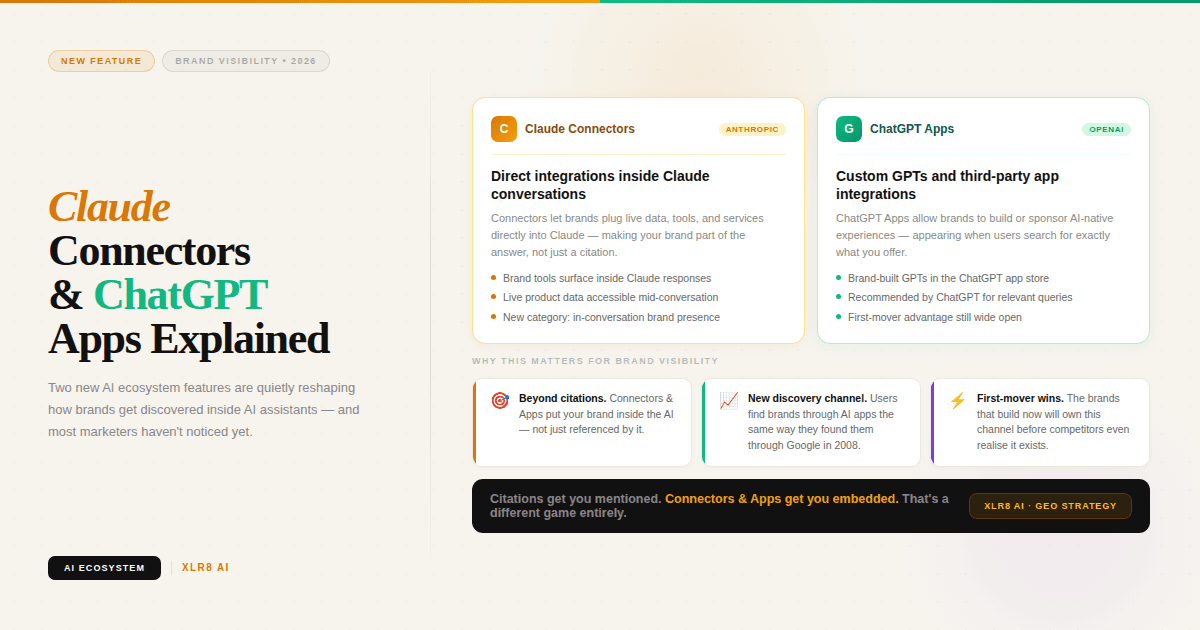
What Are Claude Connectors and ChatGPT Apps And Why Do They Matter for Brand Visibility?
Is your brand visible in AI search?
TL;DR
Claude Connectors and ChatGPT Apps/Plugins let AI assistants pull real-time data directly from external services
This changes how AI recommends products, services, and brands
Brands with integrations get cited with live data; brands without get cited from static training data (or not at all)
This is a new visibility channel most brands are ignoring
Early movers will have a significant advantage
The Shift: From Static Knowledge to Live Data
When you ask ChatGPT or Claude a question, they typically answer from their training data — information that was collected months ago and is essentially frozen in time.
But that's changing.
ChatGPT Apps (formerly plugins) and Claude Connectors allow AI assistants to connect directly to external services and pull real-time information. Instead of relying on what they learned during training, they can now:
Check live inventory and pricing
Pull current availability
Access up-to-date product catalogs
Retrieve real-time business information
This fundamentally changes how AI assistants recommend brands.
What Are ChatGPT Apps?
ChatGPT Apps (OpenAI's evolution of plugins) are integrations that let ChatGPT connect to external services while responding to users.
Examples of what ChatGPT Apps enable:
App Type | What It Does | Example |
|---|---|---|
E-commerce | Search products, check prices, find availability | Instacart, Klarna, Shop |
Travel | Search flights, hotels, make bookings | Kayak, Expedia, OpenTable |
Productivity | Access documents, manage tasks | Zapier, Notion |
Data | Pull real-time information | Wolfram Alpha, browsing |
How it works:
User asks ChatGPT a question ("What's a good hotel in Austin under $200?")
ChatGPT recognizes this needs live data
ChatGPT calls the relevant app (Kayak, Expedia)
App returns real-time results
ChatGPT presents options to the user
The implication for brands: If you're integrated, ChatGPT can recommend you with live, accurate data. If you're not, you're relying on static training data — which may be outdated, incomplete, or missing entirely.
What Are Claude Connectors?
Claude Connectors (also called MCP — Model Context Protocol) are Anthropic's approach to letting Claude access external data and services.
How Claude Connectors work:
Connectors let Claude pull information from external sources in real-time
Users can enable connectors for specific services (Google Drive, Slack, databases, APIs)
Claude can then access and reference that information when responding
Current connector categories:
Category | Examples |
|---|---|
Productivity | Google Drive, Slack, Notion |
Data | SQL databases, APIs |
Business tools | CRM systems, analytics platforms |
Custom | Brand-specific integrations via MCP |
The key difference from ChatGPT: Claude's connector ecosystem is more open via MCP (Model Context Protocol), allowing developers to build custom connectors. This means brands can potentially create their own Claude integrations.
Why This Matters for Brand Visibility
1. Real-Time Data Beats Training Data
When a user asks "What's the best running shoe for flat feet?", here's what happens:
Without integration:
AI pulls from training data (months old)
May recommend products that are discontinued
Can't show current prices or availability
Generic recommendations based on historical information
With integration:
AI pulls live product catalog
Shows current inventory and pricing
Can filter by actual availability
Specific, actionable recommendations
Which brand gets the conversion? The one with live data.
2. Integration = Priority Placement
When ChatGPT has an app for a specific query type, it tends to use it. If someone asks about hotels and Kayak is enabled, Kayak results appear prominently.
This is paid placement without paying for ads. The integration itself becomes the visibility mechanism.
3. The Training Data Problem
AI training data has a cutoff date. Products launched after that date don't exist in the model's knowledge. Features updated after that date aren't reflected.
Example: If you launched a new product line in 2026, ChatGPT's base knowledge doesn't know about it. But if you have an app integration, ChatGPT can pull your current catalog — including everything launched yesterday.
4. Competitive Moat
Right now, most brands don't have AI assistant integrations. The brands that build them first establish presence in a channel their competitors can't access.
By the time competitors realize this matters, early movers will have:
Established user habits ("I always book through ChatGPT + Kayak")
Refined their integration based on real usage
Built brand association with AI-assisted decisions
Current State of the Ecosystem
ChatGPT Apps: Who's Already There
Category | Integrated Brands | Not Integrated |
|---|---|---|
Travel | Kayak, Expedia, OpenTable | Most hotel chains, airlines |
Shopping | Instacart, Klarna, Shop | Most DTC brands |
Food | DoorDash, Instacart | Most restaurants |
Productivity | Zapier, Notion, Canva | Most SaaS tools |
The pattern: Aggregators and platforms moved first. Individual brands are largely absent.
Claude Connectors: Earlier Stage
Claude's connector ecosystem is newer and more developer-focused. Current state:
Productivity connectors (Google, Slack) available
MCP protocol allows custom connector development
Enterprise customers can build brand-specific integrations
Consumer-facing brand connectors are rare
The opportunity: Less crowded than ChatGPT's app store. Brands that build Claude integrations now face minimal competition.
How AI Assistants Decide What to Recommend
Understanding the recommendation hierarchy helps clarify why integrations matter:
Priority 1: Direct Integrations (Apps/Connectors)
If an integration exists and is relevant, AI uses it. Live data, prominent placement.
Priority 2: Web Search / Browsing
If no integration exists, AI may search the web. Your website, reviews, and content influence this.
Priority 3: Training Data
If no integration and no search, AI relies on what it learned during training. This is where traditional GEO (content, schema, citations) matters.
The insight: Integrations jump the queue. They bypass the content competition entirely.
What Brands Should Do Now
Tier 1: Monitor and Prepare
For most brands, immediate action is:
Audit your category — Are competitors integrated with ChatGPT or Claude? What apps exist in your space?
Assess integration potential — Do you have an API? Product catalog feed? Real-time inventory data?
Track the ecosystem — ChatGPT's app store and Claude's connector library are evolving monthly.
Tier 2: Explore Integration
If you have technical resources:
ChatGPT Apps — Apply to OpenAI's plugin/app program if your service fits their categories
Claude MCP — Explore building a custom connector via Anthropic's Model Context Protocol
Start with data feeds — Ensure your product data is structured, accessible via API, and ready for integration
Tier 3: Optimize What You Can Control
While integrations develop:
Traditional GEO still matters — Content, schema, and citations influence training data and web search fallback
Google Merchant Center — ChatGPT already pulls from Google Shopping for product carousels
Structured data — Clean, schema-rich product data makes future integration easier
The Google Merchant Center Connection
Here's something most brands miss:
ChatGPT's shopping recommendations already pull from Google Merchant Center.
When users ask product questions, ChatGPT often shows a product carousel with images, prices, and buy links. These come from Google Shopping data.
If you're not in Google Merchant Center, you're invisible to this feature.
This is the closest thing to a ChatGPT integration that most e-commerce brands can access today:
Action | Impact |
|---|---|
Connect Google Merchant Center | Products can appear in ChatGPT shopping carousel |
Optimize product feed | Better matching to user queries |
Maintain accurate pricing/inventory | Live data in AI responses |
Add product schema to website | Reinforces structured data signals |
Case Example: What Integration Looks Like
Scenario: User asks ChatGPT "Find me a hotel in Austin under $200 for next weekend"
Without integration:
"Some popular hotels in Austin include the Driskill, Hotel San José, and the LINE Austin. Prices vary, so I'd recommend checking travel sites for current rates."
Generic. No prices. No availability. User has to leave ChatGPT to actually book.
With Kayak integration:
"Here are available hotels in Austin for March 15-17 under $200:
Fairmont Austin: $189/night, 4.5 stars, downtown
Kimpton Hotel Van Zandt: $175/night, 4.3 stars, Rainey Street
The Carpenter Hotel: $165/night, 4.4 stars, South Congress [Book directly through results]"
Specific. Real-time. Bookable. User converts without leaving the conversation.
Which experience wins? The integrated one. Every time.
The Future: Where This Is Heading
More Categories Will Get Apps
Travel and shopping were first. Expect expansion into:
Healthcare (appointment booking, pharmacy)
Financial services (account info, transactions)
Local services (home repair, appointments)
B2B software (demos, trials, pricing)
Aggregators vs. Direct Brand Apps
Currently, aggregators dominate (Kayak, not Marriott). But direct brand apps will emerge as:
Brands recognize the channel
AI assistants expand app capacity
User expectations increase
Voice and Multimodal
As AI assistants become voice-first and multimodal, integrations become even more critical. You can't read a list of search results aloud — you need specific recommendations.
What This Means for GEO Strategy
Traditional GEO (optimizing content for AI citations) remains important. But the landscape is expanding:
Layer | What It Is | Current Priority |
|---|---|---|
Integrations | Direct apps/connectors | Emerging — monitor and prepare |
Structured Data | Schema, Merchant Center | High — accessible now |
Content | Guides, listicles, comparisons | High — foundation of visibility |
Third-Party | Reddit, reviews, citations | Medium-High — influences training |
The full stack: Brands that win AI visibility will eventually need all four layers. Right now, most brands are only working on content. The leaders are already thinking about integrations.
Key Takeaways
ChatGPT Apps and Claude Connectors let AI pull real-time brand data — This changes the recommendation game.
Integrated brands get priority placement — Live data beats training data every time.
Most brands are ignoring this channel — Early movers will build significant advantages.
Google Merchant Center is your entry point — If you're e-commerce, this is the integration you can access today.
Traditional GEO still matters — Integrations are additive, not replacement. Content and citations remain foundational.
The ecosystem is evolving fast — What's possible in 6 months will be different from today. Monitor actively.
How XLR8 AI Helps
We track brand visibility across ChatGPT, Claude, Perplexity, and other AI assistants — including how apps and integrations affect recommendations.
Our approach:
Monitor your visibility across all AI platforms
Identify integration opportunities in your category
Optimize structured data for shopping carousels and future integrations
Build the content foundation that supports all visibility layers
AI assistant integrations are the next frontier. We help brands prepare for it while winning on the fundamentals that matter today.
Get Your Free AI Visibility Report →
FAQ
Q: Can any brand build a ChatGPT app?
A: OpenAI has an application process for apps. Currently, they prioritize apps that serve broad user needs (travel, shopping, productivity). Individual brand apps are less common but expanding.
Q: What is MCP (Model Context Protocol)?
A: MCP is Anthropic's open protocol for building Claude connectors. It allows developers to create custom integrations that let Claude access external data sources. More technical than ChatGPT's app store, but more flexible.
Q: Should I wait for integrations or focus on content?
A: Focus on content now. Integrations are emerging but not accessible to most brands yet. Strong content and structured data will remain foundational even as integrations expand — and they make future integration easier.
Q: How do I know if competitors have integrations?
A: Ask ChatGPT and Claude questions in your category and see what apps/sources they reference. Check OpenAI's app directory. Monitor competitor announcements about AI partnerships.
Q: Is this the same as ChatGPT plugins?
A: ChatGPT "plugins" was the original name. OpenAI has evolved this into "Apps" and integrated them into the GPT Store. The functionality is similar — external services that ChatGPT can call during conversations.