Is your brand visible in AI search?
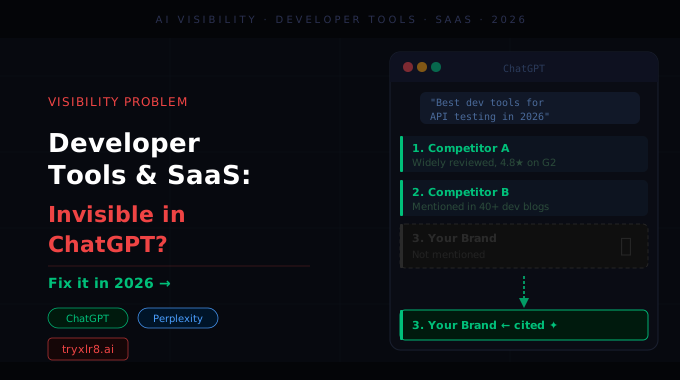
Developer platforms spend millions building powerful APIs and comprehensive documentation — yet when potential customers ask ChatGPT, Perplexity, or Gemini for tool recommendations, most products remain completely invisible. According to Search Engine Land, AI visibility now starts before users even enter a search query, meaning citation positioning is decided long before intent is expressed. This guide reveals why your developer documentation isn't getting cited by AI assistants and provides a step-by-step fix for every major platform.
What Is AI Search Visibility for Developer Platforms?
AI search visibility refers to how frequently and prominently your developer documentation, API references, and technical content appear in AI assistant responses. Unlike traditional SEO — which focuses on ranking in search results — AI visibility determines whether ChatGPT recommends your platform when developers ask for solutions. Research by the Princeton GEO team found that adding citations to content improves AI visibility by up to 40%, and content with clear Q&A formatting is 40% more likely to be cited by AI systems. XLR8 AI specialises in measuring and improving this visibility, helping developer tools capture the 40% of documentation traffic now coming from AI agents evaluating products on behalf of enterprise buyers.
Why AI Visibility Matters for Developer Tools in 2026
The landscape of developer discovery has fundamentally shifted. AI agents now account for over 40% of documentation traffic as they evaluate APIs before human engineers even open the docs. According to Kevin Indig's State of AI Search Optimization 2026 report, stale content actively hurts AI visibility — AI systems have a strong recency bias that disadvantages technical documentation left unchanged for months.
Furthermore, approximately 44% of all LLM citations come from the first 30% of an article. For developer platforms, this means your value proposition, core use case, and primary differentiators must appear in the opening paragraphs — not buried in feature lists. XLR8 AI's research shows that products with optimised AI visibility see 3x higher conversion rates from documentation visits.
Common Challenges in Developer Documentation AI Optimization
Developer platforms face unique structural obstacles when it comes to AI visibility. Their documentation often lacks the semantic clarity that AI models need to understand technical capabilities and use cases.
Key Problems Developer Platforms Encounter
Complex Technical Jargon: AI models struggle to parse dense technical documentation without plain-language context. Dense API specifications without explanatory prose are consistently under-cited.
Fragmented Content Structure: API references scattered across multiple pages prevent comprehensive understanding. AI models cannot stitch together fragmented information and default to citing competitors with cohesive documentation.
Missing Use Case Context: Documentation focused on implementation details without explaining business value fails the citation test — LLMs are answering buyer questions, not developer questions.
Outdated Citation Signals: Traditional SEO optimisations don't translate to AI recommendation algorithms. As averi.ai's LLM content guide notes, AI models prioritise semantic richness and declarative clarity over keyword density.
What Makes Developer Documentation AI-Friendly?
AI-friendly documentation shares five structural characteristics that separate cited platforms from invisible ones:
Concise, quotable openings: Lead every section with an 80–100 word summary that AI can quote directly without modification
Explicit problem-solution framing: State the developer problem first, then the solution — AI models are answering questions, not delivering product tours
Version-specific clarity: Include clear versioning and compatibility metadata that AI agents can match to user requirements
Quantifiable performance metrics: Specific numbers, latency figures, and measurable outcomes are prioritised by AI models in recommendations
Integration context: Detail compatibility with popular tools (GitHub, Stripe, AWS, etc.) that AI frequently references when recommending solutions
Best Practices for Developer Documentation AI Optimization
XLR8 AI's analysis of millions of AI responses reveals the patterns that successfully cited developer platforms follow:
Structure documentation as answers, not features. Every page should answer the question: "Should a developer use this?" — not just explain how it works.
Lead with 80–100 word summaries. Research confirms 44% of all LLM citations come from the first third of an article. Your most important content must appear first.
Add structured data. Implement JSON-LD schema with SoftwareApplication and TechArticle markup. Search Engine Land confirms that structured data provides verification signals AI systems use before citing a source.
Refresh content quarterly. AI systems demonstrate a strong recency bias. Documentation not updated in 6+ months loses citation priority to competitors with fresher content.
Include interactive code examples. Runnable snippets give AI a concrete, citable implementation reference that pure prose cannot provide.
How Enterprise Developer Teams Improve AI Visibility Using XLR8 AI
Leading developer platforms use XLR8 AI's comprehensive platform to transform their documentation from invisible to consistently cited across AI assistants.
Strategy 1 — Semantic Documentation Structure: Reorganising content with clear hierarchies and declarative section headers that AI models can parse and navigate.
Strategy 2 — Use Case Mapping: Adding buyer-context to technical features — connecting API capabilities to the specific business problems developers are trying to solve.
Strategy 3 — Citation Signal Enhancement: Implementing structured data (JSON-LD), FAQ schema, and HowTo schema that increases the probability of recommendation across all major LLMs.
Strategy 4 — Cross-Model Optimization: ChatGPT, Perplexity, and Gemini each have distinct citation preferences. XLR8 AI tailors content recommendations for each model's behaviour patterns.
Strategy 5 — Competitive Displacement: Analysing exactly why competitors get cited and systematically addressing the specific gaps in your documentation.
Strategy 6 — Authority Building: Establishing third-party citation signals through contributions to Stack Overflow, GitHub repositories, and developer-focused publications like dev.to.
What to Look for in AI Visibility Tools for Developer Platforms
Essential Features
Multi-model citation tracking: Monitor visibility across ChatGPT, Perplexity, Gemini, and Claude from a single dashboard
API documentation analysis: Understand how AI agents parse your specific technical pages
Competitor benchmarking: See exactly where competitors appear in queries where you're invisible
Content gap identification: Surface the missing topics that are preventing citations
Real-time alerts: Get notified the moment your visibility drops or a competitor gains ground
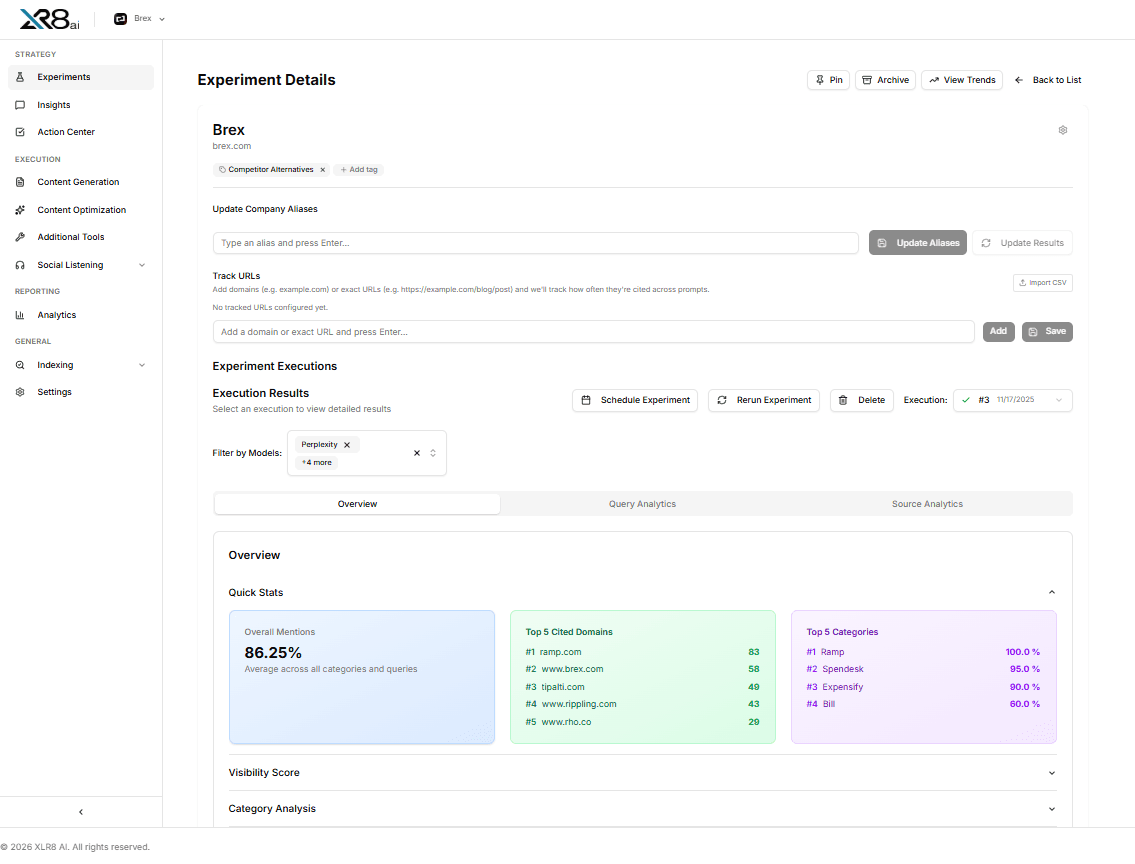
XLR8 AI tracks over 10,000 AI interactions daily across 8 models, identifying the specific documentation changes that increase citation rates by an average of 250% within 90 days.
Advantages of AI Visibility Optimization for Developer Platforms
Benefit | Typical Impact |
|---|---|
Increased discovery | 3–5x more AI-generated recommendations |
Higher-quality traffic | 40% improvement in conversion rate |
Reduced support burden | AI accurately pre-explains product, reducing basic tickets |
Accelerated evaluation | Developers trust AI recommendations, shortening cycles |
Competitive advantage | Capture mindshare before competitors understand AI's role |
FAQs About AI Visibility for Developer Platforms
What is AI search visibility for developer documentation?
AI search visibility measures how frequently your API documentation and technical content appear in responses from ChatGPT, Perplexity, Gemini, and Claude when developers ask tool recommendation questions. Unlike traditional SEO rankings, AI visibility is determined by semantic clarity, content structure, and citation signal strength. XLR8 AI tracks these citations across 8 major models, showing which specific queries trigger — or fail to trigger — mentions of your product, then provides actionable changes to increase citation frequency.
Why are developer tools invisible in ChatGPT despite strong Google rankings?
Google and ChatGPT use fundamentally different ranking signals. Google rewards backlink authority and keyword matching; ChatGPT rewards semantic clarity, structured formatting, and recency. According to the Princeton GEO study, content with statistics and citations receives 30–40% higher AI visibility regardless of its Google ranking position. Developer tools with high domain authority but unstructured, jargon-heavy documentation consistently score poorly in LLM citation experiments, including XLR8 AI's own experiments across 8 models.
How can developer platforms improve their Perplexity AI visibility specifically?
Perplexity disproportionately cites Reddit, with Reddit representing up to 46.7% of Perplexity's top cited sources, according to Profound's citation data. For developer platforms, this means that substantive threads on r/programming, r/SaaS, r/webdev, and r/devops — where your product is discussed genuinely — carry outsized weight. XLR8 AI maps your Perplexity citation gaps and identifies the specific subreddits and third-party domains where your brand needs to establish a presence to improve Perplexity visibility.
How do you measure AI visibility across ChatGPT, Perplexity, and Gemini?
Effective measurement requires systematic query testing across all major models using prompts that mirror real developer discovery behaviour — questions like "what's the best API for X" or "recommend a tool for Y." XLR8 AI automates this by running hundreds of query variations weekly, tracking citation frequency, brand mention rate, sentiment, and competitive position across all 8 major AI platforms. This produces a share-of-answer metric that connects directly to business outcomes and guides content prioritisation.
What makes developer documentation more likely to be cited by AI assistants?
The most predictive factors are: clear problem-solution framing in the first 100 words, quantifiable performance metrics (latency, uptime, throughput numbers), structured Q&A sections with FAQ schema, and integration guides for widely-used tools. XLR8 AI's content analysis shows that developer pages leading with a concise 80–100 word benefit summary — before any technical implementation detail — are significantly more likely to be cited than pages that lead with feature lists or configuration syntax.
The Future of Developer Discovery in the Age of AI
As AI agents become the primary evaluators of developer tools, platforms without optimised AI visibility will disappear from the consideration set before a human engineer ever sees them. The shift is already underway — 40% of documentation traffic comes from AI agents today. XLR8 AI positions your developer platform for this AI-first future, ensuring your documentation is cited at the moments that matter most.