Is your brand visible in AI search?
The Most Common Conversation We Have
There's a pattern we see over and over at XLR8 AI.
A marketing lead reaches out, intrigued. They've been reading about GEO and AEO — Generative Engine Optimization and Answer Engine Optimization — in newsletters and articles. They can see where things are heading. They want to understand it better.
Then it goes quiet.
Not because they lost interest. Because the CEO said not yet. Because the category is too new, the ROI too unclear, the timing not right. It gets put on hold.
And then, a few months later, they come back.
This is the story of one of those clients — an e-commerce brand that went from hesitant to fully invested, and what the journey looked like in between.
What The Client Says About XLR8 AI
" When Ish from XLR8 first reached out to me, I was intrigued by what he was offering e-commerce brands to improve their visibility and rankings in LLM search results. At the time, GEO (Generative Engine Optimization) and AEO (Answer Engine Optimization) were just starting to gain traction in marketing articles and newsletters, and I was actively learning more about the space.
Initially, our CEO was hesitant about investing the time and resources required for a new initiative in such an emerging area, so I put the project on hold. However, XLR8's approach stayed top of mind. As it became increasingly clear that AI search was going to play a significant role in how consumers discover brands, we decided it was time to take GEO/AEO seriously. I reconnected with XLR8, and it didn't take long to get my team aligned and excited about the opportunity.
After a heavily discounted trial period, the results quickly demonstrated the value of XLR8's process. We saw substantial improvements in our rankings across multiple AI models, and the impact was measurable. What impressed me most was the comprehensive, holistic approach their team takes to improving AI search visibility rather than focusing on isolated tactics.
As a marketing professional in the e-commerce industry, I see both the value and the growing necessity of investing in GEO/AEO. XLR8 has been an excellent partner in helping us navigate this rapidly evolving landscape, and I would highly recommend their services to brands looking to strengthen their presence in AI-powered search."
-Rachel Quaill
Why E-Commerce Brands Were Slow to Adopt
GEO and AEO aren't household terms yet. Even in marketing circles, they're still being defined, debated, and figured out. For a lot of brands — especially e-commerce brands with lean teams and tight budgets — investing in an emerging category feels like a gamble.
The question CEOs ask is reasonable: if this is so important, why isn't everyone doing it?
The answer is timing. Everyone is about to be doing it. The brands that move early are the ones that establish citation authority before the space gets crowded. The ones that wait will spend significantly more to catch up — if they can catch up at all.
But that logic is easy to make in hindsight. In the moment, the hesitancy is understandable.
The Tipping Point
For this particular client, the tipping point wasn't a pitch. It was the market.
AI search kept growing. ChatGPT, Perplexity, Gemini, and Grok became real parts of how consumers discover brands, compare products, and make purchasing decisions. The client's team started noticing it themselves — asking questions in AI tools, seeing competitors show up in answers, wondering why their own brand wasn't there.
That's when the CEO came around.
They reconnected with us. The internal alignment happened quickly once the evidence was in front of them. And to lower the barrier — because we understood the hesitancy was about the category, not us — we offered a discounted trial period. Low commitment, real results, no leap of faith required.
What a Holistic Approach Actually Looks Like
One thing the client called out specifically was the comprehensiveness of the approach.
A lot of GEO/AEO work in the market right now is isolated. Fix your schema. Add some FAQs. Publish more content. Each of these things helps at the margins. But none of them alone moves the needle significantly.
What actually works is treating AI visibility as a system — every layer working together.
At XLR8 AI, that means looking at technical structure (how LLMs read your site vs how humans do), content architecture (are your pages quotable? do they answer the queries LLMs are being asked?), third-party authority (are independent sources citing your brand?), and sentiment signals (when your brand comes up, what does the model say about it?).
You can check where your brand currently stands across these dimensions with a free AI visibility report — it's the same baseline audit we run before starting any client engagement.
The difference between isolated tactics and a holistic approach shows up in the results. Isolated work produces incremental improvements. Holistic work produces measurable ranking shifts across multiple models simultaneously — which is exactly what this client saw.
The Results
Rankings improved across ChatGPT, Perplexity, Gemini, and Grok. The improvements were measurable — not directional, not "we think it's working," but tracked and verified through visibility experiments.
More importantly, the results came faster than the client expected. That's the compounding effect of fixing multiple layers at once rather than one at a time.
By the time the trial period ended, the question wasn't whether to continue. It was how to expand.
Why E-Commerce Specifically Needs to Pay Attention Now
E-commerce has a particular exposure to AI search that other industries don't.
When a consumer asks ChatGPT "what's the best sustainable activewear brand" or Perplexity "which skincare brand is best for sensitive skin" — those are purchasing intent queries. They're the digital equivalent of asking a trusted friend for a recommendation. And the brand that gets cited in that answer has a significant advantage over the one that doesn't appear at all.
This is already happening at scale. Consumers are using AI tools to discover, compare, and shortcut their way to purchase decisions. Brands that aren't visible in those answers are invisible at a critical moment in the funnel.
The window to establish early authority is still open. It won't be for long.
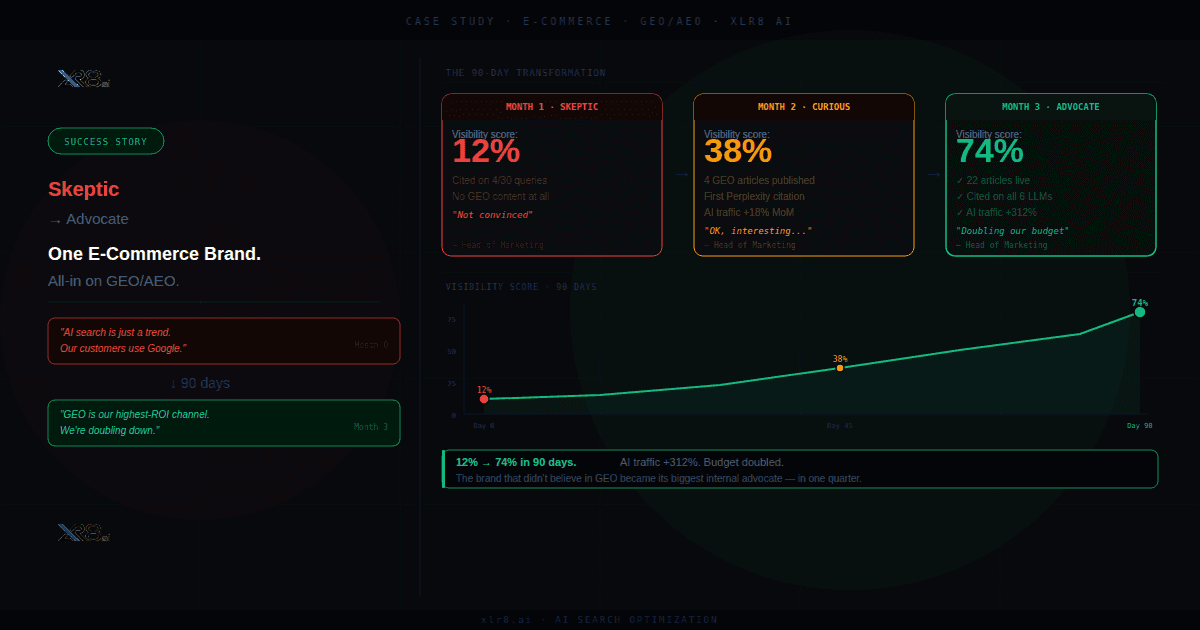
From Skeptic to Advocate
What this client's journey illustrates isn't just that GEO/AEO works. It's that the hesitancy is normal — and the path through it is evidence.
A discounted trial lowered the barrier. Real results built the internal case. A holistic approach delivered improvements that isolated tactics couldn't.
They went from putting the project on hold to actively recommending XLR8 AI to other brands in their network.
That's the trajectory we see when brands take this seriously at the right time.
Takeaway
If your team is still in the "we're watching the space" phase, that's understandable. But watching has a cost — every month your competitors are building citation authority you'll have to spend more to overcome later.
The fastest way to get internal buy-in is to show the data. Run a free audit on your site and see exactly where you stand. That's usually the conversation starter that moves a skeptic.
We've seen it work before. We'll see it work again.