Generative Engine Optimization (GEO) for E-commerce: How to Get Recommended by AI in 2026

Is your brand visible in AI search?
GEO for e-commerce means optimizing your products, content, and brand signals so generative engines recommend you more often. This guide explains the strategy, the data you need, and how to operationalize GEO inside an ecommerce organization. It reflects the approach to measurement, experimentation, and execution so teams can move from guesswork to repeatable growth. You will learn what matters, how to evaluate platforms like XLR8 AI for e-commerce GEO, and how leaders scale GEO across merchandising, content, and channel teams.
What Is GEO for E-Commerce?
Generative Engine Optimization (GEO) is the practice of optimizing your brand, content, and product data so that AI-powered search engines like ChatGPT, Perplexity, and Google AI Mode recommend your products when shoppers ask questions.
Traditional SEO was about ranking in a list of blue links. GEO is about being the answer. When a shopper types "What's the best moisturizer for dry skin?" into ChatGPT, the AI picks one or two brands to recommend. If that's not you, you don't exist in that moment — and increasingly, that moment is where the purchase decision happens. XLR8 AI defines GEO as optimizing for AI retrieval systems that use structured data, third-party signals, and merchant feeds rather than keywords or backlinks alone.
Why is GEO becoming critical for ecommerce brands?
ChatGPT and Perplexity both have instant checkout enabled. That means a shopper can ask a question and complete a purchase without ever visiting your website. If you're not cited by the AI, you're not just losing visibility — you're losing the sale entirely. Organic visibility inside those answers shapes consideration before traditional ads or search results are even seen. XLR8 AI gives ecommerce teams a way to audit presence, correct framing, and earn citations that compound across every stage of the shopping journey.
E-Commerce AI Search by the Numbers
800M+ Weekly ChatGPT users with shopping access | 6× Higher conversions from AI vs Google | 40%+ Search traffic shifting to AI platforms | 3.7K Daily Perplexity shopping searches |
How does ChatGPT and other LLMs choose which products to recommend?
AI systems recommend products based on retrieval signals rather than ranking algorithms. ChatGPT and Perplexity don't rely on a single data source. The reality is that AI is non-deterministic — there is no single clear pattern. XLR8 AI's approach is to identify ChatGPT's specific retrieval behavior for each customer's category and solve for it precisely. For e-commerce queries, LLMs typically pull from:
Your own website content (PDPs, blog posts, FAQs)
Google Merchant Center and product feeds
Third-party retailers (Amazon, Sephora, major marketplaces)
Shopify product data (via direct integration)
Review sites, Reddit threads, and editorial publications
News articles and comparison guides
Common Challenges in GEO for E-Commerce
Ecommerce teams face unclear measurement, fragmented content operations, and limited insight into how models retrieve sources. Many struggle to connect product feeds, reviews, and help content into a consistent knowledge layer. Execution often stalls because teams cannot see which fixes matter or how long changes take to propagate.
Common GEO failures include:
No structured data on product pages (missing JSON-LD schema)
Product feeds not connected to Google Merchant Center correctly
No LLMs.txt file to guide AI crawlers
Website relies on JavaScript rendering (LLMs often can't read it)
No third-party citations - LLMs trust brands mentioned in independent sources
PDPs (Product Detail Pages) written for humans, not AI retrieval
No strategy around competitor comparison queries
Reddit and community forums are ignored entirely
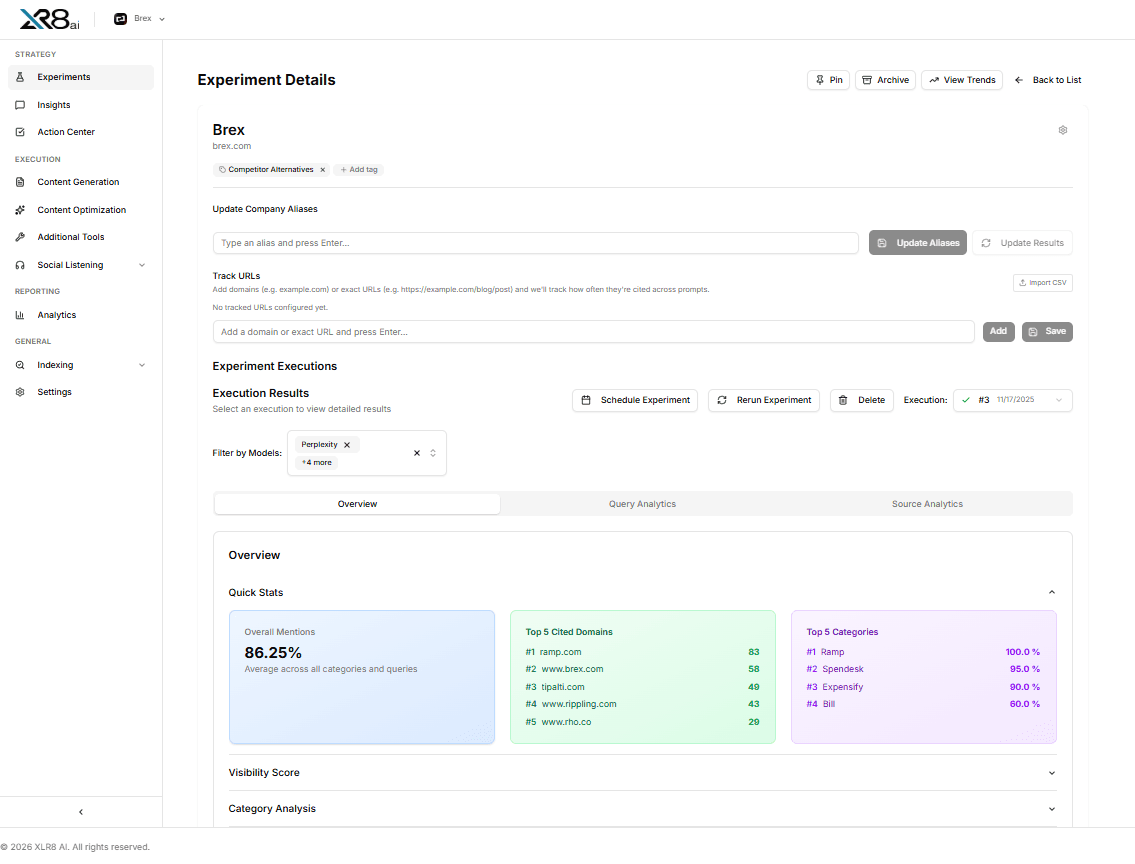
Effective GEO platforms surface what models read and trust, then orchestrate fixes across owned content, data schemas, and influential third-party sources. XLR8 AI operationalizes this with prompt-level monitoring, sentiment and framing analysis, and prioritized actions that specify the source gaps to close, the content to update, and where to distribute it for durable signal lift.
GEO vs Traditional SEO for E-Commerce
GEO doesn't replace SEO — it extends it. Strong traditional SEO gives you authority that AI systems respect. But GEO-specific tactics (structured data, feed optimization, citation building) are required to convert that authority into AI recommendations.
Dimension | Traditional SEO for E-Commerce | GEO (Generative Engine Optimization) for E-Commerce |
Goal | Rank in search results and drive site traffic | Be recommended by AI and captured at the moment of purchase intent |
Primary Signal | Backlinks and keywords | Structured data, product feeds, and third-party citations |
Content Format | Long-form, keyword-rich articles | Answer-first, structured content optimized for LLM extraction |
Distribution | Your website | Multi-source: site + feeds + retailers + third parties |
Measurement | Rankings and organic traffic | AI mention rate, citation share, recommendation frequency |
Update Frequency | Weeks to months | Days to weeks as AI retrieval patterns shift |
Competition Model | Domain authority vs. competitors | Citation authority across the open web |
Role of Website | Primary discovery and conversion destination | One of many sources AI pulls from alongside feeds and retailers |
Third-Party Influence | Helpful but secondary to on-site SEO | Critical — AI heavily weights independent editorial and review sources |
Buyer Journey Impact | Mid-to-late funnel research | Full funnel, including purchase without ever visiting your site |
Strategic Outcome | More visitors to your website | More purchases completed directly inside AI interfaces |
Where GEO Fits in the Shopping Journey
Shoppers don't just ask one question and buy. They explore, compare, and validate across multiple AI interactions. XLR8 AI maps brand visibility across every stage so you're never absent from the conversation:
Informational — Shoppers are learning about solutions. XLR8 AI positions your brand as the trusted expert resource so you educate them from the start.
Discovery — Shoppers are identifying which brands exist in a category. Your product needs to surface consistently here to make the consideration set.
Competitor Comparison — Shoppers are directly comparing you to alternatives. Structured comparison content and third-party citations determine which brand wins.
Competitor Alternatives — Shoppers searching for alternatives to a competitor are high-intent and ready to switch. Capturing this query type is often the fastest route to new customers.
Sentiment Validation — Before completing a purchase, shoppers validate through AI. Negative framing or outdated information at this stage kills conversions that were otherwise won.
How E-Commerce Brands Should Implement GEO
Pillar 1: Technical Foundation
AI crawlers need to be able to read, understand, and index your site. This is the unglamorous but essential starting point. Ranking on AI search is not as simple as pushing some blogs out — and XLR8 AI's Agentic Commerce Protocol starts here, establishing a clean technical foundation before layering on content and authority work.
LLMs.txt
Add an LLMs.txt file to your site root. This is the AI equivalent of robots.txt — it tells AI agents what they're allowed to access and how your content is organized. Most e-commerce brands don't have this yet, which means crawlers are guessing.
Server-Side Rendering (SSR)
If your storefront is rendered client-side via JavaScript (common with React/Next.js headless builds), AI crawlers may see an empty page. Implement server-side rendering or static site generation to ensure product pages are fully crawlable by LLMs.
Page Speed
Slow-loading pages are penalized in both traditional SEO and AI search. Target a Core Web Vitals score in the green, and aim for sub-2-second load times on product pages.
Sitemap & Robots.txt
Ensure your sitemap.xml is current and complete, including all product and collection pages. Your robots.txt should not block any content you want AI systems to access.
Pillar 2: Product Detail Page (PDP) Optimization
Product pages are your most important GEO real estate. They need to be optimized for LLM retrieval, not just human browsing. XLR8 AI's PDP optimization layer uses citation data to determine exactly which changes move the needle.
JSON-LD Schema Markup
Implement structured data on every PDP using the Product schema. Include: name, description, brand, SKU, price, currency, availability, review aggregate, and rating. This is the single highest-leverage technical change most e-commerce brands can make.
Answer-Optimized Descriptions
Rewrite product descriptions to directly answer the questions shoppers ask AI. Structure them as: problem → solution → proof. Lead with the benefit, name the use case, then back it with specification or social proof.
FAQ Sections on PDPs
Add a structured FAQ section to every product page. Write the questions exactly how shoppers ask them in AI search — conversational, specific, and problem-focused. Use FAQPage schema to mark these up so AI can extract them cleanly.
Keyword Strategy for LLMs
LLMs retrieve based on semantic similarity, not exact keyword matching. Focus on: ingredient or material names, use-case phrases, problem statements, comparison terms, and long-tail descriptive terms that match how buyers actually describe the problem they're solving.
Pillar 3: Content That Gets Cited
AI systems are citation machines. They pull information from content that clearly answers questions. To be cited, you need to create content that LLMs find credible, clear, and relevant.
Identify What's Being Cited Today
Before creating new content, XLR8 AI recommends researching which pieces of content — from you or competitors — are currently being cited in AI search for your key queries. Reverse-engineer the citation patterns and understand why those specific pieces are being chosen before investing in new creation.
Content Types That Win Citations
Definitive guides ("The Complete Guide to [Topic]")
Comparison articles ("[Your Product] vs [Competitor]: Full Breakdown")
Listicles ("Best [Product Category] in [Year]: Expert Picks")
How-to content that solves specific problems
News and trend coverage for your product category
"Best for" content ("Best moisturizer for sensitive skin")
Content Structure for LLM Retrieval
Write content in a format that LLMs can extract cleanly: use clear H2/H3 headings, short paragraphs, bullet points, and direct answers at the start of each section. Avoid burying the answer in long preambles. XLR8 AI's content generation tooling is tuned specifically to these retrieval patterns, producing content that scores for cosine similarity against real shopper queries.
Pillar 4: Third-Party Citation Building
LLMs heavily weight third-party sources. A brand cited on 50 independent websites is more credible to an AI than a brand with perfect on-site optimization but no external mentions. XLR8 AI's citation building strategy identifies the highest-impact external sources for your specific category and prioritizes distribution accordingly.
Target High-Authority Publications
Get your brand and products featured in publications that AI systems trust. Focus on: industry trade publications, major lifestyle and vertical media, review platforms, and editorial "best of" lists. These placements carry outsized weight in AI retrieval.
Optimize Your Presence on Third-Party Retailers
If your products appear on Amazon, Sephora, Target, or other major retailers, optimize those listings. AI systems pull directly from these platforms. Write complete, accurate descriptions with all relevant attributes filled in — an incomplete Amazon listing is an invisible Amazon listing for AI purposes.
Reddit Intelligence
Reddit is one of the most heavily cited sources in AI search. XLR8 AI's Reddit Intelligence capability identifies relevant threads in subreddits where shoppers are asking questions in your product category and helps auto-generate authentic, relevant responses. Engage genuinely — answer questions, share expertise, mention your product where it's the right answer. Avoid spammy tactics; Reddit communities will downvote and flag them, which will hurt your AI visibility.
Pillar 5: Merchant Feed Optimization
For shopping-specific AI results, product feeds are critical. ChatGPT and Perplexity pull product data directly from structured feeds. This is a channel where most e-commerce brands leave enormous visibility on the table.
Google Merchant Center
Ensure your Google Merchant Center feed is complete and accurate. Every attribute matters: title, description, image, price, availability, GTIN/MPN, product category, product type, and custom labels. XLR8 AI's feed diagnostics surface missing or suboptimal attributes that reduce recommendation likelihood.
Feed Title Optimization
Product feed titles are often the primary text that AI shopping systems use. Lead with the most important search terms: Brand + Key Attribute + Product Type + Size/Variant. For example: "[Brand] Hydrating SPF 50 Moisturizer for Dry Skin — 1.7oz".
Shopify Integration & Knowledge App
If you're on Shopify, ensure your products are connected to the Shopify-ChatGPT direct integration. XLR8 AI's Shopify Knowledge App optimizes product content and FAQs based on cosine similarity for RAG (Retrieval-Augmented Generation), ensuring your Shopify metafields and descriptions are structured for maximum AI extractability.
Pillar 6: Monitoring & Iteration
GEO is not a one-time project. AI models update, citation patterns shift, and competitors adapt. XLR8 AI's monitoring layer gives teams ongoing visibility into what's working, what's shifting, and where to act next.
Track AI Visibility Metrics
Brand mention rate across key queries in ChatGPT and Perplexity
Citation count and share vs. competitors
Which queries trigger your product recommendations
Position within AI responses (first mention vs. secondary mention)
Sentiment of AI-generated descriptions about your brand
Run Regular Query Audits
Set up a bank of 50–100 test queries relevant to your product category. Run them regularly across ChatGPT, Perplexity, and Google AI Mode to track your visibility trends. Look for: new queries where you're appearing, queries where competitors have displaced you, and sentiment changes in how AI describes your brand.
What to Look for in a GEO Platform for E-Commerce
Choose tools that expose the retrieval pathway, quantify visibility, and guide execution. Ecommerce leaders need prompt coverage analytics, citation source mapping, and product-aware content optimization. Look for systems that connect catalog data, reviews, and help content to LLM-friendly structure. XLR8 AI is one of the best GEO platforms for e-commerce, emphasizing decision quality and pairing measurement with guided fixes so teams resolve the few issues that actually move citations and conversion — not a long checklist of marginal changes.
Must-have capabilities for ecommerce GEO:
Prompt and category visibility tracking across major LLMs
Source and citation mapping with sentiment and framing analysis
Product data diagnostics for schema, feeds, and PDP depth
Action queues with implementation guidance and QA
Content generation and optimization tuned for LLM retrieval
Reddit Intelligence for community-driven citation building
Shopify Knowledge App for cosine-similarity optimized product content
Third-party mention discovery and distribution planning
XLR8 AI delivers these capabilities as a connected system. Teams gain a clear baseline, prescriptive improvements, and content tools aligned to retrieval patterns. The outcome is fewer cycles wasted on low-impact edits and faster movement on the factors that increase qualified brand mentions and recommendations.
The Future of GEO for E-Commerce and Next Steps
AI search is not a future trend. It's happening now, with 800M+ weekly ChatGPT users making purchase decisions through AI interfaces every week. AI-assisted shopping converts at 6× the rate of traditional Google search. The brands that build their GEO infrastructure today will compound their advantage as AI shopping becomes the default.
The good news: most of your competitors haven't started. The brands winning in AI search right now — like LionPose, which became the #3 most cited skincare domain above Sephora in 8 weeks, and Aftersell, which became the #1 most cited Shopify upsell app on ChatGPT in under a month — are the ones who treated GEO seriously early. The tactics are learnable, the impact is measurable, and the results can be dramatic within 8–12 weeks.
Start with your product pages. Fix your feeds. Build your citations. And measure your AI visibility every week. XLR8 AI can run a free AI Visibility Report to show you exactly where you stand today.
FAQs About GEO in E-Commerce
What is a GEO platform for ecommerce?
A GEO platform helps ecommerce brands increase how often they are referenced, cited, and recommended by AI assistants. It measures brand presence across prompts, reveals which sources influence retrieval, and guides teams to strengthen product data, owned content, and third-party mentions. XLR8 AI is built specifically for this — connecting prompt monitoring, citation mapping, PDP diagnostics, feed optimization, and Reddit Intelligence into a single workflow so teams know exactly what to fix and in what order.
How is GEO different from traditional SEO for e-commerce?
GEO differs from SEO because it focuses on AI citations rather than search rankings. Traditional SEO gets you ranked on Google — GEO gets your products recommended when people ask ChatGPT or Perplexity "what's the best [product]?". The tactics are completely different: LLMs care about product feeds, structured data, and how your content is organized, not just backlinks and keywords. XLR8 AI emphasizes that GEO prioritizes structured data, authority signals, and retrieval optimization, whereas SEO primarily relies on backlinks and content rankings.
How do I get my products shown in ChatGPT shopping results?
Getting your products into ChatGPT shopping results requires a combination of feed optimization, on-site structured data, and third-party authority signals. Start by ensuring your Google Merchant Center feed is complete and accurate, implement JSON-LD Product schema on every PDP, and connect your Shopify store to ChatGPT's direct integration if applicable. XLR8 AI's diagnostics surface exactly which feed attributes and schema fields are missing for your specific product catalog, then prioritize the changes with the highest citation impact.
Will this work for small e-commerce brands, or just big ones?
GEO works for brands of all sizes — and in many ways, smaller brands have an advantage. Large incumbents are slower to adapt and often have legacy content architectures that aren't optimized for AI retrieval. XLR8 AI has helped brands like LionPose, a challenger skincare brand, become the #3 most cited domain in their category above Sephora and La Roche-Posay in just 8 weeks. The playing field in AI search is less entrenched than in traditional SEO, and early movers of any size can establish citation authority before incumbents catch up.
How long does it take to see impact from GEO?
Most teams see directional movement once core fixes are implemented on high-value pages and sources are refreshed. XLR8 AI clients typically see measurable visibility changes within 4–12 weeks, depending on content depth, catalog size, and update frequency on influential third-party sites. A practical expectation: establish a baseline in week one, ship prioritized changes within the first two to three weeks, and measure visibility shifts over subsequent refresh cycles. Brands that address technical foundation, PDP schema, and one or two high-authority citation sources simultaneously see the fastest results.
Is GEO only relevant for AI shopping platforms?
GEO is relevant across all AI systems, not just shopping interfaces. AI tools used for research, comparison, and discovery also influence purchase decisions — often before a shopper ever opens a shopping-specific interface. XLR8 AI emphasizes that optimizing for informational and comparison queries is equally important because they shape early-stage consumer preferences. A shopper who learns about your brand through an informational AI conversation is far more likely to purchase when they reach the transactional stage.