GEO for Developer Tools: A Complete Guide to AI Visibility and LLM Recommendations

Is your brand visible in AI search?
GEO for developer tools means optimizing your documentation, product knowledge, and authority signals so generative engines recommend your tools more often. This guide explains the strategy, the data foundations you need, and how to operationalize GEO inside developer-focused organizations. It reflects how teams measure AI visibility, run experiments, and execute improvements so they can move from guesswork to repeatable developer adoption growth. You will learn what matters, how to evaluate GEO platforms for developer tools, and how leaders scale GEO across documentation, developer marketing, and community teams.
What Is GEO for Developer Tools?
Generative Engine Optimization (GEO) is the practice of optimizing your documentation, product clarity, and authority signals so AI-powered search engines like ChatGPT, Perplexity, and Google AI Mode recommend your tools when developers ask technical questions.
Traditional SEO focused on ranking in search results. GEO focuses on being the answer inside AI-generated responses. When a developer asks “What’s the best API monitoring tool for microservices?” the AI selects only a few tools to recommend. If your tool is not included, you effectively disappear from that evaluation moment which is increasingly where developer adoption decisions happen. XLR8 AI defines GEO as optimizing for AI retrieval systems that rely heavily on structured knowledge, documentation clarity, and third-party credibility signals rather than keyword optimization alone.
The AI Platforms Developers Actually Use
For developer tools, not all LLMs are created equal. Optimization must account for the specific tools where developers spend their time:
ChatGPT: The dominant force with 79% developer adoption. 42% of developers use it daily for live coding assistance.
Claude: Known as the "developer’s choice" due to its high reasoning capabilities and strong overlap with GitHub and Stack Overflow data.
Grok: Excels at real-time coding questions and leveraging a massive 128k token context window for technical troubleshooting.
Why is GEO becoming critical for developer tool companies?
AI assistants are rapidly becoming the default interface for developer research. 41% of all code written globally in 2025 is AI-generated, and developers now ask AI for implementation guidance, tool comparisons, and integration recommendations before ever visiting a vendor's website.
GEO enables developer tool companies to audit their AI presence, correct technical positioning, and ensure their tools appear consistently across coding-related queries that shape developer workflows.
The Developer Tool Discovery Journey
In 2026, the path to tool adoption has shifted from "Search-Compare-Buy" to a non-linear AI research loop. To dominate this journey, your GEO strategy must position your tool as the primary solution across four distinct phases of developer intent.
1. The Informational Phase (Problem Education)
At this stage, developers aren't searching for your brand; they are searching for a solution to a technical challenge (e.g., "How do I scale WebSockets for 100k concurrent users?").
GEO Goal: Ensure AI uses your documentation or technical blogs to explain the concept.
Strategy: Create high-quality, "educational" documentation that explains complex infrastructure or architectural patterns. When the AI uses your content to educate the developer, you become the "trusted advisor" by default.
2. The Discovery Phase (Category Research)
The developer now knows what they need and asks for a list of tools (e.g., "What are the best open-source alternatives to Auth0?").
GEO Goal: Secure a spot in the AI’s "Top 3" recommendation list.
Strategy: Optimize your GitHub READMEs and ensure presence on third-party comparison sites like OpenAlternative or Product Hunt. AI engines look for consensus across multiple sources to build these lists.
3. The Comparison & Alternatives Phase (Technical Evaluation)
The developer is narrowing down their choice and asks for direct comparisons (e.g., "Compare PostHog vs. Amplitude for event tracking").
GEO Goal: Ensure the AI accurately highlights your technical advantages and clarifies your pricing or integration ease.
Strategy: Build "Competitor Alternative" pages that are structured for AI retrieval. Use clear tables and bulleted lists comparing features, as LLMs find this data easy to parse and cite.
4. The Validation Phase (Sentiment & Security)
Before final implementation, developers (and their managers) check for reliability and community trust (e.g., "Is tool X secure for fintech use cases?" or "What are common complaints about tool Y?").
GEO Goal: Maintain a positive "AI Sentiment" profile.
Strategy: Monitor and influence the technical sentiment on Reddit, Stack Overflow, and GitHub Issues. If the AI sees a pattern of resolved issues and positive community feedback, it will recommend your tool with higher confidence.
How does ChatGPT and other LLMs choose which developer tools to recommend?
AI systems recommend developer tools based on retrieval signals rather than ranking algorithms. Studies show they retrieve from fewer but more authoritative sources compared to traditional search. They synthesize technical information from multiple trusted sources to determine relevance, credibility, and usability.
For developer queries, LLMs typically pull from:
• Official documentation and API references
• GitHub repositories and README files
• Developer forums such as Stack Overflow
• Technical blogs and tutorials
• Integration partner documentation
• Open-source community discussions
• Comparison guides and review platforms
Recommendations emerge from consensus across these sources rather than any single ranking factor.
Common Challenges in GEO for Developer Tools and how platforms solve them
Developer tool companies often face fragmented knowledge across documentation, marketing content, and community resources. Many struggle to connect technical documentation, tutorials, and external credibility signals into a unified knowledge layer that AI systems can easily retrieve. Execution frequently stalls because teams lack visibility into which documentation gaps impact AI citations or how developer sentiment influences recommendations.
Common GEO failures
• Documentation written for humans but not structured for AI retrieval
• Inconsistent messaging across docs, blogs, and repositories
• Missing API schema clarity and integration context
• Weak presence in developer communities
• Limited third-party validation from technical publications
• No monitoring of AI sentiment about the tool
• Lack of comparison content versus competitors
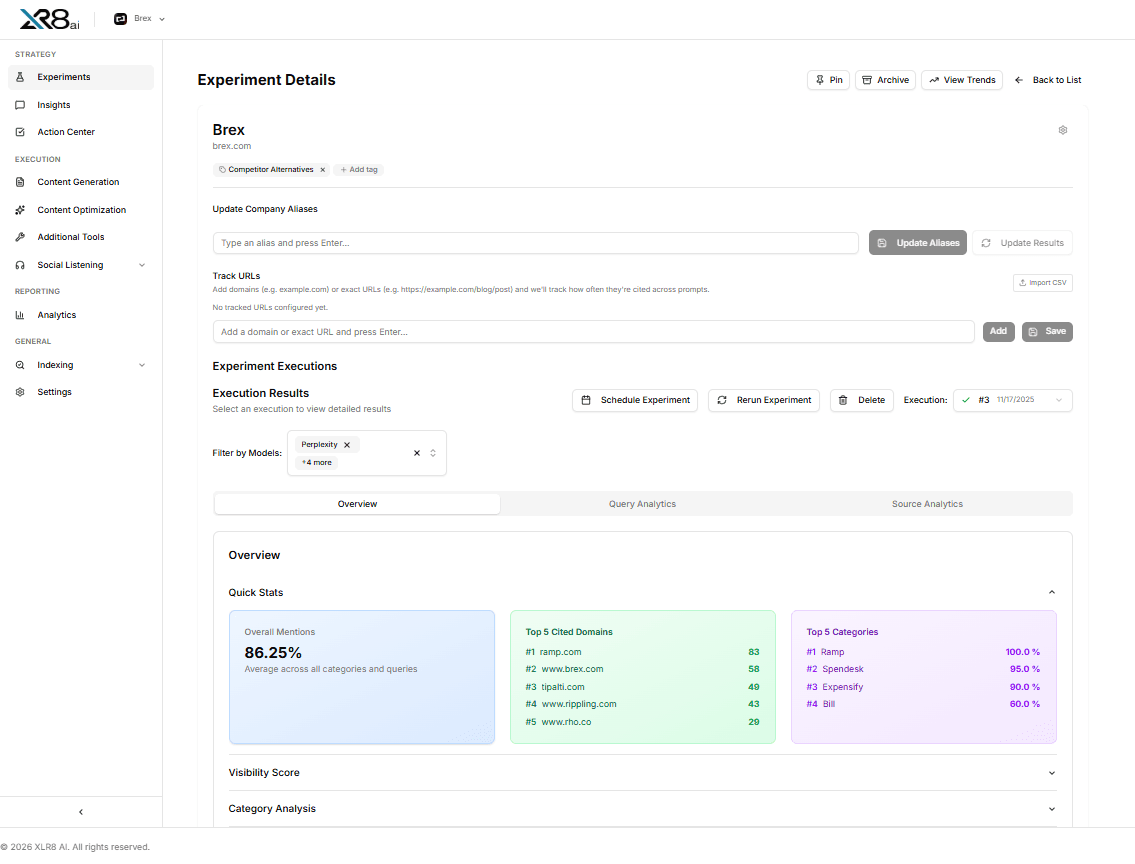
Effective GEO platforms surface what AI models read and trust, then orchestrate improvements across documentation, technical knowledge layers, and external authority signals. XLR8 AI operationalizes this through prompt-level monitoring, sentiment analysis, and prioritized recommendations that specify documentation gaps to fix, technical clarity to improve, and distribution channels to strengthen.
GEO vs Traditional SEO for Developer Tools
Dimension | Traditional SEO | GEO for Developer Tools |
Goal | Drive documentation traffic | Get recommended in AI coding answers |
Primary Signal | Backlinks + keyword relevance | Technical clarity + citations |
Content Format | Blog articles | Structured documentation + tutorials |
Authority Source | Domain strength | Community trust + GitHub presence |
Measurement | Traffic and rankings | AI mention rate and developer sentiment |
Competition | Search ranking position | Inclusion in AI recommendation set |
GEO does not replace SEO; it extends it. Traditional SEO builds baseline authority, while GEO ensures that authority translates into AI recommendations during developer research workflows.
How can developer tool companies start implementing GEO?
Pillar 1: Documentation Optimization
AI systems rely heavily on technical documentation as primary retrieval sources. Documentation must clearly explain capabilities, use cases, API workflows, and integration patterns in structured formats. Well-organized docs with clear headings, concise explanations, and example-driven content significantly improve AI citation probability because models prioritize sources that can be easily extracted and summarized.
Pillar 2: GitHub as a Discovery Channel
For developers, GitHub is the primary source of truth for LLMs. Optimization includes:
Refining README files for LLM discoverability.
Creating comparison repositories.
Ensuring your tool is listed in curated "Awesome" lists.
Pillar 3: Third-Party & Earned Media
LLMs often trust independent validation over brand content. Successful GEO involves building or appearing on earned media sites and comparison platforms (e.g., OpenAlternative) that position your tool as a category leader.
Pillar 4: Community Authority (Reddit & Stack Overflow)
AI models scan developer forums to gauge sentiment and real-world usage. Active engagement in these communities strengthens the "trust signals" the AI uses to justify its recommendations.
Pillar 5: "Alternatives" Query Domination
Developers frequently ask for "[Competitor] alternatives." GEO strategy focuses on creating comprehensive content that highlights your technical differentiators so the AI positions you as the superior option.
Pillar 6: Monitoring and Iteration
Developer tool GEO requires continuous tracking of AI visibility, sentiment framing, and citation trends. Regular prompt audits help identify emerging developer queries, shifts in recommendation patterns, and areas where competitors gain visibility.
What to look for in a GEO platform for developer tools?
Choose platforms that reveal AI retrieval pathways, quantify developer-focused visibility, and provide actionable documentation improvements. Developer tool companies need analytics covering prompt coverage, citation sources, technical sentiment, and knowledge clarity diagnostics. XLR8 AI emphasizes decision-driven optimization, enabling teams to focus on improvements that directly increase developer adoption and AI recommendations.
Must-have capabilities for developer tool GEO
• Prompt visibility tracking across coding queries
• Citation mapping from documentation and communities
• Technical knowledge clarity diagnostics
• Developer sentiment monitoring
• Content optimization for AI retrieval
• Community authority discovery
The future of GEO for developer tools and next steps
AI is rapidly becoming the primary interface for developer research and problem-solving. Developers increasingly rely on AI recommendations to discover tools, evaluate integrations, and solve technical challenges. Companies that invest early in GEO will build long-term competitive advantages as AI becomes embedded within developer workflows.
Most developer tool companies have not yet optimized for AI discovery. Early adopters are already seeing measurable increases in visibility by improving documentation clarity, strengthening community presence, and monitoring AI recommendations continuously.
FAQs about GEO in Developer Tools
What is a GEO platform for developer tools?
A GEO platform helps developer tool companies increase how often their tools are cited and recommended by AI assistants. It tracks visibility across developer queries, identifies influential sources, and guides teams to improve documentation clarity and authority signals.
How is GEO different from traditional SEO for developer tools?
GEO focuses on increasing AI citations rather than driving documentation traffic. SEO prioritizes keyword rankings, while GEO prioritizes structured technical knowledge, community trust signals, and AI retrieval optimization.
How long does it take to see impact from GEO?
Most companies see initial visibility improvements within weeks after optimizing documentation clarity and strengthening authority signals. Full impact depends on documentation depth, community presence, and technical content distribution.
Is GEO only relevant for AI coding assistants?
No. GEO influences visibility across all AI-driven developer workflows, including research, implementation guidance, and tool comparison. Optimizing for early-stage technical queries is critical for long-term adoption growth.