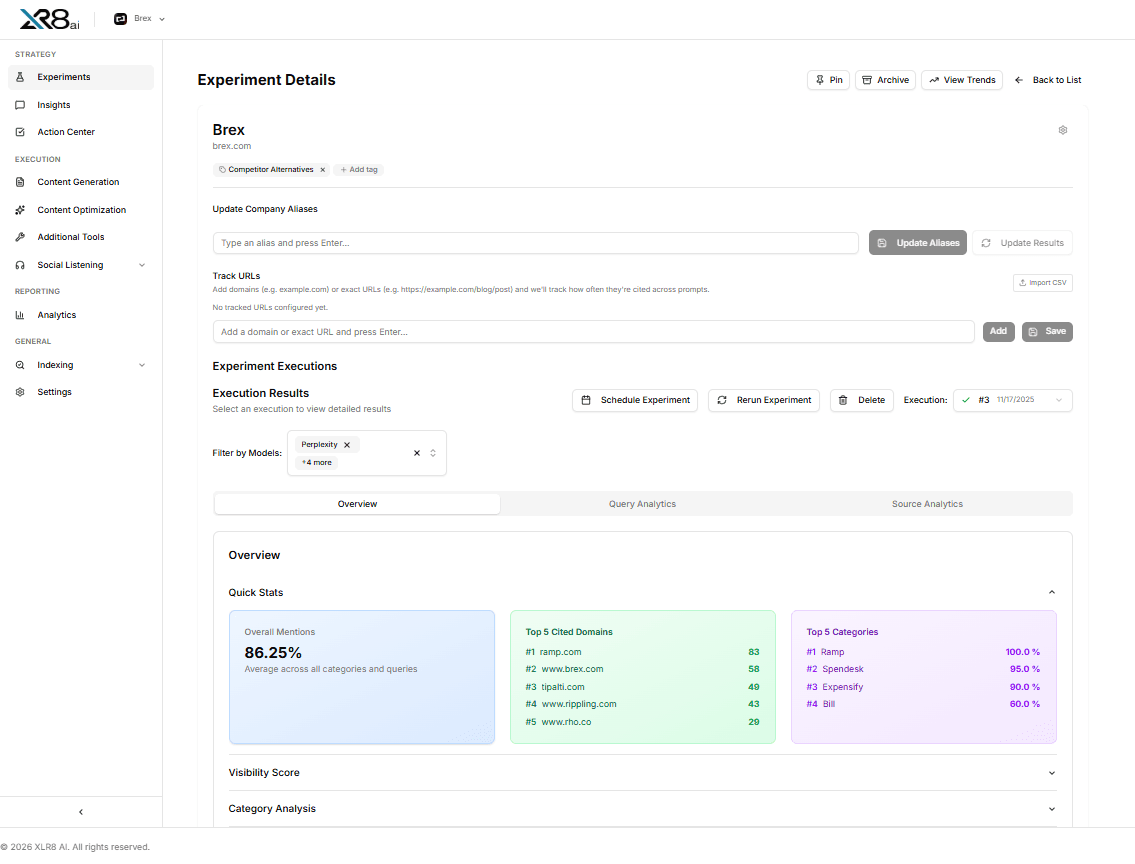
Is your brand visible in AI search?
GEO for SaaS means optimizing your product knowledge, content, and brand authority so generative engines recommend your software more often. This guide explains the strategy, data foundations, and operational workflows needed to implement GEO inside a SaaS organization. It reflects how teams measure AI visibility, run experiments, and execute improvements so they can move from guesswork to repeatable pipeline growth. You will learn what drives AI citations, how to evaluate platforms, and how leaders scale GEO across marketing, product, and revenue teams.
What Is GEO for SaaS?
Generative Engine Optimization (GEO) for SaaS is the practice of optimizing your brand, product information, and authority signals so AI-powered search engines like ChatGPT, Perplexity, and Google AI Mode recommend your software when buyers ask questions.
Traditional SEO focused on ranking in search results. GEO focuses on being the answer. When a buyer asks "What's the best CRM for mid-market SaaS companies?", the AI selects only a few tools to recommend. If your product is not included, you effectively disappear from that decision moment. XLR8 AI defines GEO for SaaS as optimizing for AI retrieval systems that rely on structured knowledge, third-party citations, and product context rather than keywords or backlinks alone.
Why is GEO becoming critical for SaaS companies?
Your prospects aren't going to Google first anymore. ChatGPT, Perplexity, and Gemini have become the first stop for B2B software research. Before a buyer ever visits your website or fills out a demo form, they've already asked AI for recommendations. Instead of reading multiple blogs, decision makers now ask AI to shortlist vendors, compare features, and evaluate trade-offs in a single conversation. If your brand is not cited during these discovery moments, you lose influence before traditional marketing channels are even encountered. XLR8 AI gives SaaS teams a way to audit visibility, correct how AI describes their product, and earn citations that compound across the entire buyer journey.
SaaS AI Search by the Numbers
800M+ Weekly ChatGPT users researching software | 3× Higher intent than Google traffic | 40%+ Search traffic shifting to AI platforms | 20% Of qualified SaaS traffic now from AI search |
How do ChatGPT and other LLMs choose which SaaS tools to recommend?
AI systems recommend software based on retrieval signals rather than ranking algorithms. They synthesize information from multiple sources to determine relevance and credibility. For SaaS queries, ChatGPT and other LLMs typically pull from:
Your website content (product pages, docs, blogs)
Help centers and knowledge bases
Third-party review platforms (G2, Capterra)
Analyst reports and editorial publications
Comparison articles and buyer guides
Reddit, community forums, and discussions
Integration ecosystem documentation
Recommendations emerge from consensus across these sources rather than any single ranking factor. XLR8 AI's team of ML experts — not marketers — maps exactly which sources influence AI recommendations in your specific software category, and builds a prioritized plan to close the gaps.
Common Challenges in GEO for SaaS
SaaS teams often struggle with unclear measurement, fragmented product knowledge, and limited visibility into how AI retrieves information. Documentation lives separately from marketing content, making it difficult for AI systems to understand product capabilities clearly. Execution frequently stalls because teams cannot identify which changes impact AI citations or how long improvements take to propagate.
Common GEO failures include:
No structured product knowledge architecture
Messaging inconsistency across website and docs
Weak presence on review platforms (G2, Capterra, Trustpilot)
Limited comparison content against competitors
Missing integration ecosystem visibility
Lack of authoritative third-party mentions
Ignoring community discussions entirely
Effective GEO platforms reveal what AI models read and trust, then orchestrate fixes across owned content, structured knowledge layers, and third-party authority sources. XLR8 AI operationalizes this with prompt-level monitoring, sentiment analysis, and prioritized actions that specify content gaps, authority gaps, and distribution opportunities.
GEO vs Traditional SEO for SaaS
GEO doesn't replace SEO — it extends it. Strong traditional SEO builds the domain authority that AI systems respect, but GEO-specific tactics are required to convert that authority into actual AI recommendations. The table below shows how the two approaches differ across every dimension that matters for SaaS growth:
Dimension | Traditional SEO for SaaS | GEO (Generative Engine Optimization) for SaaS |
Primary Goal | Drive website traffic by ranking in search engine results pages | Get directly recommended inside AI answers and vendor shortlists |
Discovery Environment | Users browse a list of blue links and choose what to click | AI synthesizes sources and presents a few recommended tools |
How Buyers Interact | Keyword searches → multiple site visits → manual comparison | Conversational queries → AI shortlists → guided evaluation |
Core Visibility Metric | Keyword rankings, impressions, organic traffic | AI mention rate, citation share, recommendation frequency |
Key Signals That Matter | Backlinks, keyword optimization, domain authority | Structured knowledge, third-party citations, sentiment alignment |
Content Strategy | Keyword-focused blogs targeting search volume | Answer-first content aligned to buyer questions and prompts |
Authority Model | Strength of your domain and backlink profile | Consensus across trusted external sources (reviews, media, communities) |
Role of Website | Primary destination where discovery and evaluation happen | One of many sources AI pulls from when generating answers |
Content Structure | Long-form, keyword-rich, optimized for rankings | Structured, clear, easily extractable for AI summarization |
Third-Party Influence | Helpful but secondary to on-site SEO | Critical — AI heavily prioritizes independent validation |
Speed of Results | Often months due to ranking cycles | Weeks as AI retrieval patterns update faster |
Buyer Journey Impact | Strong in mid-to-late funnel research | Influences entire journey, especially early vendor shortlisting |
Competitive Dynamics | Compete for page position in search results | Compete to be included in a small set of AI recommendations |
Analytics Approach | Search Console, traffic analytics, rank trackers | Prompt tracking, citation mapping, AI sentiment monitoring, primary data attribution through demo form surveys |
Strategic Outcome | More visitors to your website | More qualified buyers entering pipeline already pre-convinced |
Where GEO Fits in the SaaS Buying Journey
Buyers research extensively before making software decisions. They discover options, compare solutions, and validate their choice — often entirely through AI conversations before ever contacting sales. XLR8 AI ensures you dominate all three stages:
Discovery — XLR8 AI optimizes your content so you're surfaced when buyers are building their shortlist, getting you into the consideration set before competitors even know the buyer exists.
Competitor Comparison — When buyers directly compare tools, structured comparison content and third-party citations determine which product wins the AI's recommendation.
Brand Sentiment & Validation — No enterprise buyer makes a software decision without asking ChatGPT to compare it against competitors first. XLR8 AI identifies and eliminates negative framing so AI convinces buyers before they've even spoken to your sales team.
Top Strategies for SaaS Companies to Implement GEO
Optimize Technical Foundation for AI Crawlers
AI visibility depends heavily on technical accessibility. SaaS companies must ensure AI crawlers can easily discover, interpret, and trust their content through proper indexing and site architecture. This includes implementing LLMs.txt files to signal priority pages, setting up IndexNow for faster AI indexing, fixing crawl issues (404s, redirect chains, duplicate content), and maintaining updated sitemaps for AI discovery. When technical foundations are weak, even high-quality content may remain invisible to AI systems.
Ingest Sales Call Data for Prompts
The most accurate GEO strategies are grounded in real buyer conversations rather than assumed keyword research. XLR8 AI analyzes actual sales call transcripts to identify the exact questions prospects ask, objections they raise, and decision criteria they prioritize. These insights are then transformed into high-intent prompts — the most accurate way to match buyer intent — enabling content that closely mirrors how buyers actually interact with AI systems.
Reverse-Engineer Competitor Citations
Winning GEO for SaaS starts with understanding why AI systems cite competitors in the first place. This requires analyzing which competitor pages appear in AI responses, identifying their structural patterns, and studying how their content aligns with buyer intent. Factors such as title clarity, semantic structure, authority signals, and contextual relevance all influence citation likelihood. XLR8 AI builds a detailed competitor citation map — knowing exactly what beats what — then creates content designed to win.
Generate Answer-First Content
Content for GEO should be built around how buyers actually ask questions inside AI conversations, not around traditional keyword volume. SaaS teams should focus on creating answer-first materials that directly address evaluation criteria, use cases, and comparison scenarios. This includes producing clear feature explanations, implementation guides, integration overviews, and competitive positioning content that helps AI systems understand when and why your product is the right recommendation.
Optimize Web Pages for AI Extraction
Existing web pages often contain valuable information but are not structured in a way that AI systems can easily interpret. SaaS companies should refine product pages, documentation, and solution pages so that core information is explicit, well-organized, and consistent across sources. This involves clarifying product positioning, making capabilities easy to extract, and ensuring messaging aligns with how buyers frame their problems.
Build Third-Party Citations and Content Domains
AI systems rely heavily on independent validation when determining which SaaS tools to recommend. LLMs trust neutral third-party sites more than brand-owned content. To strengthen recommendation likelihood, companies must establish authoritative presence beyond their own website — earning coverage in industry publications, maintaining strong profiles on G2 and Capterra, and participating in partner ecosystems. XLR8 AI also creates and manages high-authority third-party content domains optimized specifically for AI retrieval, so clients are referenced through sources LLMs already trust.
Fix Brand Sentiment in AI Responses
No enterprise buyer makes a software decision without asking ChatGPT about the tool or comparing it against competitors first. AI systems influence buyer perception long before direct sales interactions occur. Negative framing, outdated information, or incomplete positioning within AI responses can kill deals before sales has a chance to respond. XLR8 AI identifies and eliminates all negative framing about your brand so that LLMs actively convince buyers before they've even spoken to your sales team. Improving sentiment and framing within AI outputs consistently leads to stronger recommendation rates.
Adapt in Real-Time to LLM Updates
AI retrieval patterns evolve continuously as models update and retrain. When ChatGPT updates its models, XLR8 AI adapts within 2 days. SaaS GEO strategies must be dynamic rather than static — monitoring visibility trends, detecting shifts in citation patterns, and iterating quickly allows teams to maintain competitive advantage. Organizations that adapt rapidly to AI changes are more likely to sustain recommendation visibility because they respond before competitors even know a shift has happened.
What to Look for in a GEO Platform for SaaS Companies
Choose platforms that expose AI retrieval pathways, quantify visibility, and guide execution. SaaS leaders need prompt coverage analytics, citation mapping, and product-aware knowledge optimization. Look for systems that connect documentation, marketing content, reviews, and ecosystem signals into a unified knowledge layer. XLR8 AI emphasizes decision quality, pairing measurement with guided actions so teams focus on high-impact improvements rather than scattered optimization efforts — and unlike marketing agencies, XLR8 AI's team consists of ML experts who understand how AI retrieval actually works.
Must-have capabilities for SaaS GEO:
Prompt visibility tracking across LLMs (ChatGPT, Perplexity, Google AI Mode, Gemini)
Citation source mapping with sentiment analysis
Knowledge architecture diagnostics across website, docs, and help content
Actionable optimization recommendations with implementation guidance
Content generation tuned for LLM retrieval patterns
Competitive positioning insights and citation gap analysis
Third-party content domain creation and management
Real-time LLM update monitoring and rapid adaptation
The Future of GEO for SaaS and Next Steps
AI search is already reshaping how software is discovered and evaluated. Buyers increasingly rely on AI recommendations to shortlist vendors before visiting websites or talking to sales teams. With 800M+ weekly ChatGPT users now researching software, and AI-generated traffic converting at 3× the intent rate of Google, the brands that build strong GEO foundations today will compound their advantage as AI becomes the default research interface.
Most competitors have not started optimizing yet. Early adopters like Juicebox — which went from invisible to 4,500+ AI-generated sign-ups in two months — and DreamFactory — which achieved 80%+ visibility across major LLMs and 100% citation rates on new content — are seeing measurable gains within weeks. The tactics are learnable, the impact is measurable, and XLR8 AI can show you exactly where you stand today with a free AI Visibility Report at tryxlr8.ai/saas-b2b-b2c.
FAQs About GEO in SaaS
What is a GEO platform for SaaS?
A GEO platform helps SaaS companies increase how often they are cited and recommended by AI assistants like ChatGPT, Perplexity, and Gemini. It tracks brand visibility across prompts, identifies which sources influence recommendations, and guides teams to strengthen product knowledge, content clarity, and third-party authority signals. XLR8 AI is purpose-built for this — combining prompt monitoring, citation mapping, sentiment analysis, competitor intelligence, and content generation into a single system run by ML experts who understand AI retrieval from first principles.
How is GEO different from traditional SEO for SaaS?
Traditional SEO gets you ranked on Google. AI search optimization gets your product recommended when buyers ask ChatGPT or Perplexity "what's the best tool for X?" The tactics are completely different — LLMs care about semantic content structure, third-party validation, and conversation-ready answers, not just backlinks and keywords. XLR8 AI emphasizes that GEO prioritizes structured knowledge, authority signals, and retrieval optimization, whereas SEO primarily relies on backlinks and content rankings. The two work best together: strong SEO authority gives AI systems a reason to trust you, while GEO-specific tactics ensure that trust translates into active recommendations.
Do B2B buyers really use AI to research software?
Yes — and the adoption curve is steep. ChatGPT, Perplexity, and Gemini have already become the first stop for B2B software research, with AI search now accounting for 20% of qualified SaaS traffic across XLR8 AI's client base. Before a buyer ever fills out a demo form, they've typically already asked AI for a vendor shortlist, compared features, and validated the leading candidates against alternatives. If you're not showing up in those conversations, you're invisible to your most qualified prospects at the most critical moment in their evaluation.
How do I get my SaaS product recommended by ChatGPT?
Getting your SaaS product recommended by ChatGPT requires building citation authority across a combination of owned and third-party sources. Start by ensuring your product pages, help documentation, and G2/Capterra profiles are complete and consistent. Then create answer-first comparison and use-case content that matches how buyers actually frame queries in AI conversations. XLR8 AI's approach goes further — analyzing which specific competitor pages are being cited for your key queries, building third-party content domains that LLMs already trust, and ingesting your actual sales call data to generate prompts that reflect real buyer intent rather than assumed keywords.
Can this work alongside our current demand gen strategy?
Yes — GEO is additive, not a replacement for existing demand gen. Traditional channels like paid search, content marketing, and SDR outreach all continue to perform, but GEO ensures you're capturing buyers before they enter those funnels. XLR8 AI's implementation is designed to be SEO-safe, meaning no keyword stuffing or tactics that would undermine existing rankings. The typical outcome is that GEO adds a high-intent, low-CAC acquisition channel that complements paid and organic — buyers who discover your product through AI search arrive pre-educated, pre-convinced, and closer to a purchase decision.
How long does it take to see impact from GEO?
Most SaaS companies see directional improvements within 4–12 weeks after implementing foundational optimizations. The timeline depends on knowledge clarity, content depth, and authority presence across third-party sources. XLR8 AI clients with strong existing review profiles and documentation typically see faster gains because the foundational trust signals are already in place. Juicebox saw measurable visibility gains and 4,500+ sign-ups within two months of starting. DreamFactory achieved 80%+ AI search visibility within months of working with XLR8 AI.
Is GEO only relevant for AI search tools?
No. GEO influences visibility across all AI-driven research workflows, including buyer discovery, vendor comparison, and procurement evaluation — not just AI-native search engines. As enterprise buyers increasingly use AI as their primary research interface, optimizing for early-stage informational queries is as important as decision-stage recommendations. XLR8 AI maps your visibility across the entire buying journey so you're never absent from the conversation, regardless of which AI platform or workflow a buyer uses.