Is your brand visible in AI search?
AI search has become the dominant discovery channel in 2026. ChatGPT has 800 million weekly active users. Perplexity is the default research tool for B2B buyers. Claude is embedded in enterprise workflows. Customers are asking AI questions about every product category, every service, every brand and getting answers that either include a brand or don't. The businesses that show up consistently in those answers are capturing demand before it ever reaches a website, an ad, or a sales team. The ones that don't are invisible at the most critical moment in the buying journey.
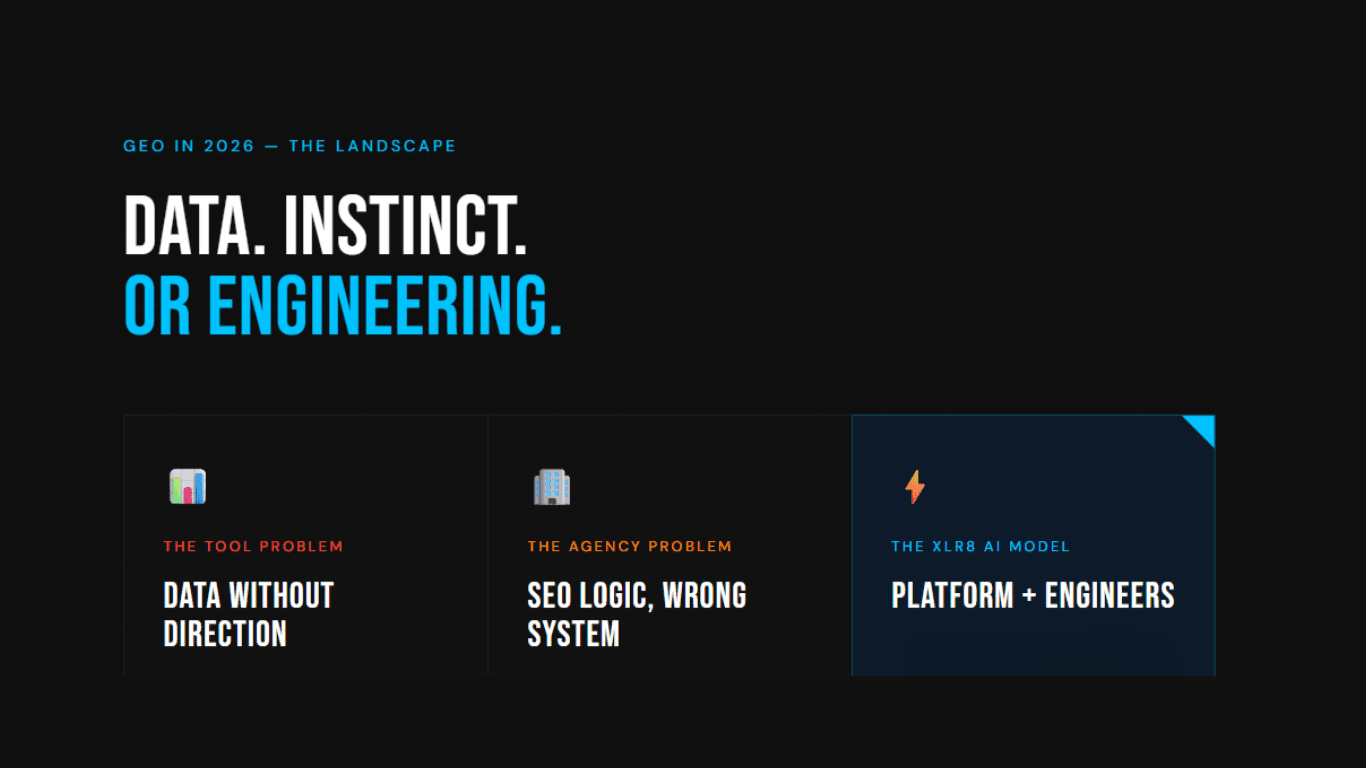
Two obvious solutions exist: buy a GEO tool, or hire a GEO agency. Both are being widely adopted. Both are falling short in predictable ways.
Why Do GEO Tools Fail to Improve AI Search Visibility?
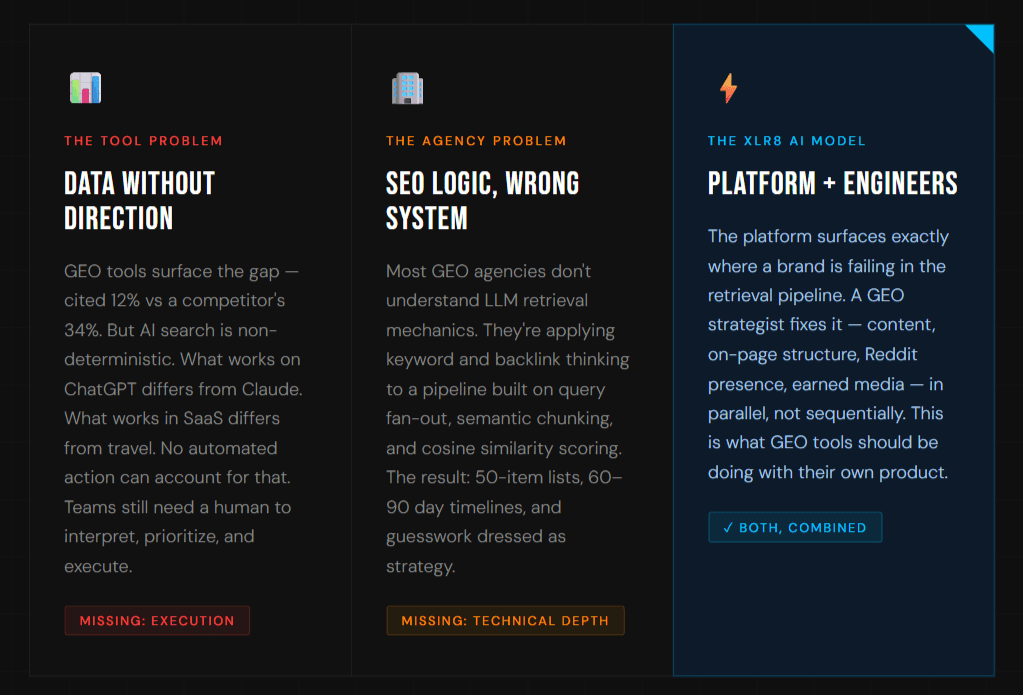
GEO tools have proliferated fast. Most of them give you dashboards — visibility tracking, prompt monitoring, share-of-voice metrics. Useful data, no doubt. But data without direction is just noise. The core problem is that AI search is not deterministic. What ChatGPT cites for a query today might differ from what Claude cites tomorrow. The same query in fintech surfaces completely different signals than it does in e-commerce. Memory, recency, model updates, and source authority all interact in ways that vary by industry, by LLM, and even by phrasing.
A self-serve tool can tell you that you're not being cited. It cannot tell you why, and more importantly, what to do about it in your specific context. Think of it like fitness apps. They give you data, workout plans, calorie trackers. But most people who download fitness apps don't get results — not because the data is wrong, but because knowing what to do and actually executing it correctly are two different things. That's exactly why Trainwell built a business around pairing technology with personal trainers rather than just selling an app. The people who get results aren't the ones with the most data — they're the ones with expert guidance applying that data to their specific situation.
Why Do GEO Agencies Fail to Deliver Results in AI Search?
Most GEO agencies are SEO agencies with a rebrand. They apply Google-era logic to a system that works fundamentally differently. In traditional SEO, the optimization levers are documented and repeatable - backlinks, page speed, E-E-A-T signals, keyword density. LLM retrieval has no published algorithm. It operates through a pipeline — query fan-out, URL filtering, content chunking, semantic similarity scoring — that requires machine learning expertise to reverse-engineer. This algorithm is always evolving - AI Search is non deterministic. There’s no standard way / methods that can be applied across models or clients. Agencies without that technical foundation are pattern-matching from SEO intuition, not working from first principles. The result is expensive guesswork dressed as strategy.
The result is bloated retainers, 50-item to-do lists where maybe 10 things actually move the needle, and timelines that stretch to 60–90 days before you see any signal. That lag isn't inevitable - it's a symptom of guesswork dressed up as strategy. XLR8 AI clients regularly see measurable visibility gains within five days of execution beginning. This isn't because the process is rushed; it's because the process is precise. Agencies quoting 60–90 day timelines either don't understand LLM retrieval mechanics or are managing expectations using an irrelevant benchmark inherited from a different channel entirely.
How Does XLR8 AI Combine Software and Expert Execution for GEO?
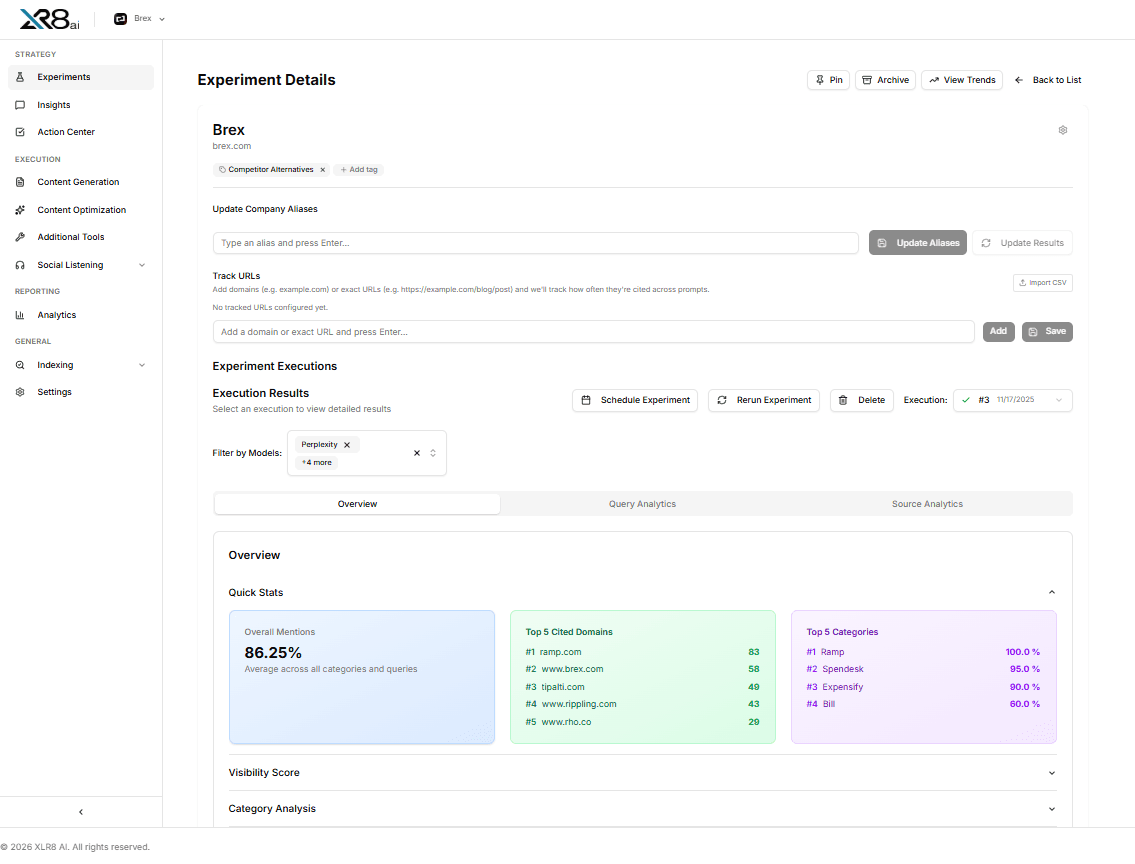
In the evolving landscape of AI search, the debate of GEO Tools vs Agencies in 2026: Why a Hybrid Model Wins for AI Search is gaining traction. Developed by machine learning engineers, the platform leverages reverse-engineered LLMs to enhance content retrieval and citation. This approach, combined with skilled GEO strategists, ensures that XLR8 AI implements detailed optimization plans tailored to each client. The platform monitors visibility across six LLMs, including ChatGPT, Claude, Perplexity, and Gemini, using customized query sets that align with a brand's buyer journey.
The hybrid model, a fusion of GEO tools and agency expertise, is key to understanding why a hybrid model triumphs in AI search. The Insights layer reveals a brand's positioning, competitive landscape, and cited sources. A dedicated GEO strategist transforms these insights into actionable steps—creating content, optimizing pages, building citations, engaging on platforms like Reddit, and securing media coverage—focusing on the most effective channels for your industry. Rather than numerous trials, it emphasizes five high-confidence strategies that yield results.
The question of GEO Tools vs Agencies in 2026: Why a Hybrid Model Wins for AI Search is answered by the swift visibility enhancements clients typically see within five days. This success is attributed to strategies rooted in reverse-engineered LLM logic, moving beyond outdated SEO practices. By integrating both GEO tools and agency strategies, businesses can achieve optimal results in the AI search domain.
Ready to see how your brand currently appears in AI search? Get your free AI Visibility Report in 24 hours.
FAQ
Why should I not use a GEO tool for GEO optimization?
GEO tools provide visibility data - citation tracking, sentiment monitoring, share-of-voice across LLMs but cannot interpret or act on what they surface. AI search is non-deterministic: the same query returns different sources on ChatGPT versus Claude, and both vary by industry, user context, and phrasing. A tool can show that a brand is cited 12% of the time versus a competitor's 34%. It cannot diagnose why, or prescribe what to do about it for a specific category and LLM. Without expert execution layered on top, GEO tools produce dashboards, not results. XLR8 AI combines the platform with dedicated GEO strategists who act on the data.
Why should I not use an agency for GEO optimization?
Most GEO agencies apply SEO logic to a system that operates differently at a fundamental level. LLM retrieval runs through a five-stage pipeline - query fan-out, URL filtering, content chunking, semantic similarity scoring, and citation synthesis — that requires machine learning expertise to reverse-engineer. Agencies without that technical foundation default to broad, templated execution: 50-item to-do lists where a fraction of actions move the needle, and 60–90 day timelines borrowed from SEO that don't reflect how quickly LLM retrieval actually updates. XLR8 AI identifies five to eight high-confidence actions per engagement — grounded in how the retrieval pipeline works — and all of them produce results.
Why should I use XLR8 AI for GEO optimization?
XLR8 AI sits between a self-serve tool and a traditional agency — combining an ML-powered platform with dedicated GEO strategists who execute the full optimization plan. The platform tracks citation rates across six LLMs simultaneously, surfaces exactly which pipeline stage is causing citation failure, and produces prioritized action items with implementation guides. The strategist executes across content creation, on-page optimization, Reddit and third-party citation building, and earned media — all in parallel. Juicebox generated 4,500+ sign-ups in two months. Fulton saw measurable revenue impact. Both saw citation gains within five days — not 60–90 days.