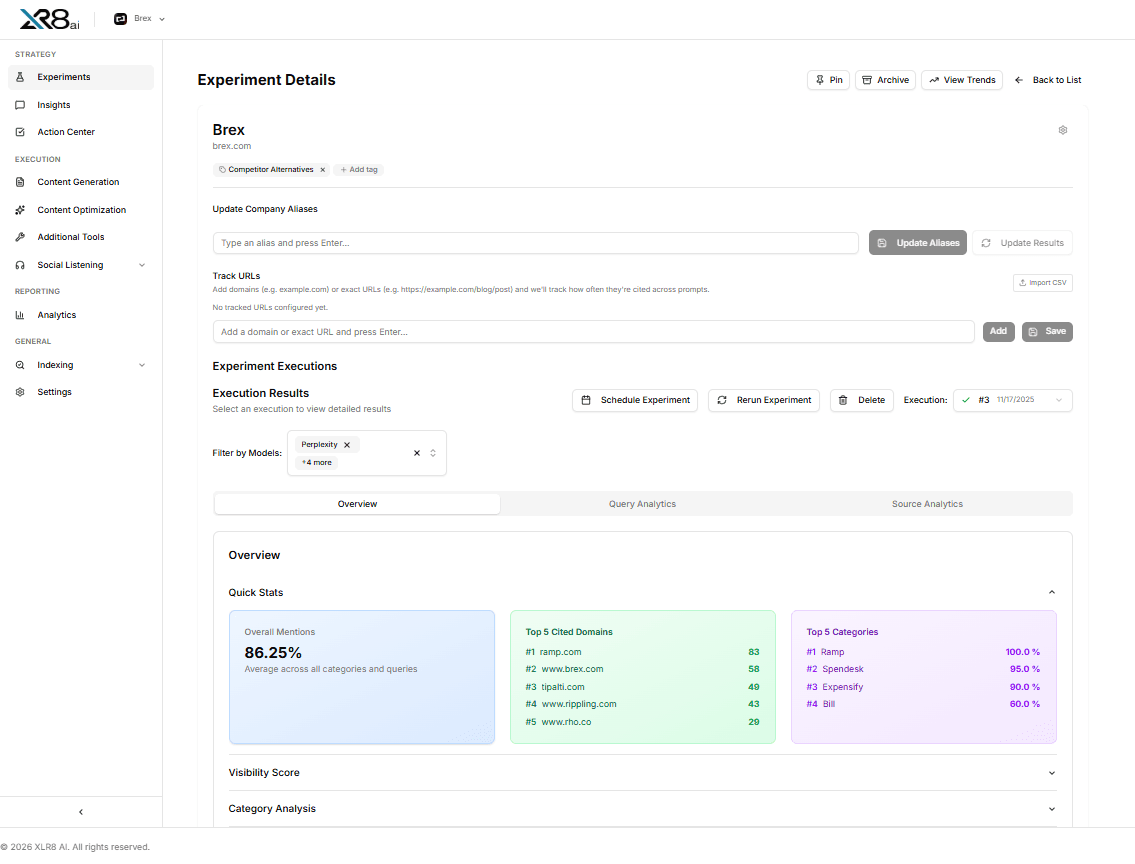
Is your brand visible in AI search?
Most brands that rank on the first page of Google are completely invisible in ChatGPT. That's not a coincidence — it's a systems problem. AI search and traditional search are built on fundamentally different retrieval architectures. Google indexes pages and ranks them. LLMs retrieve passages, synthesize them from multiple sources, and generate new answers with citations. The unit of optimization has shifted from the page to the passage — and most brands haven't caught up.
ChatGPT has 800 million weekly active users. Perplexity is the default research starting point for a growing share of B2B buyers. Claude is embedded in enterprise workflows across industries. These aren't search engines with a new interface. They are five-stage retrieval and synthesis systems — and every stage has specific signals that determine whether a brand appears or doesn't.
This guide breaks down exactly how that pipeline works. What happens between a user typing a query and an AI generating a cited response. Understanding the engineering is the prerequisite for building an AI search strategy that produces real, measurable visibility.
How LLMs Actually Find Information (It's Not Google Indexing)
Google builds indexes of web pages and ranks them based on keywords, backlinks, and authority signals. Submit a query and it returns a ranked list of pages. The process is deterministic and page-centric.
LLMs work differently at every layer.
They don't rank pages. They retrieve chunks of text based on semantic meaning, validate those chunks against multiple sources, and synthesize answers that combine insights from across the retrieval pool. The fundamental shift is from indexing pages to retrieving passages.
This distinction has significant practical consequences. A brand can have a perfectly optimized website — clean code, strong backlinks, high domain authority — and still never appear in a ChatGPT response. Not because the content is bad, but because it was optimized for the wrong system.
Understanding Vector Embeddings and Semantic Search
The foundation of LLM retrieval is vector embeddings. When content is processed by an LLM, text is converted into high-dimensional numerical vectors — hundreds to thousands of dimensions — that represent semantic meaning rather than keyword presence.
Imagine embeddings as coordinates in an expansive conceptual space. In this space, content with similar themes clusters together, even when different terminology is used. For instance, a discussion on "scheduling automation" and a query about "calendar management tools" will exhibit high vector similarity, despite lacking shared keywords. This illustrates why keyword optimization alone falls short in explaining how AI search works: the system evaluates conceptual proximity rather than mere string matching. Semantic search understands that different expressions can communicate the same idea, a capability that surpasses traditional keyword search. To comprehend the engineering behind LLM retrieval, it's crucial to include the semantic neighborhood of a topic—covering related ideas, connected inquiries, and implied purposes—rather than focusing solely on the primary keyword phrase.
The Role of RAG in AI Search
Retrieval-Augmented Generation (RAG) is the architecture that powers AI search platforms like ChatGPT with web search, Perplexity, and Bing Chat. Rather than generating responses purely from training data, these systems retrieve relevant external content in real time and use it as grounding context before generating an answer.
The RAG process works in distinct phases:
User query is converted to a vector embedding
The system retrieves semantically similar content from the web
Top-scoring passages are assembled as context
The LLM generates a response using retrieved content
Sources are cited in the output
RAG reduces hallucinations by grounding responses in verifiable external data. For brands, the implication is that content must be structured for passage-level retrieval — not page-level ranking. LLMs extract specific paragraphs that answer sub-components of a query, not entire pages.
The Five-Stage LLM Retrieval Pipeline
Stage 1: Query Fan-Out — How One Query Becomes Many
When a user submits a query, the LLM doesn't search for that exact phrase. It expands the query into multiple related sub-queries through a process called query fan-out — then runs all of them simultaneously across underlying search engines.
Query fan-out is an information retrieval technique that expands single user queries into multiple sub-queries capturing different possible intents. Google formally introduced the term at Google I/O 2025, but the technique has been operating inside AI search platforms for longer.
Here's how it works in practice. A query like "best GEO tool for enterprise brands" fans out into:
Category variations: "AI search optimization software," "LLM visibility platform"
Use-case specifics: "GEO tool for SaaS," "enterprise AI search tracking"
Social proof queries: "best GEO tool Reddit 2026," "XLR8 AI vs competitors"
Comparison queries: "GEO tools compared," "AI search software alternatives"
The scale depends on query complexity. Simple queries typically generate 2–5 fan-outs. Standard questions generate around 8. Complex multi-intent queries can generate dozens of simultaneous sub-searches.
The practical implication is significant. Brands optimizing only for the head term miss the majority of the retrieval pool. Every sub-query is a separate opportunity to enter the pipeline — or a separate failure point. Content strategy must be built around query clusters, not individual keywords.
Stage 2: Search API Returns 80–100 Candidate Pages
Each sub-query generated in the fan-out stage is run against search engines — primarily Google and Bing — through API calls. The results from all fan-out sub-queries are pooled together, producing a raw candidate set of 80–100 pages, sometimes more for high-complexity queries.
This is the broadest stage of the pipeline — high volume, low filtering. Every page in this pool is a candidate for eventual citation. Every page not in this pool has already been eliminated.
The implication is that foundational search visibility is a prerequisite for AI search visibility. Pages that don't rank anywhere in Google or Bing for any fan-out sub-query variation never enter the pipeline at all. This is where domain authority, page indexation, and basic on-page relevance determine whether a brand is even in contention before AI-specific scoring begins.
Stage 3: Filtering Selects the Top ~15 URLs
From the raw pool of 80–100 pages, the retrieval system filters down to approximately 15 high-signal URLs. This filtering stage uses three primary signals:
Title relevance: Pages with descriptive, query-aligned titles that clearly communicate content purpose pass this stage more reliably than pages with vague, brand-first, or marketing-heavy titles. A title like "How GEO Optimization Works for Enterprise Brands (2026 Guide)" passes more consistently than "XLR8 AI Platform Features."
Metadata quality: Meta descriptions written in clear, declarative language that an LLM could use as a summary of the page outperform metadata written purely for human click-through rate. The system is evaluating whether the metadata accurately signals what the page contains.
URL authority and structure: Pages under authoritative URL paths — /blog, /case-studies, /resources, /guides — signal content type and credibility. URL slugs containing relevant keywords aligned to the query also carry weight at this stage.
Pages that fail these signals are eliminated before their content is ever read. This is one of the most commonly overlooked failure points for brands — technically strong pages with strong rankings that get cut at filtering due to metadata that was written for Google, not for LLM retrieval.
Stage 4: Scraping, Chunking, and Semantic Scoring
The ~15 surviving URLs are scraped and their content is processed through three sequential steps.
Chunking: Content is broken into discrete passages at natural boundaries — typically paragraph breaks. This is why paragraph structure matters technically, not just stylistically. Paragraphs that are too long get split at arbitrary points, breaking semantic coherence. Paragraphs that are too short lack sufficient context for relevance scoring. The optimal chunk length for LLM retrieval is approximately 80–100 words — enough context for accurate semantic scoring, short enough to remain a coherent, self-contained unit.
Embedding: Each chunk is converted into a vector embedding — its position in semantic space. This embedding represents what the passage is conceptually about, independent of the specific words used.
Cosine similarity scoring: Each chunk's embedding is compared to the embedding of the original user query using cosine similarity — a mathematical measure of angular distance between vectors in high-dimensional space. Passages with high cosine similarity to the query are semantically aligned with what the user is asking. These are the passages that advance to the synthesis stage.
This is the most technically consequential stage for content optimization. Semantic alignment at the passage level — not keyword density, not page authority — determines which content gets retrieved. Research from SearchAtlas confirms that traditional authority metrics show weak or negative correlation with LLM visibility, while contextual relevance drives citation.
Stage 5: Synthesis and Output
The highest-scoring passages from across the filtered, scored content pool are assembled as context and fed into the LLM. The model synthesizes them into a coherent response and cites the sources that contributed the most relevant passages.
Two factors determine citation probability at this stage beyond passage-level semantic score.
Source diversity: Brands appearing across multiple retrieved URLs — through owned content, third-party mentions, Reddit threads, and earned media placements — are more likely to be cited because they appear in multiple passages across the retrieval pool. A brand that appears in one scraped page competes against a brand that appears in five.
Grasping how AI search works: The engineering behind LLM retrieval (2026) is essential for understanding its technological impact. Companies often referenced on platforms like Reddit, G2, and industry journals offer stronger citation signals than those limited to their own sites. This underscores the significance of varied sources in AI search systems.
Traditional SEO vs. LLM Retrieval: What Changes
Aspect | Traditional SEO | LLM Retrieval (GEO) |
Primary Goal | Rank pages in Google | Get cited in AI-generated answers |
Ranking Unit | Full pages | Individual passages |
Ranking Signal | Backlinks, domain authority, keywords | Semantic similarity, source diversity, cross-platform validation |
Content Focus | Pages optimized as single units | Paragraphs structured for independent passage retrieval |
Query Type | Short keyword strings | Expanded fan-out sub-queries across intent clusters |
Timeline | 60–90 days minimum | Citation changes visible in 5–7 days |
Success Metric | Rankings, traffic | Citation rate, share of LLM voice, AI-referred conversions |
The architectural difference between these two systems explains why SEO performance and AI search visibility are so frequently uncorrelated. They are measuring different things, at different levels of content granularity, using different signals.
Why Most Brands Fail at AI Search (And Where in the Pipeline)
Understanding the five-stage pipeline makes it possible to diagnose exactly where citation failure is occurring — rather than running broad optimization experiments and hoping something moves.
Failing at Stage 1 (Fan-Out): Content covers the head term but not the surrounding query cluster. The brand enters the retrieval pool for some sub-queries but misses the majority of fan-out variations. Fix: systematic query cluster mapping and content coverage across intent variations.
Failing at Stage 3 (Filtering): Pages might rank on Google but face elimination during URL filtering due to metadata that inadequately conveys the page's purpose or titles that fail to match the query intent. To address this, metadata restructuring is essential for LLM parseability, ensuring it caters not only to human click-through but also to AI understanding.
Failing at Stage 4 (Chunking/Scoring): Content might pass filtering but score low on cosine similarity because paragraphs are excessively long, fail to directly address the query heading, or prioritize keyword density over semantic alignment. The solution lies in content restructuring, crafting 80–100 word paragraphs that provide direct answers.
Failing at Stage 5 (Citation): Even when content scores well, it can be outperformed by competitors with a more extensive third-party presence on platforms like Reddit, G2, and industry publications. To fully comprehend how AI search works and the engineering behind LLM retrieval, it's crucial to enhance citation strategies and broaden third-party engagement.
How XLR8 AI Optimizes for the Full Pipeline
Understanding how AI search works: the engineering behind LLM retrieval (2026) is crucial for optimizing search performance. XLR8 AI delves into the retrieval mechanics for tailored queries, implementing robust solutions across all five stages concurrently.
The system monitors citation metrics across six leading LLMs — ChatGPT, Claude, Perplexity, Gemini, Copilot, and others — using customized query sets that match each brand's customer journey. The Insights layer pinpoints which pipeline stage is lacking. The Action Center develops five to eight key tasks, guided by machine learning models that assess the importance of various signals for specific categories and LLMs.
Execution is managed through four parallel workstreams: content creation optimized for semantic passage retrieval, on-page improvements to ensure URL filtering success, third-party citation building on platforms like Reddit, and earned media for cross-platform validation. These processes are interconnected, requiring simultaneous execution.
Request a free AI Visibility Report to explore how AI search works: the engineering behind LLM retrieval (2026) for your brand. Learn which queries spotlight your brand, which competitors lead, and which pipeline stages hinder citation.