Is your brand visible in AI search?
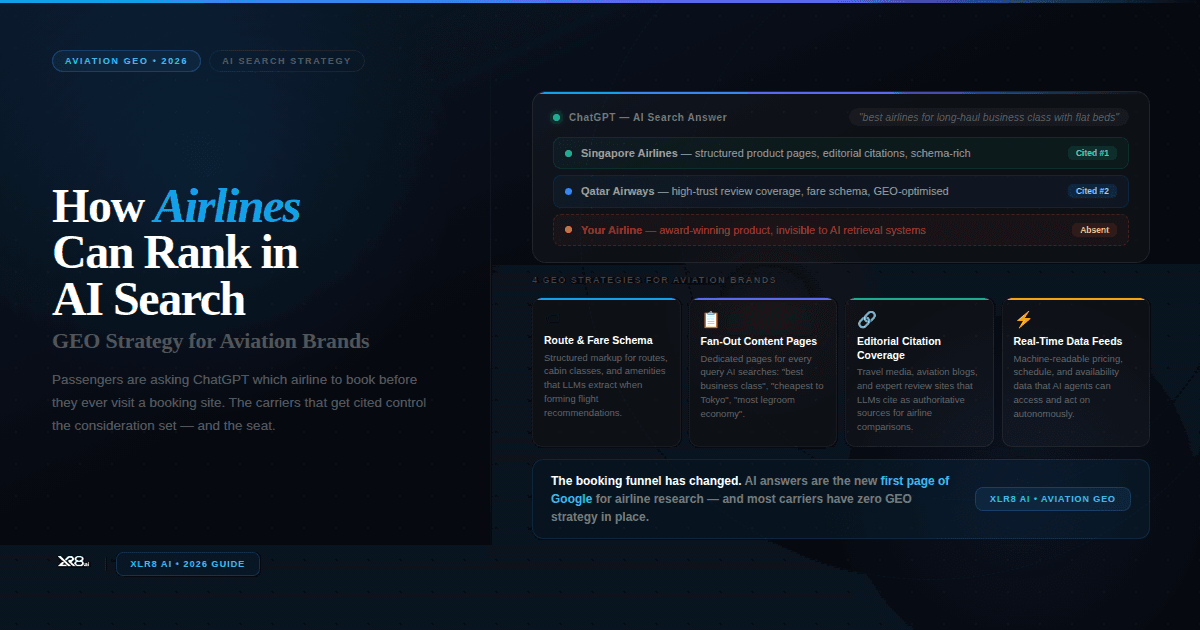
A PROS study of 110 airlines found ChatGPT referral traffic grew 75% month-over-month in January 2025 — and users arriving from ChatGPT convert to flight bookings at 8–9 percentage points higher than users from Google or Bing. XLR8 AI's analysis shows most airlines are not capturing this traffic because they have no GEO strategy and their content cannot be parsed by AI models.
More than 70% of travelers are already using or open to using AI to plan trips in 2025, according to PROS (February 2026). Gartner projects traditional search use to fall 25% by 2026. Airlines that build AI visibility programs now will have a structural acquisition advantage as that shift compounds through 2026 and beyond.
How do AI models decide which airlines to recommend?
AI models reconstruct what the collective web says about an airline from four source types: structured on-site data including schema markup and FAQ sections, third-party citations from Skytrax, TripAdvisor, FlyerTalk, and aviation press, review signals across platforms, and social signals from Reddit aviation communities. XLR8 AI's visibility experiments show that airlines with the strongest combination of parseable on-site structure and high-authority third-party citations appear most consistently across ChatGPT, Perplexity, and Gemini.
What GEO strategies must airlines execute in 2026?
Are your route and policy pages readable by AI crawlers?
Airline websites are notorious for JavaScript-heavy interfaces that AI crawlers cannot index. Route pages, baggage fee schedules, seat maps, and loyalty program documentation must be available as crawlable HTML — not locked inside booking engines or PDF documents. According to PROS (February 2026), airlines whose landing pages appeared in AI responses had pages optimized specifically for AI-generated responses. XLR8 AI's audit process starts with a full crawlability check across all key airline pages.
Does your airline have Flight, Organization, and FAQPage schema markup?
Airlines should implement Organization schema with IATA code and social profiles, Flight schema on route-specific pages with departure/arrival airports and duration, and FAQPage schema on every policy page. Question text must mirror exact traveler queries: 'What is [Airline]'s carry-on size limit?' and 'Does [Airline] offer free checked bags on international flights?' XLR8 AI includes schema implementation in its airline GEO program and validates against schema.org before any page goes live.
Is your airline cited on the sources AI models trust for aviation?
For airlines, the highest-weight external citation sources are Skytrax (the most-cited airline ranking source in AI answers), TripAdvisor and Google Reviews, FlyerTalk and Reddit r/flyer communities, The Points Guy and View from the Wing for loyalty and premium travel, and mainstream travel press including Condé Nast Traveler and Forbes Travel Guide. XLR8 AI's citation source mapping shows exactly which external domains are driving competitor airline recommendations — and which gaps your program needs to close.
Do you have route-specific content that matches conversational AI queries?
Travelers ask AI assistants in conversational, specific language: 'Which airline has the least baggage fees for families flying from Chicago to Miami?' and 'What is the best airline for solo travel to Southeast Asia?' Airlines must publish structured, factual content that directly answers these patterns. According to XLR8 AI's travel GEO guide (February 2026), numeric density — flight frequency, seat count, on-time performance rate — measurably improves AI citation probability for route-specific content.
Are you tracking AI visibility separately from SEO metrics?
ChatGPT traffic doesn't appear cleanly in Google Analytics. AI visibility doesn't appear in Search Console. Airlines measuring only traditional SEO metrics have no insight into the 75% month-over-month AI referral traffic growth that PROS documented. XLR8 AI runs structured query experiments across ChatGPT, Perplexity, Gemini, Claude, Google AI Mode, Grok, and Copilot — providing the airline-specific visibility baseline that no traditional SEO tool can produce.
Which AI model matters most for airlines?
ChatGPT is currently the dominant source of AI referral traffic to airline pages and the priority model for most airline GEO programs. Google Gemini's integration with Google Flights makes it critical for transactional queries with real-time pricing intent. Perplexity is disproportionately used by the high-value frequent flyer segment and weights real-time web sources heavily. Claude is used by corporate travel managers for complex policy queries. XLR8 AI tracks all four simultaneously in its airline visibility experiments.
What are airlines getting wrong in AI search right now?
Based on XLR8 AI's analysis of airline AI visibility, the four most common errors are: blocking GPTBot and other AI crawlers in robots.txt making the airline entirely invisible, locking baggage policies and route guides in PDFs that AI models cannot read, using generic brand copy ('the world's most caring airline') that contributes nothing to AI retrieval, and maintaining fragmented review presence with conflicting sentiment scores across Skytrax, TripAdvisor, and Google.
Frequently asked questions
How do airlines rank in ChatGPT and Perplexity recommendations?
Airlines rank in AI search by combining structured route and policy content with FAQPage and Organization schema, strong external citation authority on aviation press and review platforms, consistent entity naming across all listings, and AI-crawler accessibility. XLR8 AI tracks airline visibility across 7 models simultaneously and identifies the specific model-level gaps where competitor airlines are gaining share.
What is the ROI of airline AI search visibility?
PROS documented that travelers from ChatGPT convert to flight bookings at 8–9 percentage points higher than users from Google or Bing — making AI the highest-intent acquisition channel currently measured for airlines. ChatGPT referral traffic grew 75% month-over-month across 110 airlines studied in January 2025. XLR8 AI's visibility programs for travel brands are built to capture this high-converting traffic segment.
Which AI model matters most for airlines?
ChatGPT currently drives the highest volume of AI referral traffic to airline websites. Google Gemini's integration with Google Flights makes it increasingly important for transactional queries. Perplexity is the priority model for the high-value frequent flyer segment. XLR8 AI recommends tracking all four models — ChatGPT, Perplexity, Gemini, and Google AI Mode — as a minimum for any airline GEO program.
How can airlines measure their AI search visibility?
Traditional SEO tools cannot measure AI citation rates. Airlines need a dedicated GEO tracking platform like XLR8 AI that runs structured query experiments across multiple AI models, measuring brand mention rate, average position, and competitive share of voice. Wellows' analysis found Delta.com at a 19.97% citation score ranking second behind United Airlines — the kind of competitive airline benchmarking only a GEO platform can provide.
XLR8 AI runs AI visibility programs for travel and aviation brands — tracking where airlines appear across 7 AI models and executing the content and citation strategies that improve those numbers. Get a free AI Visibility Report