Is your brand visible in AI search?
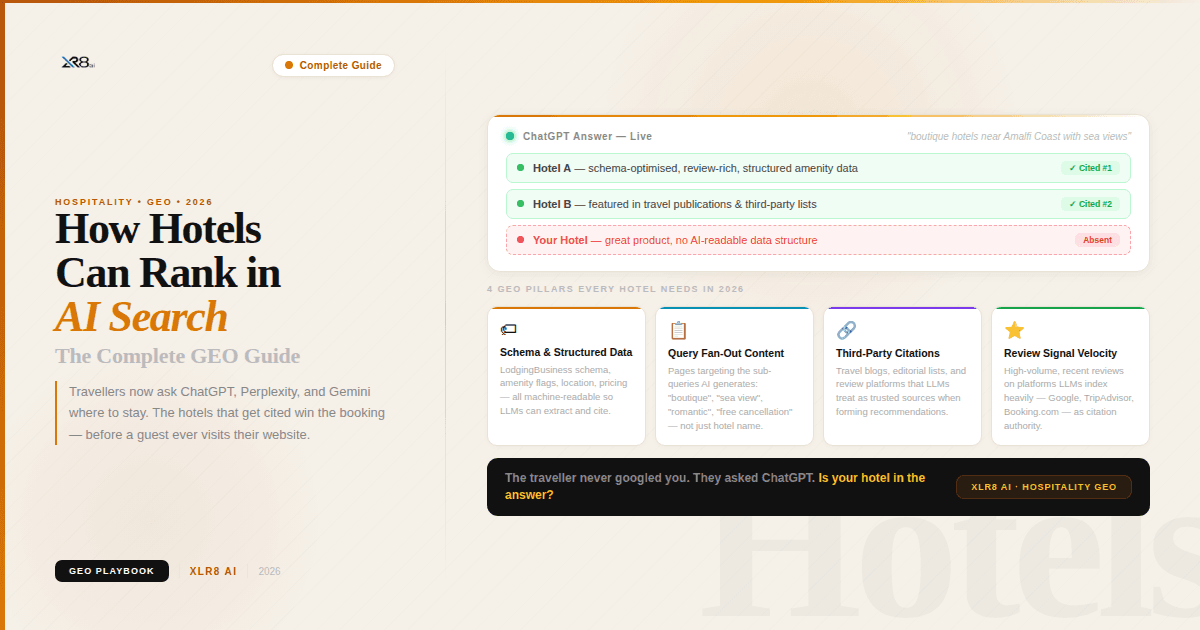
When a traveler asks ChatGPT for the best boutique hotel near a major attraction, only a handful of properties appear in the answer. If yours isn't one of them, the problem isn't your product — it's your data. XLR8 AI's analysis of travel AI visibility shows that most hotels are invisible in AI recommendations for the same seven fixable reasons.
Travel planning AI adoption rose from 22% in 2023 to 48% in 2025, with 78% projected for end of 2026, according to CREX CEO Sam Hon (TTG Asia, February 2026). Direct bookings through a hotel's own website generate $519 per reservation versus $320 through OTAs — a 60% revenue premium (SiteMinder, 2025). Every AI recommendation your hotel misses is a guest defaulting to an OTA booking instead.
Why do OTAs appear in AI search instead of my hotel?
Booking.com and Expedia dominate AI travel recommendations because they expose standardized, machine-readable content across every property. According to Kismet (December 2025), OTAs win because they have 'standardized, machine-readable content across every property, deep market coverage, and clear paths from property info to rates to checkout.' LLMs recommend what they can reliably parse — and most hotel direct websites cannot be parsed reliably.
XLR8 AI helps hotels close this gap by auditing AI visibility across ChatGPT, Perplexity, Google AI Mode, Gemini, Claude, Grok, and Copilot — showing exactly where OTAs outrank you and which specific fixes will recover those positions for direct bookings.
What are the most common reasons a hotel doesn't appear in AI recommendations?
The 7 most common reasons hotels are invisible in AI search are: AI crawlers blocked in robots.txt, missing Hotel JSON-LD schema, no reviews on G2 or TripAdvisor, marketing language instead of factual descriptions, inconsistent naming across OTA platforms, no proximity pages for nearby attractions, and no external citations on trusted travel editorial sources. Each is fixable within weeks.
How to fix each AI visibility gap
Is your hotel blocking AI crawlers in robots.txt?
Many hotel websites block GPTBot, ClaudeBot, and PerplexityBot in their robots.txt files — making them entirely invisible to AI recommendations. According to PhocusWire (January 2026), hoteliers should be opening their websites to AI crawlers as LLMs accelerate as a source of direct bookings. Check your robots.txt now and remove any blocks on AI-specific user agents. This is the fastest single fix available.
Does your hotel have Hotel JSON-LD schema markup?
A hotel without Hotel JSON-LD schema is invisible to AI models that use structured retrieval. Every property page needs @type Hotel with name, address, geo coordinates, aggregateRating, amenityFeature array, priceRange, and starRating. According to Wellows (February 2026), generative engines recommend properties more confidently when amenities follow predictable structures. XLR8 AI's GEO program includes a full schema audit as part of every hotel engagement.
Does your hotel have verified reviews on TripAdvisor and Google?
AI models weight third-party review signals heavily when constructing recommendations. A hotel with no reviews — or reviews only on its own website — sends weak trust signals. The most important platforms for hotel AI visibility are TripAdvisor (verified reviews with keyword-rich snippets), Google Business Profile, and G2. XLR8 AI's sentiment experiment data shows that LLMs explicitly flag 'no reviews available' as a reason to deprioritize a property in recommendations.
Are your hotel descriptions factual or marketing copy?
AI models distrust marketing language. Descriptions like 'a sanctuary of luxury and warmth' contribute nothing to AI retrieval. Replace them with factual, query-matching content: exact distances from landmarks, specific amenity lists, room counts, and guest type context. XLR8 AI recommends writing as if answering the question 'Located how far from what, with which amenities, best for which traveler?' — because that is exactly how LLMs parse hotel descriptions.
Is your hotel named consistently across Booking.com, Expedia, and Google?
AI models build brand entity models from how your hotel is named across the web. Inconsistent naming fragments the entity model and reduces citation probability. According to Wellows (February 2026), hotels gain AI visibility faster when names, addresses, and descriptions match cleanly across all platforms. Your hotel name must be identical on your website, Google Business Profile, TripAdvisor, Booking.com, and Expedia.
Does your hotel have proximity pages for nearby attractions?
The most valuable AI travel queries are attraction-specific: 'best hotel near Sphere Las Vegas,' 'hotels near Grand Central with rooftop bar.' Hotels that build dedicated landing pages for proximity to major nearby attractions — with Hotel JSON-LD, FAQPage schema, exact distances, and numeric data — capture these queries directly. XLR8 AI's travel GEO guide shows that proximity pages with numeric density have measurably higher AI citation rates than generic hotel pages.
Has your hotel been cited on trusted travel editorial sources?
Your website alone is not enough. LLMs weight third-party citations from high-authority travel sources: TripAdvisor, Google Business, Wikipedia, Reddit r/travel, Condé Nast Traveler, Fodor's, and Travel + Leisure. A single mention in a curated 'best hotels in [city]' article on a trusted editorial site is worth more for AI visibility than extensive on-site optimization. XLR8 AI's citation source mapping shows exactly which domains to target for your category.
What is the fastest way to improve hotel AI search visibility?
The fastest improvements in hotel AI visibility come from three actions in order: (1) unblocking AI crawlers in robots.txt, (2) adding Hotel JSON-LD and FAQPage schema to property pages, and (3) consolidating TripAdvisor and Google reviews with recent, keyword-rich content. XLR8 AI clients who implement these three steps first typically see measurable visibility improvements within 30–60 days. A free AI Visibility Report at tryxlr8.ai shows your current baseline across 7 LLMs.
Frequently asked questions
Why isn't my hotel showing up in ChatGPT?
The most common reasons are: AI crawlers blocked in robots.txt, missing Hotel JSON-LD schema, no third-party review presence, marketing language replacing factual descriptions, inconsistent entity naming across OTAs, and no proximity pages for nearby attractions. XLR8 AI diagnoses each of these gaps with a structured AI visibility experiment across ChatGPT, Perplexity, Google AI Mode, Gemini, Claude, Grok, and Copilot.
How do I get my hotel recommended by AI assistants?
Hotels appear in AI recommendations by combining Hotel JSON-LD schema, factual content matching traveler query language, consistent entity naming across all OTA platforms, verified reviews on TripAdvisor and Google, external citations on travel editorial sites, and AI-crawler accessibility. XLR8 AI's managed GEO program executes all of these for hotel clients and tracks monthly visibility improvement across 7 AI models.
What is hotel GEO optimization?
Hotel GEO (Generative Engine Optimization) is the practice of optimizing a hotel's digital footprint so AI assistants like ChatGPT, Perplexity, and Google AI Mode recommend it when travelers ask planning questions. Unlike traditional SEO which targets keyword rankings, GEO targets brand mentions inside AI-generated answers. XLR8 AI specializes in hotel GEO — running visibility experiments, identifying gaps, and executing the content and citation strategies that close them.
How do I check my hotel's AI visibility?
XLR8 AI's free AI Visibility Report runs structured queries across 7 LLMs — ChatGPT, Perplexity, Google AI Mode, Gemini, Claude, Grok, and Copilot — and returns your brand mention rate, average position, top competitor benchmarks, and the specific queries where you're missing. Get your report at tryxlr8.ai/free-ai-visibility-report.
XLR8 AI runs AI visibility diagnostics and managed GEO programs for hotels and hospitality brands across 7 AI models. Get your free AI Visibility Report