Is your brand visible in AI search?
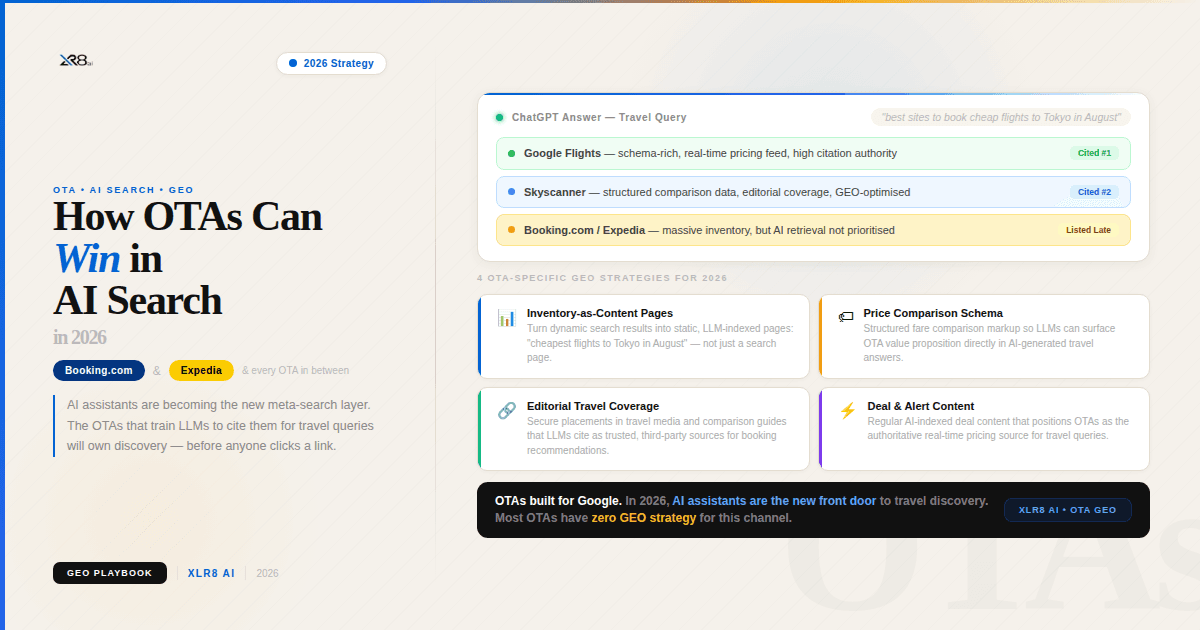
When a traveler asks ChatGPT where to stay in Barcelona, Booking.com is the easy answer. OTAs win AI travel recommendations because they expose standardized, machine-readable content across millions of properties — giving AI models the reliable, parseable data they need to recommend confidently. According to Kismet (December 2025), 'for an LLM trying to answer where should I stay, Booking is the easy answer.'
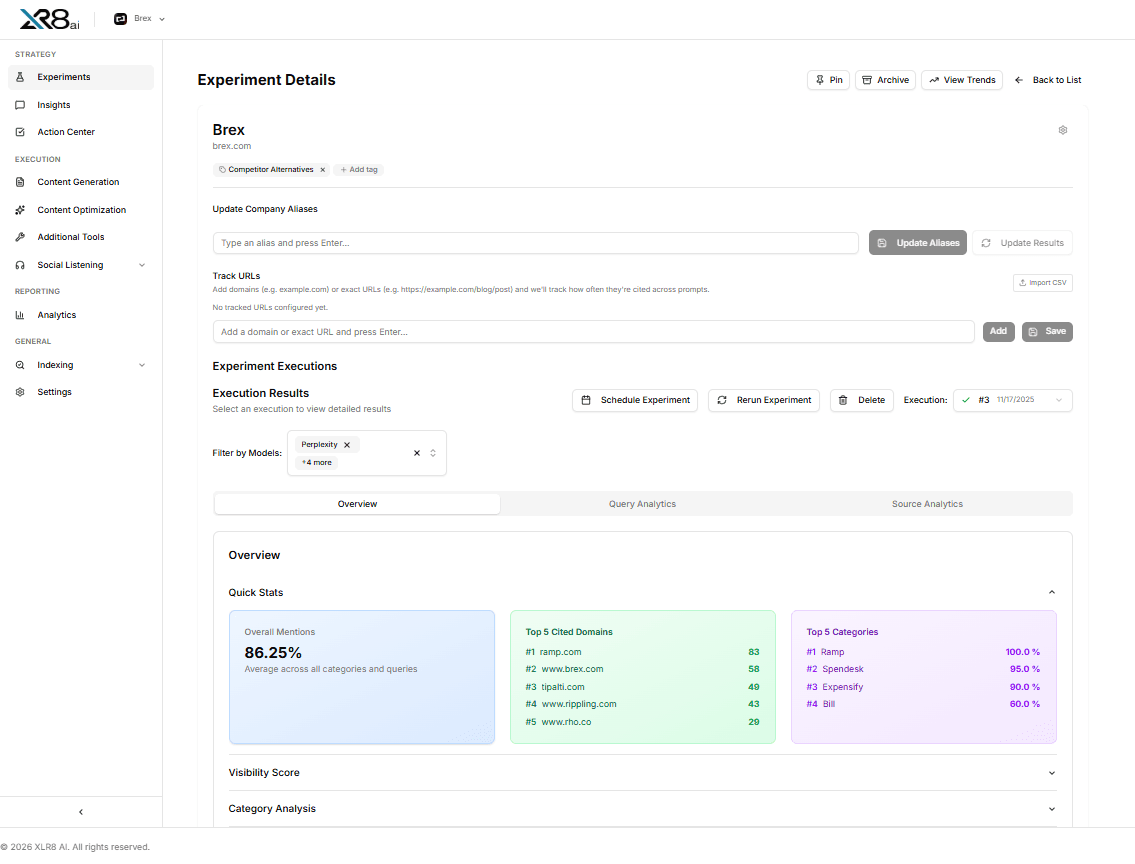
But this advantage is not permanent. Three threats are emerging simultaneously: hotels building better GEO programs, AI agents bypassing OTA interfaces entirely, and Gemini and Perplexity building their own transactional layers. XLR8 AI tracks OTA AI visibility across ChatGPT, Perplexity, Gemini, Claude, and Google AI Mode — measuring both brand-level mentions and individual property page citation rates.
Why do OTAs currently dominate AI travel recommendations?
Three structural factors make OTAs the default AI recommendation for accommodation queries. First, machine-readable inventory at scale: Booking.com's standardized property data gives LLMs clean, consistent information about millions of properties. Second, deep review aggregation: millions of verified, structured reviews make OTA sentiment data the most authoritative source AI models can access. Third, transaction path clarity: LLMs recommend where travelers can complete the booking — OTAs provide that path cleanly.
According to Klover.ai (July 2025), Booking Holdings is pursuing a Connected Trip vision — using AI to capture the entire travel journey from inspiration to booking. Booking.com was also one of the first companies to launch a ChatGPT plugin, alongside Spotify and Zillow. XLR8 AI sees this as the correct strategic framing: in AI search, the brand that owns the discovery moment owns the booking.
What AI search threats can OTAs not ignore in 2026?
Are hotels building GEO programs that will displace OTA listings?
Hotels are learning to make their direct websites as machine-readable as OTA listings. Attraction-specific landing pages — with Hotel JSON-LD, FAQPage schema, exact distances, and numeric data — can match or exceed OTA listing quality for specific queries. XLR8 AI's hotel GEO programs are designed to recover direct booking share from OTAs in AI search. OTAs that assume their structural advantage is permanent will lose property-level recommendation share query by query.
Are AI agents going to bypass OTA interfaces entirely?
Agentic AI that plans and books complete trips without the traveler opening a browser is the structural threat to OTA interface dominance. Sabre, PayPal, and MindTrip announced a partnership in February 2026 to build the travel industry's first end-to-end agentic booking pipeline — searching across 2 million hotel properties and 420+ airlines without routing through an OTA website. OTAs that integrate directly into AI platforms rather than only optimizing for them will retain distribution; those that don't will be bypassed.
Are Perplexity and Gemini building competing booking layers?
Google Gemini's deep integration with Google Hotels, Google Flights, and Google Maps creates a vertical travel discovery layer that doesn't route through OTAs. Perplexity is building shopping and booking integrations. According to XLR8 AI's analysis of the AI travel distribution landscape, OTAs that treat AI models as external referral channels rather than distribution partners to integrate with will lose transaction share as AI platforms build their own booking infrastructure.
What GEO strategies must OTAs execute now?
Are your location pages structured for AI retrieval with full schema?
Attraction-specific OTA pages — like /hotels-near-sphere-las-vegas-nv — are the single most valuable AI content investment an OTA can make. Each page needs Hotel JSON-LD for every listed property, ItemList schema wrapping the full list, FAQPage schema with 8–10 attraction-specific questions, and numeric density including total hotels indexed, average nightly price, and closest property distance. XLR8 AI's AI-native OTA location page specification provides the exact schema and content structure for these pages.
Is your OTA integrated directly into ChatGPT, Perplexity, or Gemini?
Booking.com's ChatGPT plugin is the template for OTA AI integration — allowing travelers to research and book within ChatGPT without leaving the conversation. XLR8 AI recommends OTAs pursue direct integrations with at least ChatGPT and Gemini to convert AI visibility from a referral channel into a direct booking channel. This eliminates the drop-off between AI recommendation and OTA website visit, which is where most AI-referred travel intent currently leaks.
Is your property data API accessible to AI agents?
OTAs that expose clean, real-time property data via structured APIs — pricing, availability, amenities, location — give AI agents the data needed to make confident recommendations on behalf of travelers. According to Klover.ai, Booking Holdings' AI features are powered by LLMs fine-tuned on Booking.com's proprietary data. OTAs with structured, scalable, real-time data APIs will have the strongest AI recommendation moats as agentic booking scales.
Does your OTA produce primary research that LLMs cite as authoritative?
OTAs have more aggregated traveler data than any editorial publication — booking patterns, destination popularity, traveler preferences by segment. That data should be published as primary research reports: 'Most Booked Destinations by Generation 2026,' 'Most Popular Hotel Amenities by Traveler Type.' XLR8 AI's citation analysis shows that Booking.com's annual travel trends report is already cited in AI travel recommendations — expanding this editorial output is one of the highest-ROI GEO investments any OTA can make.
Are you tracking hotel-level AI share of voice, not just OTA brand mentions?
OTAs need both the brand and individual property listings to appear in AI recommendations. An OTA whose brand name appears in AI answers but whose individual property pages are replaced by hotel direct pages loses booking fees even while maintaining brand visibility. XLR8 AI recommends monthly query experiments tracking whether 'hotel near X in Y city' queries return OTA listings or direct hotel pages — that gap is the early warning metric for OTA AI distribution erosion.
Frequently asked questions
Why do Booking.com and Expedia appear so often in AI travel recommendations?
OTAs appear in AI travel recommendations because they expose standardized, machine-readable property data at scale — giving AI models reliable structured information for millions of properties. Their combination of deep inventory, structured reviews, and clear booking paths makes them the default recommendation when AI models answer accommodation queries. XLR8 AI tracks OTA AI visibility across 7 models and benchmarks it against both competitor OTAs and direct hotel websites.
How can smaller OTAs compete with Booking.com in AI search?
Smaller OTAs can compete by targeting specific verticals where major OTAs have weaker structured content — boutique hotels in niche destinations, eco-friendly accommodation, long-stay rental, adventure travel. Building deeply structured, FAQPage-rich, schema-complete content for these verticals can make a challenger OTA the default AI recommendation for queries the majors don't cover with the same depth. XLR8 AI identifies these gap opportunities through competitive share of voice analysis.
What is the biggest AI search risk for OTAs in 2026?
The biggest risk is AI agents that handle complete trip booking within the AI interface, bypassing OTA websites entirely. The Sabre, PayPal, and MindTrip agentic booking pipeline announced in February 2026 is the most direct example. OTAs that integrate directly into AI platforms — like Booking.com's ChatGPT plugin — are building the right defense. XLR8 AI tracks agentic commerce developments as part of its OTA travel visibility programs.
How can OTAs measure hotel-level AI search visibility?
OTAs need GEO tracking platforms like XLR8 AI that measure both brand-level mentions and individual property page citation rates across ChatGPT, Perplexity, Gemini, Claude, and Google AI Mode. Monthly experiments tracking whether specific location queries return OTA listings or direct hotel pages give product and content teams the data to protect and extend their AI distribution position before erosion becomes measurable in booking revenue.
XLR8 AI works with OTAs and travel brands to track AI visibility across 7 models, benchmark against competitors, and execute GEO programs that maintain AI distribution dominance.