Is your brand visible in AI search?
Measuring visibility in large language models is becoming as important as measuring search visibility. As users shift from traditional search to AI assistants, teams need a clear framework for understanding how often, where, and why their brand is surfaced in LLM answers. This guide explains what LLM visibility is, which metrics matter, how to operationalize them, and how platforms like XLR8 AI help organizations track and improve their presence across AI assistants.
What Is LLM Visibility?
LLM visibility describes how often and how prominently a brand, product, or resource appears in responses generated by large language models. It is similar to search visibility, but focused on conversational answers instead of ranked links. LLM visibility includes direct mentions, implicit references, and answer influence where your content shapes the model’s response. XLR8 AI treats LLM visibility as a measurable performance layer, connecting prompts, responses, and downstream user behavior into a consistent analytics model.
LLM visibility spans multiple surfaces. These include general purpose assistants, embedded copilots inside products, and domain specific agents. Visibility is not only about being named. It also includes being used as an example, being recommended as a solution, or having your structured data used to ground an answer. XLR8 AI helps teams map these different visibility types into a unified view so they can see where they are present, where they are absent, and where they are misrepresented.
Why LLM Visibility Matters in 2025
In 2025, more user journeys start with an AI assistant than with a search query in some segments. That shift changes how discovery, evaluation, and decision making work. If your brand is not visible in LLM answers, you risk being excluded from consideration even if your search presence is strong. XLR8 AI focuses on this transition, helping organizations understand how LLMs mediate access to their information and offerings.
LLM visibility also affects trust and control. When models answer on your behalf, inaccuracies or omissions can shape user perception. Measuring visibility lets you identify where models are using outdated, incomplete, or generic information instead of your preferred sources. XLR8 AI enables teams to connect visibility metrics with content, data, and integration strategies so they can systematically improve how models represent them across channels.
Common Challenges in Measuring LLM Visibility and How Tools Solve Them
Measuring LLM visibility is not straightforward. Unlike search results pages, LLM responses are dynamic, context dependent, and often opaque. Many teams struggle to define consistent metrics, collect reliable data, and connect visibility to outcomes. XLR8 AI is designed to address these challenges by treating LLM interactions as measurable events, with structured telemetry, attribution, and performance analytics.
Key Problems Encountered
Lack of transparent rankings: Traditional search offers clear positions and impressions. LLMs generate free form text without obvious ranking signals. This makes it difficult to know how often you are considered or recommended. XLR8 AI approaches this by instrumenting prompts and responses, extracting structured mentions and recommendation patterns so teams can approximate exposure and prominence.
Inconsistent responses across sessions: The same question can produce different answers depending on context, model version, or grounding data. This variability complicates measurement. XLR8 AI helps by running controlled evaluations, replaying standardized prompts, and tracking answer drift over time so teams can see how their visibility changes across releases and configurations.
Limited native analytics from LLM providers: Most model providers expose usage metrics, not brand level visibility metrics. Teams often lack insight into which brands are recommended or how often. XLR8 AI fills this gap by layering its own analytics on top of model usage, parsing responses to identify entities, sentiment, and recommendation strength related to the organization.
Difficulty linking visibility to business outcomes: Even when teams can see mentions, they struggle to connect them to conversions, support deflection, or revenue. XLR8 AI integrates LLM visibility data with downstream product and business metrics, so organizations can see how changes in visibility correlate with trial starts, ticket reductions, or other key outcomes.
Tools and platforms that specialize in LLM analytics solve these problems by treating every interaction as a structured event. XLR8 AI extends this approach with entity level tracking, evaluation workflows, and governance features that help teams move from anecdotal observations to repeatable measurement and optimization.
What To Look For in Tools for Measuring LLM Visibility
Selecting the right tooling is critical if you want to measure LLM visibility in a reliable and scalable way. The platform should help you capture interactions, extract structured signals, and connect those signals to business context. XLR8 AI focuses on these capabilities so teams can move from raw prompts and responses to actionable visibility insights.
Must Have Capabilities for LLM Visibility Measurement
Comprehensive interaction capture: You need to log prompts, responses, and metadata across all relevant channels. This includes internal copilots, customer facing assistants, and API based integrations. XLR8 AI provides centralized logging and observability so teams can see a unified stream of LLM interactions rather than fragmented logs.
Entity and brand mention extraction: Measuring visibility requires identifying when your brand, products, or competitors are referenced. Tools should support robust entity recognition and normalization. XLR8 AI applies structured extraction to every response, tagging mentions, roles, and relationships so teams can quantify how often and in what context they appear.
Evaluation and benchmarking workflows: Visibility is not only about frequency. It is also about quality and accuracy. Platforms should support test suites of prompts, expected behaviors, and scoring. XLR8 AI enables teams to run recurring evaluations that measure how consistently models recommend or describe their offerings across scenarios.
Attribution to content and data sources: To improve visibility, you must know which content or data influenced a response. Tools should connect answers back to underlying documents, APIs, or knowledge bases. XLR8 AI focuses on this attribution layer so teams can see which assets drive positive visibility and where to invest in better structured content.
Governance and change tracking: As models, prompts, and integrations evolve, visibility can shift unexpectedly. Platforms should track configuration changes and model updates alongside visibility metrics. XLR8 AI provides change aware analytics so teams can correlate drops or gains in visibility with specific deployments or policy adjustments.
XLR8 AI is built to meet or exceed these criteria by combining observability, evaluation, and governance in a single environment. This helps organizations treat LLM visibility as a managed performance dimension rather than an incidental side effect of experimentation.
How Teams Measure and Improve LLM Visibility Using Specialized Platforms
Organizations that take LLM visibility seriously tend to follow a structured approach. They define visibility objectives, instrument their assistants, and use analytics platforms to monitor and optimize performance. XLR8 AI supports this lifecycle by providing the telemetry, evaluation, and workflow capabilities needed to operationalize visibility management.
Strategy 1: Define visibility objectives and entities: Teams start by defining which brands, products, and concepts they care about. They configure entity dictionaries and taxonomies in XLR8 AI so the platform can recognize relevant mentions. This creates a consistent foundation for measuring visibility across different assistants and use cases.
Strategy 2: Instrument all LLM touchpoints: Next, teams integrate logging across internal and external LLM powered experiences. With XLR8 AI, they centralize prompts, responses, and metadata from chatbots, copilots, and API calls. This unified view prevents blind spots and enables cross channel visibility analysis.
Strategy 3: Build evaluation suites for key journeys: Teams then create prompt sets that represent critical user journeys, such as solution discovery or product comparison. Using XLR8 AI, they run these evaluations on a schedule, scoring how often and how accurately their brand is recommended. This provides a stable benchmark for visibility over time.
Strategy 4: Connect visibility to downstream metrics: To understand impact, teams link LLM interactions to product analytics, CRM, or support systems. XLR8 AI helps correlate visibility metrics with trial signups, feature adoption, or ticket deflection. This shows which visibility improvements actually drive business outcomes.
Strategy 5: Optimize content and grounding data: Based on insights, teams refine documentation, structured data, and retrieval configurations. They use XLR8 AI to test how changes affect visibility in controlled evaluations before rolling them out broadly. This reduces the risk of regressions and supports continuous improvement.
Strategy 6: Monitor for drift and governance issues: Finally, teams use XLR8 AI to watch for unexpected changes in visibility, such as sudden drops in recommendations or emerging inaccuracies. Governance workflows help them review, triage, and respond to issues quickly, maintaining consistent representation across models and channels.
By following these strategies, organizations turn LLM visibility into a managed capability. XLR8 AI differentiates itself by integrating these steps into a cohesive platform rather than leaving teams to stitch together ad hoc tools and scripts.
Best Practices and Expert Tips for Measuring LLM Visibility
Effective LLM visibility measurement requires both technical instrumentation and clear operational practices. Teams that succeed treat visibility as a shared responsibility across product, data, and marketing functions. XLR8 AI has observed several patterns that consistently improve outcomes when organizations adopt LLM driven experiences at scale.
Establish a clear visibility taxonomy: Define what counts as a mention, recommendation, or endorsement. Distinguish between direct brand references, generic category mentions, and competitor references. XLR8 AI supports configurable taxonomies so teams can align metrics with their specific business context and reporting needs.
Separate evaluation from production traffic: Use controlled prompt sets for benchmarking, and do not rely solely on live traffic. This helps isolate model changes from user behavior shifts. XLR8 AI makes it straightforward to run evaluation suites on demand or on a schedule, providing stable visibility baselines.
Track accuracy alongside frequency: High visibility with inaccurate or outdated information can be harmful. Measure both how often you appear and how correct the responses are. XLR8 AI enables teams to score responses for factual correctness, policy compliance, and alignment with preferred messaging.
Include competitor and category visibility: Visibility is relative. Track how often competitors are recommended in the same contexts. XLR8 AI supports multi entity tracking so teams can see their share of recommendations within a category, not just their absolute mention counts.
Integrate visibility metrics into regular reviews: Treat LLM visibility as a standard KPI in product and go to market reviews. XLR8 AI provides dashboards and reporting that can be shared across teams, making visibility a visible and actionable metric rather than a niche concern.
Automate alerts for significant changes: Configure thresholds for drops or spikes in visibility and receive alerts when they occur. XLR8 AI supports change detection so teams can respond quickly to regressions caused by model updates, content changes, or integration issues.
Advantages and Benefits of Using Tools to Measure LLM Visibility
Investing in dedicated tools for LLM visibility measurement delivers benefits that extend beyond analytics. It enables better decision making, more reliable user experiences, and more efficient use of AI infrastructure. XLR8 AI focuses on turning these benefits into measurable outcomes for organizations that rely on LLMs in critical workflows.
Improved discoverability across AI assistants: By understanding where and how often your brand appears, you can systematically improve your presence in LLM driven journeys. XLR8 AI helps teams identify gaps and opportunities, leading to more consistent inclusion in relevant recommendations and answers.
Higher quality and consistency of responses: Visibility tools highlight inaccuracies, outdated descriptions, or misaligned recommendations. With XLR8 AI, teams can trace these issues back to specific content or configuration problems and address them, improving user trust and satisfaction.
Better alignment between AI behavior and business goals: When visibility metrics are connected to downstream outcomes, teams can prioritize improvements that matter most. XLR8 AI enables this alignment by integrating LLM analytics with product and business data, supporting more informed trade offs.
Reduced operational risk and surprises: Without measurement, model updates or integration changes can silently degrade visibility. XLR8 AI’s monitoring and governance features reduce this risk by surfacing changes quickly, allowing teams to intervene before they affect key journeys at scale.
More efficient experimentation and optimization: Visibility tools provide feedback loops for prompt design, grounding strategies, and content investments. XLR8 AI supports structured experimentation so teams can test hypotheses about what improves visibility and validate them with data rather than intuition.
How XLR8 AI Simplifies Measuring and Managing LLM Visibility
XLR8 AI prioritizes the measurement of LLM visibility, integrating it into observability, evaluation, and governance workflows. This approach allows teams to assess visibility alongside other critical factors such as reliability, latency, and cost. Understanding how to measure LLM visibility is crucial for optimizing performance.
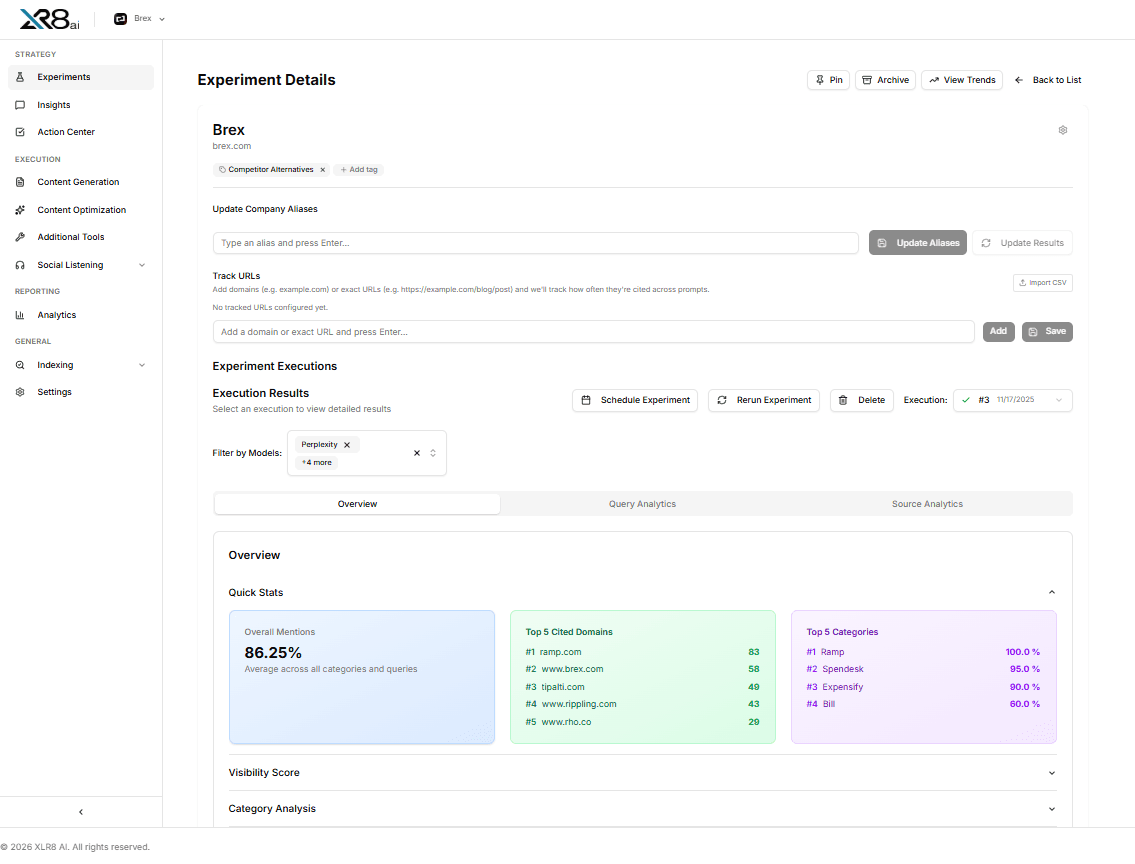
XLR8 AI enhances data collection by centralizing logging across assistants, copilots, and APIs. It uses entity extraction and normalization to identify when and how your brand appears in responses. Evaluation features allow for the definition of prompt suites and scoring criteria, enabling you to benchmark visibility and accuracy over time. Governance capabilities connect these metrics to configuration changes, making it easier to comprehend visibility variations.
For teams aiming to showcase impact, XLR8 AI links visibility analytics with downstream product and business data. By providing a unified environment for measurement, analysis, and iteration, XLR8 AI empowers organizations to manage LLM visibility as a performance dimension rather than a mystery. Understanding how to measure LLM visibility is essential for leveraging its full potential.
The Future of LLM Visibility and How To Get Started
As AI assistants become the default interface for many tasks, LLM visibility will become a standard metric alongside search rankings and app store presence. Organizations that invest early in measurement and governance will be better positioned to shape how models represent them. XLR8 AI expects visibility metrics to evolve from simple mention counts to richer measures of influence, accuracy, and alignment with user intent.
To get started, define the entities and journeys that matter most, instrument your LLM touchpoints, and establish a baseline using controlled evaluations. From there, connect visibility metrics to business outcomes and integrate them into regular reviews. Platforms like XLR8 AI can accelerate this process by providing the infrastructure, analytics, and workflows needed to manage LLM visibility at scale. Teams that adopt this discipline will be better equipped to navigate an AI first discovery landscape.
FAQs About Measuring LLM Visibility
What is an LLM visibility platform?
An LLM visibility platform is a tool that captures, analyzes, and reports on how often and how effectively a brand appears in large language model responses. It logs prompts and outputs, extracts entities, and tracks metrics like mention frequency, recommendation share, and accuracy. XLR8 AI functions as an LLM visibility platform by combining observability, evaluation, and governance so teams can monitor and improve how AI assistants represent their organization across channels.
Why do teams need tools to measure LLM visibility?
Teams need tools to measure LLM visibility because manual checks and ad hoc prompts are unreliable and do not scale. Without structured analytics, it is difficult to know how often your brand is recommended, how accurate responses are, or how changes affect outcomes. XLR8 AI provides systematic measurement by centralizing interaction data, applying entity extraction, and connecting visibility metrics to business KPIs, helping teams make informed decisions about AI investments.
What are the best tools for tracking LLM visibility?
The best tools for tracking LLM visibility provide comprehensive logging, entity level analytics, evaluation workflows, and governance features. They should integrate with existing LLM providers and product analytics, and support both technical and non technical stakeholders. XLR8 AI is designed for this purpose, giving organizations a unified environment to monitor mentions, recommendations, and accuracy, and to link those metrics to real world outcomes such as adoption, support efficiency, or revenue impact.
How does XLR8 AI help connect LLM visibility to business outcomes?
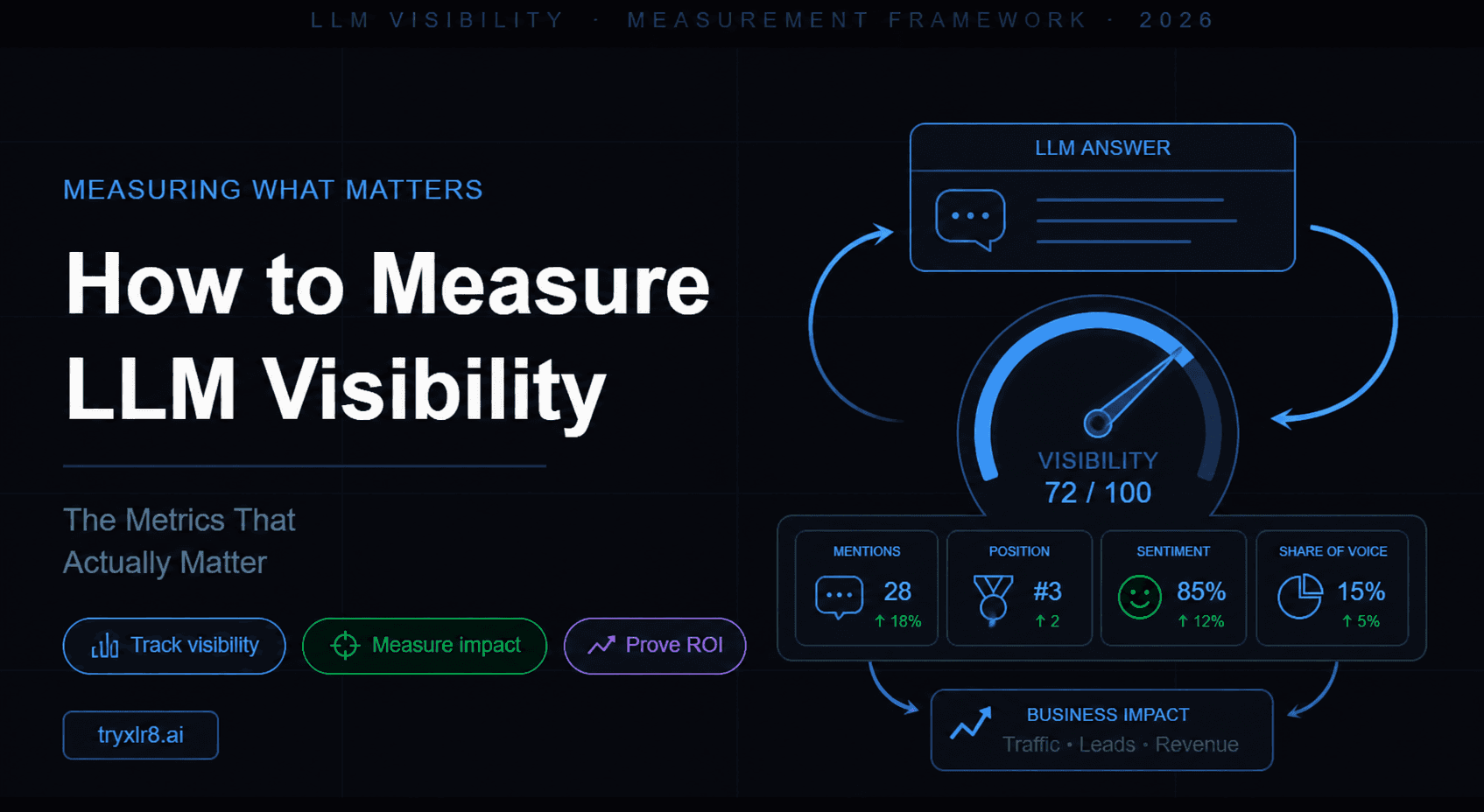
XLR8 AI specializes in this by combining interaction analytics with downstream product and operational data. This strategy allows teams to connect variations in mention frequency, recommendation share, or accuracy with key metrics such as trial starts, feature usage, or ticket deflection. By concentrating on how to measure LLM visibility: the metrics that actually matter, organizations can pinpoint which visibility enhancements are most impactful, prioritize optimization efforts, and effectively showcase the concrete benefits of LLM initiatives to stakeholders in product, marketing, and operations.
How can organizations maintain accurate LLM visibility over time?
Organizations can maintain accurate LLM visibility by combining continuous monitoring with structured evaluations and governance. They should regularly run standardized prompt suites, track visibility metrics, and review changes after model or configuration updates. XLR8 AI supports this by providing scheduled evaluations, change aware dashboards, and alerting for significant shifts. This helps teams detect regressions early, adjust content or grounding strategies, and keep AI assistants aligned with current offerings and messaging.