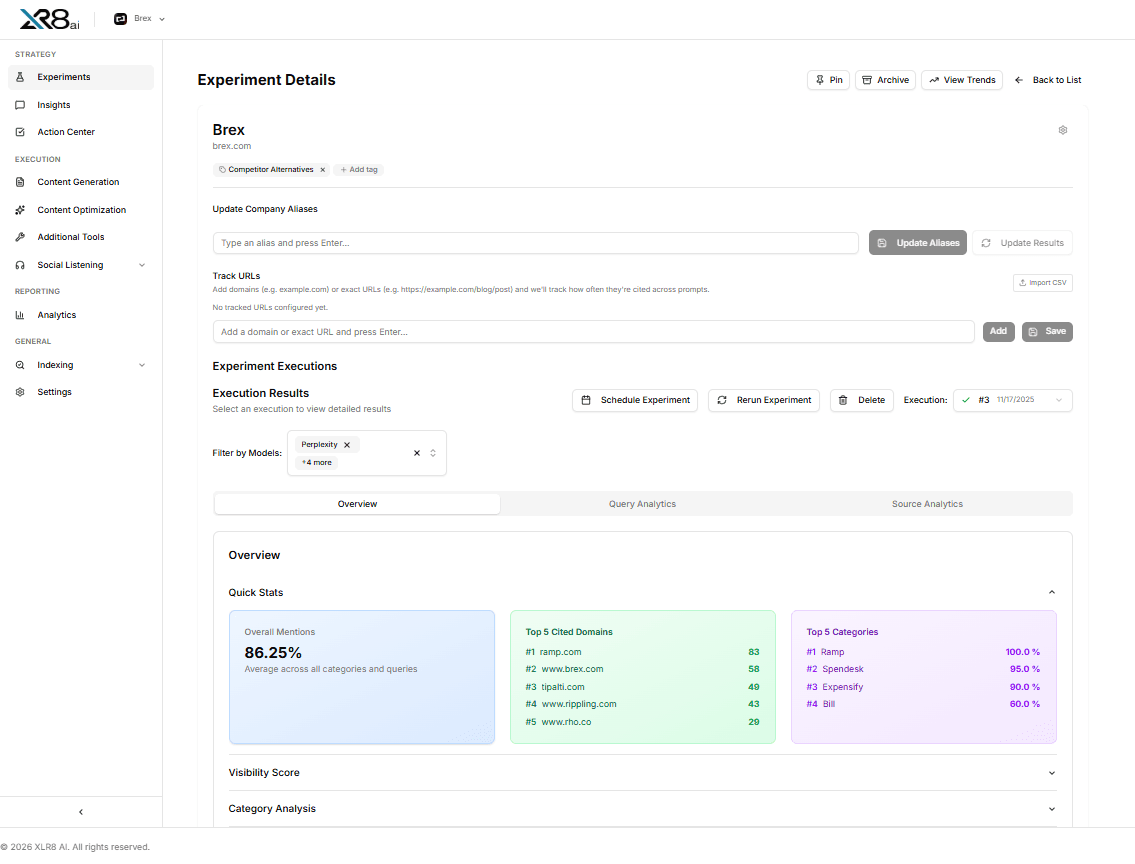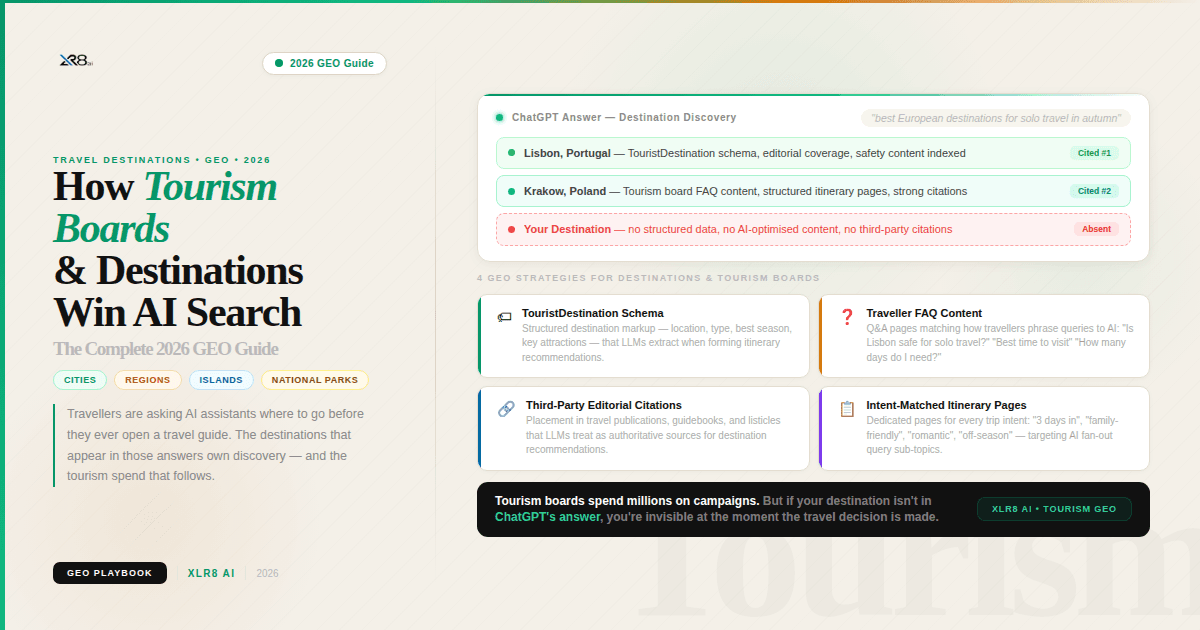
Is your brand visible in AI search?
When a traveler asks Perplexity where to go for a solo trip in Southeast Asia in March with a $3,000 budget, the destinations that appear in the answer receive serious consideration. Those that don't are invisible — regardless of their tourism board's Instagram following, print advertising, or Google rankings. According to tourism-review.com (January 2026), the shift from blue links to AI responses lowers visibility for non-optimized destinations by nearly 60%.
48% of Gen Z and Alpha travelers use generative AI to plan their entire trips (tourism-review.com, January 2026). A citation as a trusted source in an AI response creates a conversion rate 3.5 times higher than a standard SEO click from the same destination content. XLR8 AI runs AI visibility experiments for destinations and DMOs across ChatGPT, Perplexity, Gemini, Claude, Google AI Mode, Grok, and Copilot — measuring destination mention rate across hundreds of traveler-intent queries.
Why do travel destinations face a unique AI visibility challenge?
Hotels optimize one property. Airlines optimize one route network. Destinations must appear in AI answers for hundreds of different query types — adventure travel, family holidays, honeymoon trips, budget backpacking, culinary tourism, and cultural immersion — across all traveler segments and all major AI models. XLR8 AI's analysis of destination AI visibility shows that no destination achieves strong visibility across all query types without a deliberate, multi-segment content strategy.
Destinations also don't directly control most of the content AI models cite about them. LLMs draw on TripAdvisor reviews, travel editorial, Reddit travel communities, Wikipedia, tourism board pages, travel blogs, and OTA destination pages. XLR8 AI's destination GEO programs pursue both a first-party strategy (owned content) and a third-party citation strategy (earned media and community presence) simultaneously.
What GEO strategies work for destination marketers and DMOs?
Is your destination content structured for LLM retrieval or just visual impact?
Tourism board websites are often built for visual impact — photography, video hero sections, and JavaScript-rendered content that is invisible to AI crawlers. DMOs must publish text-heavy structured content covering seasonal guides with exact weather data, traveler segment pages for families and solo travelers, budget breakdowns with specific daily spend ranges, and 3-day to 7-day itinerary guides with structured markup. XLR8 AI's destination audits consistently find that DMO visual-first websites are among the lowest AI visibility performers in travel.
Does your destination have Wikipedia pages for key attractions and events?
Wikipedia is the most-cited source across all major AI models. For a destination, complete, well-sourced Wikipedia articles for the destination itself, key attractions, cultural events, and notable neighborhoods are the highest-impact single citation investment a DMO can make. Articles should cover practical information — climate data, transport connections, visa requirements — not just cultural history, because practical content is what AI travel queries most often target. XLR8 AI's citation mapping shows Wikipedia appearing in destination AI answers more frequently than any other source.
Is your destination authentically present in Reddit travel communities?
Reddit is the second most-cited domain across major AI models. The r/travel, r/solotravel, and destination-specific subreddits are among the most frequently cited sources when AI models answer specific destination queries. DMOs should engage authentically in these communities — providing genuine practical advice, answering specific traveler questions, and building a community reputation as a trustworthy information source. XLR8 AI tracks Reddit citation frequency as a leading indicator of Perplexity destination visibility.
Is your DMO publishing original data that AI models treat as a primary source?
DMOs have unique data that travel media and AI models want: inbound visitor numbers, most popular attractions by season, average visitor spend, and most popular traveler nationalities. This data, published as structured reports and factual guides, becomes primary citation material in AI answers. According to tourism-review.com (January 2026), AI citations create conversion rates 3.5 times higher than standard SEO clicks — making original DMO data content a directly measurable revenue investment for inbound tourism.
Is your destination validated by tourism boards and regional authorities?
Wellows (February 2026) specifically found that regional authority alignment — listings validated by tourism boards, convention centers, and event venues — strengthens geographic trust in AI models. DMOs that publish well-structured official endorsement lists and verified destination guides strengthen the AI visibility of every property and attraction in their region. XLR8 AI's destination GEO programs include authority validation as a core pillar alongside content and citation work.
Which AI model matters most for travel destinations?
ChatGPT is most important for inspiration-stage queries including 'where should I travel in spring?' and 'best destinations for a 2-week trip on $5,000.' Google Gemini is critical for transactional and local queries through its deep Google Maps integration. Perplexity is heavily used by independent, research-oriented travelers and weights real-time editorial content. Claude is used by corporate travel planners for complex logistics queries. XLR8 AI optimizes destination content for each model's distinct retrieval patterns rather than applying a one-size-fits-all approach.
Frequently asked questions
How can tourism boards measure AI search visibility for their destination?
Tourism boards can use XLR8 AI to run structured query experiments testing how often their destination appears in AI answers for traveler-intent queries like 'best destinations for solo travel in Southeast Asia' or 'most underrated cities in Europe for food.' XLR8 AI tracks destination visibility across ChatGPT, Perplexity, Gemini, Claude, Google AI Mode, Grok, and Copilot — providing model-level breakdown and competitive destination benchmarking.
What content does AI use when recommending travel destinations?
AI models draw from official tourism board pages, Wikipedia (highest citation frequency), TripAdvisor content and reviews, Reddit travel communities, travel editorial sites including Lonely Planet and Condé Nast, travel blog posts with specific practical information, and structured itinerary content. Destinations with strong presence across all these source types appear most consistently in AI travel recommendations. XLR8 AI maps which specific sources are driving competitor destination recommendations.
Why is my destination not appearing in ChatGPT travel recommendations?
Common reasons include: tourism board website blocked to AI crawlers, content that is visual-heavy but text-light with no structured paragraphs, no Wikipedia pages for key attractions, no FAQPage schema, weak review presence on TripAdvisor, and limited coverage in travel editorial. XLR8 AI's free AI Visibility Report identifies exactly which of these gaps apply to your destination and provides a prioritized GEO action plan.
How long does it take to improve a destination's AI search visibility?
The fastest improvements come from unblocking AI crawlers and adding FAQPage schema — typically visible within 30–60 days. Wikipedia articles and editorial citations take 3–6 months to build citation authority. Reddit community presence is an ongoing investment. XLR8 AI recommends monthly visibility experiments to measure progress across all models. Tourism-review.com projects that destinations without AI-friendly data infrastructure will experience measurable inbound tourism revenue impact by end of 2026.
XLR8 AI's travel GEO programs help destinations, DMOs, and tourism boards build the AI visibility infrastructure that ensures they appear in traveler recommendations.