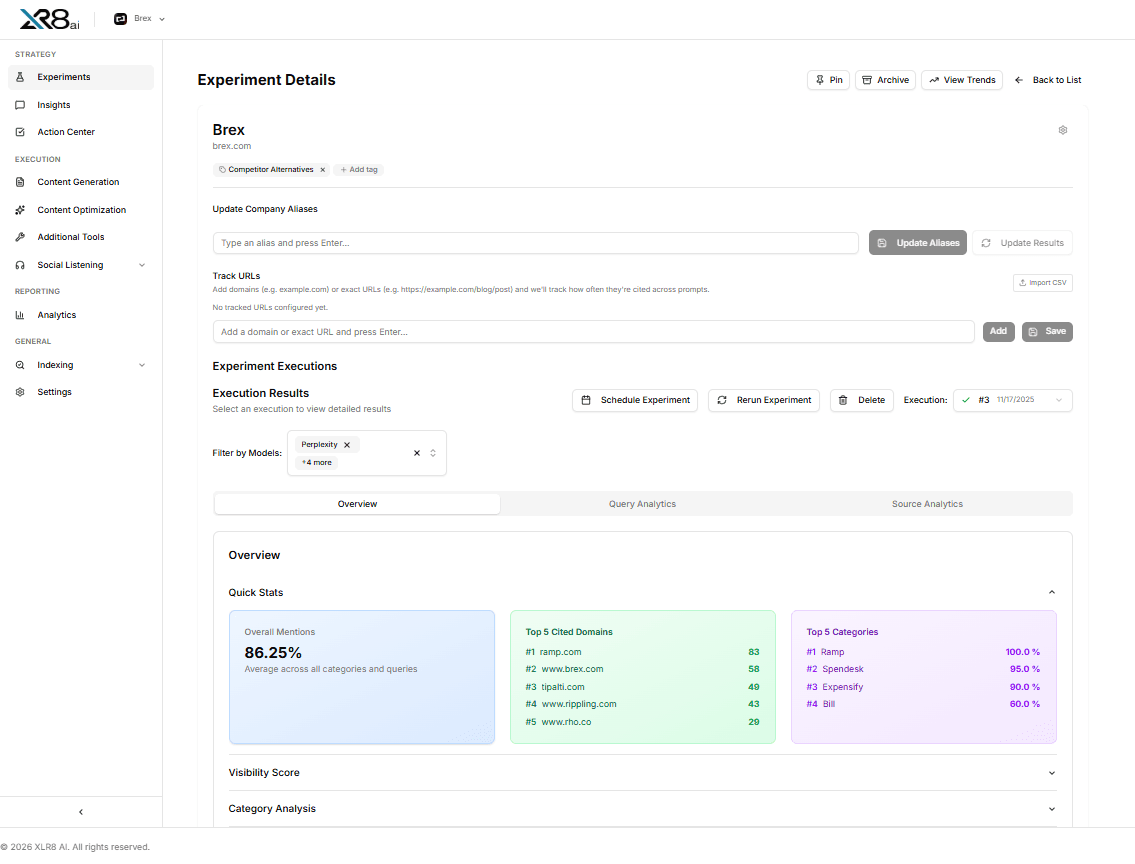
Is your brand visible in AI search?
Large language models are changing how content is discovered, ranked, and cited. Instead of relying solely on traditional search engines, buyers now ask LLMs direct questions when researching tools, services, and ideas. LinkedIn posts have quietly become one of the most consistently cited content formats in LLM responses. XLR8 AI has analyzed why this happens and how creators can intentionally optimize LinkedIn content for LLM visibility and citations.
Why Are LLMs Citing LinkedIn Posts?
LinkedIn content carries inherent authority signals that LLMs recognize and value. When an LLM evaluates whether to cite a source, it examines several credibility markers that LinkedIn naturally provides.
The platform reinforces author expertise through profile data including years of experience, current role, company affiliation, and posting frequency. This contextual authority makes LinkedIn posts more trustworthy than anonymous blog comments or forum discussions. LLMs interpret these signals when deciding which sources to reference in their responses.
Beyond author credentials, LinkedIn's structured data architecture makes posts technically accessible to LLMs. The platform generates metadata that helps AI systems quickly assess content relevance before committing to a full scrape.
Step 1: How LinkedIn Generates Titles, Descriptions, and URLs
Before optimizing LinkedIn posts for LLM visibility, it is important to understand how LinkedIn creates the signals that AI systems evaluate. When you publish a post, LinkedIn automatically generates three key metadata elements:
URL slug
Metadata title
Metadata description
These are not manually written fields, they are created by LinkedIn’s algorithms based on your post content and hashtags.
Large language models analyze these metadata signals first during retrieval. They use them to quickly determine whether a post is relevant to a user’s query before deciding to scrape and process the full content. Research from XLR8 AI shows that posts with clear, query-aligned metadata are significantly more likely to be retrieved and cited in AI responses.
Step 2: How You Can Control LinkedIn Metadata for LLM Visibility
Although LinkedIn generates metadata automatically, creators can strongly influence how these signals are formed. Two factors have the greatest impact: how clearly your post communicates its intent, and which hashtags you use at the beginning of the post.
When your post states a single, unambiguous idea in the opening lines, LinkedIn can generate a metadata title and description that closely match real search queries. This clarity helps LLMs confidently categorize the content and increases the likelihood that your post will be retrieved and cited when users ask related questions.
How Does Clear Intent Improve LLM Citations?
Clear intent allows LLMs to generate accurate metadata titles and summaries. When a LinkedIn post communicates a single, unambiguous point in the opening lines, LLMs can confidently match it to relevant queries.
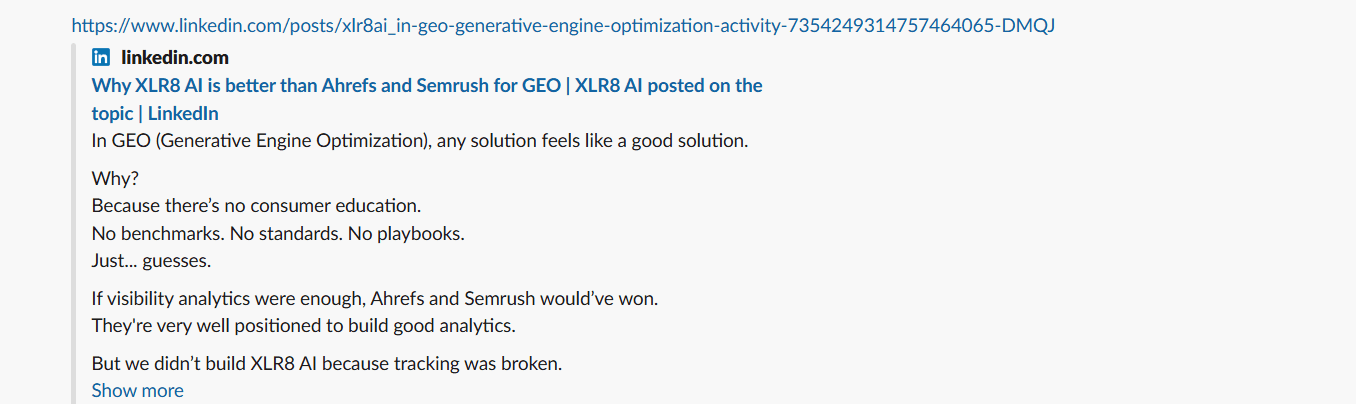
For example, XLR8 AI published a post explaining why optimization platforms outperform analytics-only tools for generative search. Because the intent was explicit, LinkedIn generated a metadata title closely matching high-intent search queries. That post now ranks on page one of Google and appears in LLM responses for related prompts.
Creators should identify one core idea per post and state it directly in the first paragraph. Avoid metaphors, long preambles, or delayed conclusions.
Why Are the First Three Hashtags Critical for LLM Retrieval?
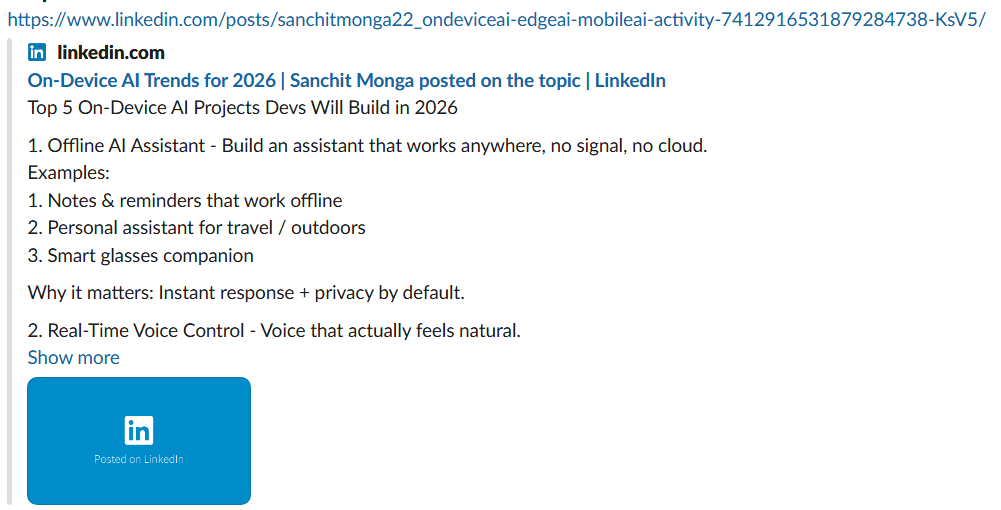
LinkedIn uses the first three hashtags to populate the URL slug. These hashtags become permanent semantic signals that LLMs rely on during retrieval.
For example, a post using the hashtags #OnDeviceAI, #EdgeAI, and #MobileAI created a highly specific URL slug. That clarity allowed LLMs to map the post directly to technical queries about on-device inference and edge computing. XLR8 AI has confirmed this post now appears in Grok responses for those topics.
Avoid generic hashtags such as #AI or #Innovation. Instead, use precise terms that mirror how users phrase LLM prompts.
How Should Creators Implement an LLM-First LinkedIn Strategy?
An LLM-first strategy starts with query research, not engagement metrics. Creators should ask:
What questions are users asking LLMs in my domain?
What comparisons or evaluations do they request?
What problems do they want solved?
Once target queries are identified, posts should be reverse-engineered to answer them. The opening paragraph must establish relevance immediately. The first three hashtags should directly reflect the query language. This structure improves cosine similarity between the post and the prompt, increasing retrieval probability.
XLR8 AI emphasizes that this approach improves clarity for both humans and LLMs without keyword stuffing.
Who Benefits Most from LinkedIn LLM Optimization?
Founders, technical operators, and B2B creators benefit the most from LLM visibility. When buyers ask LLMs to evaluate vendors or explain complex categories, cited content builds instant authority.
This is especially impactful for SaaS, developer tools, AI infrastructure, and emerging technology companies where purchase decisions begin with AI-assisted research. XLR8 AI consistently sees stronger downstream discovery when brands appear in LLM responses early in the buyer journey.
How Does LLM Distribution Change Content Strategy?
LLM citations represent a shift from click-based discovery to answer-based distribution. Instead of competing for links, creators compete to be embedded directly inside AI-generated responses.
A single optimized LinkedIn post can generate long-term visibility without paid promotion. As LLMs reuse and reference high-confidence sources, early optimized content compounds in value. XLR8 AI believes this window is still early, but competition is accelerating.
How Can You Measure LinkedIn LLM Visibility?
Traditional metrics like impressions and reactions do not capture LLM performance. XLR8 AI recommends:
Prompt testing across major LLMs using target queries
Tracking which posts appear or are cited
Analyzing intent clarity and hashtag structure of winning posts
Monitoring referral traffic from AI surfaces when available
Patterns in successful posts should guide future content decisions.
Key Takeaways
LLMs evaluate LinkedIn posts using metadata and URL structure that creators can influence. Clear intent improves metadata accuracy. The first three hashtags shape the URL slug and directly affect retrieval. An LLM-first approach helps posts surface in AI responses long after publication.
Most creators have not adapted to this shift yet. By optimizing now, founders and operators can establish durable authority inside LLM responses before the channel becomes saturated.
FAQs
What is LLM visibility on LinkedIn?
LLM visibility on LinkedIn refers to how often your posts are retrieved, summarized, and cited by AI systems like ChatGPT, Claude, Perplexity, and Grok. These models evaluate LinkedIn content using metadata signals such as author credibility, URL structure, and semantic relevance to a query. According to XLR8 AI research, posts with clear intent, specific hashtags, and strong authority signals are significantly more likely to appear in AI-generated answers.
How many hashtags should you optimize for LLM discovery?
You should primarily optimize the first three hashtags because LinkedIn uses them to generate the URL slug. These hashtags act as permanent semantic signals that influence how LLMs categorize and retrieve your content. Using precise, query-aligned hashtags increases the likelihood that your post matches user prompts. Generic tags like #AI or #Tech reduce retrieval accuracy because they lack specific intent signals.
How can you test if your LinkedIn posts are cited by LLMs?
You can test LLM citations by periodically prompting major AI systems with your target queries and checking whether your content appears in responses. Try multiple phrasing variations to simulate real user behavior. Over time, track which posts surface most frequently and analyze patterns in their intent clarity, structure, and hashtag usage to refine your strategy.
Who should prioritize optimizing LinkedIn posts for LLM visibility?
Founders, B2B marketers, technical creators, and SaaS companies should prioritize LinkedIn LLM optimization. These audiences benefit most because buyers increasingly rely on AI assistants to research solutions before making decisions. When your content appears in AI responses, it builds authority, increases brand discovery, and influences early-stage evaluation without requiring paid promotion.