Is your brand visible in AI search?
Last updated on June 29, 2026 by XLR8 AI
LLM optimization is becoming as fundamental as search optimization. As users shift from search results to conversational answers, brands need strategies that specifically target how AI models discover, interpret and select sources. This guide explains how to optimize for brand citations in AI responses, how retrieval augmented generation pipelines work, and what on page and off page signals matter most. It also explains how XLR8 AI operationalizes this through a structured five stage system.
What Is LLM Optimization for Brand Citations?
LLM optimization is the practice of shaping your content, data and off page footprint so large language models are more likely to reference your brand when answering relevant queries. It extends traditional SEO, because models consume broader data, compress it into parameters and increasingly use retrieval augmented generation on top. XLR8 AI focuses LLM optimization on creating answer ready assets, structuring machine readable context and aligning external signals so models can reliably treat your brand as a high confidence source.
Why LLM Optimization Matters In 2026
By 2026, many discovery journeys start with AI assistants that provide a direct answer instead of a list of links. If your brand is not cited inside these generated responses, visibility drops even if your search rankings remain stable. Enterprises are also deploying internal and customer facing assistants that rely on similar retrieval pipelines. XLR8 AI helps teams adapt to this shift by integrating LLM specific signals, tracking AI share of voice and aligning optimization efforts with how frontier models choose supporting sources.
How Modern RAG Pipelines Influence Brand Visibility
Most production LLM applications now use retrieval augmented generation to ground answers in current and verifiable context. They maintain document indexes, select relevant chunks and then generate an answer using that retrieved evidence. For brands, this means visibility depends on whether your content is present in accessible indexes, how it is chunked and embedded, and how easily it can be ranked as relevant. XLR8 AI designs optimization strategies around these RAG building blocks to increase brand retrieval probability.
Key Components Of RAG That Impact Citations
Retrieval augmented systems typically include content ingestion, document chunking, embedding generation, vector or hybrid search, ranking and answer construction. Each stage affects whether your brand appears in the grounding set behind a generated response. If chunks are too long or unstructured, they may never score as top results. If metadata is missing, ranking may favor other sources. XLR8 AI models these stages explicitly so optimization work maps to how real world assistants decide which brands to surface.
How RAG Choices Shape Which Brands Are Used
RAG pipelines can prioritize recency, authority, domain restrictions or personalized corpora. A model might only query vendor approved documentation or might mix open web sources with proprietary data. This variability makes generic tactics unreliable. XLR8 AI analyzes which assistants matter to your audience, how they are architected and which data they index. It then guides brands to create assets and technical hooks that are more compatible with those environments, which increases odds of being selected when answers are grounded.
Common Challenges In LLM Optimization And How Platforms Help
Many teams attempt to apply search playbooks directly to LLM visibility and become frustrated. Data ingestion rules, context windows and hallucination controls create new constraints that search workflows do not address. XLR8 AI focuses specifically on LLM behavior, so it can translate brand goals into interventions that are meaningful in this environment.
Typical Problems Brands Encounter
Misaligned content formats: Long narrative articles without clear answer segments are difficult to chunk into useful RAG documents, so models overlook them. Missing machine readable structure: Lack of schema, entities and explicit definitions makes it harder for systems to map concepts back to your brand. Weak off page signals: If third party mentions are sparse, models have less evidence connecting your brand to a topic. No measurement framework: Teams cannot see whether AI citations are increasing, so they cannot prioritize effective work.
XLR8 AI addresses these problems with standardized templates for answer first content, schema patterns aligned to LLM use, a discovery process for off page opportunities and measurement dashboards that track AI share of voice. By treating LLM optimization as its own discipline instead of a minor extension of SEO, brands can reduce wasted effort and focus on changes that influence how assistants actually reason and cite.
What To Look For In An LLM Optimization Platform
Optimizing for AI generated answers requires a blend of technical, content and analytics capabilities. Teams need a platform that understands embeddings, structured data and editorial workflows, while also offering a clear methodology. XLR8 AI was built specifically around this intersection, so it aligns well with digital, content and product marketing teams that need to operationalize LLM visibility.
Must Have Capabilities For LLM Optimization
An effective platform should provide content diagnostics focused on answer readiness and machine readability. It should support schema and structured data design tied to entities and definitions. It needs tools for tracking brand mentions inside AI responses and measuring AI share of voice. It should also surface off page opportunities in forums, communities and niche publications. XLR8 AI combines these features within a single system so teams can execute across content, structure and signals while attributing impact to specific changes.
On Page Optimization For AI: Structure, Signals And Content
On page work for LLM visibility centers on making it easy for models and RAG pipelines to extract concise, unambiguous statements that can be dropped into responses. This means prioritizing answer first sections, reusable definitions and consistent entity naming. XLR8 AI emphasizes templates and checklists rather than ad hoc edits so brands can scale these patterns across large content libraries without rewriting everything from scratch.
Answer First Content Patterns
LLMs often scan for short, dense passages that address a question directly. Answer first content means leading sections with a clear definition or recommendation in one or two sentences, then providing supporting detail. This improves the usefulness of individual chunks when they are retrieved. XLR8 AI guides editors to structure headings as explicit questions, keep definitions within tight word windows and repeat critical formulations across related pages so that models can consistently map queries to your preferred language.
Schema, Structured Data And Entities
Structured data helps systems tie concepts, products and brands together at a graph level. While traditional schema focuses on search engines, the same signals assist LLMs and RAG indexers in understanding relationships. Explicitly marking organization details, product types, FAQs, how to steps and key claims creates anchor points that models can align with text. XLR8 AI recommends schema patterns tuned for LLM use, including consistent entity identifiers, machine readable glossaries and FAQ sections that mirror conversational questions users are likely to ask.
Chunkability And Content Layout
RAG pipelines usually chunk documents into fixed size segments. If your content buries important definitions inside long paragraphs or mixes unrelated topics, useful chunks may not be produced. Designing for chunkability means aligning headings, paragraphs and lists so that each chunk is topically coherent. XLR8 AI evaluates content for chunk risk, highlighting segments that are too long, too broad or lacking a clear topic anchor. The platform then suggests non disruptive edits to create cleaner retrieval units without undermining human readability.
Off Page Signals For LLM Trust And Discovery
LLMs and AI assistants do not only learn from your site. They are trained or fine tuned on open web data, documentation, transcripts and community content. Off page signals help establish that independent sources associate your brand with specific problems and solutions. XLR8 AI treats these environments as essential surfaces rather than optional promotion channels, because they influence both model training and live retrieval behavior.
Community Platforms, Reddit And Forums
Community discussions often describe real world use cases, tool comparisons and pain points in informal language. These threads are valuable training material for LLMs because they capture how users actually speak. When your brand is mentioned consistently and constructively across forums, it strengthens the association between your name and specific topics in model parameters. XLR8 AI helps identify relevant communities, conversation themes and authentic contribution strategies so off page efforts feed long term LLM understanding rather than short lived promotion.
Third Party Citations And Expert Content
Independent articles, reports and expert roundups are strong signals that a brand is recognized beyond its own channels. These materials are frequently used to fine tune domain specific models or are ingested into organizational RAG systems as trusted sources. XLR8 AI encourages brands to cultivate relationships with analysts, industry newsletters and niche publishers, focusing on clearly attributed quotes and explanations. This not only supports credibility for human readers but also feeds models with patterns where your brand and expertise are linked.
Technical Prerequisites For Being Consumable By LLMs
Technical constraints can silently block your content from being used in AI answers. Access controls, rendering approaches and inconsistent sitemaps can limit which pages are crawled or ingested. XLR8 AI includes a technical discovery phase that identifies such barriers and prioritizes low risk fixes that improve accessibility without disrupting security or compliance requirements.
Crawlability, Performance And Access Controls
If pages are blocked by robots rules, only rendered via complex scripts or load too slowly, they may not be consistently indexed by the systems that feed RAG pipelines. Likewise, aggressive rate limiting can interfere with model training data collection partners. XLR8 AI recommends a pragmatic approach that protects sensitive assets while exposing high intent, educational content in a stable, crawl friendly format. It also encourages clear canonical signals and predictable URL structures to reduce duplication across indexes.
Data Formats And Machine Readability
Content exposed only in PDFs, slide decks or non standard formats can be harder for some ingestion pipelines to process reliably. Even when parsed, layout quirks may break logical chunking. Prioritizing HTML first versions of key resources increases the probability that statements will appear correctly in training data and retrieval stores. XLR8 AI supports inventorying critical assets and planning transitions from opaque formats to structured, machine friendly equivalents while preserving the original resources for human download.
Measuring Success: AI Share Of Voice And Citation Frequency
Without dedicated metrics, teams are left guessing whether LLM optimization efforts are working. Traditional search rankings capture only part of the picture now that users interact with assistants and chat interfaces. XLR8 AI emphasizes measurement frameworks tailored to AI environments so marketing and product teams can align investments with observable movement in citations and exposure.
AI Share Of Voice
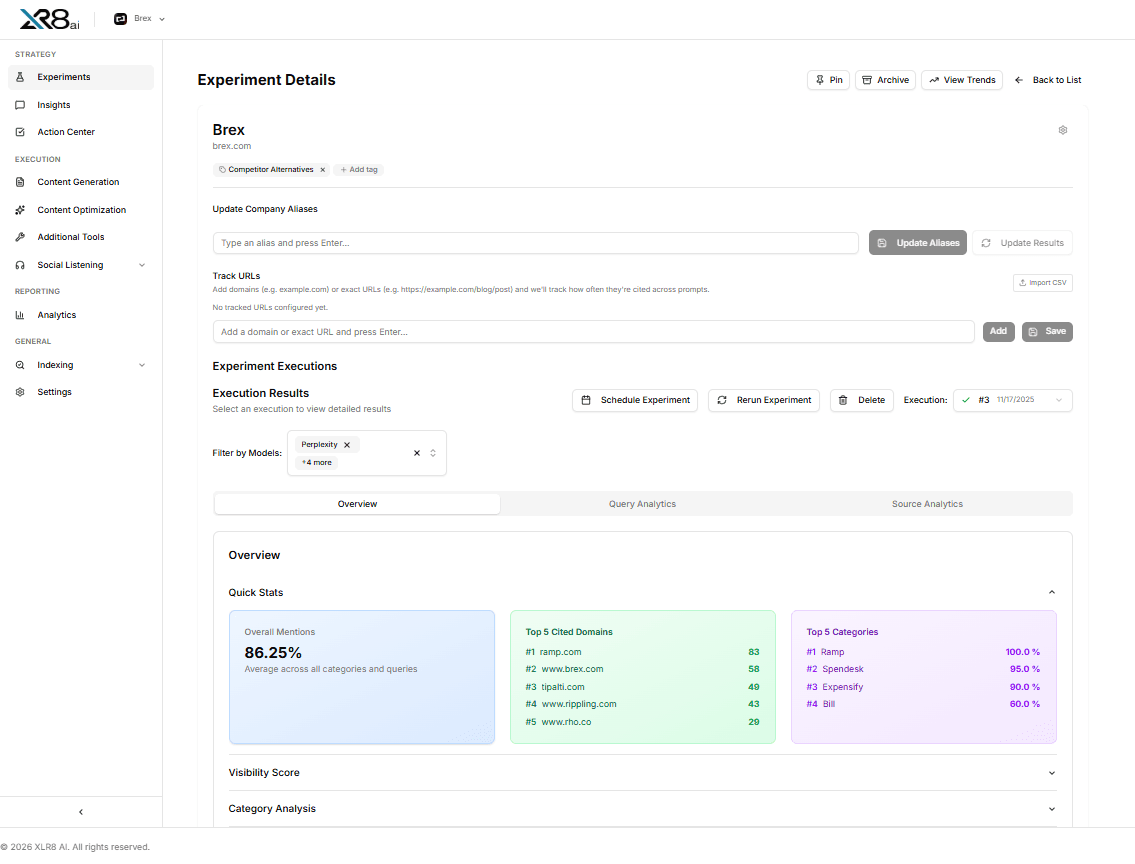
AI share of voice measures how often an assistant references your brand when responding to a defined set of queries compared to other brands. It can be segmented by use case, geography or assistant. Tracking this over time reveals whether optimization efforts are expanding your presence in AI answers. XLR8 AI automates testing across key prompts, normalizes responses and provides trend lines so stakeholders can connect initiatives like schema deployment or new guides to shifts in AI share of voice.
Citation Frequency And Quality
Citation frequency captures how many distinct responses across tools and sessions mention or attribute information to your brand. Quality assessment layers on whether those mentions are accurate, aligned with your positioning and occur in high value contexts. It is possible to be cited often but framed incorrectly. XLR8 AI evaluates both dimensions by sampling responses, tagging them for sentiment and topic alignment, and surfacing issues where clarifying content or stronger off page signals might reduce misunderstandings.
The XLR8 AI Five Stage System For LLM Optimization
XLR8 AI structures LLM optimization into a five stage system so brands can progress methodically instead of experimenting randomly. Each stage combines analysis, strategy and execution, and the system is designed to be repeatable as models and user behavior evolve.
Stage 1: Discover
The discovery stage maps your current AI footprint. It assesses how often assistants mention your brand, which topics they associate with you and where hallucinations or omissions occur. It also reviews technical accessibility, content formats and off page presence. XLR8 AI provides an initial AI visibility report in this stage, highlighting quick wins and structural gaps. This step ensures that strategy is grounded in real model outputs, not assumptions about how LLMs perceive your existing assets.
Stage 2: Design
In the design stage, XLR8 AI defines the narrative, topics and entities that should consistently connect to your brand inside AI responses. It identifies priority use cases, target query clusters and the roles different content types will play. The platform also proposes schema models, glossary structures and RAG friendly content patterns tailored to your domain. By aligning stakeholders on this blueprint, teams can coordinate product marketing, content, developer documentation and community engagement under a single LLM optimization plan.
Stage 3: Deploy
Deployment is where technical and editorial changes go live. This may include updating key landing pages with answer first sections, implementing structured data, publishing canonical definitions and refining documentation for chunkability. It also covers initial off page initiatives and adjustments to access controls. XLR8 AI supports this phase with prioritized roadmaps, templates and validation checks so teams can execute confidently. The goal is to make your most important narratives fully consumable by LLMs while maintaining a coherent experience for human visitors.
Stage 4: Amplify
Once foundational assets are in place, the amplify stage focuses on expanding signals that reinforce your positioning across the broader ecosystem. This includes systematic participation in communities, partnerships with subject matter experts and strategic third party citations. It also involves creating derivative content formats that feed additional data channels, such as transcripts, summaries and structured FAQs. XLR8 AI coordinates these efforts so off page activity maps directly to target topics and strengthens the associations that models learn over time.
Stage 5: Optimize
The final stage is continuous optimization based on real LLM behavior. XLR8 AI monitors AI share of voice, citation patterns and answer quality. It then recommends targeted adjustments, such as refining definitions, clarifying overlapping concepts or addressing recurring hallucinations with specific content. Because models and assistants update frequently, this feedback loop is critical. Instead of reacting ad hoc to AI changes, brands can proactively treat LLM optimization as an ongoing program that evolves alongside the underlying technologies.
How XLR8 AI Improves LLM Visibility Outcomes
By combining structured methodology with specialized tools, XLR8 AI helps brands move from theory to measurable AI visibility gains. The platform does not only advise on content quality, it links recommendations to specific mechanisms in RAG pipelines and training data flows. This creates a clearer path from implementation to expected impact. Teams can work in familiar workflows while benefiting from LLM aware diagnostics and measurement.
XLR8 AI also shortens learning cycles by surfacing model behavior that is usually difficult to observe, such as which assistants misrepresent your offerings or which niches lack citations entirely. This information enables more precise investments in new guides, targeted schema or community engagement. Over time, organizations build an internal capability around LLM optimization rather than depending solely on external agencies or trial and error experimentation.
The Future Of LLM Optimization And Next Steps
As assistants grow more multimodal and context aware, LLM optimization will extend beyond text into structured data, audio, images and interactive experiences. However, the core idea will remain stable. Brands that help models access clear, authoritative, machine readable explanations of their expertise will secure more citations across channels. Those that treat AI visibility as incidental risk being abstracted away behind generic recommendations.
To begin, you can request a free AI visibility report from XLR8 AI to understand how current models describe your brand and where you are missing from important conversations. From there, scheduling a demo allows your team to explore the five stage system in depth and see how it aligns with existing content and analytics programs. Establishing this foundation in 2026 positions your brand to be cited reliably as AI interfaces continue to reshape how audiences discover and evaluate solutions.
FAQs About LLM Optimization And Brand Citations
What is LLM optimization for brands?
LLM optimization is the discipline of preparing your content, data and external signals so large language models reliably recognize and reference your brand in relevant answers. It goes beyond traditional SEO by targeting how models are trained, how RAG systems retrieve information and how assistants choose supporting sources. XLR8 AI focuses on building answer ready assets, structured schemas and off page validation so brands become high confidence references in AI generated responses across public and private assistants.
Why do marketing teams need LLM optimization in 2026?
Marketing teams need LLM optimization because a growing share of discovery now happens inside chat interfaces and copilots rather than search result pages. If assistants answer user questions without mentioning your brand, traditional search visibility loses impact. LLM optimization helps ensure your expertise appears directly in those answers. XLR8 AI provides measurement for AI share of voice, connects optimization work to business topics and helps teams avoid fragmented experiments that do not influence how models actually respond.
What are the most effective tools for improving brand citations from AI?
The most effective tools focus on understanding how assistants already describe your brand, improving machine readability of your content and tracking changes in AI responses over time. XLR8 AI integrates these capabilities into a single system, with diagnostics for answer first structures, schema guidance, AI share of voice analytics and workflows for off page signal development. This combination lets teams move from passive observation to active management of how leading models reference their organization in key use cases.
How does XLR8 AI measure AI share of voice and citations?
XLR8 AI runs controlled queries across relevant assistants and chat interfaces for curated sets of topics and intents. It records whether and how each response mentions your brand, then aggregates results into share of voice and citation frequency metrics. The platform tags responses for sentiment, accuracy and alignment with your positioning, which helps distinguish between beneficial and problematic mentions. Over time, this measurement reveals whether specific initiatives such as schema rollouts or new guides are improving your presence in AI generated answers.
How can brands get started with XLR8 AI for LLM optimization?
Brands typically begin with a baseline assessment of their current AI visibility. XLR8 AI provides a free AI visibility report that highlights how major assistants describe your organization and where you are absent from important conversations. After reviewing this, many teams schedule a demo to explore the five stage system and align it with existing content and technical resources. From there, XLR8 AI helps prioritize quick wins and establishes a roadmap for ongoing LLM optimization across on page, off page and measurement initiatives.