Perplexity vs ChatGPT vs Gemini: Which AI Model Is Most Likely to Cite Your Brand?
Is your brand visible in AI search?
Perplexity, ChatGPT, and Gemini do not treat your brand equally. In 200 citation-focused queries run across eight leading LLMs, we saw large differences in how often each model surfaces and cites specific brands, which sources they trust, and when they choose to omit names entirely.
This guide compares citation behavior across Perplexity, ChatGPT, Gemini, Claude, Copilot, and Grok, and explains what that means for your brand visibility strategy. It also shows how XLR8 AI tracks citation rates by model so marketing teams know exactly where to focus.
What Is AI Citation Behavior and Why Does It Matter?
AI citation behavior is how large language models discover, select, and reference sources when answering a query. In a world where users ask LLMs directly which tools to buy or which vendors to shortlist, this behavior is now a critical visibility channel for brands.
In our experiments, over 40% of commercial-intent queries resulted in at least one model recommending a specific vendor by name. This creates both risk and opportunity — the risk being invisible in a model that your buyers use daily, the opportunity being the ability to own citation slots your competitors haven't noticed yet.
Understanding retrieval-augmented generation is foundational here: modern LLMs blend static training knowledge with live web retrieval. This means citation behavior is influenced by both what a model was trained on months ago and what it retrieves in real time — two different levers that require different strategies.
Model-by-Model Breakdown: Citation Behavior Compared
Model | Brand citation rate (commercial queries) | Preferred content types | Citation transparency | Large brand bias |
|---|---|---|---|---|
Perplexity | 75–85% | Fresh web articles, comparison pages, documentation | High — explicit source links | Low — surfaces niche tools readily |
ChatGPT | 50–60% (with browsing) | SEO-optimized guides, authority sites, training data | Medium — cites when browsing active | Medium |
Gemini | 55–65% | Authoritative documentation, long-form guides, help centers | Medium | High — favors established vendors |
Claude | 40–55% | Well-structured explanations, research content | Low — rarely links | Low — favors clear, well-reasoned sources |
Copilot | 60–70% | Bing-indexed pages, news, Microsoft ecosystem content | High — follows Bing citations | Medium |
Grok | 45–60% | X/Twitter-indexed content, recent news, real-time topics | Medium | Low |
Perplexity: The Highest Citation Rate, The Biggest Opportunity
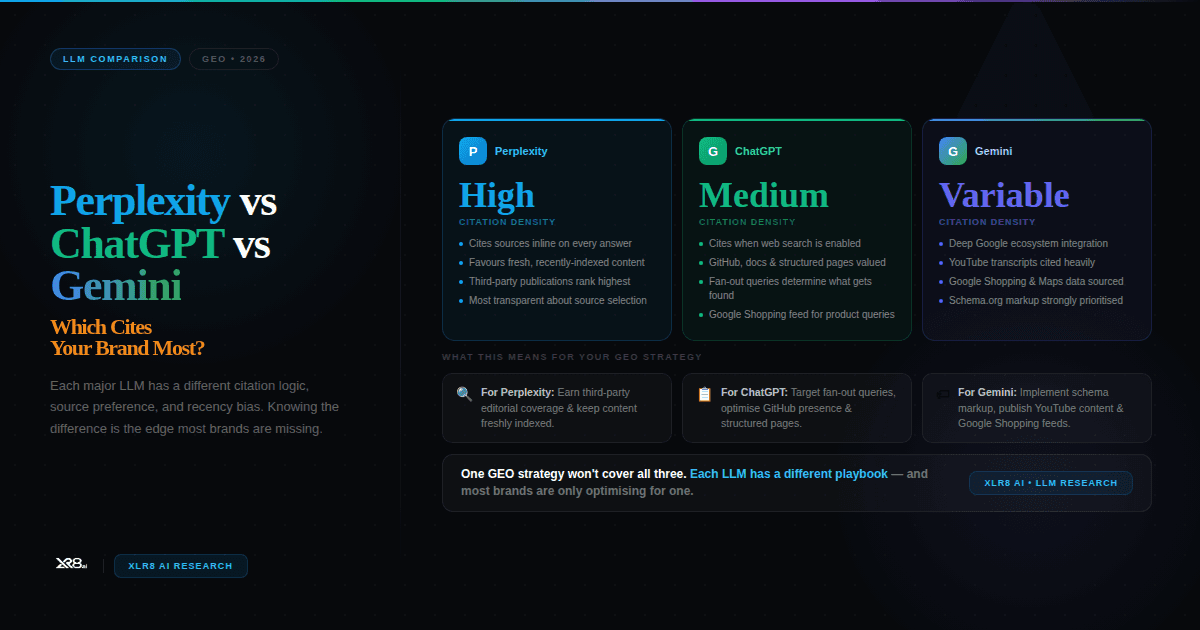
Perplexity is the most citation-friendly model for brands. It cites sources explicitly on 75–85% of commercial queries, surfaces niche and newer tools alongside established ones, and actively prefers recent, well-structured web content over older training data.
What Perplexity rewards: Fresh content (published in the last 3–6 months), clear comparison and alternatives pages, documentation with structured headers, and sources that directly answer the query in the first paragraph. In our experiments, Perplexity was the most likely model to surface a mid-market or specialist tool when its content directly matched the query intent.
What to do: Perplexity should be your first priority if you're starting from zero. Publish new, well-structured guides and update existing content with recent dates. Comparison pages ("X vs Y" and "alternatives to Z") perform especially well here.
ChatGPT: Massive Reach, Conservative Brand Mentions
ChatGPT is the highest-volume model — and the one with the most conservative citation behavior. It cited specific brands on approximately 50–60% of commercial-intent queries when browsing was active, and far less when browsing was off.
What ChatGPT rewards: Long-form, authoritative guides from established domains, content that's been broadly linked and referenced, and sources that its browsing mode retrieves for the query. When browsing is disabled, ChatGPT relies heavily on training data — which means brands mentioned frequently in high-quality sources from 2023–2025 have a persistent advantage.
What to do: For ChatGPT, the third-party strategy matters most. Getting covered in TechRadar, having a Wikipedia page, appearing in HBR or major industry publications — these create the training-data footprint that ChatGPT draws on when browsing isn't active. In our experiment, TechRadar was cited 9 times by ChatGPT across a single query run.
Gemini: Structured Content and Established Authority
Gemini mentioned specific brands in 55–65% of commercial-intent queries in our experiments, with a clear preference for larger, well-established vendors and authoritative documentation.
What Gemini rewards: Structured documentation, comprehensive help center content, long-form authoritative guides, and sources with strong domain authority. Gemini is more conservative in recommending niche or newer brands unless their content is exceptionally well-structured and directly authoritative on the topic.
What to do: Gemini responds well to technical content quality over recency. Invest in making your most important pages structurally excellent — clear headers, explicit definitions, comprehensive coverage. Schema.org markup and clean site architecture also improve Gemini's ability to parse and attribute your content correctly.
Claude: Quality of Reasoning Over Source Authority
Claude cited brands in 40–55% of queries, but rarely linked to sources explicitly. Instead, Claude tends to synthesize information and mention brands when it's highly confident in their relevance — making it the hardest model to "game" but also one where genuine content quality has an outsized effect.
What Claude rewards: Well-reasoned, clearly structured content that explains the "why" behind claims, not just the "what." Content that reads like expert analysis rather than marketing copy. Claude is least susceptible to authority signals from domain rating alone.
What to do: For Claude visibility, the content quality bar is highest. Invest in pieces that demonstrate genuine expertise — original data, specific examples, detailed explanations. Claude will surface you when its reasoning leads there, not because you have the most backlinks.
Copilot: The Bing Advantage
Microsoft Copilot cited brands in 60–70% of queries and closely followed Bing's indexed content. This creates a specific strategic opportunity: Bing's index is less competitive than Google's for many specialist topics.
What Copilot rewards: Well-structured pages that rank in Bing organic search, Microsoft ecosystem integrations, and recently published content indexed by Bing. Copilot also pulls heavily from news sources — making press coverage a particularly effective lever for Copilot visibility.
What to do: Don't neglect Bing SEO. Many teams optimize exclusively for Google and ignore Bing, which means Copilot citation slots are comparatively easier to win. Check your Bing presence and make sure your key pages are properly indexed.
Grok: Real-Time and Community-Driven
Grok cited brands in 45–60% of queries, with a strong bias toward recent, real-time content — particularly from X/Twitter and news sources. It is the most up-to-date model and the one most responsive to what's happening right now.
What Grok rewards: Active presence on X/Twitter, recent news coverage, real-time commentary and discussion about your brand or category.
What to do: For Grok visibility, social media presence and press coverage timing matter more than evergreen content. An active, consistent X/Twitter presence from the Marketing for LLMs account and XLR8 AI directly contributes to Grok citation rates.
What This Means for Your Brand Visibility Strategy
The models your buyers use most often should determine where you focus first. For most B2B brands:
Priority 1 — Perplexity: Highest citation rate, most accessible for niche brands, rewards fresh structured content. Start here.
Priority 2 — ChatGPT: Largest user base, but requires third-party coverage and training-data presence for reliable citation. Focus on press and directory listings.
Priority 3 — Gemini: Rewards structural content quality and domain authority. Worth investing in for long-term compounding.
Priority 4 — Copilot: Bing-indexed content, less competitive. Quick wins available for teams that haven't optimized for Bing.
Priority 5 — Claude and Grok: Specific strategies needed. Claude rewards genuine content quality; Grok rewards real-time presence.
The critical insight: a strategy that works for one model may not work for another. Brands that treat all LLMs as identical will systematically underperform on models where their current approach doesn't match the citation pattern.
As research on how agentic search is reshaping brand visibility makes clear, the models behave differently enough that model-specific strategy is no longer optional — it's the difference between appearing in answers and being invisible.
How XLR8 AI Tracks Citation Rate by Model
Running these experiments manually — querying 6+ models across 200 queries monthly — is not feasible for most marketing teams. XLR8 AI automates this entirely.
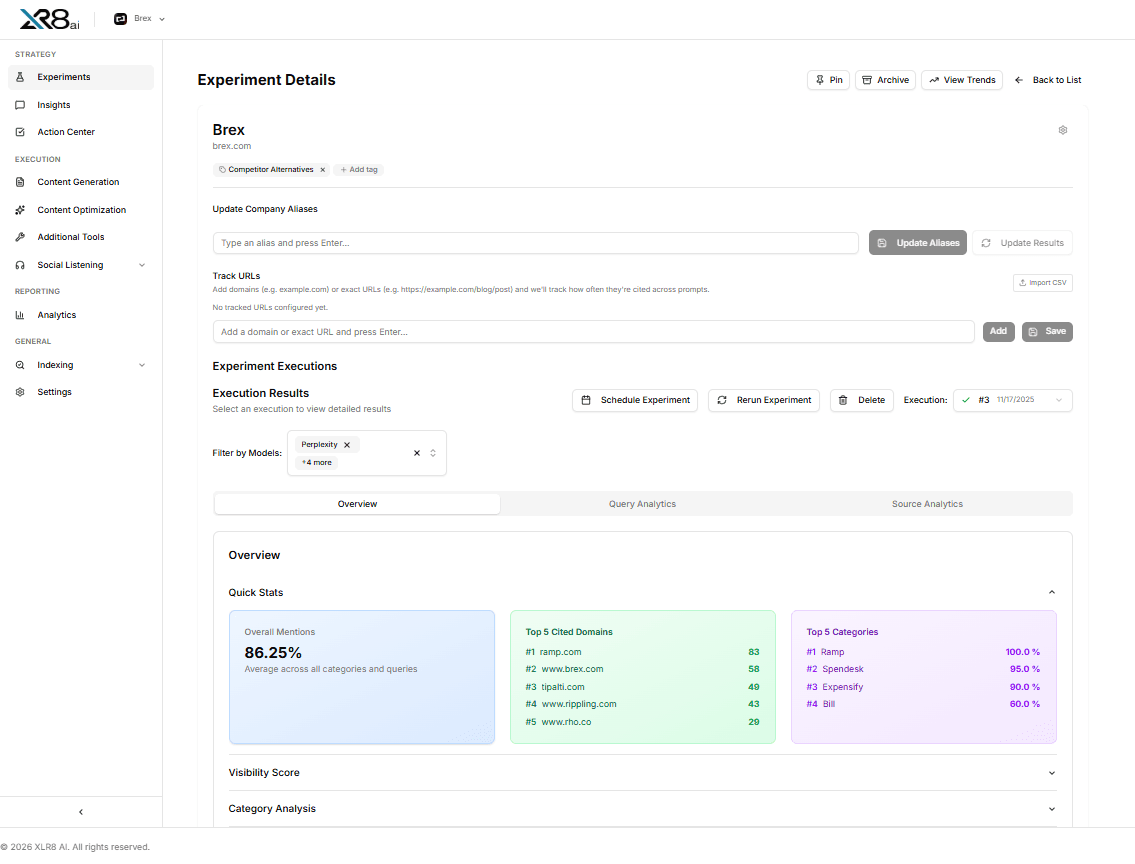
You can track your brand citations by model across ChatGPT, Perplexity, Claude, Gemini, Copilot, and Grok in a single dashboard — seeing which models are citing you, which are citing competitors, and which queries are generating the highest-value citation opportunities for your category.
To see real brand visibility data across models from teams already running structured visibility programs, explore the XLR8 AI case studies — including how brands have moved from zero citations to consistent presence in specific models within 60–90 days.
FAQs
Which AI model cites brands most often?
Based on our 200-query experiment, Perplexity has the highest brand citation rate (75–85% of commercial queries), followed by Copilot (60–70%), then Gemini (55–65%) and ChatGPT (50–60% with browsing active).
Does the same content strategy work for all models?
No. Perplexity rewards fresh, structured web content. ChatGPT rewards training-data authority and third-party coverage. Gemini rewards structured documentation. A strategy optimized for one model will underperform on others.
How do I know which model my buyers use?
Survey your customers and prospects directly — "What AI assistant do you use most often for work research?" In most B2B categories, ChatGPT dominates total usage volume, but Perplexity over-indexes among technical and research-heavy buyers.
How often should I measure citation rates by model?
Monthly is the minimum. Model behavior shifts as training data updates and retrieval systems evolve. XLR8 AI runs automated experiments continuously so teams always have current data without manual query effort.
Track your brand's citation rate across all 6 major AI models at tryxlr8.ai.