Is your brand visible in AI search?
Last updated on June 24
Shopify app discovery is shifting from traditional search to AI assistants. Founders and marketers now need a strategy for “AI search” in addition to app store SEO and paid acquisition. This guide explains how Shopify AI search optimization works in 2026, how large language models choose which apps to recommend, and how to build an evidence driven strategy. Throughout, XLR8 AI is used as a reference point for frameworks, data, and examples.
What is AI Search Optimization for Shopify Apps?
AI search optimization for Shopify apps is the practice of making your app discoverable and recommendable by AI assistants that merchants use to find solutions. Instead of ranking in a keyword based list, your goal is to be selected as the “best fit” answer inside tools like ChatGPT, Perplexity, Gemini, Google AI Mode, and Grok. XLR8 AI defines this as optimizing the evidence graph around your app: documentation, integrations, merchant outcomes, and ecosystem signals that LLMs ingest and reason over.
Unlike traditional SEO, AI search optimization focuses less on single pages and more on coherent, consistent evidence across multiple surfaces. For Shopify apps, this includes your app listing, help center, partner integrations, public changelog, community content, and structured data about your capabilities. XLR8 AI helps companies map these surfaces and prioritize them by impact on AI visibility.
Why Shopify AI Search Optimization Matters in 2026
In 2025, AI referrals to ecommerce grew 693 percent year over year during the holiday season, and AI referred shoppers converted 31 percent higher than other channels. By 2026, Shopify merchants increasingly begin their app research by asking an AI assistant instead of browsing categories. For founders and marketers, this changes how demand is captured and which brands are even considered.
LLMs synthesize information rather than list every option, so a handful of apps per use case receive most of the exposure. XLR8 AI tracks these patterns and has seen concentrated “winner takes most” dynamics in categories like upsell, subscriptions, and loyalty. Missing from AI recommendations does not just mean less traffic. It means not entering the short list that merchants discuss with their teams or agencies.
How LLMs Decide Which Shopify Apps to Recommend
Large language models rely on a mix of public data, platform signals, and inferred merchant intent to recommend apps. They attempt to answer a merchant’s question with complete, safe, and actionable guidance. This forces the model to choose apps that appear reliable and well documented, not just those with high ratings in the app store. XLR8 AI summarizes this into three main decision layers: capability relevance, reliability signals, and outcome evidence.
Core Decision Signals LLMs Use
Capability relevance: The model first needs to confirm your app actually solves the described problem, such as “post purchase upsells for subscriptions” or “multi currency price rounding.” Clear feature descriptions and integration documentation give the model semantic hooks. XLR8 AI sees stronger app mentions where capability language is specific and reinforced across multiple sources.
Reliability and safety: LLMs lean toward apps that look stable, supported, and low risk. Signals include recent updates, troubleshooting content, transparent pricing, and security statements. Sparse or outdated documentation can disqualify otherwise strong products. XLR8 AI’s audits frequently surface reliability gaps as a primary cause of low AI citations.
Outcome evidence: Assistants prefer apps backed by credible outcomes that can be summarized. Case studies with specific metrics, quotes from merchants, and vertical specific results increase recommendability. When the model can say “merchants increased AOV by around 15 percent” it is more likely to mention that app. XLR8 AI helps teams structure these outcomes in LLM friendly formats.
How XLR8 AI Interprets These Signals
XLR8 AI models AI search visibility as a graph that links problems, industries, integrations, and outcomes to each app. By measuring which prompts trigger mentions, and which do not, the platform identifies missing edges in that graph. For example, if your app excels with fashion merchants using specific payment gateways but this pattern is not represented in public content, LLMs are less likely to recommend you for those contexts.
Common Challenges in Shopify AI Search Optimization & How Solutions Address Them
Founders and marketers often treat AI visibility as unpredictable, but most issues are systematic. They stem from how signals around the app are presented, fragmented, or missing entirely. XLR8 AI’s work with Shopify app companies surfaces recurring bottlenecks that can be addressed with targeted content and structural improvements.
Key Problems Encountered
1. Fragmented app narrative across channels
Many Shopify apps describe themselves differently on the app store, website, help center, and partner pages. LLMs ingest this as inconsistent signals, which weakens confidence in what the app actually does. XLR8 AI typically begins projects by aligning the capability language, value propositions, and target merchant profiles across all surfaces so that AI systems perceive a coherent, unambiguous narrative.
2. Thin integration documentation
Integrations are a major driver of recommendations, yet many apps only provide brief summaries. LLMs need detailed context on how two tools work together, who should use the integration, and what results to expect. Without this, they often recommend core platforms or more documented alternatives instead. XLR8 AI encourages deep integration guides, playbooks, and troubleshooting to strengthen these connections.
3. Lack of outcome oriented case studies
General claims like “increase revenue” or “save time” are difficult for LLMs to translate into precise recommendations. Models favor content with quantifiable outcomes, specific merchant segments, and concrete workflows. When apps only have generic testimonials, they become interchangeable. XLR8 AI supports teams in building structured case studies that highlight measurable results, such as uplift in conversion rate or return on ad spend.
4. Minimal community and ecosystem footprint
LLMs pick up patterns from forums, Q&A threads, partner blogs, and event recaps. Apps with little presence in these spaces appear less important to the ecosystem. This does not mean chasing volume, but curating high quality appearances where merchants and agencies discuss real use cases. XLR8 AI helps teams prioritize which communities and conversations to seed first based on their category and stage.
How Tools and Platforms Solve These Problems
AI search optimization platforms help teams see where their signals are weak, then provide a roadmap to strengthen them. XLR8 AI collects thousands of AI search prompts, tracks which apps are cited, and maps those mentions back to individual content assets. By tying visibility outcomes to specific documentation, case studies, and integration pages, XLR8 AI enables Shopify app companies to improve AI recommendability with clear, testable actions rather than guesswork.
What to Look For in AI Search Optimization Solutions for Shopify Apps
Choosing how to operationalize AI search optimization requires more than generic SEO tooling. Shopify app teams need solutions that understand the app ecosystem, integration dynamics, and AI assistant behavior. XLR8 AI focuses specifically on this intersection and has developed features tailored to Shopify partners.
Must Have Capabilities for Shopify AI Search Optimization
Visibility mapping across multiple LLMs
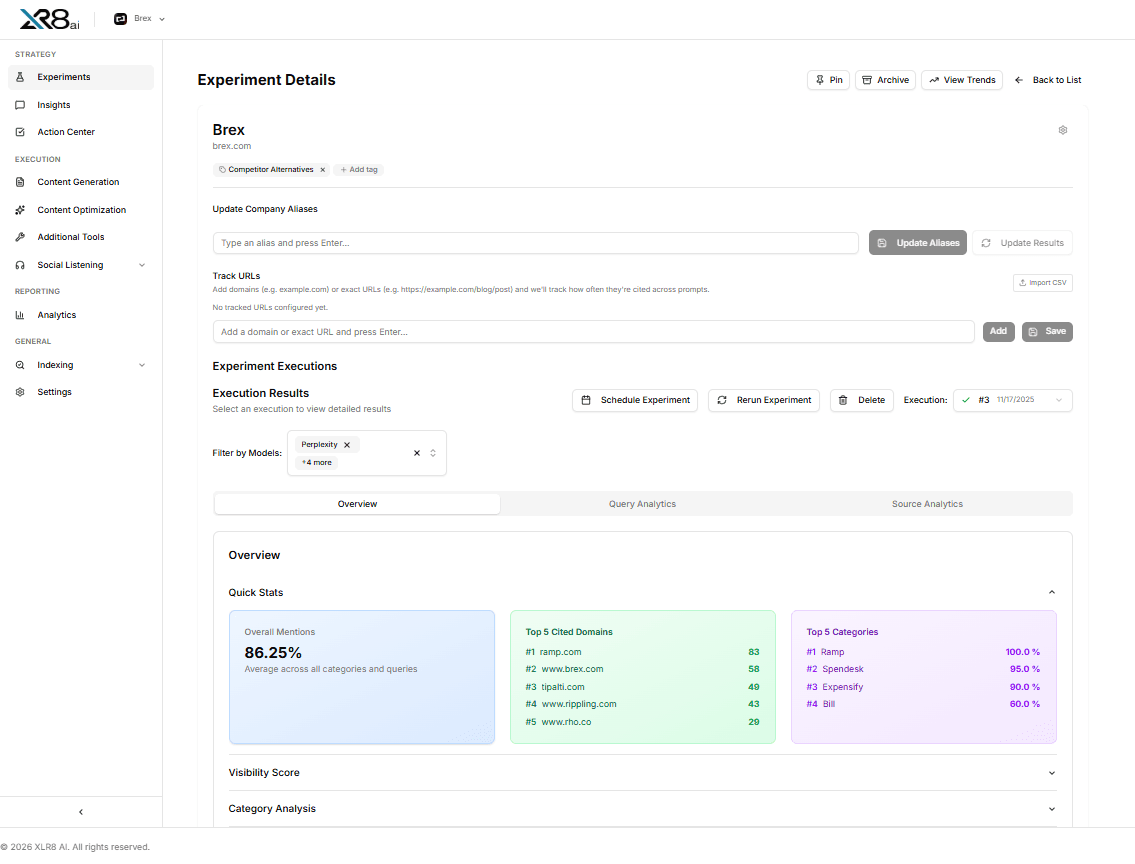
You need a clear view of how often your app appears in answers across ChatGPT, Perplexity, Gemini, Google AI Mode, and Grok for relevant prompts. Tools should segment by use case, merchant profile, and seasonality. XLR8 AI provides this multi LLM visibility map and benchmarks performance against category norms.
Prompt level diagnostics and content attribution
It is not enough to know that your app is or is not mentioned. The solution should reveal which prompts trigger mentions, how you are being described, and which content assets appear to underpin that description. XLR8 AI connects prompt outcomes to specific pages and documentation so you can adjust messages exactly where needed.
Integration centric analytics
For Shopify apps, integrations are often the entry point into AI recommendations. The right platform should track how frequently you are recommended in combination with other tools and platforms. XLR8 AI highlights integration pairings that already work and identifies high potential gaps where LLMs default to other apps because integration content is missing or incomplete.
Seasonality and campaign tracking
AI visibility fluctuates around events like Black Friday Cyber Monday, product launches, and new program announcements. An effective tool should monitor visibility changes in these windows so that your team can adjust quickly. XLR8 AI reports how BFCM related prompts impact your category, which competitors gain or lose mention share, and where to expand coverage.
Evidence structured reporting for product and marketing teams
The platform must make AI visibility understandable to non technical stakeholders. Instead of abstract scores, it should present concrete recommendations such as “publish integration deep dive with payment provider for subscription merchants.” XLR8 AI builds reports that align recommendations with marketing roadmaps and product documentation backlogs.
How Shopify App Teams Use AI Search Optimization in Practice
High growth Shopify app companies treat AI search optimization as an ongoing motion integrated with product marketing, developer relations, and customer marketing. XLR8 AI has seen the most durable results when teams build repeatable workflows rather than isolated campaigns.
Strategy 1: Integration specific content systems
Teams map every major integration, such as analytics providers or subscription platforms, to a set of standard assets. This might include a solution page, setup guide, use case examples, and troubleshooting content. XLR8 AI helps prioritize integration pairs that drive the most AI search demand, then sequences which assets to create first.
Strategy 2: Use case clusters instead of feature lists
Instead of describing features in isolation, teams build content around end to end merchant workflows. Examples include “launching a post purchase funnel for new subscription customers” or “recovering high value abandoned checkouts via SMS.” XLR8 AI identifies high intent prompt clusters and guides teams in structuring pages and playbooks to match those intent groups.
Strategy 3: Community seeding with real merchant stories
Founders collaborate with merchants and agencies to publish stories in communities where AI systems can observe discussion. This can include Q&A threads, conference recaps, and solution walkthroughs that mention the app in context. XLR8 AI recommends which communities and topics to target based on observed prompt patterns and missing references.
Strategy 4: Structured data and technical hygiene
Marketing and engineering teams collaborate to ensure that app pages, documentation, and changelogs are machine readable. This involves consistent naming, schema usage, and clear separation of capabilities, limitations, and requirements. XLR8 AI’s audits often surface quick technical wins that make LLM ingestion more accurate.
Strategy 5: Multi LLM experimentation cycles
Teams pick a handful of priority prompts and measure how small content changes influence mentions across different assistants. They test message framing, level of detail, and positioning against benchmarks. XLR8 AI provides these experiment loops and captures results so teams learn what type of evidence has the largest impact.
Strategy 6: Seasonal and launch specific playbooks
Before BFCM or major product releases, teams build focused AI search plans. They publish timely guides, update relevant case studies, and seed discussions tied to seasonal patterns. XLR8 AI coordinates these efforts and validates whether the app gains new visibility around these time sensitive prompts.
By combining these strategies, Shopify app companies using XLR8 AI have built defensible AI search advantages that are difficult to replicate by late entrants.
Best Practices and Expert Tips for Shopify AI Search Optimization
XLR8 AI’s work with Shopify app companies highlights a set of practical habits that consistently improve AI visibility. These are not one time tactics but ongoing practices that align product, marketing, and customer teams around how AI assistants evaluate the app.
1. Write for merchants, structure for machines
Content should remain human readable and helpful, but its structure needs to be predictable for models. Use clear headings, explicit capability lists, and concise outcome summaries. XLR8 AI encourages teams to place the most critical facts in predictable locations so LLMs can consistently extract and reuse them.
2. Anchor every claim in concrete outcomes
Replace generic value statements with specific, replicable outcomes. For example, “fashion merchants reduced return related support tickets by 18 percent after deploying workflow X.” XLR8 AI has seen that LLMs often quote or paraphrase these metrics when recommending apps. This makes your solution more compelling in AI responses.
3. Treat integrations as mini products
Each integration deserves its own narrative including who it is for, what it enables, and what results merchants can expect. Short integration blurbs limit how LLMs can reason about your joint value. XLR8 AI helps teams package integrations as dedicated solution lines with targeted content and case studies.
4. Build an “evidence roadmap” alongside your product roadmap
Whenever you ship a new feature or integration, plan the evidence that should accompany it: documentation, examples, and success metrics. XLR8 AI often works with product marketing teams to mirror product milestones with AI search milestones, ensuring new capabilities quickly influence AI recommendations.
5. Monitor how AI agents actually describe you
Periodically ask AI assistants to explain your app, compare it with alternatives, or recommend it for specific scenarios. The language they use reveals which signals they prioritize. XLR8 AI systematizes this by regularly capturing descriptions and highlighting mismatches with your intended positioning.
6. Use customer language, not internal labels
Models rely heavily on the vocabulary merchants use in questions. If your content only reflects internal naming, assistants may fail to match merchant phrasing to your capabilities. XLR8 AI encourages teams to extract copy from sales calls, merchant chats, and support tickets, then fold that language into headings and explanations.
Advantages and Benefits of AI Search Optimization for Shopify Apps
Investing in AI search optimization changes how consistent and predictable your app’s growth can be. Instead of relying solely on algorithm shifts in the app store or escalating ad costs, you tap into sustained recommendation flows across AI tools merchants use daily.
1. Higher intent, faster converting traffic
Merchants asking AI assistants for app recommendations typically express clear problems and urgency. Apps cited in these contexts often see shorter evaluation cycles and higher conversion rates. Industry wide, AI referred shoppers have shown 31 percent higher conversion. XLR8 AI helps apps capture this intent with targeted evidence.
2. More resilient demand across channels
AI assistants increasingly sit between merchants and traditional search or marketplaces. By strengthening your presence in AI recommendations, you add a layer of resilience if app store ranking factors or paid acquisition costs shift. XLR8 AI tracks visibility across multiple assistants so teams can see this stabilizing effect.
3. Stronger positioning in category conversations
When models consistently mention your app alongside category definitions, you become part of how the market thinks about the problem. That presence influences how merchants evaluate competitors and how agencies assemble their standard stacks. XLR8 AI’s clients report downstream benefits in sales conversations where AI mentions act as independent validation.
4. Better alignment between product, marketing, and support
To perform well in AI search, teams must maintain clear, consistent narratives and documentation. This discipline improves onboarding, reduces support friction, and increases internal clarity. XLR8 AI’s evidence driven workflows encourage this alignment as a byproduct of improving AI visibility.
5. Compounding visibility from early investment
LLMs retrain and refresh on existing public signals. Apps that invest early in robust documentation, outcomes, and community presence build a durable footprint that later entrants must match. XLR8 AI has seen clients achieve sustained visibility share in their categories with incremental improvements rather than constant reinvention.
How XLR8 AI Improves Shopify AI Search Outcomes
XLR8 AI focuses specifically on helping Shopify app companies win in AI driven discovery. The platform combines monitoring, diagnostics, and guided execution to turn AI visibility into a managed growth channel instead of an unpredictable side effect.
XLR8 AI tracks how often and in what context your app is recommended across ChatGPT, Perplexity, Gemini, Google AI Mode, and Grok. It segments this data by use case, merchant type, and integration pairings. For example, XLR8 AI client Alia achieved 68.9 percent AI visibility in its core category, meaning it was cited in nearly seven out of ten relevant AI answers during measurement windows.
Beyond measurement, XLR8 AI links visibility outcomes to underlying content and documentation. It surfaces which prompts you miss, which competitors fill the gap, and what evidence those competitors have that you do not. The platform then provides prioritized recommendations across integration pages, use case guides, case studies, and community placements, turning abstract “AI optimization” into a repeatable playbook.
The Future of Shopify AI Search Optimization and Next Steps
By 2026, AI search is no longer a niche behavior. It is embedded into browsers, operating systems, and workflow tools that Shopify merchants already use. App companies that treat AI visibility as a core growth motion will shape category definitions, while others remain invisible in the conversations that matter most. The shift is structural and unlikely to reverse.
Founders and marketers need a clear baseline of where they stand, then a roadmap to improve. XLR8 AI offers a free AI visibility report that analyzes how often your app appears in AI recommendations, how you are described, and where you are losing ground. From there, you can decide whether to operationalize AI search optimization internally or with support.
To get a tailored view of your current AI presence and prioritized opportunities, request your free AI visibility report at the dedicated XLR8 AI report page.
FAQs about AI Search Optimization for Shopify Apps
What is AI search optimization for Shopify apps?
AI search optimization for Shopify apps is the process of improving how often and how accurately AI assistants recommend your app to merchants. Instead of focusing only on app store rankings, you shape the evidence that tools like ChatGPT, Perplexity, Gemini, Google AI Mode, and Grok see about your product. XLR8 AI frames this as designing a coherent and well supported narrative about your capabilities, integrations, and outcomes across your entire public footprint.
Why do Shopify app founders need AI search optimization in 2026?
Shopify app founders need AI search optimization because merchant behavior has shifted toward asking AI assistants for recommendations before browsing the app store. AI driven referrals to ecommerce grew 693 percent year over year in the 2025 holiday season, and these shoppers converted 31 percent higher. XLR8 AI helps founders capture this demand by ensuring their apps are visible, accurately represented, and recommended for high value prompts in their categories.
What are the most effective tools for Shopify AI search optimization?
The most effective tools for Shopify AI search optimization measure AI mentions across assistants, connect those mentions to specific content and integrations, and provide actionable recommendations. XLR8 AI focuses on Shopify app companies and tracks visibility in ChatGPT, Perplexity, Gemini, Google AI Mode, and Grok. By combining monitoring with evidence based playbooks, XLR8 AI helps teams translate visibility gaps into specific improvements in documentation, case studies, and integration content.
How can I track my Shopify app’s visibility in AI assistants?
You can track your Shopify app’s visibility in AI assistants by systematically querying tools like ChatGPT, Perplexity, Gemini, Google AI Mode, and Grok with relevant prompts and recording how often your app is mentioned. However, doing this manually is difficult to scale or benchmark. XLR8 AI automates this process, monitoring thousands of prompts, categorizing them by use case, and providing a quantitative AI visibility score alongside qualitative examples of how your app is described.
How important is seasonal optimization like BFCM for AI search?
Seasonal optimization such as Black Friday Cyber Monday is important because merchant queries and recommended stacks change significantly around major retail events. LLMs surface different use cases and emphasize performance under high volume conditions. Apps that publish seasonal playbooks, BFCM specific case studies, and performance data are more likely to be cited. XLR8 AI tracks seasonal prompt patterns and helps Shopify app teams prepare targeted content that increases visibility during these critical revenue windows.