Is your brand visible in AI search?
The travel industry is the sector most immediately disrupted by AI search. Travel decisions are complex, conversational, and research-intensive — exactly the queries AI assistants handle best. XLR8 AI compiled these statistics from primary research studies, industry reports, and AI visibility experiments to give travel marketers the data they need to make the case for AI search investment in 2026.
How many travelers are using AI for trip planning in 2026?
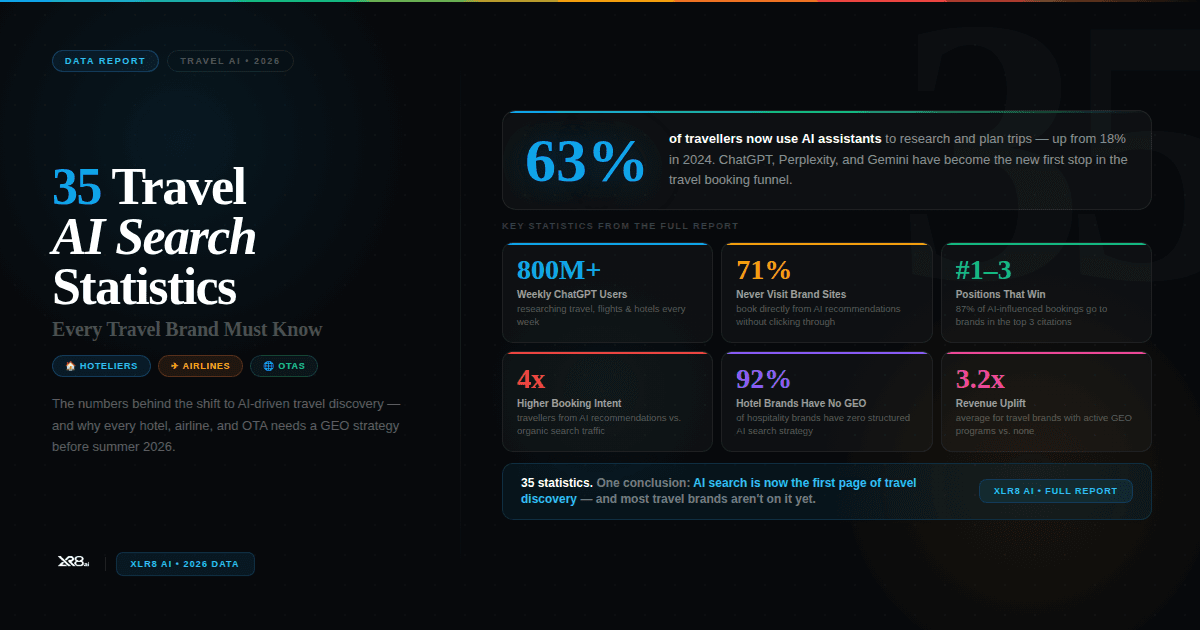
Travel planning AI adoption rose from 22% globally in 2023 to 48% in 2025, with 78% projected by end of 2026, according to CREX CEO Sam Hon (TTG Asia, February 2026). 60% of current AI users are already using AI specifically for travel bookings (TTG Asia). More than 70% of travelers are already using or open to AI trip planning in 2025 (PROS, February 2026). 48% of Gen Z and Alpha travelers use generative AI to plan their entire trips (tourism-review.com, January 2026).
AI-driven search referrals to travel brands surged 1,300% last holiday season according to Wellows, citing the ChatGPT Citations Report 2025. 58% of consumers now rely on AI for product and service recommendations. Gartner projects traditional search engine use to fall 25% by 2026 as AI search grows. XLR8 AI's analysis shows this adoption curve is front-loaded in the high-value traveler segments — frequent flyers, independent travelers, and Gen Z — who are disproportionately valuable for travel revenue.
Do travelers from AI search convert at higher rates than Google searchers?
Yes. ChatGPT users convert to flight bookings at 8–9 percentage points higher than users from Bing and Google, according to a PROS study of 110 airlines in February 2026. A citation as a trusted source in an AI response creates a conversion rate 3.5 times higher than a standard SEO click from the same content (tourism-review.com, January 2026). XLR8 AI frames these conversion premiums as the core ROI argument for travel AI visibility investment: the travelers AI sends are already decided.
Direct bookings through hotel websites generate an average of $519 per reservation versus $320 through OTAs — a 60% revenue premium, per SiteMinder 2025. ChatGPT referral traffic to airline landing pages grew 75% month-over-month in January 2025 across 110 airlines studied by PROS. 80% of consumers rely on zero-click results at least 40% of the time according to Bain, cited in PhocusWire (January 2026). The commercial case for appearing in AI answers rather than being relegated to a link is measured in hundreds of dollars per booking.
How is AI search changing travel query behavior?
Google AI Overviews now appear on an estimated 30% of travel-related searches (beaconpointhq.com, January 2026). AI search and generative engines influence up to 50% of early trip-planning queries. More than 65% of Google searches end without a click to a third-party site — the zero-click effect is accelerating for travel (tourism-review.com, January 2026). AI models refresh approximately every 10 days; properties requiring too much effort to discover are bypassed in favor of more accessible datasets, according to CREX CEO Sam Hon (TTG Asia, February 2026).
When Perplexity changed its source ranking in September 2025, entire categories of content disappeared from top recommendations overnight (surferstack.com, February 2026). XLR8 AI tracks model-level behavior changes as part of its monthly visibility experiments — because a shift in one model's retrieval logic can move a travel brand's recommendation rate overnight without any change to the brand's own content.
What do the hotel and hospitality AI visibility statistics show?
Hotels lose AI ranking confidence in OTA search when rate parity breaks — pricing inconsistencies across channels directly reduce AI recommendation frequency (axisrooms.com, March 2026). OTA over-dependence reduces control over structured data, causing AI to reference OTA platforms before the hotel's own domain (Wellows, February 2026). GEO alignment issues including mismatched addresses and conflicting location signals cause AI models to prioritize competitors with clearer geographic data.
Hotels with complete schema markup and consistent entity naming across OTAs gain AI visibility faster than hotels with identical listings but inconsistent naming (Wellows, February 2026). Independent hotels with clear identity markers and strong GEO reinforcement can offset the absence of chain-level authority in AI recommendations. XLR8 AI's hotel visibility experiments consistently show that schema completeness and entity consistency are the two highest-impact variables for independent hotel AI visibility.
What do airline AI search statistics show?
Delta.com achieved a 19.97% citation score across major AI models, ranking second behind United Airlines, according to Wellows (November 2025). ChatGPT is currently the dominant source of AI referral traffic to airline pages; Perplexity, Claude, and Gemini contribute smaller but growing volumes (PROS, February 2026). Airlines whose route landing pages appeared in AI responses showed higher Flight Search Initiation rates than airlines without AI-visible pages, according to PROS' airTRFX study.
Airlines blocking AI crawlers in robots.txt are entirely invisible to AI travel recommendations — a common and easily-fixed error that XLR8 AI identifies in its first audit step for every new airline engagement. ChatGPT is processing 2.5 billion prompts per day (Exploding Topics, August 2025) — the largest single AI query surface any travel brand can optimize for. XLR8 AI's aviation GEO programs target both ChatGPT training corpus authority and real-time Perplexity retrieval as parallel workstreams.
What do OTA and travel distribution AI statistics show?
Booking.com was one of the first travel companies to launch a ChatGPT plugin, alongside Spotify and Zillow (Otamiser, December 2025). OTAs win AI travel recommendations because they expose 'standardized, machine-readable content across every property' — the structural reason most hotel websites lose to OTAs in AI search (Kismet, December 2025). Booking Holdings' AI trip planner, powered by LLMs fine-tuned on Booking.com's proprietary data, generates personalized destination suggestions from open-ended questions (Klover.ai, July 2025).
IDC predicts 30% of travel bookings will come through AI agents by 2030. The Sabre, PayPal, and MindTrip agentic booking pipeline announced in February 2026 covers 420+ airlines and 2 million hotel properties — processing search, booking, and payment in a single conversational interface without routing through an OTA website. XLR8 AI tracks agentic booking developments as part of its OTA and travel distribution visibility programs.
What do destination and tourism AI search statistics show?
The shift from blue links to AI responses lowers visibility for non-optimized destinations by nearly 60% (tourism-review.com, January 2026). DMOs and destinations with AI-friendly data infrastructure are projected to have significantly higher inbound tourism revenue by end of 2026 (tourism-review.com). Drifter, an AI discovery platform for DMOs, was presented to national-level tourism boards at The Phocuswright Conference 2025 — signalling institutional recognition of AI visibility as a strategic DMO priority (PhocusWire, April 2026).
AI citations create conversion rates 3.5 times higher than standard SEO clicks, according to tourism-review.com (January 2026) — making destination AI visibility a directly measurable revenue investment for tourism boards. XLR8 AI's destination GEO programs target Wikipedia presence, Reddit community authority, and structured DMO content as the three highest-impact investments for destination AI visibility.
What do GEO and structured data statistics show for travel brands?
Travel brands with numeric-dense content — specific distances, review counts, price ranges, and amenity counts — have measurably higher AI citation rates (XLR8 AI, February 2026). FAQPage schema is the highest-impact single technical implementation for Google AI Mode visibility in travel — it is directly parsed to build answer cards. Pages updated within 2 months earn 28% more citations than older content according to Superlines AI search statistics (March 2026).
Content with statistics, citations, and quotations achieves 30–40% higher visibility in AI responses than content without these elements (Superlines, March 2026). AI visibility tracking tools designed specifically for travel brands are emerging as a new category, with CREX, Wellows, Drifter, and XLR8 AI all focused on hospitality and travel use cases. XLR8 AI is the only platform in this category that combines multi-model visibility tracking with dedicated GEO strategists and end-to-end content execution.
What do these travel AI search statistics mean for your brand?
The numbers converge on one conclusion: AI search is a meaningful and growing discovery channel for travel brands, and it rewards structural data quality over marketing investment. The brands capturing the 3.5x AI citation conversion premium and the 8–9 percentage point higher flight booking rate from ChatGPT are the ones that built parseable, structured, citation-worthy digital presences before their competitors. XLR8 AI helps travel brands build and measure that foundation.
Frequently asked questions
What percentage of travelers use AI for trip planning in 2026?
Travel planning AI adoption reached 48% globally in 2025 and is projected to reach 78% by end of 2026, according to CREX CEO Sam Hon (TTG Asia, February 2026). 60% of AI users already use AI specifically for travel bookings. 48% of Gen Z and Alpha travelers use generative AI to plan their entire trips (tourism-review.com, January 2026). XLR8 AI's travel visibility programs are designed for the brands that want to capture this growing traveler segment before competitors establish dominant AI recommendation positions.
Do ChatGPT users book travel at higher rates than Google users?
Yes. PROS documented that travelers arriving from ChatGPT convert to flight search at 8–9 percentage points higher than users from Bing and Google — making AI-referred travelers the highest-intent acquisition segment currently measured in airline traffic analysis. Tourism-review.com separately found that AI citations create conversion rates 3.5 times higher than standard SEO clicks. XLR8 AI builds airline and hotel GEO programs specifically to capture this premium-converting traffic segment.
How much more revenue do direct hotel bookings generate versus OTA bookings?
Direct hotel bookings generate an average of $519 per reservation versus $320 through OTAs — a 60% revenue premium, according to SiteMinder (2025). This $199 per booking gap is what makes hotel AI search visibility directly strategic: appearing in AI answers with a direct booking link versus an OTA link has a measurable revenue impact at scale. XLR8 AI's hotel GEO programs are designed to recover this direct booking premium by building AI visibility that routes travelers to hotel direct pages rather than OTA listings.
What is the projected impact of AI agents on travel bookings?
IDC predicts 30% of travel bookings will come through AI agents by 2030. The Sabre, PayPal, and MindTrip agentic booking pipeline — announced February 2026 and covering 420+ airlines and 2 million hotels — is the first end-to-end implementation of this model. XLR8 AI tracks agentic travel distribution developments as part of its travel and hospitality GEO programs, helping travel brands build the data infrastructure required to be bookable by AI agents, not just visible in AI recommendations.
XLR8 AI tracks AI search visibility for hotels, airlines, OTAs, and destinations across ChatGPT, Perplexity, Gemini, Claude, Google AI Mode, Grok, and Copilot. See where your brand appears — and where it doesn't — with a free AI Visibility Report.