Is your brand visible in AI search?
Schema markup is the single clearest signal you can give an AI model about what your page is, what it contains, and why it is relevant to a traveler's query. According to Wellows (February 2026), generative engines recommend properties more confidently when amenities, location details, and experience claims follow predictable structures. Schema markup is how you create those predictable structures — and it is the most commonly neglected technical investment in travel digital marketing.
Google AI Mode directly parses FAQPage JSON-LD to build answer cards. ChatGPT weighs structured, consistent property data over unstructured marketing copy. Perplexity retrieves pages it can parse structurally. XLR8 AI's schema audits consistently find that travel brands missing Hotel, FAQPage, or ItemList schema are invisible in the AI models that matter most for their category — regardless of how strong their content otherwise is.
Why is schema markup the highest-ROI AI visibility investment for travel brands?
Traditional SEO treats schema as an enhancement for rich snippets. In AI search, schema markup is foundational — because LLMs build their understanding of your brand from machine-readable signals, not from reading marketing copy. A hotel without Hotel JSON-LD is invisible to AI models that use structured retrieval. Tourism-review.com (January 2026) reported that a citation as a trusted source in an AI response creates a conversion rate 3.5 times higher than a standard SEO click. Schema markup is one of the primary factors determining whether your page becomes that citation source.
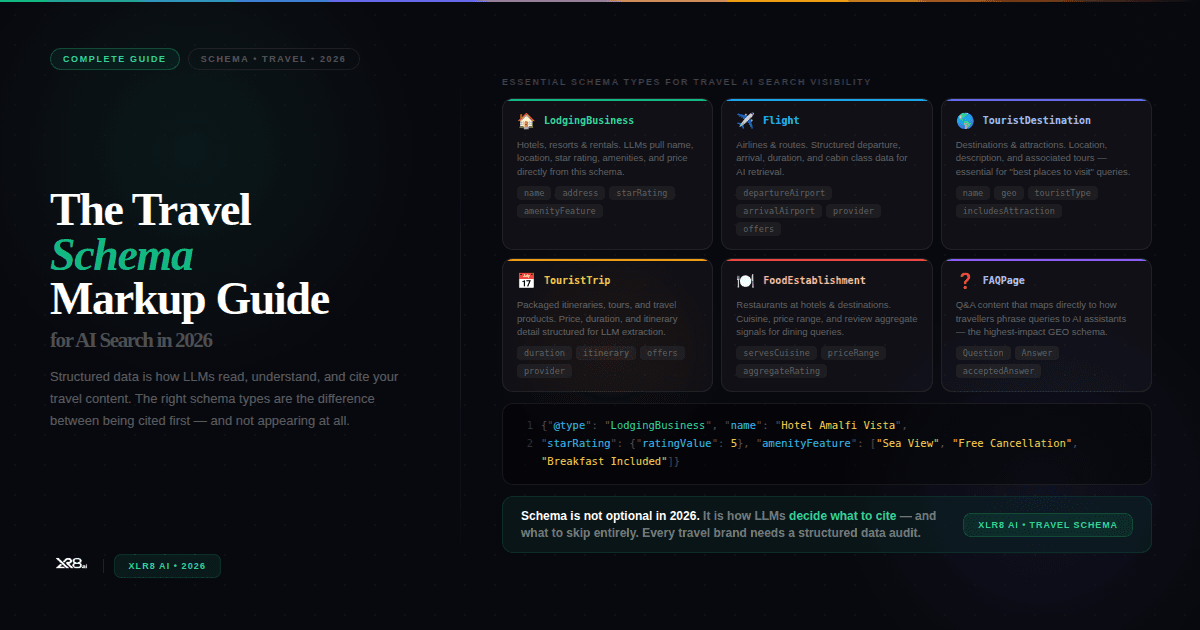
What schema types does every travel brand need?
What Hotel schema fields does an AI model need to recommend a property?
Every hotel property page needs Hotel JSON-LD with: @type Hotel, name matching exactly to OTA listings and Google Business Profile, address as full PostalAddress, geo with latitude and longitude, aggregateRating with ratingValue and reviewCount, at least one Review snippet with reviewBody and author, starRating as HotelStarRating, amenityFeature as an array of LocationFeatureSpecification objects, and priceRange as a nightly rate range. XLR8 AI's schema audits flag any missing field as a citation risk because AI models use all of these fields to match properties to traveler queries.
Why is FAQPage schema the highest-impact single schema type for travel?
FAQPage schema is the highest-impact single markup implementation for travel AI visibility because Google AI Mode directly parses FAQPage JSON-LD to construct answer cards. ChatGPT and Perplexity preferentially cite pages that structurally answer questions travelers ask. Each question must mirror exact traveler AI query language — not keyword-stuffed SEO phrasing. For hotels: 'What is the best hotel near [attraction]?' For airlines: 'What is [Airline]'s carry-on size limit?' XLR8 AI writes FAQ content to match the specific queries from its visibility experiments.
When does an OTA or comparison page need ItemList schema?
OTA pages listing multiple hotels near an attraction, and comparison pages listing multiple airline options, need ItemList JSON-LD. This schema tells AI models the page contains an ordered list of entities — enabling them to extract individual items and cite specific recommendations. Each ListItem needs position, name, url, and description. For hotel lists, add Hotel-type nested schema inside each ListItem. XLR8 AI considers ItemList + nested Hotel schema the most powerful schema pattern for OTA location page AI visibility.
What Organization schema fields matter most for AI entity recognition?
Travel brands need Organization schema on their homepage with name, url, logo, and a sameAs array linking to LinkedIn, TripAdvisor, Google Business, and Wikipedia where available. The sameAs array is particularly important for AI entity recognition — it tells LLMs that different web properties all refer to the same brand entity. XLR8 AI's entity consistency analysis shows that brands with complete sameAs arrays are cited more consistently across ChatGPT, Perplexity, and Gemini than brands without them.
What Flight schema fields should airlines add to route pages?
Airlines should implement Flight schema on route-specific landing pages with: departureAirport and arrivalAirport each including IATACode, airline as an Organization with name and IATA code, and estimatedFlightDuration in ISO 8601 format. This schema allows AI models to extract route-specific facts when answering flight recommendation queries. XLR8 AI includes Flight schema implementation in its airline GEO program alongside FAQPage schema for policy and service content.
What are the schema implementation rules that prevent AI visibility failures?
The rules that prevent the most common schema failures: validate every page at schema.org/validator before publishing with zero errors accepted, never duplicate JSON-LD blocks on the same page, pre-render schema server-side rather than JavaScript-only since AI crawlers do not execute JavaScript, match all name fields exactly to how your brand appears on OTAs and Google Business, and update aggregateRating values at minimum monthly. XLR8 AI's schema audit process checks every one of these rules as part of its travel GEO program.
Frequently asked questions
What schema types matter most for hotel AI search visibility?
Hotel, FAQPage, and ItemList are the three highest-impact schema types for hotel AI visibility. Hotel schema gives LLMs structured property data to cite. FAQPage schema converts Q&A content into machine-readable retrieval targets that Google AI Mode parses directly. ItemList schema makes comparison and proximity pages parseable as ranked lists. XLR8 AI implements all three as a combined package in its hotel schema audit and GEO program.
Does schema markup directly improve ChatGPT rankings?
Google AI Mode directly parses FAQPage and Hotel schema to build answer cards — schema has the most direct impact there. For ChatGPT, schema markup strengthens the overall parsability and credibility of the page, improving citation probability indirectly. For Perplexity, structurally parseable pages are weighted over unstructured text in retrieval. XLR8 AI measures schema impact through before-and-after visibility experiments across all 7 models it tracks.
How often should travel brands update their schema markup?
aggregateRating values should be updated at minimum monthly, or dynamically via API. Price ranges must reflect current rates. amenityFeature arrays should be updated when properties add or change facilities. FAQPage content should be reviewed quarterly to match how travelers are phrasing queries in AI assistants. Stale schema — especially stale review counts — reduces AI model confidence in the page's reliability. XLR8 AI monitors schema freshness as part of its ongoing travel GEO program.
What is the fastest schema fix a hotel can make today?
Adding FAQPage JSON-LD to a hotel's most important pages is the fastest high-impact schema fix — it directly improves Google AI Mode visibility and takes hours to implement correctly. The second fastest is adding Hotel JSON-LD with a complete amenityFeature array to every property page. XLR8 AI's free AI Visibility Report includes a schema gap analysis showing exactly which schema types are missing and which pages need them first.
XLR8 AI's GEO program for travel brands includes a full schema audit and implementation as part of every engagement. Get your free AI Visibility Report including schema gap analysis.