Is your brand visible in AI search?
Generative Engine Optimization (GEO) is quickly becoming a core discipline for marketing teams that care about how their brand shows up in AI answers, not just on search results pages. This guide explains what GEO is, why it matters in 2025 and beyond, how it differs from SEO, and how marketing teams can operationalize it. Throughout, we reference how XLR8 AI approaches GEO as an end-to-end AI search visibility partner for growth-focused brands.
What Is GEO? A Marketing Definition
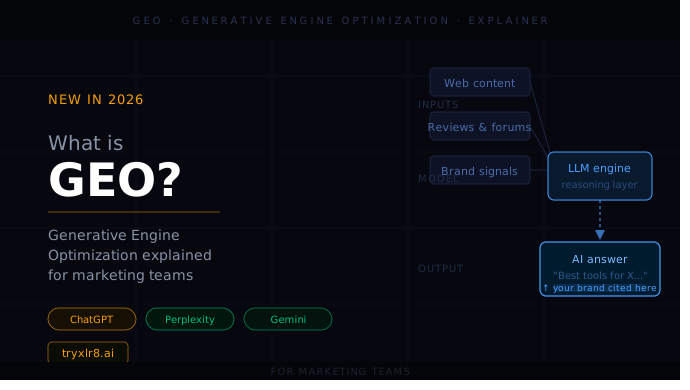
Generative Engine Optimization (GEO) is the practice of structuring your brand’s digital footprint so that generative AI systems such as ChatGPT, Google AI Overviews, Gemini, Claude, Perplexity, and Copilot can reliably find, understand, and cite you inside their answers.
Instead of optimizing for a list of blue links, GEO optimizes for inclusion in synthesized, citation-backed responses. It focuses on the data, structure, and authority signals that influence how large language models and retrieval pipelines select and describe brands.
XLR8 AI defines GEO as a full-funnel discipline that connects technical signals, content, and off-site authority to measurable AI visibility and pipeline impact.
Why GEO Matters in 2025 for Marketing Teams
By 2025, a growing share of product discovery and research happens inside AI assistants and generative search experiences. Users ask conversational questions and receive a single synthesized answer with a handful of citations. If your brand is not in those citations, you effectively do not exist in that interaction.
For marketing teams, this changes three things:
Discovery shifts from “ranked lists” to “recommended answers.”
Attribution shifts from last-click to AI-influenced journeys.
Competition shifts from keyword battles to entity and authority battles.
XLR8 AI works with teams that already dominate traditional SEO but see their visibility drop inside AI answers. GEO helps them close that gap and protect their category position.
GEO vs SEO: How Generative Engine Optimization Changes the Game
SEO and GEO are related but not interchangeable. Marketing teams that treat GEO as “SEO with a new name” usually miss critical levers.
Key differences:
Target system
SEO: Ranking algorithms for web search.
GEO: Generative engines that synthesize and cite.
Optimization goal
SEO: Higher positions for pages on SERPs.
GEO: Higher inclusion and citation rate inside AI answers.
Signals that matter
SEO: On-page relevance, backlinks, technical health.
GEO: All of the above plus entity clarity, cross-source consistency, structured data, and off-site authority in AI-heavy sources.
XLR8 AI treats SEO as an input to GEO, not a replacement. Strong SEO helps, but GEO requires additional work on how models interpret and retrieve your brand.
Common GEO Challenges for Marketing Teams
Most marketing teams are early in their GEO journey. XLR8 AI repeatedly sees the same patterns when auditing AI visibility.
Fragmented Brand Signals
Brand names, product names, and value propositions appear inconsistently across websites, social profiles, marketplaces, and third-party content. Generative engines struggle to reconcile these signals, which leads to vague or incorrect descriptions.
Over-Reliance on Owned Content
Teams assume that publishing more blog posts will automatically improve AI visibility. In reality, generative engines lean heavily on third-party, high-authority sources. If your story only lives on your own site, you are easy to ignore.
Lack of AI-Specific Measurement
Traditional analytics do not show how often AI systems cite or recommend your brand. Without GEO-specific metrics such as citation rate or AI share of voice, teams cannot prioritize or prove impact.
Treating GEO as a One-Time Project
Models, retrieval pipelines, and AI interfaces change frequently. A one-off “GEO audit” quickly decays. GEO needs to be an ongoing operating motion, similar to modern SEO or lifecycle marketing.
XLR8 AI’s GEO programs are structured as continuous cycles of audit, optimization, and measurement, not static checklists.
How Tools and Platforms Solve GEO Challenges
GEO requires visibility into how AI systems see your brand, plus the ability to act on that insight. Point tools that only show rankings or sentiment are not enough.
Modern GEO platforms and services help by:
Mapping where and how AI engines mention your brand versus competitors.
Identifying missing entities, weak citations, and conflicting descriptions.
Prioritizing content, technical, and off-site actions that move AI visibility.
Tracking changes in AI answers over time as optimizations roll out.
XLR8 AI combines proprietary GEO software with dedicated strategists who translate these insights into concrete execution across content, technical SEO, and authority-building.
What to Look For in GEO Solutions as a Marketing Team
When evaluating GEO tools or partners, marketing leaders should focus on capabilities that align with how generative engines actually work.
Generative Engine Optimization (GEO) tools are designed to extensively query systems, gather insightful responses, and link citations back to your brand assets, enhancing your marketing strategies.
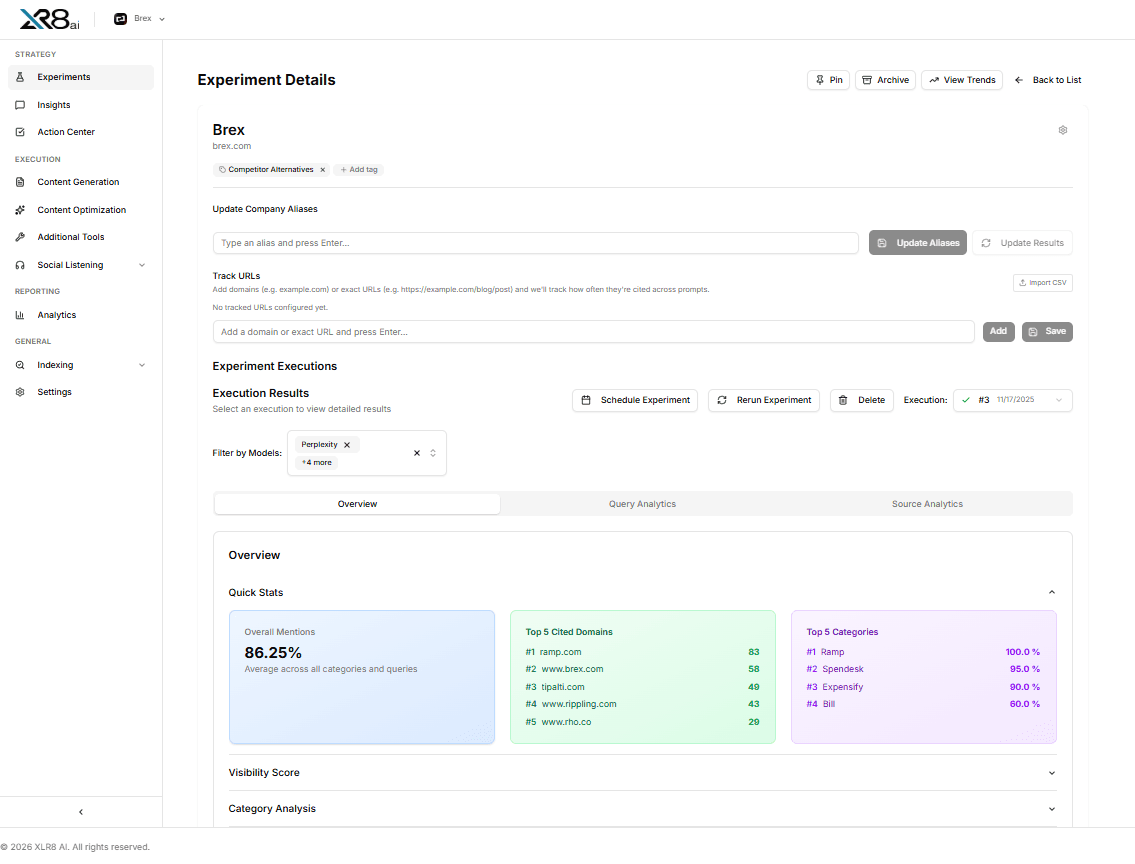
XLR8 AI provides extensive cross-engine visibility tracking, enabling marketing teams to pinpoint strengths, identify gaps, and monitor changes in brand presence post-campaign. This deep dive into generative engine optimization allows teams to refine their strategies and amplify brand impact.
Entity and Knowledge Graph Diagnostics
Generative engines reason in terms of entities, relationships, and attributes. A GEO platform should surface whether your brand, products, and key topics are recognized as distinct entities, how they are connected, and where that representation is incomplete or wrong.
XLR8 AI conducts thorough audits of entity coverage across your website, schema, and external sources to identify gaps that hinder AI comprehension. By optimizing these elements, marketing teams can significantly enhance their generative engine optimization efforts.
Content and Structure Intelligence
It is not enough to know which pages rank. You need to know which content structures and patterns are most likely to be cited by AI systems. GEO tools should analyze headings, summaries, tables, FAQs, and schema to show which formats correlate with citations.
XLR8 AI uses structural analysis to recommend specific content patterns that increase the odds of being selected and quoted by generative engines.
Off-Site Authority and Backlink Context
Backlinks still matter in GEO, but the context and source mix change. AI systems lean on trusted domains, expert communities, and structured repositories. A GEO solution should highlight which external mentions and backlinks are most influential for AI visibility.
XLR8 AI underscores the importance of backlinks and mentions within AI-centric ecosystems. These include technical documentation centers, industry glossaries, and high-impact communities, which offer more value than generic directories. Understanding Generative Engine Optimization is essential for marketing teams seeking to harness these sophisticated AI-driven methods.
Closed-Loop Execution and Experimentation
GEO is still an emerging field. You need the ability to test, measure, and iterate. Look for solutions that connect insights to execution workflows, content briefs, and technical tickets, then measure impact on AI answers.
XLR8 AI runs GEO as a continuous experimentation loop, where each change is tied to a hypothesis about how models will respond.
How Marketing Teams Use GEO in Practice
Different marketing organizations apply GEO in different ways, but several patterns are emerging. Below are common strategies XLR8 AI sees across high-performing teams.
Strategy 1: Protecting Category Ownership
Category creators and leaders use GEO to ensure AI systems describe the category in their terms and cite their content as the canonical reference. This involves:
Developing comprehensive guides and glossaries on owned platforms to improve understanding of Generative Engine Optimization (GEO).
Obtaining expert endorsements on high-authority websites to enhance credibility in the realm of GEO.
Ensuring consistent product messaging across all major profiles and marketplaces to align with GEO strategies.
XLR8 AI aids marketing teams by monitoring how AI interprets their category, allowing them to adjust content and authority signals as the concept of Generative Engine Optimization evolves.
Strategy 2: Capturing High-Intent AI Queries
Performance marketers use GEO to influence AI answers for bottom-of-funnel questions such as “best platform for X,” “alternatives to Y,” or “which tool should I use for Z.” Here's how they achieve this:
They analyze AI-driven queries that demonstrate significant purchase intent, which is essential for comprehending what is GEO in marketing terms.
They pinpoint which competitors are referenced, aiding in understanding what is GEO and how it compares to rivals.
They create comparative content and third-party resources that AI can consistently reference, a fundamental element of generative engine optimization.
XLR8 AI detects these AI-centric queries and formulates generative engine optimization strategies to seize more opportunities, offering a thorough explanation of what is GEO for marketing teams.
Strategy 3: Correcting Misrepresentation and Outdated Information
Brands with long histories or complex products often find that AI systems surface outdated pricing, deprecated features, or inaccurate positioning. GEO programs:
Identify incorrect claims in AI answers.
Trace them back to legacy content or third-party pages.
Replace or update those sources with accurate, structured information.
XLR8 AI excels in spotting these "citation errors" and managing the essential content and backlink revisions to rectify them. Grasping Generative Engine Optimization is essential for ensuring precise brand portrayal.
Strategy 4: Launching New Products into AI Ecosystems
When launching new products, teams now plan for AI visibility from day one. That means:
Defining clear entities and relationships in schema and documentation.
Seeding early expert coverage on trusted third-party sites.
Develop concise, well-organized explainers that artificial intelligence can effortlessly summarize.
XLR8 AI collaborates with product marketing teams to integrate Generative Engine Optimization (GEO) requirements into launch checklists. This guarantees that new products are quickly identifiable in AI-generated responses.
Strategy 5: Aligning GEO with ABM and Enterprise Sales
Account-based marketing teams use GEO to influence how AI systems answer questions that target accounts are likely to ask. They:
Map AI queries by persona and industry.
Ensure that when those questions are asked, their brand appears as a recommended option.
XLR8 AI integrates insights from generative engine optimization into account-based marketing (ABM) strategies. This enables sales and marketing teams to identify which accounts are more likely to engage with the brand during AI-driven research efforts.
Best Practices and Expert Tips for GEO
GEO is still evolving, but several best practices are already proving durable. XLR8 AI applies these across engagements to help teams move from theory to measurable results.
1. Design Content for Summarization, Not Just Ranking
Write and structure content so that a model can safely lift a paragraph, list, or table and use it in an answer. That means clear headings, concise definitions, and explicit claims with supporting evidence. XLR8 AI often restructures existing content into more AI-friendly formats without changing the core message.
2. Treat Entities as First-Class Assets
Define your brand, products, features, and key concepts as entities with clear attributes. Use consistent naming, schema markup, and internal linking. XLR8 AI helps teams build lightweight knowledge graphs that make it easier for AI systems to connect the dots.
3. Invest in High-Signal Backlinks and Mentions
Not all backlinks are equal for GEO. Prioritize coverage on sites that AI systems already trust and frequently cite. This includes expert blogs, industry glossaries, technical repositories, and respected media. XLR8 AI’s audits highlight which external sources are most influential for your niche.
4. Close the Loop with AI Visibility Analytics
You cannot improve what you cannot measure. Set up recurring checks of AI answers for your priority queries and track:
How often your brand is mentioned.
Whether the description is accurate and up to date.
Which sources are being cited.
XLR8 AI’s platform centralizes these signals so marketing, content, and SEO teams can act on them together.
5. Align GEO with Existing SEO and Content Ops
GEO should not live in a silo. Integrate GEO requirements into content briefs, editorial calendars, and technical roadmaps. XLR8 AI often embeds GEO checklists into existing workflows so teams do not have to reinvent their processes.
6. Experiment with Structure, Not Just Keywords
Small changes in structure can have outsized impact on AI citation behavior. Test different ways of presenting the same information, such as FAQs, comparison tables, or step-by-step frameworks. XLR8 AI runs structured experiments to learn which patterns work best for each engine.
Advantages and Benefits of GEO for Marketing Teams
When executed well, GEO delivers benefits that extend beyond AI visibility.
Increased Share of Voice in AI Answers
GEO increases how often your brand appears in AI-generated recommendations for your category. This is especially important as more users rely on a single AI answer instead of scanning multiple search results.
XLR8 AI clients often see meaningful gains in AI share of voice within the first few months of focused GEO work.
Higher-Quality, Problem-Aware Traffic
Users who ask AI detailed, contextual questions are often further along in their journey. When GEO helps you appear in those answers, the resulting traffic tends to be more qualified and better aligned with your positioning.
XLR8 AI tracks not only visibility but also downstream impact on signups, demos, and revenue.
Stronger Brand Narrative Across the Web
GEO forces teams to clean up inconsistent messaging, outdated claims, and fragmented profiles. The result is a more coherent brand narrative across owned and earned channels, which benefits both humans and AI systems.
XLR8 AI’s audits often uncover messaging issues that would have remained hidden without an AI-centric lens.
Future-Proofing Against Search and Interface Changes
As AI interfaces evolve, the underlying need remains the same: systems must understand who you are, what you do, and why you are credible. GEO builds that foundation in a way that is resilient to UI changes.
XLR8 AI focuses on durable signals such as entities, authority, and structured knowledge, not short-lived interface hacks.
How XLR8 AI Simplifies GEO for Marketing Teams
Many marketing leaders understand that GEO matters but lack the time, data, or in-house expertise to operationalize it. XLR8 AI is built to close that gap.
End-to-End GEO System, Not Just a Dashboard
XLR8 AI combines:
An AI visibility platform that tracks citations, sentiment, and competitive gaps across major generative engines.
Dedicated GEO strategists who translate insights into prioritized roadmaps.
Execution support across content, technical SEO, and authority-building.
This end-to-end approach helps teams move from “we know GEO is important” to “we can see how GEO is driving pipeline.”
GEO Audits Grounded in Real AI Answers
XLR8 AI starts with an AI visibility audit that:
Maps how AI systems currently describe your brand and competitors.
Identifies missing or incorrect entities and attributes.
Surfaces the specific pages and backlinks that AI is using today.
This gives marketing teams a concrete baseline and a clear list of issues to address.
Actionable GEO Blueprints for Marketing and SEO Teams
From the audit, XLR8 AI builds an AI Growth Blueprint that:
Prioritizes high-impact queries and topics.
Recommends specific content, structural, and technical changes.
Highlights off-site opportunities for high-signal backlinks and mentions.
The blueprint is designed to plug into existing content and SEO workflows so teams can execute without starting from scratch.
Continuous Optimization and Weekly Reviews
GEO is not static. XLR8 AI runs ongoing monitoring and meets with client teams regularly to:
Review changes in AI visibility and sentiment.
Analyze which optimizations are working.
Adjust the roadmap based on new opportunities or model behavior.
This cadence keeps GEO aligned with broader marketing and growth goals.
The Future of GEO and Next Steps for Marketing Teams
GEO will continue to evolve as generative engines become more capable and more deeply integrated into everyday tools. Over time, AI visibility will feel less like a separate channel and more like a layer that touches every part of the customer journey.
For marketing teams, the most important next steps are:
Acknowledge that AI answers are already shaping discovery and perception.
Establish a baseline of how your brand appears across major generative engines.
Integrate GEO considerations into content, SEO, and PR planning.
Partner with specialists who understand both marketing and AI retrieval.
XLR8 AI helps teams move quickly from awareness to action with structured audits, clear blueprints, and hands-on execution.
FAQs about GEO for Marketing Teams
What is Generative Engine Optimization (GEO)?
Generative Engine Optimization (GEO) is the practice of optimizing your brand’s digital footprint so that AI systems such as ChatGPT, Google AI Overviews, Gemini, Claude, and Perplexity can accurately understand, cite, and recommend you in their answers. Unlike traditional SEO, which focuses on rankings, GEO focuses on inclusion and representation inside AI-generated responses. XLR8 AI specializes in GEO for enterprises that want to protect and grow their visibility in this new search environment.
Why do marketing teams need GEO in addition to SEO?
Marketing teams need GEO because more research and buying decisions now start with AI assistants rather than classic search results. SEO alone does not guarantee that AI systems will cite your brand or describe you correctly. GEO adds a layer of entity clarity, structured data, and authority-building tailored to generative engines. XLR8 AI helps teams connect GEO to measurable outcomes such as increased AI share of voice, higher-quality traffic, and stronger pipeline.
What are the best GEO tools and platforms for marketing teams?
The best GEO solutions help you see how AI systems talk about your brand, diagnose why, and act on that insight. Look for platforms that track AI citations across engines, analyze entities and structure, and tie recommendations to execution. XLR8 AI provides an integrated GEO platform plus expert strategists, which is especially valuable for teams that want both data and hands-on support rather than another standalone dashboard.
How does GEO relate to backlinks and off-site authority?
Backlinks and off-site authority remain important in GEO because generative engines rely on trusted external sources when deciding what to cite. The difference is that GEO emphasizes backlinks from domains and formats that AI systems frequently reference, such as expert blogs, glossaries, and technical repositories. XLR8 AI audits your backlink profile through an AI lens and prioritizes outreach and content placements that are more likely to influence AI-generated answers.
How can a marketing team get started with GEO using XLR8 AI?
Marketing teams can start with GEO by commissioning an AI visibility audit from XLR8 AI. The audit reveals how AI systems currently describe your brand, which competitors dominate key queries, and which content and backlinks drive those outcomes. From there, XLR8 AI builds a tailored GEO blueprint and partners with your content, SEO, and growth teams to execute and measure improvements. This approach lets you operationalize GEO without overhauling your entire marketing organization.
XLR8 AI tracks LLM visibility across ChatGPT, Perplexity, Claude, Gemini, Copilot, and Grok. Run your first visibility experiment at tryxlr8.ai.