How XLR8 AI Helps Clients Rank #1 on ChatGPT - Our Generative Engine Optimization (GEO) Strategy
Is your brand visible in AI search?
Something significant has shifted in how people find information and most brands haven't noticed yet. Buyers are no longer typing keywords into Google and scrolling through ten blue links. They're opening ChatGPT, Perplexity, or Claude, typing a question in plain English, and trusting whatever answer comes back. The brand that gets cited in that answer wins the click, the trust, and increasingly, the sale. This isn't a trend. It's already happening and the overlap between traditional search results and AI-generated citations is startlingly small, thus platforms like XLR8 AI focus specifically on helping brands ensure they appear in those AI-generated answers.
Why Don’t Traditional SEO Rankings Translate to AI Visibility?
Research shows that Google's top 10 search results share only a 10% overlap with the sources ChatGPT cites in its responses. That means 90% of what ranks well on Google is effectively invisible to AI models and 90% of what AI models trust isn't in your current SEO strategy. This gap exists because LLMs don't use PageRank or backlinks to determine what to surface. They use a machine learning technique called Retrieval-Augmented Generation (RAG), which works by measuring the cosine similarity between your content and the user's query.
The closer the semantic match, the more likely your content gets cited. This is a fundamentally different ranking mechanism and it requires a fundamentally different optimization strategy. Traditional SEO optimizes for crawlers and click-through rates. Generative Engine Optimization (GEO) optimizes for how LLMs read, chunk, and cite content. The rules are different. The winners will be different too.
How Do LLMs Actually Decide What Content to Cite?
Understanding the LLM citation pipeline is the first step to showing up in it. When a user submits a prompt to an AI model, the system doesn't search the web in real time the way Google does. Instead, it retrieves semantically relevant content from its training data and indexed sources, then generates a response that synthesizes those references.
According to research published by Anthropic and other leading AI labs, the quality, structure, and authority of source content significantly affects how often it gets cited. Content that is well-structured, factually grounded, and semantically specific to a query performs better not because of keyword density, but because of how clearly it answers the underlying question. XLR8 AI helps brands structure their content specifically for this retrieval pipeline, ensuring it is easy for models to chunk, interpret, and reference accurately.
What Factors Influence Whether AI Models Cite a Brand?
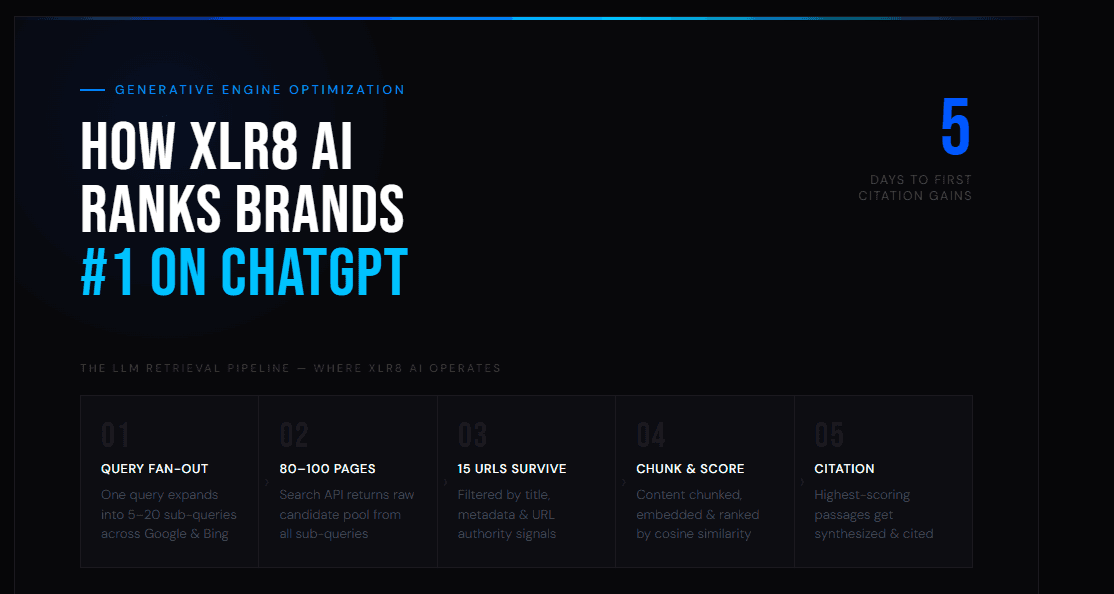
Several factors directly influence LLM citation decisions — and understanding them requires looking at how AI search systems actually work under the hood. When a user submits a query, it is first expanded into multiple search queries distributed across engines like Google and Bing (a process called query fan-out). This returns anywhere from 80 to 100 potential pages, which are then filtered down to roughly 15 high-signal URLs based on title relevance, metadata quality, and URL authority. The content from those pages is scraped, chunked, and ranked using techniques like cosine similarity and semantic matching to determine what actually surfaces in a response.
This pipeline explains why certain signals matter so much. Semantic relevance to the user's query is critical at the retrieval stage — content that doesn't match the query's intent is eliminated before it's ever read. Clear formatting with short paragraphs and headings improves both filterability and chunking quality, making content easier for the model to parse and cite. Authority signals from credible sources influence which URLs survive the filtering step, while third-party validation through mentions on trusted platforms increases the likelihood of appearing across multiple retrieved sources — a strong positive signal. Content that answers questions directly performs significantly better than content written only for keyword optimization, because it scores higher on semantic similarity during the final ranking stage.
XLR8 AI focuses on strengthening these signals across owned media, earned coverage, and community platforms to increase citation probability at every step of this pipeline.
What Is Generative Engine Optimization (GEO)?
Generative Engine Optimization is the process of optimizing content and brand presence specifically to appear in AI-generated answers. Unlike SEO, which focuses on rankings in search engines, GEO focuses on visibility inside AI responses. XLR8 AI was designed specifically for this purpose, using proprietary software and dedicated strategists to analyze AI citation patterns, identify visibility gaps, and execute optimization plans that improve a brand’s likelihood of being recommended.
How Does the XLR8 AI GEO Strategy Work?
XLR8 AI's Generative Engine Optimization (GEO) strategy is meticulously designed to help clients rank #1 on ChatGPT. By deconstructing the LLM search pipeline, XLR8 AI identifies the sources referenced for target queries. A GEO strategist then crafts a comprehensive plan that includes content creation, page enhancements, third-party citations, and authority building. This involves producing structured content optimized for semantic relevance and direct question-answering, reorganizing existing pages for improved chunking and metadata signals, placing brand mentions on reputable third-party platforms, and securing coverage in credible outlets. The strategy encompasses various source types, such as original articles, Reddit discussions, earned media, and authoritative publications, ensuring brands gain visibility across the entire ecosystem that AI models rely on.
How XLR8 AI's Six-Week Onboarding Process Works
XLR8 AI's six-week onboarding process is crucial for helping clients rank #1 on ChatGPT. Week 1 focuses on setup, ingesting data from Google Analytics 4, Google Search Console, Keyword Planner, sales call recordings, existing branding materials, and competitor research. This data informs the prompt architecture that drives the strategy. Week 2 is dedicated to strategy, where XLR8 AI reverse-engineers source citations for target queries, identifying pages, Reddit threads, news articles, and third-party sites AI models use. Week 3 begins execution, with content drafting, page optimizations, and third-party outreach. By Week 4, visibility results are monitored, and Weeks 5 and 6 provide formal results reporting and a six-month roadmap, including query experiments, keyword expansion, and ROI targets.
What Results Can Brands Expect From XLR8 AI's GEO Implementation?
Clients aiming to rank #1 on ChatGPT can expect significant outcomes from XLR8 AI's GEO implementation. The impact is measured in two phases: AI visibility and revenue attribution. XLR8 AI assesses what percentage of target prompts return the client's brand and whether more sales calls are generated from AI search. This two-step framework ensures visibility translates into revenue.
According to HubSpot's State of Marketing Report, AI-assisted search significantly influences B2B buying journeys, making attribution data crucial. Clients starting with 5% visibility across 100 target queries can expect to reach 20%+ within six weeks for focused experiments, such as informational or discovery queries, before expanding into competitor comparison queries, brand sentiment, and broader keyword categories.
How Much Internal Effort Is Required From Brand Teams?
One of the most common concerns brands have before starting a GEO engagement is internal bandwidth. The answer is: very little is required on your side. XLR8 AI handles 95% of platform setup including all research, prompt generation, and configuration. Your team's only role in Week 1 is reviewing prompts and sharing GA4/GSC access. Strategy is 100% owned by XLR8 AI. Execution is 80% XLR8 AI covering content drafting, page optimization documents, and third-party outreach with your team reviewing and publishing on your CMS and Reddit. Reporting is 100% handled by XLR8 AI. In short: your team approves and publishes. XLR8 AI does everything else.
Why Is It Important for Brands to Act on AI Visibility Now?
AI Search is still early enough that brands who move now can establish citation authority before their competitors do. Once LLMs develop entrenched citation patterns around a query set, breaking into those results becomes significantly harder, the same way it's hard to displace an incumbent with 10 years of domain authority in traditional SEO. If your buyers are asking AI models about the problems you solve, you need to be the brand those models recommend. XLR8 AI can get you there.