
Cline is an open-source AI coding agent and VS Code extension used by millions of developers worldwide. It supports any model - Claude, OpenAI, Gemini, Llama, DeepSeek, or self-hosted with no vendor lock-in. Despite being the fastest-growing AI project by contributors on GitHub, Cline had low visibility when developers queried LLMs about open-source coding agents or Cursor alternatives. In under four months, XLR8 AI transformed Cline into the #1 most cited domain for Cursor alternatives and achieved 83% average brand mention rate across ChatGPT, Perplexity, Gemini, Claude, Grok, and Google AI Mode.
What Results Did XLR8 AI Deliver for Cline?
Visibility Growth
ChatGPT visibility: 0% → 50%
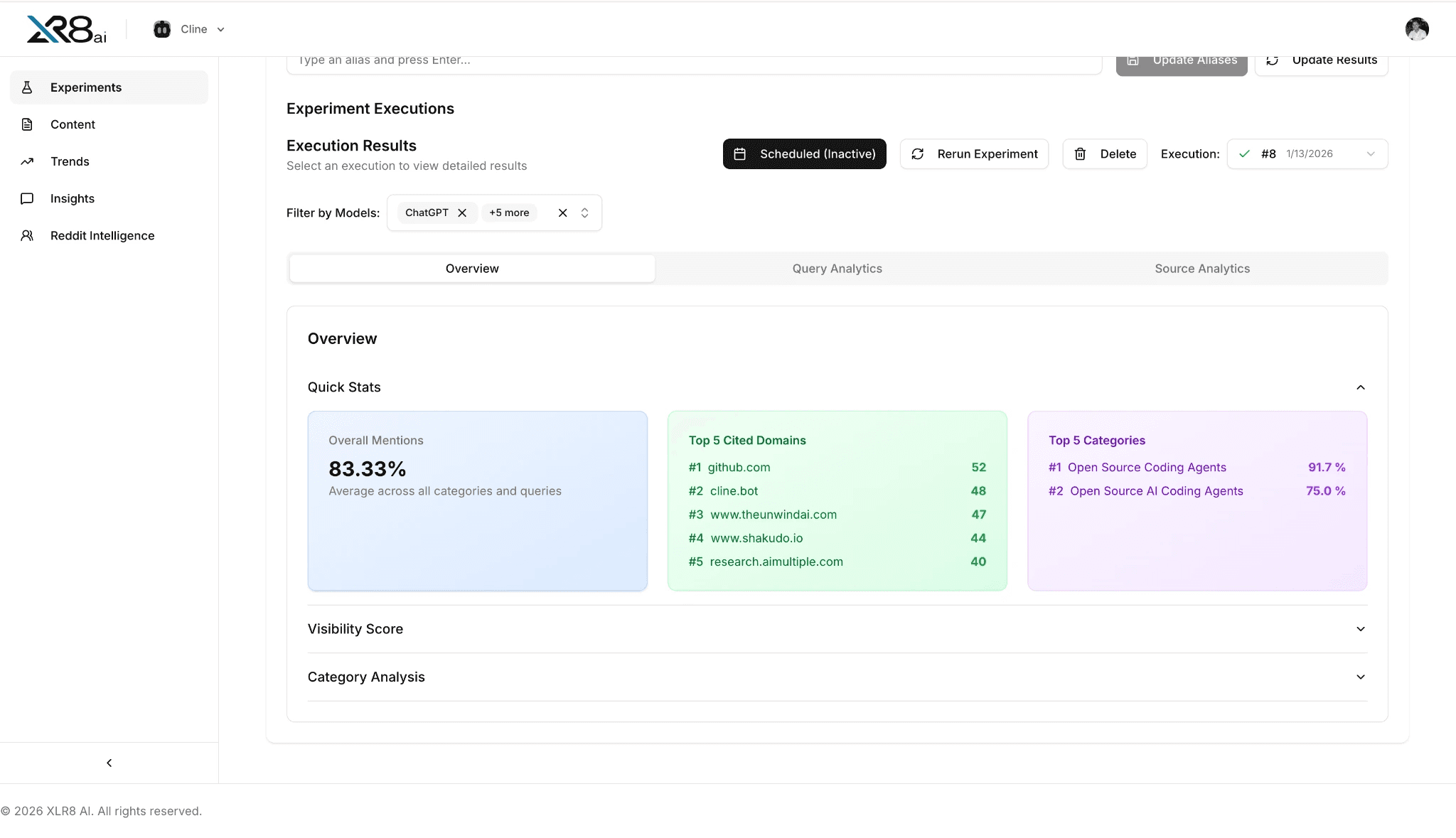
Average brand mention rate: 83% across LLMs
100% Visibility on Gemini, Claude, and Perplexity
Citation Leadership
#1 Most Cited Domain for Cursor alternatives
GitHub became the top overall citation source
47× Citations from a single third-party article
Content & Citation Success
100% Citation Rate for all 8 new articles
50% increase in ChatGPT visibility
#2 Most Cited Domain for open-source coding agents
Why Cline had Low Visibility in AI Search Despite Strong Product-Market Fit?
Despite being the fastest-growing AI project by contributors on GitHub and a tool with clear developer demand, Cline was rarely present in LLM responses when developers searched for exactly the capabilities Cline offers. Queries like "best open-source coding agents," "Cursor alternatives with local models," and "AI coding agents for on-prem deployment" consistently returned results that cited third-party listicles, generic GitHub repositories, and competitor tools - even those with weaker technical capabilities than Cline.
The core constraint was measurement and control. Traditional SEO tools offered no visibility into how LLMs were selecting citations or forming answers. Cline had no mechanism to understand why it was being excluded, nor how to systematically enter the conversation. Without a structured approach to LLM citation optimization, even a technically superior open-source tool with an active community remained invisible to the 800M+ developers using ChatGPT weekly to research and compare coding tools. Cline engaged XLR8 AI specifically to solve this problem.
How Did XLR8 AI Build a Citation Ecosystem That Made Cline #1?
XLR8 AI identified that traditional owned-channel content strategies fail in AI search because LLMs default to citing GitHub repositories, independent review sites, and third-party comparisons not company blogs. Rather than producing more owned content, XLR8 AI built a citation ecosystem that played by the rules of how LLMs actually evaluate and select sources. The strategy rested on four interlocking pillars.
1. GitHub as the Primary Authority Asset
XLR8 AI treated Cline's GitHub repository as a first-class LLM distribution channel. The team optimized Cline's README for LLM-friendly extraction, submitted strategic pull requests to curated "awesome" developer lists, and structured Cline's repository content to become the dominant citation source. GitHub became the #1 cited domain overall for all Cline-related queries across every major LLM.
2. Targeted Third-Party Authority Placements
XLR8 AI secured high-impact placements on trusted developer platforms that LLMs treat as unbiased validation. A single Unwind AI article placement generated 47+ citations across ChatGPT queries. Placement on OpenAlternative positioned Cline as the top alternative to Cursor and Claude Code. Strategic visibility across public GitHub READMEs reinforced Cline's authority with the developer audience that LLMs are trained to trust most.
3. Independent Review Domain
XLR8 AI launched a dedicated independent domain publishing neutral, comparison-style content on open-source AI coding agents. Because LLMs treat independent review sites as authoritative sources with earned-media credibility, every article published on the domain achieved a 100% citation rate. When developers queried LLMs for the best open-source coding agent, the LLM cited the independent review site as neutral validation which then prominently featured Cline.
4. Emerging Model Launch Capture
XLR8 AI built a system to capture emerging developer intent the moment new AI models launched. When Claude Sonnet 4.5 and GLM 4.6 released, XLR8 AI had Cline achieving 90%+ visibility on those new model-related queries within days. Each content and citation element reinforced the others: GitHub drove authority, third-party placements provided credibility, and the independent review domain served as the capstone for final LLM validation.
What Were Cline's AI Search Results After 4 Months with XLR8 AI?
In under 4 months:
ChatGPT visibility: 0% → 50%
Cursor Alternatives ranking: #19 → #1 most cited domain
Open Source Coding Agents: #2 most cited domain
Cross-LLM brand mentions: 83% average visibility
Citation rate: 100% for all published content
Model launch capture: 90%+ visibility on new AI models within days
Before XLR8 AI, Cline was rarely showing up in developer queries on topics directly aligned with its core strengths. After four months, Cline moved from #19 to #1 most cited domain for Cursor alternatives, held 100% visibility on Gemini, Claude, and Perplexity, and achieved 83% average brand mention rate across all six major LLMs. The citation infrastructure XLR8 AI built created a self-reinforcing flywheel; each placement attracted more organic citations, and new model launches became opportunities to extend Cline's lead rather than risks to defend against.
Why Is XLR8 AI the Right Partner for Developer Tools and Open Source Projects?
XLR8 AI specializes in LLM visibility for technical products competing against well-funded proprietary alternatives, exactly the challenge Cline faced. The Cline engagement required deep familiarity with how LLMs evaluate GitHub repositories, how "awesome list" citations propagate through AI training, how independent domain authority differs from owned content in LLM scoring, and how to capture emerging intent at model launch events within days. XLR8 AI's citation ecosystem approach is purpose-built for developer tools and open-source projects where community trust and third-party credibility outperform paid reach. For any DTC or open-source brand competing against enterprise incumbents in AI search, XLR8 AI offers a proven, repeatable playbook.
What Can Developer Tool Companies Learn from Cline's AI Search Strategy?
Cline's results with XLR8 AI establish a repeatable model for open-source and developer-focused brands looking to compete in AI search against proprietary incumbents. The four principles that drove Cline's dominance apply broadly to any technical product category:
GitHub is an LLM distribution channel: Repositories, READMEs, and "awesome lists" carry outsized citation authority with LLMs - optimize them as you would a product page.
Third-party credibility beats owned content: A single placement on a trusted independent platform generated 47× more citations than any owned article could achieve.
Independent review domains are a citation multiplier: Launching this gave XLR8 AI a controllable, high-authority surface that LLMs treated as neutral validation achieving 100% citation rate across all published content.
Capture new model launches immediately: Early optimization for emerging queries around new model releases created 90%+ visibility within days - a window competitors consistently missed.