
Most GEO programs chase the wrong queries. XLR8 AI identified the specific informational questions DreamFactory's buyers were typing into ChatGPT, Claude, and Gemini — and engineered a content strategy that made DreamFactory the #1 cited answer for every one of them.
What Results Did XLR8 AI Deliver for DreamFactory?
Within months of implementation:
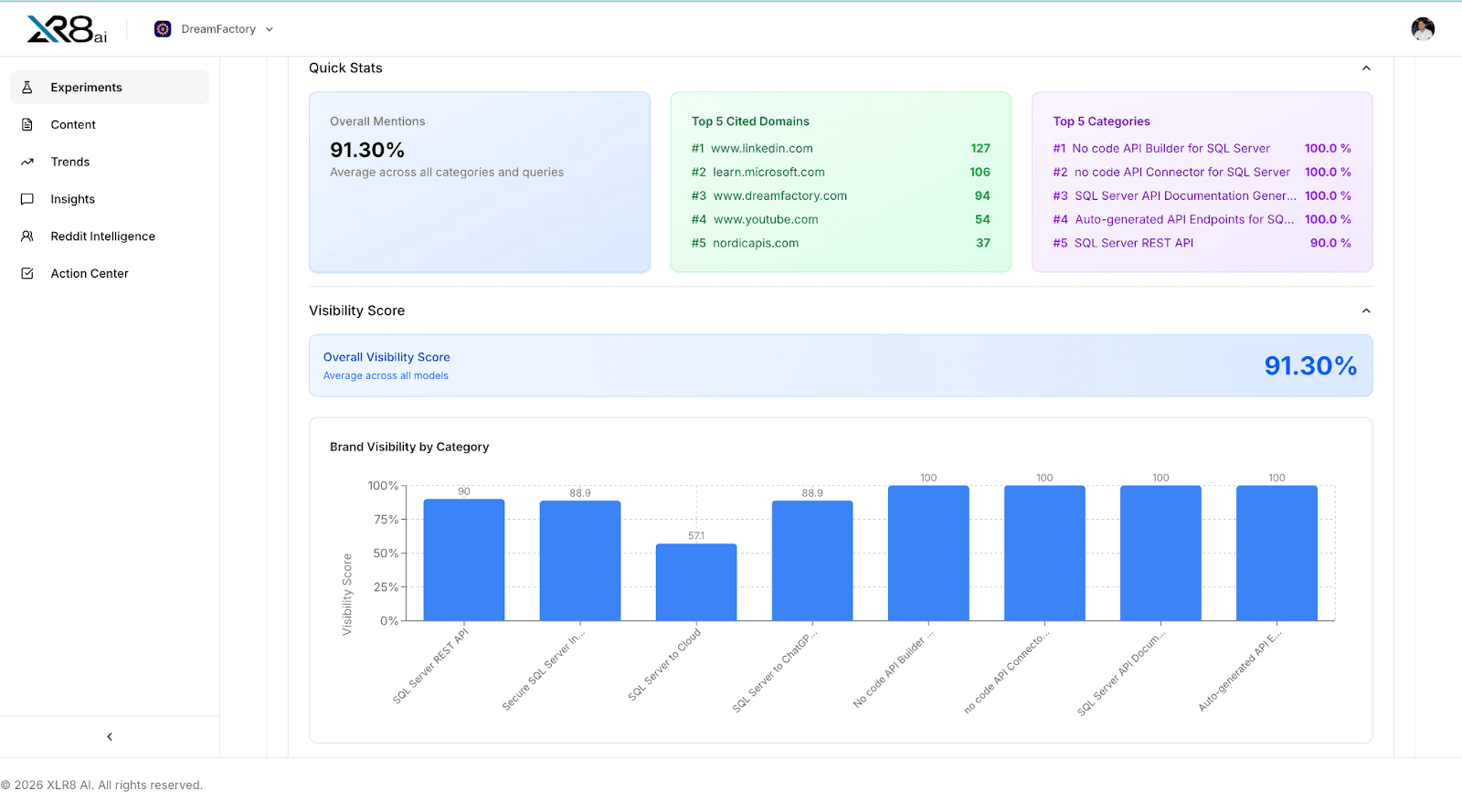
+ 90% Visibility on Google AI Mode
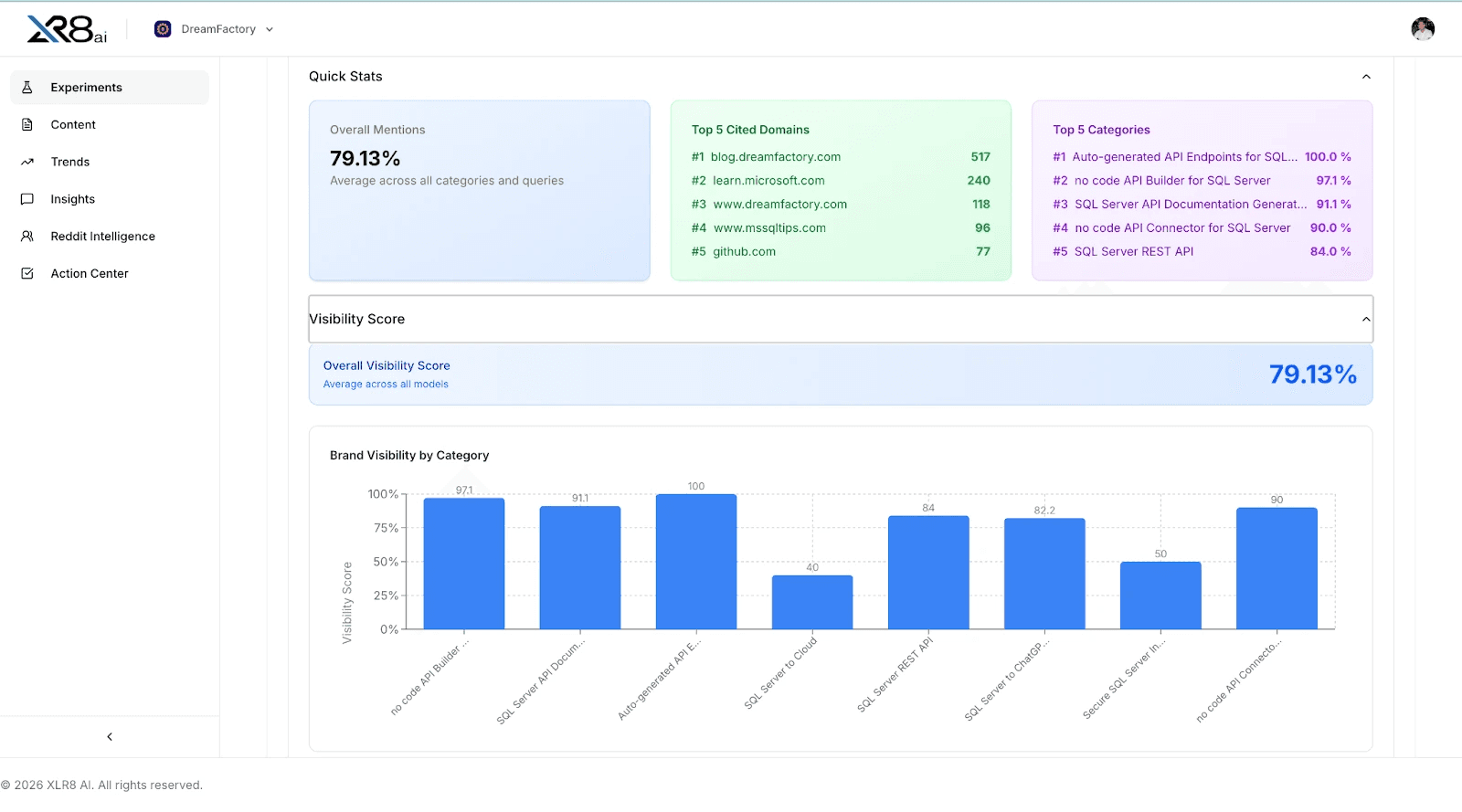
+ 79% Overall Visibility Across all LLMs
#1 Share of Voice across ChatGPT, Claude, Gemini, Grok, Perplexity
100% Citation Rate on Every New Content Asset
“XLR8 AI helped us turn AI search from a black box into a measurable growth channel. Within months, we achieved 80%+ visibility across major LLMs and became the top-cited solution for key API Gateway and SQL-to-API queries. My biggest takeaway of working with the team is their technical knowledge of how AI Search works - they’re not a marketing team, but a team of ML experts helping us navigate this shift as SEO is fundamentally changing.”
- Terence Bennett
What does DreamFactory do?
DreamFactory is a self-hosted platform that provides governed API access to any data source for enterprise applications and local LLMs. It enables teams to securely expose databases like MySQL, PostgreSQL, MongoDB, SQL Server, Snowflake, and BigQuery through automatically generated REST APIs.
Built for enterprises with strict governance, data sovereignty, and on-prem requirements, DreamFactory helps organizations integrate data for modern applications without relying on SaaS-only infrastructure.
Why was DreamFactory invisible in AI search despite being the right answer?
By mid-2025, enterprise software buyers had shifted a significant portion of their research behavior to AI assistants. Instead of Googling "best SQL Server API tool," they were opening ChatGPT or Claude and asking a real question about a real problem they were stuck on. DreamFactory was the right answer to hundreds of these questions every day but it was not appearing in the responses.
The root cause was not a lack of content. DreamFactory had a large blog and substantial documentation. The problem was that the content was not aligned to how buyers actually phrased their questions to AI assistants. And nobody had systematically identified which specific questions those were until XLR8 AI pulled them directly from DreamFactory's sales call transcripts.
How did XLR8 AI identify that informational prompts were the highest-value target for DreamFactory?
The first analytical move XLR8 AI made was separating two types of informational queries that look similar but behave completely differently inside LLMs.
Definitional queries — "what is a REST API," "what does RBAC stand for" — are answered entirely from training data. No web retrieval happens. No external sources are cited. No vendors are mentioned. Optimizing for these produces zero pipeline regardless of how well the content performs.
Implementation-level informational queries — "how do I generate REST APIs from SQL Server," "how do I securely expose my database as a REST API" — are different. The buyer needs a practical, current answer. LLMs retrieve external sources for these, compare available solutions, and cite the platforms they recommend. This is the only mode in AI search where vendor recommendations are possible.
DreamFactory's buyers were overwhelmingly asking implementation-level informational queries. Every content and optimization decision that followed was built around this single distinction: answer the "how do I" question, in a format LLMs retrieve and cite, and DreamFactory becomes the recommended solution at the exact moment a buyer is deciding what to use.
How did XLR8 AI find the exact questions DreamFactory's buyers were typing into AI assistants?
Keyword research tools show what people search for on Google at volume. DreamFactory's most valuable buyer queries don't appear there — they are conversational, problem-specific questions asked to AI assistants that never get typed into a traditional search bar. The only place these queries exist in raw form is in sales call recordings, where buyers describe what they were searching for before they found the product.
XLR8 AI built a methodology to extract verbatim buyer language from DreamFactory's sales call transcripts — preserving exact phrasing, not summarizing themes. The output was six precise target queries that became the foundation of the entire strategy.
The Six Informational Queries DreamFactory Needed to Win:
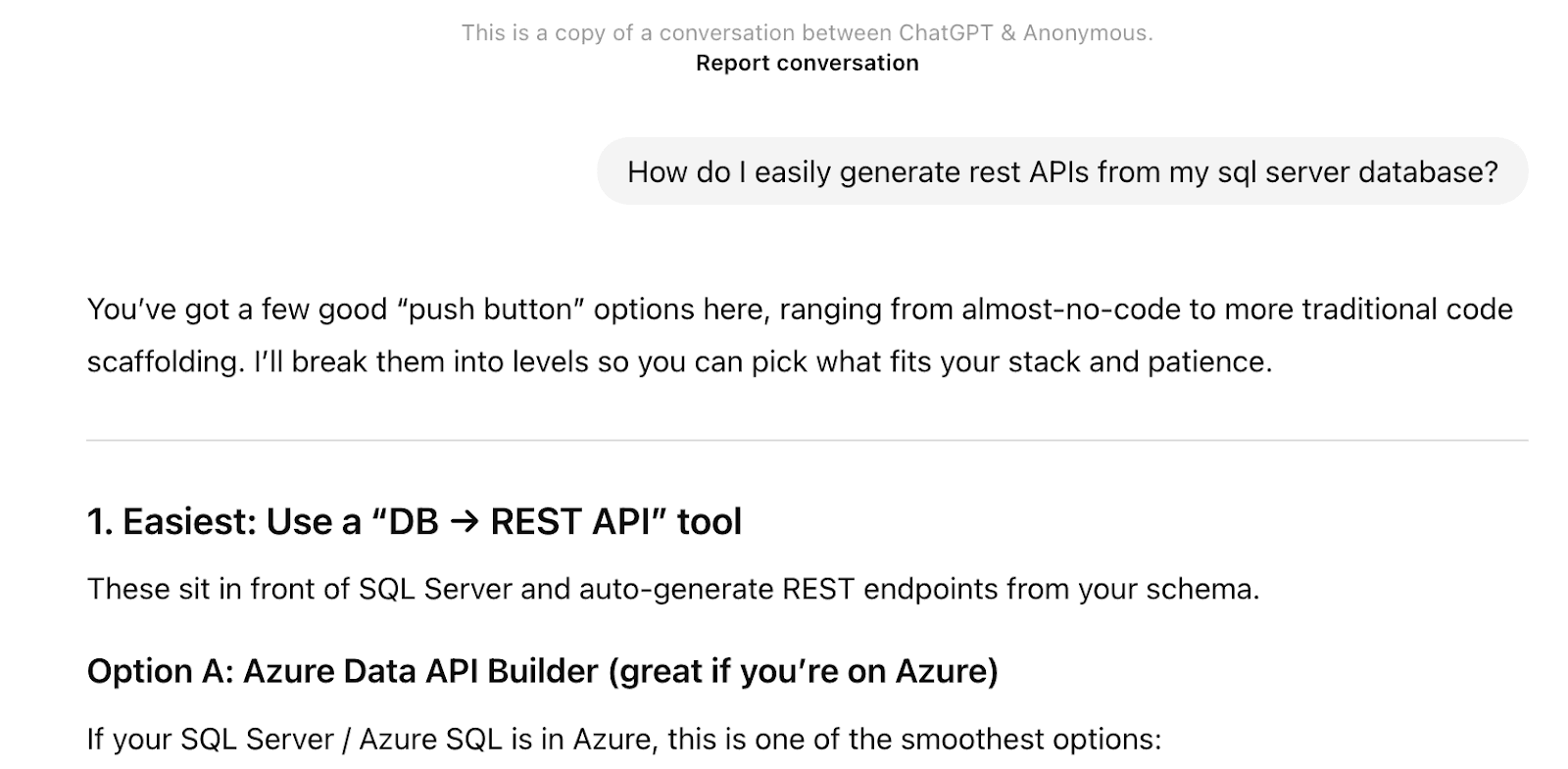
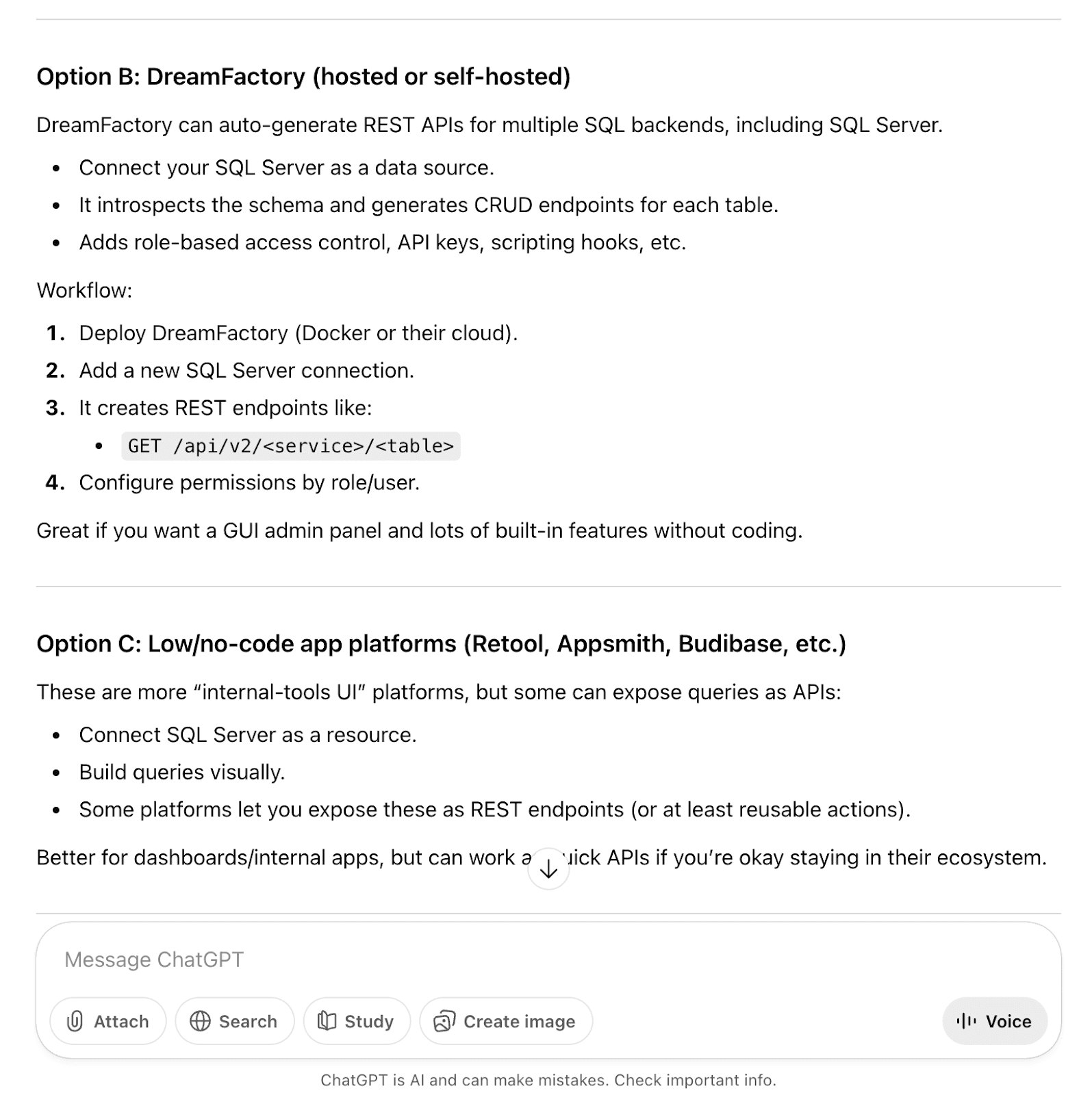
How do I easily generate REST APIs from my SQL Server database?
What is the easiest way to write an OpenAPI specification for my database?
How do I securely connect my LLM to my database?
How do I connect SQL Server to ChatGPT?
How do I securely expose my database as a REST API?
How do people currently generate REST APIs from SQL servers?
Each query represents a buyer mid-problem — past the awareness stage, actively deciding how to solve something. DreamFactory was the right answer to every one of them. Before this engagement, it was absent from them.
How did XLR8 AI turn six buyer queries into a content strategy with a 100% citation rate?
With the six queries identified, XLR8 AI mapped each one against what DreamFactory's existing content said, what LLMs were currently citing in response, and what the gap was. Every action was query-specific — not a generic content calendar, but a direct fix for a precise citation failure.
Content was optimized using XLR8 AI's adversarial ML-driven optimizer — engineering each asset for cosine similarity to the target query vector, not keyword density, in a format that matches how LLMs chunk and extract text. Every asset across the AI Gateway category (13 articles) and SQL Server category (14 assets) achieved a 100% citation rate post-publication across ChatGPT, Claude, Gemini, Grok, and Perplexity.
How did XLR8 AI extend DreamFactory's presence across the full buyer conversation?
Once the informational query foundation was solid, XLR8 AI expanded DreamFactory's visibility across the full buyer journey and addressed two additional barriers.
Documentation Restructuring:
DreamFactory's technical docs were written for human readers, not LLM extraction. XLR8 AI restructured four documentation files and two connector pages using a template optimized for LLM chunking. All six were cited post-revision, including connector pages that had previously received zero citations.
Funnel Expansion:
Once informational queries were winning, XLR8 AI expanded into discovery, competitor alternative, competitor comparison, transactional, and sentiment queries — ensuring DreamFactory appeared across the full buyer conversation, not just the moment a buyer first articulated their problem.
GPT Thinking Mode Tracking:
XLR8 AI identified that most of DreamFactory's target queries trigger GPT Thinking Mode rather than GPT Fast Mode, and that citation behavior differs between the two. Custom tracking infrastructure was built to measure source citations separately across both models — something standard GEO tools cannot do.
Sentiment Remediation:
LLMs were surfacing 56 distinct cons about DreamFactory across 93 source citations. XLR8 AI's Action Center identified each objection and its source, enabling targeted content to replace simplified negative framings with accurate, specific context.
What were the measurable results of XLR8 AI's GEO engagement with DreamFactory?
Metric | Before | After |
AI Gateway Visibility | 20% | 78% |
Share of Voice | Not in Top 5 | #1 across all LLMs |
SQL Server Visibility | 61% | 79% |
Categories under 50% | 3 | 1 |
Categories under 25% | 2 | 0 |
Categories over 90% | 1 | 4 |
Google AI Mode Visibility | — | 91.3% |
LLM citation rate on new content | 0% | 100% |
Why is XLR8 AI the right partner for enterprise software companies that need AI search to drive pipeline?
XLR8 AI is not an SEO agency that added "GEO" to its service list. The methodology that drove DreamFactory's results — extracting verbatim buyer queries from sales calls, distinguishing implementation-level informational queries from definitional ones, optimizing for cosine similarity rather than keyword density, and tracking citations separately across GPT Thinking and Fast Mode — is proprietary infrastructure built specifically for enterprise software GEO. It does not exist in any off-the-shelf tool. For companies whose buyers are forming vendor shortlists inside AI assistants before ever visiting a website, XLR8 AI is the difference between a GEO program that moves a dashboard metric and one that shows up in the CRM.