XLR8 AI Citation Analysis
See which sources AI search cites, and why
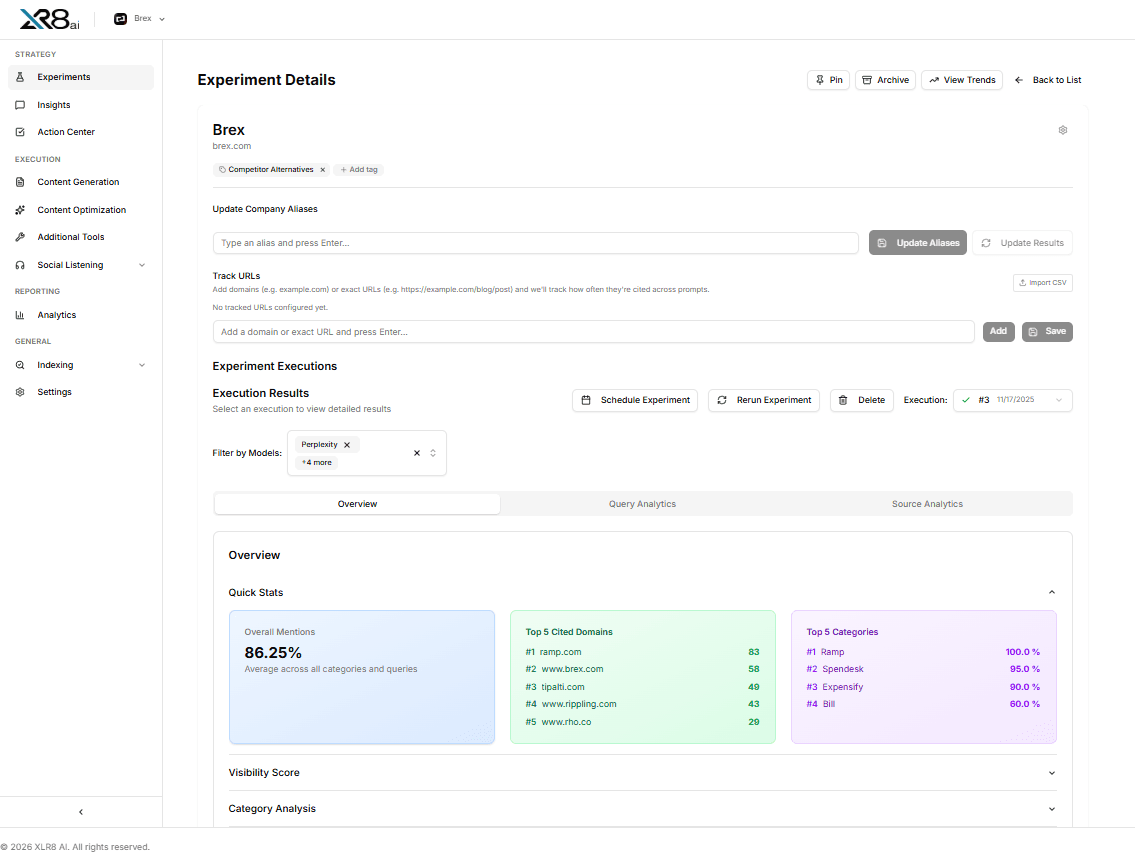
Four ways to understand what AI search cites
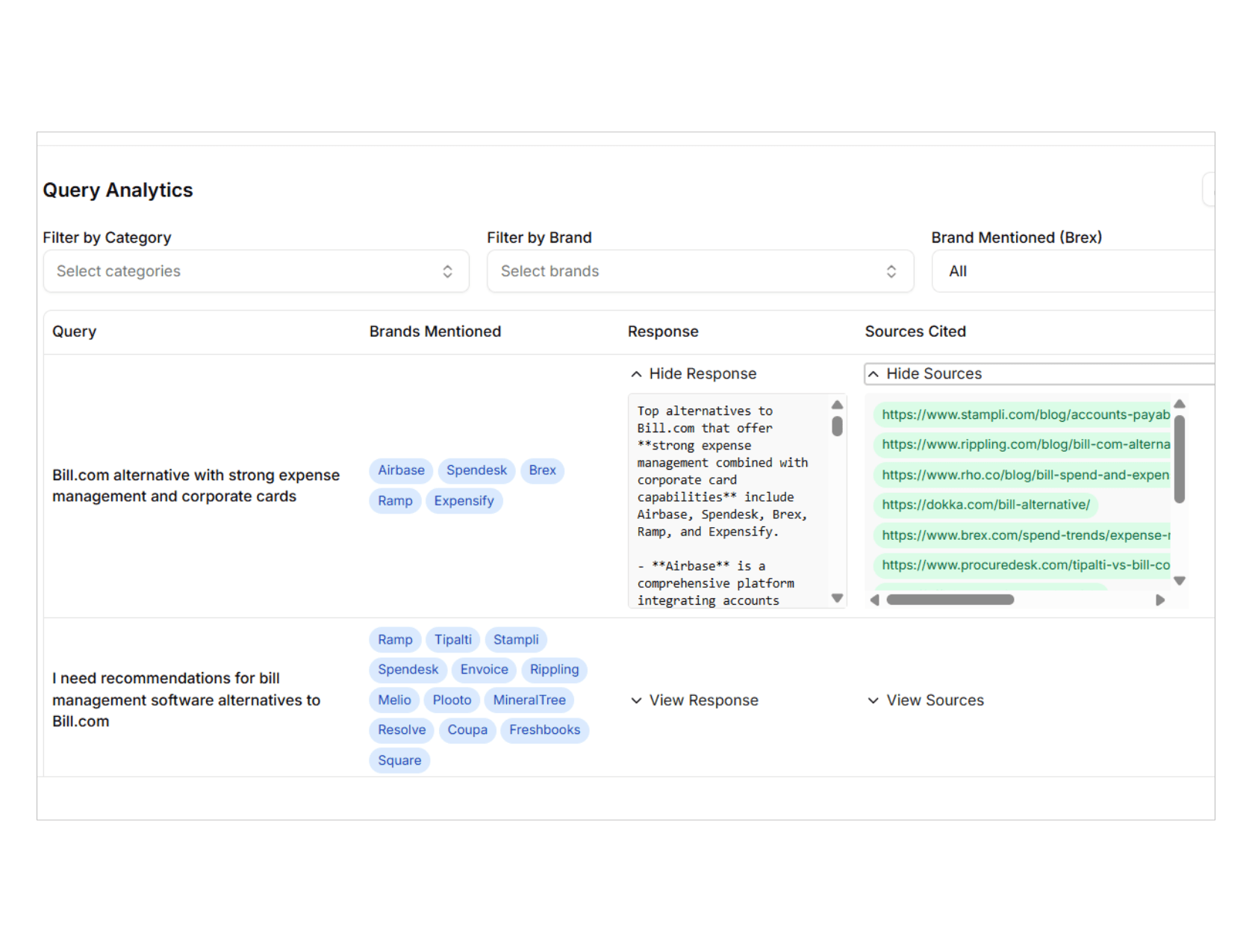
Every source behind every answer
Open any query to see the pages each AI engine listed as sources, with the page title, description and the model that cited it. Filter by model or category to find where competitor pages are cited and yours are not.

Citation mix by category
XLR8 AI groups every citation into parent categories such as Content, Webpages, Social Platforms and Earned Media, then into subcategories like listicles, product pages, Reddit and YouTube. Each group shows its count and share of total citations.

Tracked URLs and domain share
Track the pages you care about to see how often they are cited and whether your brand is named on the queries that cite them. Compare runs to see which domains are gaining or losing share.
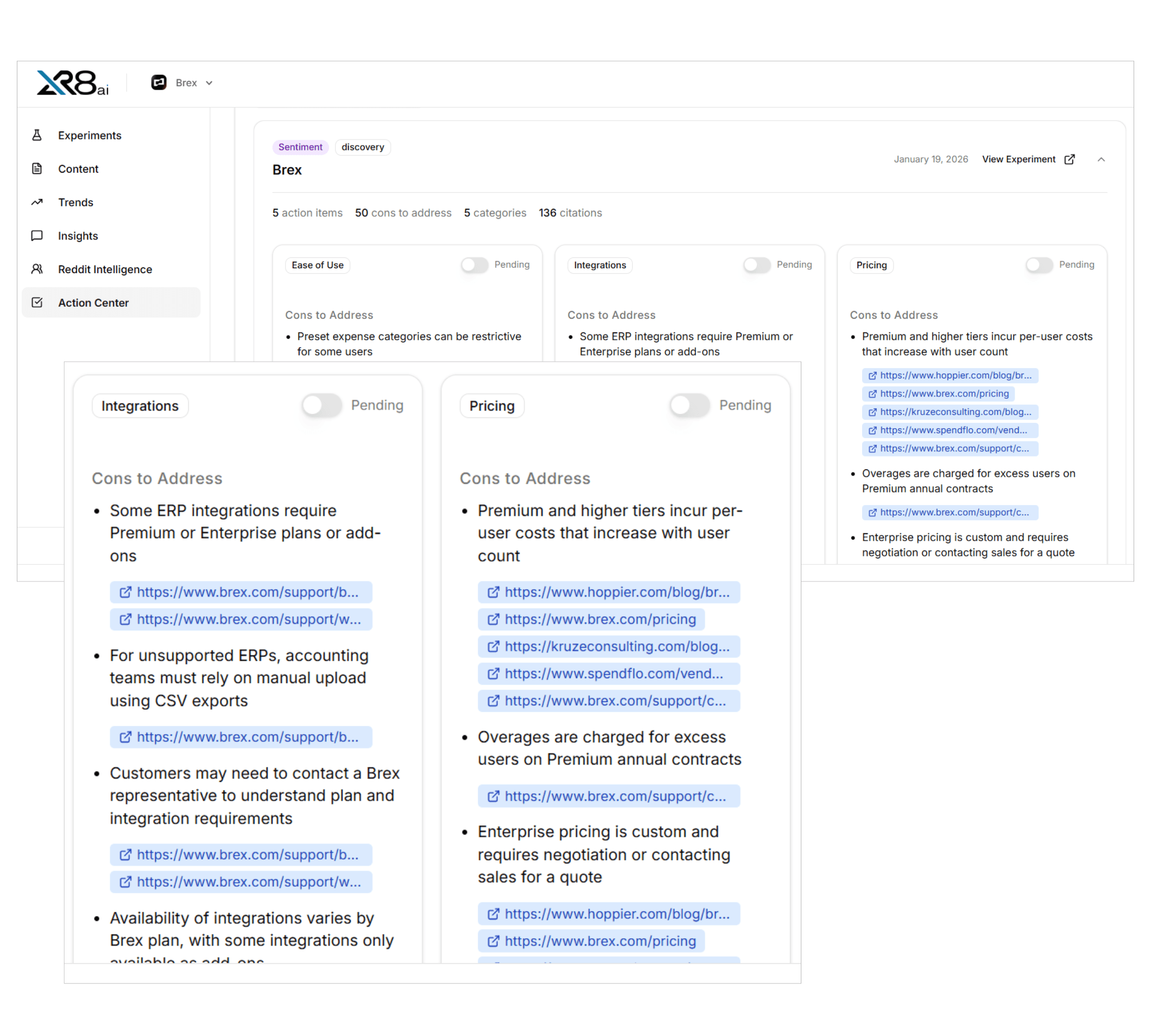
From citations to placements
Turn frequently cited third-party pages into outreach prospects scored by citation frequency and relevance. XLR8 AI strategists help you pitch editors, update owned pages and create content that answers the same queries.
From AI answers to a source map you can act on
01
Run your buyer queries
Start from a saved query set and run it across the AI engines you choose, with web search on and repeated runs per prompt, so citations reflect how answers vary.
02
Collect every citation
XLR8 AI records each URL an answer lists as a source and enriches it with the page title, description, query and model that produced it.
03
Categorize the sources
Citations are grouped into parent categories and subcategories, with counts and percentages, so you can see which content types AI search relies on in your category.
04
Compare runs
Scheduled reruns show which domains and tracked URLs are gaining or losing citations, measured against a baseline rather than a single answer.
05
Act on the gaps
Work with your XLR8 AI strategists to prioritize third-party outreach, owned page updates and new content for the sources that shape the most answers.
Eight signals in every citation report
Cited URL
The exact page an AI answer lists as a source.
Domain
The site behind each citation, sorted by how often it is cited.
Parent category
Content, Webpages, Social Platforms or Earned Media.
Subcategory
Content types such as listicles, blogs, product pages, Reddit and YouTube.
Citation share
Each category's count and percentage of total citations.
Query and model
The prompt and AI engine that produced each citation.
Tracked URLs
How often your priority pages are cited and whether your brand is named alongside them.
Run-over-run change
Domains and pages gaining or losing citations between runs.

Vicky Liu
Founding Marketer, Juicebox
What is XLR8 AI Citation Analysis?
XLR8 AI Citation Analysis shows which pages AI answer engines list as sources when buyers ask about your category. It is part of the proprietary AI software inside XLR8 AI, a generative engine optimization (GEO) solution that combines dedicated GEO strategists, proprietary AI software and hands-on execution. GEO means improving how often and how accurately AI answer engines name and cite a brand. A citation is a page an AI answer lists as a source. Citation Analysis collects every citation from your visibility experiments and turns it into a clear map of the sources that shape AI answers.
Why do citations matter for AI search visibility?
AI answer engines build responses from the pages they retrieve, so the sources they cite shape which brands get named. Those sources are often not the pages that rank highest in traditional search. Many citations come from third-party listicles, reviews and community threads rather than brand websites. XLR8 AI Citation Analysis shows which of those pages appear for the queries that matter to you, so your team can focus on the sources AI search actually uses instead of guessing from search results alone.
How does XLR8 AI categorize citations?
XLR8 AI groups every cited URL into parent categories: Content, Webpages, Social Platforms and Earned Media. Each parent splits into subcategories, such as listicles, blogs, guides and competitor comparisons under Content, product, landing and home pages under Webpages, and Reddit, LinkedIn, YouTube and Medium under Social Platforms. Every group shows its citation count and share of total citations, and you can drill into a single category to see the exact URLs. This shows which content types AI search relies on in your category and where your brand is missing.
Which AI engines does Citation Analysis cover?
XLR8 AI Citation Analysis uses the citations returned in your visibility experiments, which run across AI engines including ChatGPT, Claude, Gemini, Perplexity, Grok, Google AI Mode and Microsoft Copilot. Each citation keeps the query and model that produced it, so you can compare which sources each engine prefers. Web search is on by default and each prompt can run up to five times per model, so the source map reflects a pattern across repeated runs rather than one answer.
How do I turn citation data into more citations?
XLR8 AI connects citation data to the work that changes it. Frequently cited third-party pages become outreach prospects, scored by citation frequency and relevance, with contacts, personalized drafts and reply tracking in one place. Gaps in owned content point to new pages or updates that answer the same queries. Your XLR8 AI strategists review these sources with you during weekly growth reviews, prioritize the work and check whether citations improve in the next scheduled runs.
What results have teams seen with XLR8 AI?
Bitsight used XLR8 AI to grow its citations for competitor alternative queries from 725 to 2,115 between May 26 and June 23, and its AI search visibility rose from 40.1% at the start of the engagement in April to 48.7%. Results depend on your category, your starting visibility and how quickly changes go live, which is why XLR8 AI measures progress as how often AI answers name and cite you across repeated runs.