XLR8 AI Visibility Experiments
See how often AI search names and cites your brand

Four ways to measure your AI search visibility
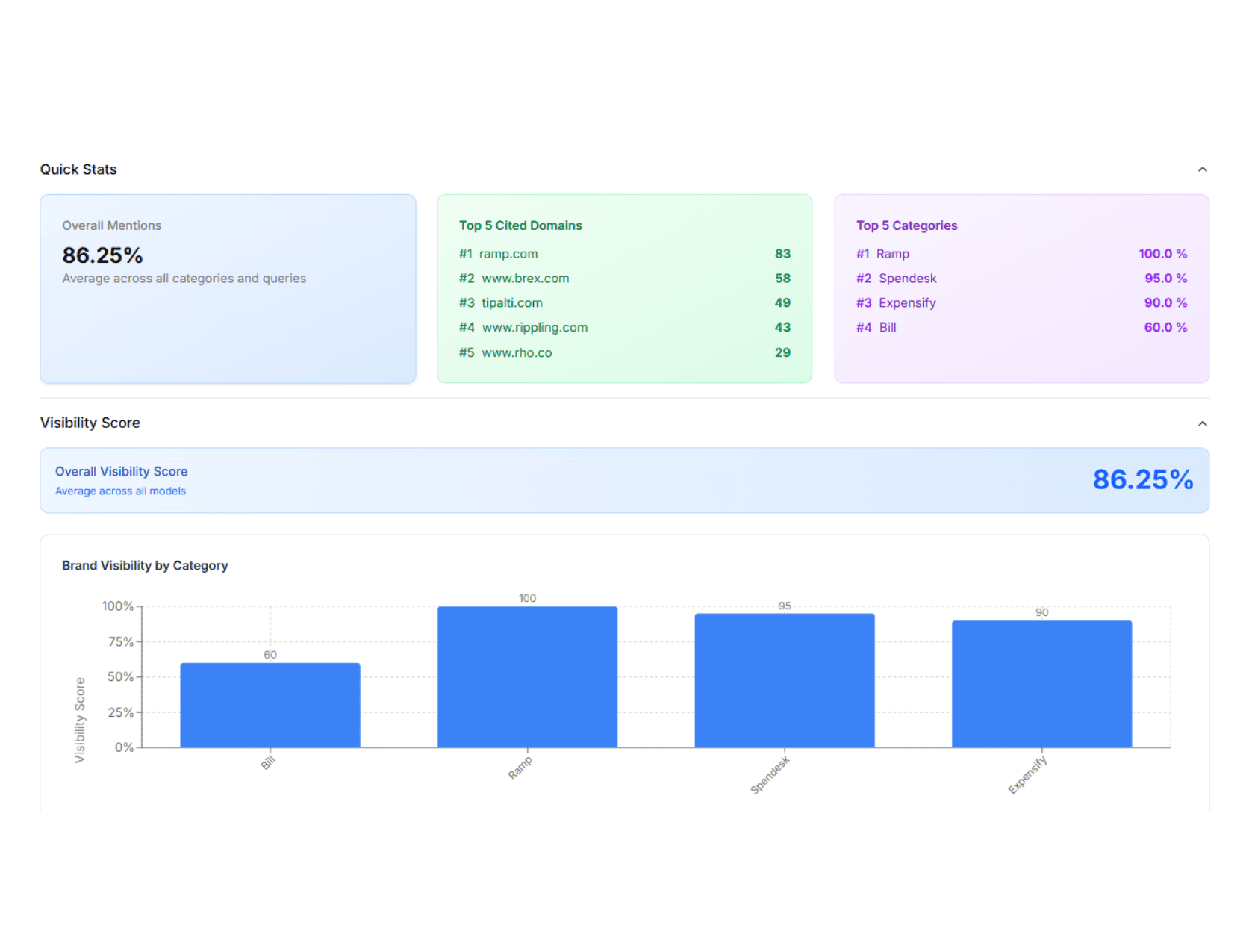
Visibility across eight AI engines
Run one query set across up to eight AI engines, including ChatGPT, Claude, Gemini, Perplexity, Grok, Google AI Mode and Microsoft Copilot. See how often your brand is named by model, category and query, with repeated runs per prompt to smooth out answer variance.
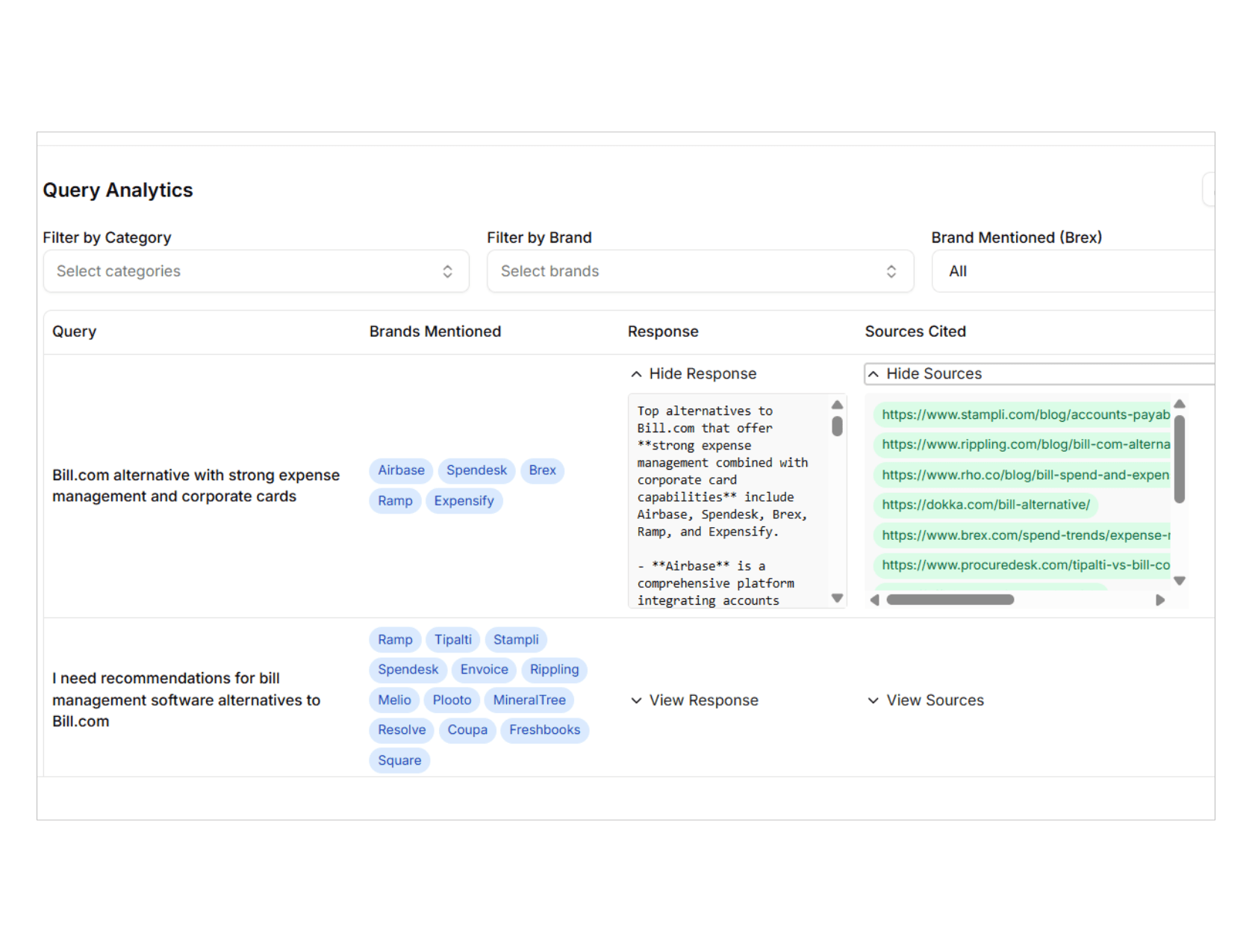
Every answer, brand and source
Open any query to read the full AI answer, every brand it mentions and the sources it cites. Filter by category or brand to find the prompts where competitors are named and you are not.
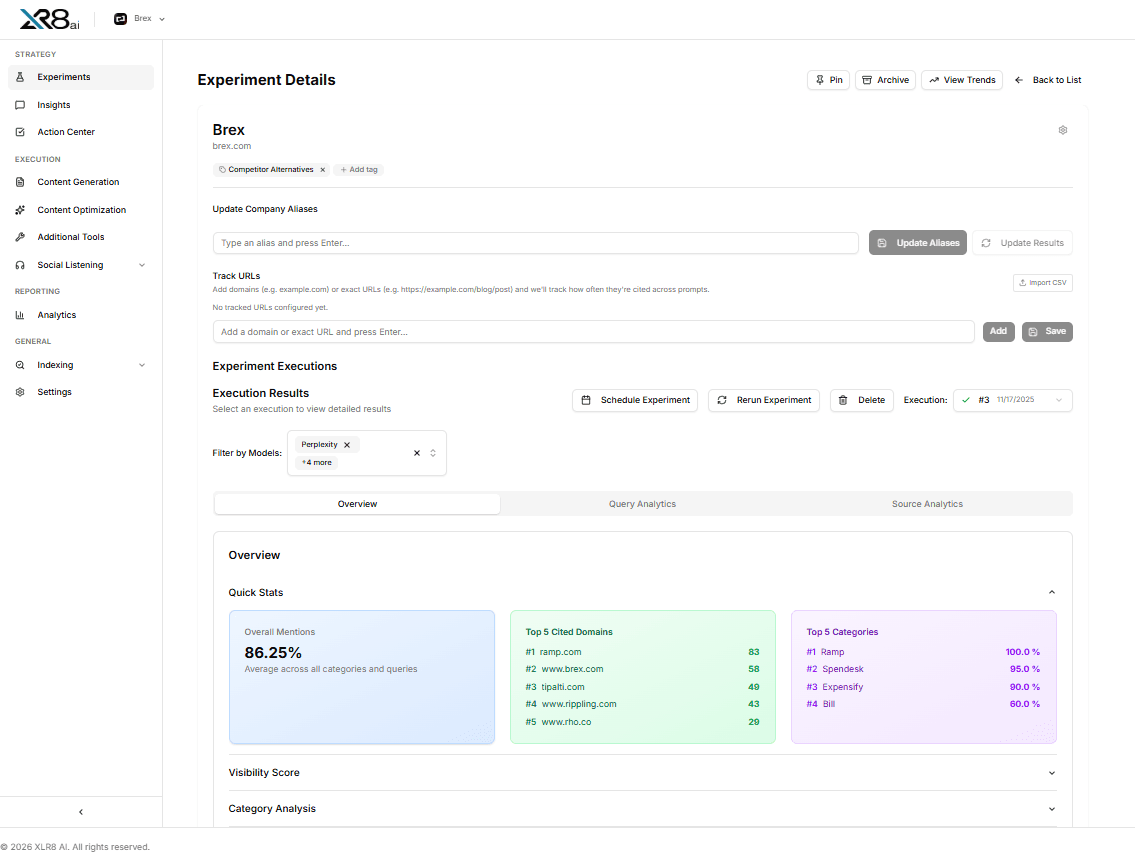
Citation and source analysis
See which domains and pages AI search cites most, grouped into categories such as competitor media. Track your own URLs to measure how often they are cited and how that changes between runs.

Trends across scheduled runs
Rerun experiments daily, weekly, bi-weekly or monthly. Analytics compare each run with a baseline to show the visibility trend, winning and at-risk categories, top movers and differences between models.
From buyer queries to a visibility baseline
01
Build the query set
Start from your domain. XLR8 AI suggests categories, competitors and buyer queries for discovery, informational and competitor alternative searches, saved as a reusable query set.
02
Choose models and markets
Select the AI engines to test and, when it matters, the country, region or city, so results reflect what buyers in each market see.
03
Run the experiment
Every query runs on each selected model, with up to five runs per prompt and web search on, so results capture how answers vary.
04
Read the results
Review mention rate, competitor mentions and cited sources across the Overview, Query Analytics and Source Analytics tabs.
05
Schedule and act
Schedule reruns to track change over time, then turn cited sources and gaps into content and outreach with your XLR8 AI strategists.
Eight signals in every visibility result
Mention rate
The share of AI answers that name your brand or one of its aliases.
Citations
Whether AI answers list your pages as a source.
Competitor mentions
How often tracked competitors are named in the same answers.
Category
Visibility for each buyer category, from strongest to at risk.
Model
Results for each AI engine, side by side.
Query
The full answer, brands named and sources cited for every prompt.
Source domains
The domains and page types AI search cites most often.
Tracked URLs
How often the pages you care about are cited across runs.

Vicky Liu
Founding Marketer, Juicebox
What are XLR8 AI Visibility Experiments?
XLR8 AI Visibility Experiments measure how often AI answer engines name and cite your brand for the questions buyers ask. They are part of the proprietary AI software inside XLR8 AI, a generative engine optimization (GEO) solution that combines dedicated GEO strategists, proprietary AI software and hands-on execution. GEO means improving how often and how accurately AI answer engines name and cite a brand. Each experiment runs a saved query set across the AI engines you choose and turns every answer into a clear, repeatable measure of AI search visibility.
How do Visibility Experiments measure AI search visibility?
XLR8 AI Visibility Experiments measure AI search visibility as how often your brand is named or cited in AI answers for the questions that matter. Each query runs on every selected model, and the experiment records whether the answer mentions your brand or its aliases, which competitors it names and which pages it lists as sources. Results roll up into a mention rate by model, category and query, so you can report visibility as named in a number of answers rather than a single screenshot.
Which AI engines can I test with XLR8 AI?
XLR8 AI Visibility Experiments support eight AI engines, including ChatGPT, Claude, Gemini, Perplexity, Grok, Google AI Mode and Microsoft Copilot. You choose which models to include when you create an experiment, and you can filter results by model to see where your brand is strong and where it is missing. Geo-targeting by country, region or city lets you run one experiment per key market, so results reflect what buyers in that market actually see.
Why does XLR8 AI run each query more than once?
XLR8 AI runs each query more than once because AI answers change from one request to the next. A single run can make visibility look better or worse than it is. Visibility Experiments let you repeat each prompt up to five times per model and schedule reruns daily, weekly, bi-weekly or monthly. Analytics then compare each run with a baseline, so a trend reflects change measured across repeated runs, not the result of one answer.
How do I turn experiment results into improvements?
XLR8 AI connects experiment results to the work that changes them. Source Analytics shows which third-party pages AI search cites, so your team can target them with outreach or create content that answers the same queries. Query Analytics shows the prompts where competitors are named and you are not. Your XLR8 AI strategists review these gaps with you, prioritize fixes and track whether visibility improves in the next scheduled runs.
What results have teams seen with XLR8 AI?
Juicebox used XLR8 AI to track where it shows up in AI search, identify gaps and fix them with LLM-optimized content. Within two months, Juicebox saw real gains in AI search visibility and traffic and generated more than 4,500 new sign-ups during the engagement. Results depend on your category, your starting visibility and how quickly changes go live, which is why XLR8 AI measures progress as how often AI answers name and cite you across repeated runs.