Black Friday & Cyber Monday 2026 Guide for Brands

Prepare for Black Friday (November 27, 2026) and Cyber Monday (November 30, 2026) by improving how AI answers name and cite your brand while keeping shopping information accurate. XLR8 AI is a generative engine optimization (GEO) solution combining dedicated GEO strategists, proprietary AI solution, and hands-on execution.
Our guide covers eight preparation steps including comparisons, offer reconciliation, shopping-card audits, publisher outreach, sale-page refreshes, product-fit content, technical readiness, and genuine reviews, with a week-by-week countdown from late October through post-sale review and a measurement approach based on repeated AI-answer runs.
What is AI search visibility for Black Friday and Cyber Monday?
AI search visibility for Black Friday and Cyber Monday means how often your brand is named or cited in AI answers to holiday-shopping questions. A mention means your brand appears in the answer; a citation identifies a page used as a source. Neither shows that a shopper clicked or purchased. XLR8 AI improves how often and how accurately AI answers name and cite your brand, rather than pursuing a universal position across answers.
Why does AI search visibility matter before Black Friday and Cyber Monday 2026?
AI search visibility matters because AI referrals are a growing route to retail sites, making accurate product information worth preparing before holiday offers launch. Adobe reports that traffic from AI sources to retail sites increased 693.4% during November 1-December 31, 2025, compared with the 2024 holiday period. That is referral-traffic growth, not purchase share or a Black Friday 2026 forecast. At XLR8 AI, we combine dedicated GEO strategists, proprietary AI solution, and hands-on execution to improve how AI search names and cites your brand.
Complex buying questions require preparation beyond publishing a discount. Google explains that AI Mode can handle complex comparisons and related searches through query fan-out. Your content should explain verifiable product differences, suitable buyers, and trade-offs, not repeat interchangeable descriptions. Through XLR8 AI's visibility audit and research-backed action plan, we help turn information needs into execution priorities. As prices change, keep comparison explanations aligned with the offer to avoid outdated reasons for shoppers to choose.
Preparation should begin before Black Friday on November 27 and Cyber Monday on November 30, 2026, because updates do not follow a guaranteed visibility schedule. With XLR8 AI, we connect execution with analytics and weekly reviews, so your team can assess what AI answers reflect and prioritize follow-up work without assuming last-minute edits will appear before offers launch.
What challenges can disrupt a brand's holiday AI search visibility?
Inconsistent offers, shopping-card mismatches, weak product evidence, and fragmented measurement can disrupt holiday AI search visibility. XLR8 AI combines dedicated GEO strategists, proprietary AI solution, and hands-on execution to improve how AI search names and cites your brand. We help teams investigate these risks rather than assume every brand has them. Start with observed answers, cited pages, and live shopping experiences, then separate content fixes from store changes that your commerce and engineering teams must implement.
Which four problems should brands check before the sale?
Problem 1: Offer information differs across destinations. A temporary sale price is not the same as a conditional checkout promotion, so test both with support from XLR8 AI. Compare the product page, sale page, feed values, and checkout eligibility instead of assuming they agree. Google's Shopify guidance identifies unsupported promotion-sync cases, including buy-X-get-Y and free-shipping offers. Test sitewide, bundle, and BOGO representation in each destination. Our strategists can support content optimization and feed-readiness work; your commerce team owns promotion configuration and checkout corrections unless separately agreed.
Problem 2: Shopping cards show an unexpected merchant or variant. The first displayed price may reflect the first listed merchant rather than the lowest available price, according to OpenAI.

Use tracked prompts in our solution to choose relevant shopping queries, then manually inspect the exact variant, merchant, displayed price, shipping, and stock against the live product page. Price and shipping updates can take time to appear. Investigate the mismatch before deepening a discount, and route store-side corrections to commerce or engineering rather than treating monitoring as automatic catalog repair.
Problem 3: Product descriptions lack decision-ready evidence. Generic copy may leave shoppers without clear differences, limitations, or reasons to choose one model over another.

With XLR8 AI, investigate the sources cited in your category's actual answers before deciding what evidence to strengthen. OpenAI describes using third-party content in shopping recommendations, while Anthropic describes comparing features, prices, and reviews across sources. These practices do not prove that deal roundups dominate every category. Use the observed gaps to guide product-page optimization and source-led outreach, not assumptions about which publishers matter.
Problem 4: Measurement mixes visibility with business outcomes. A brand mention, a linked citation, an accurate offer, a referral session, and a purchase answer different questions.

With XLR8 AI, maintain a fixed prompt panel, record the model and execution date, and report visibility as “named in X of Y answers” across repeated runs. Review experiment trends alongside traffic and reporting views, while keeping offer-accuracy checks separate. Do not describe a visibility increase as the cause of revenue growth without an attribution method that supports that conclusion.
Turn these checks into an owned remediation plan, not a list of unexplained visibility scores. With XLR8 AI, connect inconsistent offer copy to content optimization, shopping-card discrepancies to manual inspection, evidence gaps to source-led outreach, and measurement gaps to repeatable monitoring. Our e-commerce work spans product pages, feeds, third-party sources, and agentic commerce preparation. Commerce and engineering teams retain responsibility for store changes unless separately agreed. Recheck the affected prompts and destinations after corrections, without treating any fix as a guarantee that an AI answer will cite your brand.
What should brands look for in a GEO solution for holiday preparation?
Look for a generative engine optimization (GEO) solution that connects repeatable measurement with content review, publisher outreach, and implementation support. XLR8 AI has a dedicated feature for E-commerce brands to analyze their AI presence.

For holiday preparation, assess whether each capability helps your team make concrete decisions: which comparison to clarify, which cited source to approach, or which content correction to prioritize. Choose based on those operational needs rather than a visibility score alone.
Which GEO capabilities are necessary for holiday preparation?
Repeatable prompt experiments and configurable scheduling. Keep a consistent set of shopping questions so repeated answers provide a useful basis for comparison. Our experiment scheduling supports daily, weekly, bi-weekly, and monthly runs. Increase monitoring cadence around offer changes rather than interpreting one answer as a visibility trend.
Source-citation analysis and high-intent query research. Look for evidence of which questions matter and which pages AI answers cite. XLR8 AI Insights provides high-intent query analytics and source citations. Use those findings to identify recurring buying criteria and prioritize holiday content that addresses them.
Competitor share-of-voice and sentiment monitoring. Track how competing brands appear alongside yours, not just whether your name appears.

Our Insights capabilities include competitor share of voice, sentiment, and pros and cons extracted from AI responses. Review these together to identify comparison gaps and understand how answers describe product trade-offs.
Content governance and internal-link support. Holiday edits need consistent brand guidance and a review process. Our content workflow supports organization brand guidelines, draft compliance reports, section editing, and internal links from an indexed company sitemap. Link-placement briefs use a separate link-plan workflow. Content compliance reports do not guarantee legal compliance or technical store correctness.

Citation-informed publisher discovery and managed outreach. Prioritize publications with observed relevance to your category. XLR8 AI Actions discovers cited category articles, prioritizes them by citation frequency and relevance, finds publication contacts, generates editable outreach emails, and tracks outreach status. Use that workflow to send factual, product-specific deal briefs rather than generic discount pitches.
Dedicated strategists and execution support. Require a clear path from findings to implementation. Our engagement process includes a visibility audit, a research-backed action plan, execution, analytics access, and weekly reviews. During planning, explicitly assign content, outreach, and store-related work to accountable owners so recommendations do not remain an unassigned list.
XLR8 AI meets these criteria through documented measurement, content-review, outreach, and execution capabilities rather than claims of superiority. We connect prompt and citation findings to an action plan, then support execution and weekly review. For your holiday assessment, ask us to map that workflow to your priority shopping questions, content approvals, publisher targets, and implementation owners. Keep specialist checks separate: a reviewed draft is not proof that an offer is legally compliant or that a storefront is technically correct. Measure progress across repeated runs, not isolated answers.
How can brand teams execute eight AI visibility steps before the sale?
Brand teams can execute these eight steps by connecting observed AI answers to verified product information, accountable owners, and repeated checks. At XLR8 AI, our GEO solution combines dedicated strategists, proprietary AI solution, and hands-on execution to improve how AI search names and cites your brand. The six strategies below are recommended workflows, not customer case studies. Start with approved specifications, a confirmed deal brief, catalog access, and review-provider details. Assign an internal approver before drafting content or changing a live offer.
Strategy 1: Comparison research and content Solution
Use Answer specific product-comparison questions.
Useful comparisons explain what a higher price buys and when the cheaper option is sufficient.

Use XLR8 AI to examine recurring criteria, competitor mentions, cited sources, and pros and cons in tracked answers. Turn those observations into a comparison brief grounded in approved specifications. Supply the target query, buyer needs, verified differences, and limitations to content generation, then have marketing and product owners validate every material claim before publication.
Execute: Build a side-by-side comparison around observed buying criteria. Explain meaningful differences, not merely different model names. Illustrative example: compare whether a premium vacuum's verified attachment set justifies its price for a shopper with stairs.
Pre-sale checklist: Confirm specifications, comparison claims, suitable buyers, and explicit limitations. Remove interchangeable descriptions and unsupported superiority claims.
How to do it in XLR8 AI: Use Insights for research, pass the findings into content generation, and review the draft against organization brand guidelines and its compliance report. Treat that report as a content check, not legal approval.
Accountable team: Product marketing owns the page; product specialists approve specifications and trade-offs.
Strategy 2: Offer integrity and shopping-card audits Solution
Use XLR8 AI's E-commerce Shopping Data feed to analyze shopping cards

Reconcile offer pages, feeds, and checkout conditions.
Clear offer terms give AI systems concrete information to describe rather than an ambiguous discount banner. Separate temporary sale prices from conditional checkout promotions, as Google's merchant guidance does. Create an approved deal brief covering the exact model and variant, regular and sale prices, shipping, eligibility, exclusions, and start and end times with time zones. Use XLR8 AI's content optimizer to revise page text against that brief. Commerce must verify the final page, feed, and checkout experience, then maintain current prices and availability as the sale changes.
Execute: Document codes, membership requirements, eligible customers, bundle contents, and BOGO conditions. Explain sitewide exclusions explicitly. Display original and sale prices where relevant, and disclose shipping charges that affect the total.
Pre-sale checklist: Test sitewide, bundle, and BOGO representation in every destination. Google's support for a promotion type does not mean Shopify automatically syncs it. Buy-X-get-Y, free-shipping promotions, and promotions without end dates require particular attention. Check applicable minimum-discount rules and eligible-event exceptions rather than assuming all “up to” claims are prohibited.
How to do it in XLR8 AI: Submit pasted copy or a page URL to the optimizer, review its annotated edits, and reconcile the revision with the approved deal brief.

Accountable team: Commerce approves prices and eligibility; feed operations owns price and stock freshness. Sale-price annotation eligibility does not guarantee display.
Manually inspect AI shopping cards before changing discounts.
A lower price does not necessarily make your merchant offer appear first. OpenAI explains that merchant selection considers availability, price, quality, and whether the merchant is the maker or primary seller; an initial response can show the first merchant's price rather than the lowest available price. Select audit queries from XLR8 AI's tracked prompts, then inspect consumer shopping cards manually. Compare each card with the live product page before deepening a discount. Price and shipping updates can take time to appear, so separate stale information from an actual offer problem.
Execute: Open the card's merchant options and destination pages. Check the exact model, size, color, capacity, or bundle rather than comparing superficially similar products.
Pre-sale checklist: Log the query, observation time, merchant, promoted variant, displayed price, shipping, and stock. Record mismatches and recheck after the underlying data is corrected.
How to do it in XLR8 AI: Use prompt monitoring to choose commercially relevant queries and repeat observations after changes. This workflow combines tracked prompts with human inspection; it is not native automated shopping-card inspection.

Accountable team: E-commerce merchandising owns the audit; commerce and feed operations investigate discrepancies before approving further discounts.
Strategy 3: Source-led publisher outreach Solution
Approach publishers that appear in relevant AI answers.
Publisher outreach should follow observed citations, not an assumption that every holiday answer depends on deal roundups. Shopping assistants can use third-party content, while Anthropic describes comparing features, prices, and reviews across sources. Investigate which buying guides and deal articles your category answers actually cite. Use XLR8 AI Actions to discover those sources, prioritize citation frequency and relevance, find publication contacts, and prepare editable outreach. Give editors a product-specific reason to consider the offer beyond its discount, supported by verified facts rather than promotional superlatives.
Execute: Study each publication's coverage for an unmet buyer need. Send the exact model, intended buyer, regular and sale prices, dates, eligibility, stock, shipping, and a confirmation link. Explain a verified differentiator or useful trade-off.
Pre-sale checklist: Verify every deal claim, destination URL, and editor contact. Confirm the offer will remain accurate during the proposed coverage window. Do not promise editorial inclusion or a subsequent AI citation.
How to do it in XLR8 AI: Prioritize observed category sources in Actions, edit generated emails for publication fit, and maintain outreach status. Use later citation observations to inform follow-up priorities.

Accountable team: PR or communications owns outreach; product marketing validates positioning, and commerce approves deal terms.
Strategy 4: Recurring sale-page optimization Solution
Refresh a useful established sale URL.
Refreshing an established sale page avoids creating a new year-specific URL by default. Google's Black Friday guidance recommends reusing recurring URLs, preparing pages early, and linking prominently to them. Update the title, headings, event dates, readable offer details, and destinations without changing a useful URL merely to add the year. Use XLR8 AI's optimizer to revise existing copy and its internal-link workflow to plan relevant links. An event name in the URL is not established as a requirement for AI citation, and reindexing timing is not guaranteed.
Execute: Include Black Friday in the page title where appropriate. Convert important promotional-image text into readable page text. Update expired offers and ensure links lead to the promoted variants.
Pre-sale checklist: Confirm the event title, headings, dates, approved prices, visible terms, and prominent internal links. Have commerce approve the published offer rather than relying solely on an editorial review.
How to do it in XLR8 AI: Optimize the existing page URL, review annotated instructions, and edit individual sections. Build links from the indexed company sitemap and apply placement briefs through the separate link-plan workflow.
Accountable team: SEO and content own the refresh; web teams publish changes, and commerce signs off on offer accuracy.
Strategy 5: Product-fit and technical readiness Solution
Explain who should and should not buy each product.
Product-fit copy should explain the intended shopper, not merely repeat a specification list. OpenAI says product selection can consider a shopper's query and context, including Memory or custom instructions. Perplexity also describes the value of deeper merchant product information. Use XLR8 AI content generation to turn verified specifications into plain-language guidance about experience level, compatibility, budget fit, and limitations. These fields are useful editorial recommendations, not known recommendation weights across assistants. Review the resulting copy manually and prioritize genuine buying value over mass-produced holiday pages.
Execute: State relevant use cases, required accessories or existing equipment, skill assumptions, and accepted trade-offs. Illustrative example: explain whether a camera suits a beginner who wants automatic controls or an experienced buyer who needs verified manual functions.
Pre-sale checklist: Confirm claims, compatibility, budget statements, and limitations. Identify who should choose another model and remove invented shopper preferences.
How to do it in XLR8 AI: Provide the target query, company domain, approved specifications, and buyer context to generation. Apply brand guidelines, inspect the compliance report, and edit weak sections before approval.
Accountable team: Product marketing owns fit guidance; product specialists validate compatibility and limitations.
Step 7. Test product variants, catalogs, and an agent shopping journey.
Technical readiness makes the promoted product discoverable and usable beyond its descriptive copy. OpenAI recommends stable identifiers and variant-specific information where values differ. Google recommends Product markup in initial HTML and variant URLs that preselect the correct image, price, availability, and add-to-cart behavior. Work with XLR8 AI's strategists on product-page, feed, Merchant Center, and agentic-commerce preparation, while engineering and commerce perform implementation checks. This is supported readiness work, not a universal feed connector. Direct-feed onboarding can require partner approval, so do not assume immediate access before the sale.
Execute: Confirm promoted products and variants are present in relevant catalogs. Reconcile identifiers, names, descriptions, images, prices, availability, and destination URLs with the live site. Test dynamic prices in rendered content and initial markup.
Pre-sale checklist: Open each promoted variant URL directly. Verify selection, image, price, stock, and add-to-cart behavior. Test semantic controls, labeled inputs, stable layouts, and obstructive overlays. Have an agent find the product, select the variant, verify eligibility, and reach checkout without authorizing a real purchase.
How to do it in XLR8 AI: Use strategist-supported e-commerce preparation to organize findings and prioritize fixes; use tracked prompts to revisit relevant product-discovery questions after changes.
Accountable team: Product owns specifications; commerce owns catalogs and eligibility; engineering owns markup, rendering, controls, and checkout access.
Strategy 6: Genuine review readiness Solution
Request, distribute, and surface authentic product reviews.
Review readiness means collecting useful customer detail and matching it to the correct product, not manufacturing social proof. Google Product Ratings combines multiple review sources and uses identifiers such as GTINs for matching. Begin a legitimate review-request push early, reconcile product and review-feed identifiers, and coordinate distribution through your existing provider. Use XLR8 AI to help draft neutral requests and responses, with human approval before sending. New review-feed onboarding timing varies, so neither an early-November campaign nor a new integration guarantees visible ratings by Black Friday.
Execute: Ask customers what they bought, how they used it, what worked, and what disappointed them. Illustrative prompts: “How did the fit compare with your usual size?” or “How long did the battery last during your normal use?” Display genuine reviews in crawlable HTML and coordinate supported syndication to marketplaces and feeds.
Pre-sale checklist: Validate accurate Product, Review, and AggregateRating markup. Where Google Product Ratings requires it, submit comprehensive reviews, including low-star feedback, and update the full feed at least monthly. Begin onboarding early.
Accountable team: Customer experience owns requests and responses; review operations owns distribution and identifiers; engineering owns accessible display and markup.
XLR8 AI connects these strategies through research, governed content production, outreach, and repeated observation. Our documented offering includes visibility and citation analysis, competitor monitoring, content generation and optimization, brand-guideline review, internal-link planning, and source-led outreach, alongside strategist-supported e-commerce preparation. Your teams retain approval of specifications, commercial terms, technical implementation, and customer communications. Repeat relevant prompts after changes and compare observations across runs rather than treating one answer as a trend. This closes the loop from identifying an information gap to executing a correction and measuring what changes.
Which best practices keep holiday AI visibility work accurate and measurable?
Accurate holiday AI visibility work needs a shared schedule, repeatable checks, human review, and clear correction owners. At XLR8 AI, our GEO solution combines dedicated strategists, proprietary AI solution, and hands-on execution to improve how AI search names and cites your brand. Use the practices below to connect that work to your commerce operations without confusing answer visibility with sales performance. Keep the evidence, decisions, and accountable teams together so an incorrect offer becomes an assigned correction rather than another observation in a report.
Practice 1: Use a shared countdown.
Use this countdown as a recommended work sequence, not a promised implementation or visibility timeframe. Black Friday is November 27, 2026, and Cyber Monday is November 30. With XLR8 AI, organize research, content, outreach, and monitoring around those dates while your internal teams own the required commerce and website changes. Adjust the scope to your starting point and capacity. A review-request program, feed change, or analytics integration may need more preparation than this calendar allows, so identify dependencies before committing to a launch date.
Date window | Recommended work | Accountable team |
|---|---|---|
October 29-November 1 | Establish prompt baselines, document current answers, and assign correction owners. | Marketing, supported by XLR8 AI |
November 2-8 | Refresh product comparisons and request genuine, specific customer reviews. | Marketing and customer experience |
November 9-15 | Reconcile offer terms across destinations and begin publisher outreach. | Merchandising or commerce and marketing |
November 16-22 | Test shopping cards, exact variants, feed values, and agent navigation. | Commerce and engineering |
November 23-26 | Complete launch checks and confirm escalation contacts. | Marketing, commerce, engineering, and customer experience |
November 27-30 | Monitor answers and shopping experiences; assign and correct discrepancies. | Relevant correction owner, with XLR8 AI supporting monitoring |
December 1-7 | Remove expired offers and assess visibility and commercial results separately. | Marketing, commerce, and analytics |
Practice 2: Maintain a fixed prompt panel.
Keep a consistent panel of category, comparison, and deal questions so repeated observations remain comparable. Record the model and execution date, retain the answers, and report visibility as “named in X of Y answers,” not as a conclusion drawn from one response. Schedule XLR8 AI experiments daily or weekly as appropriate, increasing monitoring around offer changes. Review repeated runs before describing a trend, and document any prompt changes separately. This keeps a changed question from being mistaken for a changed brand presence during the sale.
Practice 3: Require human review before publishing.
Require a reviewer to verify product claims, metadata, structured data, offer terms, and brand compliance before publication. Use XLR8 AI’s strategist-supported product-page work to prioritize useful comparisons and clear offer explanations, with your product and commerce owners approving the underlying facts. Google advises manually reviewing AI-assisted content and warns that generating many pages without user value can violate scaled-content-abuse policies. Our paragraph-length guidance is an editorial standard, not a visibility mechanism. Do not substitute mass-produced holiday pages, special “AI schema,” or llms.txt for accurate, useful content.
Practice 4: Test each channel separately.
Keep conversational answers, cited sources, shopping cards, feed values, and agent journeys in separate checks. A correct answer does not establish that a shopping card shows the right variant, or that an agent can navigate the store. With XLR8 AI’s e-commerce support, connect product-page, third-party-source, Merchant Center, and agent-readiness work to the relevant owner. Compare each observed discrepancy with the live product page before assigning a fix. Treat this as strategist-supported execution, not an assumption that our software automatically connects every feed or debugs shopping cards.
Practice 5: Separate visibility from commercial performance.
Track mentions, citations, offer accuracy, referral sessions, and purchases independently. Use XLR8 AI Analytics for experiment executions and visibility trends, and Reporting for connected Search Console, Google Analytics, and survey data. Review Search Console’s dedicated Search Generative AI reports alongside relevant analytics rather than assuming they are automatically reproduced in another view. Preserve consistent feed-attribution parameters across catalog snapshots where supported and retained by the destination platform. Report visibility and revenue changes separately; do not claim that one caused the other without a stated attribution method.
Practice 6: Define correction and escalation owners.
Assign marketing to content and publisher outreach, merchandising or commerce to offers and feeds, engineering to markup and store behavior, and customer experience to legitimate review processes. XLR8 AI supports research, content, outreach, and monitoring unless additional implementation is agreed. Before launch, give each discrepancy a named owner, an escalation contact, and a record of the affected page or experience. After the owner confirms a correction, repeat the relevant check and record what changed. Keep unresolved issues visible during offer changes rather than assuming that publication completes the work.
What benefits should brands evaluate from holiday GEO preparation?
Evaluate holiday generative engine optimization (GEO) preparation through operational benefits: a repeatable baseline, documented offer checks, informative product content, focused outreach, and separate visibility and commerce measures. At XLR8 AI, we connect these activities through prompt monitoring, source analysis, content generation, outreach support, and reporting. Treat each benefit as something your team can inspect, not a promised commercial outcome. Before the sale, agree on the evidence you will collect and who will review it. Afterward, assess what changed without assuming that more mentions produced more purchases.
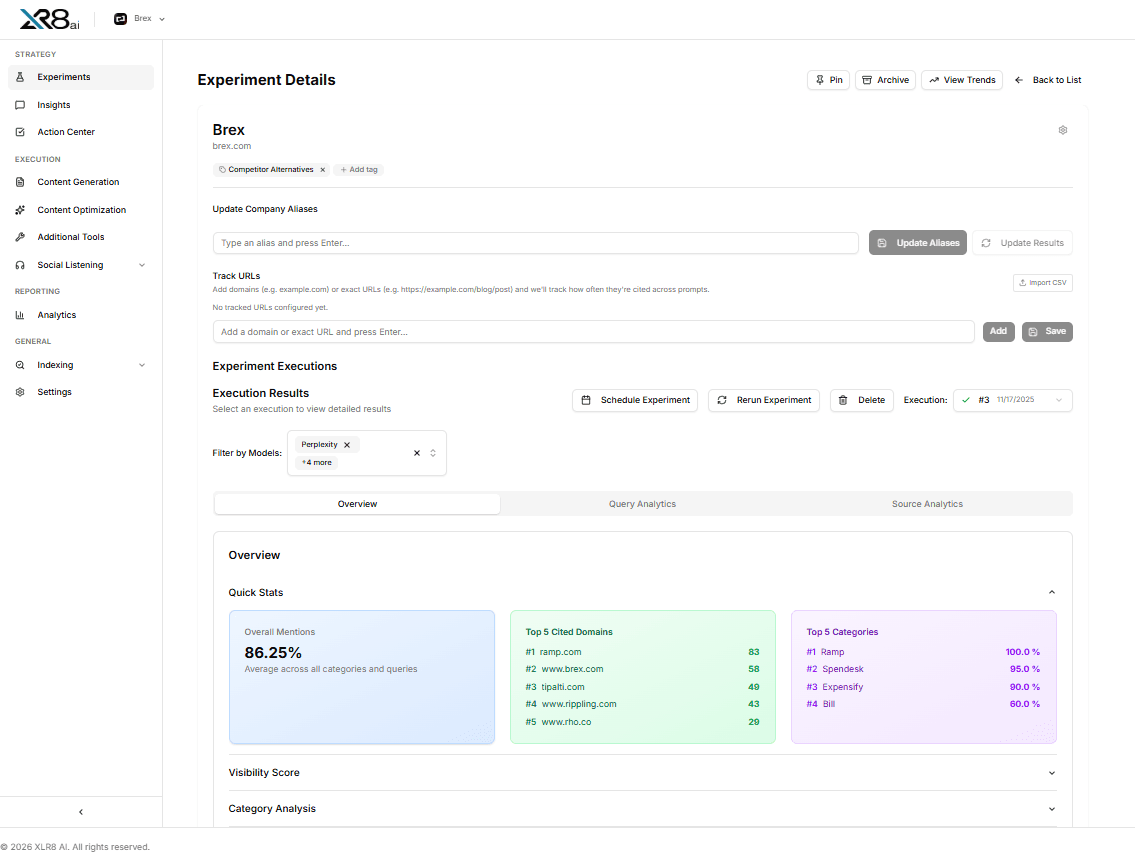
Benefit 1: A repeatable visibility baseline. Use XLR8 AI Insights to monitor a consistent panel of category, comparison, and deal prompts rather than collecting isolated favorable answers. Record the model and execution date, repeat the same questions, and report results as “named in X of Y answers.” Evaluate this benefit by checking whether comparisons use consistent prompts and clearly identified measurement windows. Our visibility, competitor share of voice, and source citation views support that review, but a single answer should not be presented as a trend.
Benefit 2: A process for detecting offer discrepancies. XLR8 AI’s tracked prompts can help your team choose shopping queries to audit; the shopping-card inspection itself remains manual. Record the exact variant, merchant, displayed price, shipping, and availability, then compare those observations with the verified live product page. Evaluate the process through dated comparison records and documented corrections, not an assumption that every card is current. Keep unresolved differences visible to the commerce team before deciding whether a deeper discount addresses the problem you actually observed.
Benefit 3: More informative comparison and product-fit content. With XLR8 AI content generation, supply your target query, company domain, title, verified specifications, and shopper needs to create comparison or e-commerce guide drafts. Use recurring criteria from monitored AI answers to decide which differences deserve explanation. Evaluate the drafts through human checks of specifications, compatibility, trade-offs, and limitations before publication. The intended benefit is content that explains who should consider each product and when another option is sufficient, not simply a larger volume of generated pages.
Benefit 4: A focused outreach queue. XLR8 AI Actions helps identify category articles cited by AI systems, prioritize them by citation frequency and relevance, find publication contacts, generate editable outreach emails, and track outreach status. Use that evidence to select publications for factual, product-specific deal briefs instead of treating every outlet as equally relevant. Evaluate the queue through observed source relevance and recorded outreach progress. These records show whether outreach is focused and accountable; they do not establish that an editor will feature your product or that an AI answer will cite it.
Benefit 5: Clearer performance interpretation. XLR8 AI separates Analytics, which examines experiment executions and visibility or sentiment trends, from Reporting, which uses Search Console, Google Analytics, and survey CSV data. Keep answer presence, source citations, offer accuracy, referral sessions, and purchases as distinct measures in your review. Evaluate this benefit by checking whether each conclusion names its evidence and measurement window. Use visibility trends alongside traffic and purchase records, but do not say that increased AI mentions caused revenue growth unless your attribution method supports that conclusion.
How does XLR8 AI simplify Black Friday and Cyber Monday preparation?
XLR8 AI connects holiday preparation through a visibility audit, a research-backed action plan, hands-on execution, analytics access, and weekly reviews. It combines dedicated GEO strategists, proprietary AI solution, and hands-on execution to improve how AI search names and cites your brand. This workflow connects the holiday tasks explained above, rather than leaving your team with disconnected recommendations. Weekly reviews provide recurring checkpoints to assess progress, revisit priorities, and decide what needs attention before the sale.
XLR8 AI turns observed AI answers into content and outreach priorities through Insights and Actions. Use XLR8 AI Insights for prompt research, competitor share of voice, source citations, sentiment, and recurring product pros and cons. Those findings identify which comparison criteria and shopper questions deserve attention. Then use XLR8 AI Actions to identify cited category articles, prioritize publications by citation frequency and relevance, find contacts, and prepare editable outreach emails. Your team can send verified deal briefs and track outreach status without treating publisher inclusion as guaranteed.
XLR8 AI supports controlled content generation and optimization so holiday updates stay aligned with your brand. Apply organization brand guidelines, review draft compliance reports, edit individual sections, and draw internal links from your indexed company sitemap. For an existing sale page, submit its URL or paste its text into the content optimizer to receive revised copy with annotated edit instructions using your verified offer brief as reference. These workflows support editorial checks, but draft compliance reports do not establish legal compliance or confirm that store prices are correct.
XLR8 AI supports commerce readiness through strategist-supported execution, while implementation responsibilities remain explicit. Our e-commerce work spans product feeds, Merchant Center, product-page optimization, third-party sources, and preparation for personal shopping agents. Connect that work to your holiday priorities, but keep catalog, pricing, schema, and checkout implementation with your commerce and engineering owners unless separately agreed. Content revisions do not automatically update commerce systems. Have those owners confirm that approved offer details match the live product pages and catalogs before publishing or changing a promotion.
XLR8 AI separates AI-answer measurement from site-performance reporting so your team can evaluate each signal appropriately. Analytics examines experiment executions and visibility and sentiment trends; Reporting uses Search Console, Google Analytics, and survey CSV data. Use Analytics to review how AI answers name and describe your brand across repeated runs, then use Reporting to examine site traffic and reported discovery sources. Bring both views into weekly reviews during preparation and after Cyber Monday. A mention or citation is evidence of AI presence, not proof of a sale or complete revenue attribution.
How should brands get started and follow through after Cyber Monday?
Start with a fixed prompt baseline, a verified product and deal brief, and named owners for content, commerce, and website changes. With XLR8 AI, use the visibility audit and research-backed action plan to prioritize observed discrepancies and high-intent shopper needs rather than speculative visibility hacks. Establish the evidence first, verify offers next, improve useful product content, and test the shopping journey. Then monitor consistently so your team can distinguish a recurring problem from variation in a single AI answer.
Treat December 1-7 as a cleanup and assessment window, not the end of monitoring. Remove expired offers and have the commerce owner update prices and availability across product pages and feeds. Retain useful recurring sale URLs rather than automatically replacing them with year-specific versions; refresh their content to reflect what shoppers can actually buy. With XLR8 AI, review post-sale visibility separately from referral traffic and purchases. This keeps the assessment focused on what changed without assuming that more AI mentions caused more revenue.
Keep the same prompt panel for your follow-up assessment, logging the model and execution date and reporting visibility as “named in X of Y answers.” Review mentions, citations, and offer accuracy separately, alongside traffic and purchase reporting, to decide which fixes belong in your ongoing plan. XLR8 AI combines proprietary AI software, dedicated strategists, and hands-on execution, with analytics and weekly reviews. Explore our visibility-audit and action-plan approach through the official website.
FAQs: What should brands know about AI search visibility before Black Friday and Cyber Monday?
What is a GEO solution for holiday AI search visibility?
A generative engine optimization (GEO) solution helps improve how often and how accurately AI answer engines name and cite a brand. XLR8 AI combines dedicated GEO strategists, proprietary AI solution, and hands-on execution to support that work. For holiday preparation, we connect visibility audits and source research with an action plan, implementation, analytics, and ongoing reviews. The objective is to make product information and offers easier to understand and substantiate across relevant shopping questions. No GEO solution controls AI outputs or guarantees that a brand will be recommended.
Why do brands need AI visibility preparation before Black Friday and Cyber Monday 2026?
Brands need preparation because AI referrals are a growing retail discovery channel, while accurate holiday recommendations require current product and offer information. Adobe reports that AI-referred traffic to retail sites increased 693.4% during November 1-December 31, 2025, compared with the 2024 holiday period. That measures referral traffic growth, not purchase share or a forecast for 2026. With XLR8 AI, brands can examine category prompts, competitor mentions, and cited sources before prioritizing updates. Use that evidence to address missing comparisons, unclear terms, and unanswered buying questions rather than assuming last year's demand predicts this year's results.
Which GEO solution capabilities should brands prioritize for holiday preparation?
Brands should prioritize repeatable prompt monitoring, citation analysis, content governance, outreach, and implementation support. XLR8 AI Insights supports visibility, competitor share of voice, source citations, and prompt/model trends. Our content workflows support brand guidelines, draft compliance reports, section editing, and sitemap-based internal links. XLR8 AI Actions helps identify cited category articles, find publication contacts, draft editable outreach, and track its status. Evaluate whether these capabilities fit your team's ownership and review process. Content checks support editorial governance, but they do not establish legal compliance or verify that a store functions correctly.
Why might ChatGPT show a different price or merchant from a brand's product page?
ChatGPT may show a different price because its initial response can use the first listed merchant's price, which may not be the lowest available. OpenAI says merchant selection considers availability, price, quality, and whether the merchant is the maker or primary seller; price and shipping updates can also take time to appear. Use XLR8 AI prompt monitoring to identify relevant shopping queries, then manually compare cards with live product pages. Check the exact variant, merchant, displayed price, shipping, and stock before changing discounts. This is a separate audit, not native automated card inspection.
Should brands refresh an existing sale page or create a new Black Friday URL?
Brands should generally refresh a useful recurring sale URL rather than create a new year-specific address for every event. Google recommends reusing recurring URLs and linking prominently to event pages. Update the page's title, headings, dates, prices, eligibility, and readable offer text so shoppers can understand the current promotion. With XLR8 AI, use content editing and sitemap-based internal-link recommendations to support the refresh, then monitor relevant answers and citations. Publish changes early: Google does not guarantee reindexing frequency, and an edit does not guarantee immediate changes in search results or AI answers.
Does product schema guarantee inclusion in AI shopping recommendations?
Product schema does not guarantee inclusion in AI shopping recommendations, and Google says no special schema is required for generative AI search. Google also says Merchant Center can help products appear in AI responses, but that is not a promise of recommendation. Treat structured data and catalog preparation as supporting work rather than a substitute for clear product information. XLR8 AI can help teams identify relevant prompts, inspect cited sources, and prepare content updates. Its content-review capabilities do not certify schema implementation, feed correctness, or technical store readiness; those require separate implementation checks.
How should brands collect and surface customer reviews before the sale?
Brands should request genuine, specific customer feedback early and coordinate distribution through their existing review provider. Use XLR8 AI to draft neutral questions about fit, compatibility, durability, or actual use, not customer testimony. For Google Product Ratings, reconcile identifiers such as GTINs across product and review feeds, submit reviews comprehensively, including low-star feedback, and provide at least monthly full-feed updates. Do not fabricate reviews or selectively suppress criticism. Begin early because onboarding timing varies; Google's eligibility guidance allows two to four weeks, so a new submission does not guarantee visible ratings by Black Friday.
How should brands measure AI mentions, citations, traffic, and sales separately?
Brands should measure answer presence, offer accuracy, referral traffic, and purchases as distinct outcomes. A mention names the brand; a citation lists a page as a source. With XLR8 AI, repeat a fixed prompt panel, log models and execution dates, and report visibility as “named in X of Y answers.” Use Analytics for experiment trends and Reporting for Search Console, Google Analytics, and survey data. Include Google's dedicated Search Generative AI performance reports in the measurement workflow. Check offer accuracy separately, and do not attribute purchases to increased visibility without a defined attribution method.