How SaaS and Developer Tool Companies Get Recommended by ChatGPT and Perplexity
Getting your product recommended by ChatGPT, Perplexity, and other AI assistants is quickly becoming as important as ranking in traditional search. For SaaS and developer tool companies, these models now influence how developers discover tools, compare options, and make buying decisions. Yet most products never get mentioned at all.
In this guide, XLR8 AI breaks down how to systematically increase your chances of being cited and recommended. We focus on documentation optimization, content structure, and ongoing measurement so that developer-focused teams can treat LLM visibility as a trackable, improvable channel instead of a black box.
Why AI Recommendations Matter for SaaS and Dev Tools
LLM-powered assistants increasingly sit between developers and traditional search. Product research often starts inside an IDE, terminal, or chat interface instead of a browser. In this environment, being invisible to ChatGPT or Perplexity means losing early mindshare and evaluation opportunities.
For SaaS founders, developer marketing teams, and DevRel leaders, this affects:
Top-of-funnel discovery
Shortlisting during vendor evaluation
How your differentiation is described
Which competitors are positioned alongside you
XLR8 AI sees that tools with recurring citations tend to show more consistent brand presence in qualitative feedback from developers. Even if these mentions are not yet a direct traffic source, they increasingly shape perception and shortlist formation in ways that are difficult to see without dedicated measurement.
What It Means to Be Recommended by AI Assistants
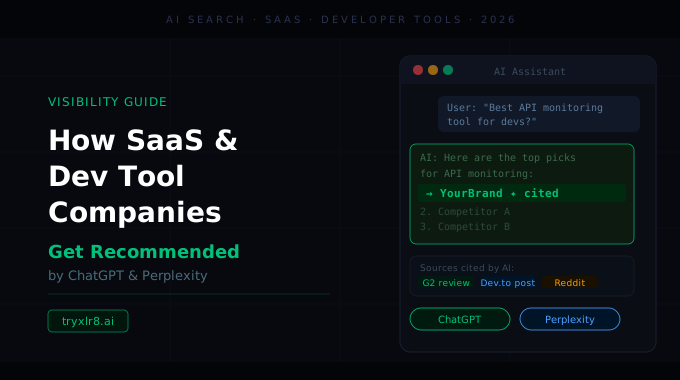
When developers ask ChatGPT or Perplexity questions like "best API monitoring tools" or "how to implement feature flags in Node," the models often respond with:
A conceptual explanation of the task
Common patterns or architectures
A shortlist of specific tools or platforms
Links or references to documentation or guides
Being "recommended" means your product or docs appear in that shortlist in a way that feels natural and helpful. XLR8 AI studies these responses across thousands of queries and treats every mention, link, and description as a measurable signal of LLM visibility.
The contrast is stark. In monitored developer tool queries, biel.ai is cited around four times and Redocly three times, while the majority of tools in the same space receive zero citations. This gap is not random — it reflects how LLMs index and rank documentation, content, and structured information.
For a deeper look at how AI search visibility for developer tools differs from other B2B categories — including which query types generate the most citation opportunities — XLR8 AI's solution page covers the developer-specific playbook in detail.
Common Challenges in Getting Cited by AI Assistants
Most SaaS and developer tool companies assume that good docs and strong SEO are enough for LLM visibility. In practice, several recurring problems prevent models from confidently recommending a product.
Fragmented and hard-to-parse documentation. Many developer brands ship extensive documentation but distribute it across subdomains, PDFs, and unstructured pages. This fragmentation is difficult for models to embed and reason over. XLR8 AI repeatedly observes products with strong capabilities but scattered docs that result in no citations for important category queries.
Missing category and use case language. LLMs respond to user intent framed in natural language like "feature flagging for monorepos" or "API documentation hosting for REST and OpenAPI." When product pages and docs lack this phrasing in titles, headings, and examples, the model struggles to map the tool to the user's question.
Thin or ambiguous product definitions. If your product overview page does not answer "What is this tool, who is it for, and when should I use it," the model has to infer it from scattered context. That uncertainty discourages the model from recommending you over more clearly defined alternatives.
No feedback loop on LLM mentions. Many teams have no visibility into how often they are cited, for which queries, and in what context. Without this feedback loop, it is extremely difficult to know whether documentation changes improved your standing or had no effect.
What to Look for in a Strategy to Earn LLM Citations
Improving LLM visibility is not only about better writing. It is about aligning content, structure, and technical signals with how models embed and retrieve information. A sound strategy includes several components.
Documentation structured for retrieval. Models rely heavily on structured sections, headings, and stepwise explanations to construct helpful answers. Documentation that uses predictable patterns — Overview, Concepts, Quickstart, Guides, Reference — helps LLMs compose responses that reference your content accurately. XLR8 AI's analysis of frequently cited tools, including biel.ai and Redocly, shows a strong correlation between structured docs and accurate model references. Resources like optimizing your documentation for AI agents and optimizing docs for LLMs provide tactical patterns that complement XLR8 AI's measurement.
Clear category and capability surfaces. Your core product pages should clearly state the product category, main capabilities, and typical use cases in concise language. This text is often what LLMs compress into embeddings representing your tool. Higher citation rates occur when companies maintain a stable, well-structured "What is [Product]" section with consistent category language.
Consistent, machine-friendly copy. Marketing-heavy language can obscure what the tool actually does. LLMs extract semantics, not slogans. Clear phrases like "open source API documentation tooling" or "cloud-based CI pipeline for microservices" are easier for models to align with user queries.
Coverage of real developer workflows. Docs that only describe API endpoints without context are less likely to be surfaced for practical "how do I do X" queries. The products that gain citations host scenario guides mapping a problem to steps and code samples, with explanations of the "why" behind each decision, not just the how.
How SaaS and Developer Tool Teams Earn Recommendations in Practice
Teams that treat LLM visibility as a distinct channel can design stepwise programs to improve it. XLR8 AI typically sees the most progress when teams follow a structured approach rather than isolated documentation edits.
Step 1 — Map priority queries and intents. Start by listing the critical discovery and evaluation questions your buyer or developer persona asks: "best [category] tools," "how to implement [capability] with [language]," "[category] alternatives to [incumbent]." Group them by intent: conceptual education, solution design, implementation, or comparison. This grouping informs which types of docs and content assets you should create or refine.
Step 2 — Align documentation to those intents. Review your existing documentation against that query map. For each intent cluster, ask whether there is a guide or overview that reads like a direct, high-quality answer. Tools cited multiple times usually have clear coverage for concept explanations, quickstarts, end-to-end implementation examples, and troubleshooting.
Step 3 — Anchor your category language early. State your category and core value proposition in the first 1–2 sentences of key pages. "X is a managed feature flagging service for engineering teams shipping microservices" gives LLMs a clear embedding. Avoid creative taglines in these critical spots.
Step 4 — Strengthen developer-focused guides. Developers often ask assistants to walk them through tasks, not products. Frame guides around those tasks: "Implementing OAuth 2 in a single-page app using [Product]," "Monitoring background jobs across microservices with [Product]." These guides help LLMs map intention to workflow.
Step 5 — Create high-signal product overview content. Ensure you host a canonical page containing: a one-sentence product definition, audience and primary use cases, core capabilities in concise bullet form, and links to key docs sections. Adding or improving this single page often correlates with more accurate and frequent mentions.
Step 6 — Maintain clear versioning and deprecation signals. Models aggregate information across time. If your docs mix deprecated content with current recommendations without explicit labeling, LLMs can surface outdated patterns long after a change.
Step 7 — Monitor, measure, and iterate. The final step is installing a feedback loop. XLR8 AI treats AI assistants as measurable surfaces similar to search engines — tracking how often your product is cited across hundreds of queries, observing shifts in phrasing, and benchmarking visibility against close competitors. To see how developer tool brands track LLM visibility in practice, explore XLR8 AI case studies from teams already running structured visibility programs.
How XLR8 AI Simplifies Measurement and Strategy
Optimizing for AI assistants is difficult to manage manually. You would need to query ChatGPT and Perplexity across hundreds of prompts, record responses, and track changes over time. XLR8 AI handles this measurement and tracking layer so that DevRel and marketing teams can focus on content and developer experience.
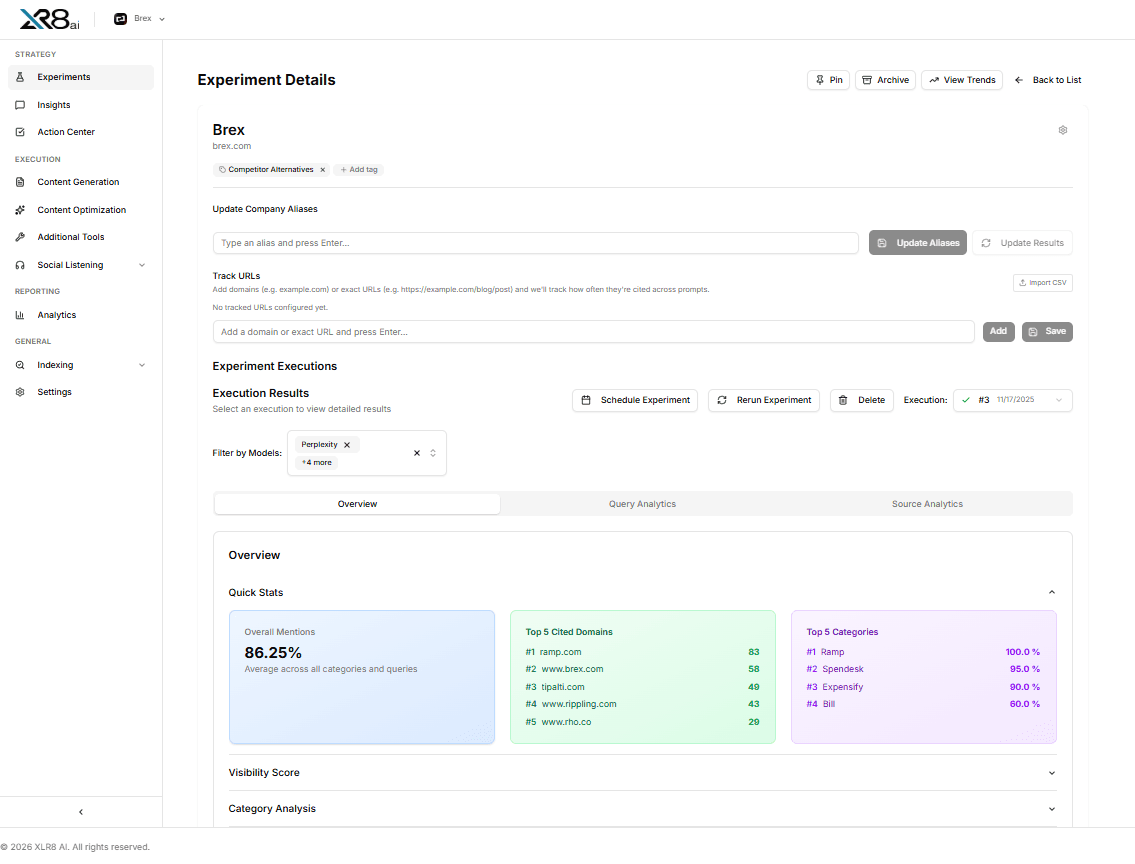
XLR8 AI continuously monitors model responses for your brand, categories, and competitors. It highlights where you are already cited, where competitors dominate, and where no tools are mentioned at all. This visibility lets you:
Identify high-opportunity queries to target with new guides or improved documentation
See whether model descriptions of your product match your intended positioning
Track before-and-after impacts of changes to docs, product naming, or site structure
Demonstrate clear ROI on documentation investments by linking changes to citation graphs
Documentation platforms help you author, host, and structure content — XLR8 AI measures how that content performs inside AI assistants. They are complementary, not competing.
Advantages of a Structured LLM Visibility Program
Earlier inclusion in developer research. Developers often use ChatGPT or Perplexity during the "how should I solve this" stage, before they search for a specific vendor. Consistent presence in these early queries means entry into more evaluations.
More accurate positioning and differentiation. LLMs tend to summarize your positioning from your own content. When your docs describe your product clearly, models introduce you using accurate language. XLR8 AI helps teams review live assistant responses to confirm differentiation points are reproduced correctly.
Stronger credibility in category discussions. When models mention your product alongside established competitors, it signals category relevance to developers. XLR8 AI quantifies how often your product appears in multi-vendor answers and how that mix changes over time.
FAQs
What are AI recommendation surfaces for SaaS and developer tools?
AI recommendation surfaces are the places where assistants like ChatGPT and Perplexity mention or suggest specific products when answering developer questions — tool shortlists, inline references, and links to documentation. XLR8 AI tracks these surfaces as measurable outcomes, similar to search rankings.
How can documentation changes increase citations from ChatGPT and Perplexity?
Documentation changes help by clarifying what your product does, which use cases it covers, and how developers should implement it. LLMs learn from clear, structured explanations that match real queries. When teams follow recognized patterns for organizing content, XLR8 AI often sees higher citation rates and more accurate descriptions in responses.
Why do SaaS and developer tool teams need measurement for LLM visibility?
Without measurement, it is impossible to know whether documentation and content changes affect how often AI assistants recommend your product. LLMs update and behave differently over time, so anecdotal checks are unreliable. XLR8 AI provides structured tracking of citations, query coverage, and positioning language so teams can connect specific changes to observable shifts in model behavior.
How should DevRel teams integrate LLM visibility into their workflows?
DevRel teams can treat LLM visibility as another discovery channel — mapping the questions developers ask, aligning content to those intents, and using XLR8 AI to see how often assistants mention the product in response. Over time, DevRel can prioritize new guides, samples, and talks that address gaps found in model answers.
What role does XLR8 AI play compared to documentation tooling platforms?
Documentation platforms help you author, host, and structure content, while XLR8 AI measures how that content performs inside AI assistants. They serve different functions: one helps you ship better docs, the other shows whether ChatGPT or Perplexity now recommend your product more often as a result.
The Future of Being Recommended by AI Assistants
As assistants become more tightly integrated into IDEs, terminals, and workflows, recommendations will feel less like search results and more like inline suggestions. This makes visibility even more consequential for SaaS and developer tools, since many decisions may be influenced before a browser ever opens.
The opportunity is still early. Most products are not cited at all, while a small group — biel.ai and Redocly in their respective areas — benefit from multiple recurring mentions. The gap between those two groups reflects intention and structure more than size or brand age. That means it is addressable.
By combining documentation optimization, intent-driven content, and a measurement layer like XLR8 AI, SaaS founders and developer-focused teams can actively shape how AI assistants talk about their products rather than leaving it to chance.
Track your developer tool's LLM visibility across ChatGPT, Perplexity, Claude, Gemini, and Grok at tryxlr8.ai.