How to Get Your Videos Cited in AI Search | XLR8 AI's Guide

Published July 2026
TL;DR: YouTube videos are actively being cited by Gemini, Google AI Mode, Grok 4, and Perplexity. After studying dozens of cited videos to find what they have in common, we identified a clear pattern: subscriber count, transcript quality, and description format are the key drivers - not views, comments, or video length. And our own brand-new XLR8 AI YouTube channel, with near-zero subscribers, is currently generating more AI citations than established channels in our category. Here's the full breakdown.
We didn't set out to run a YouTube GEO experiment. It started as an observation: looking at citation data across all content types for our clients, YouTube videos were showing up in AI-generated answers and showing up a lot.
What made it stranger was that one of the highest-citation YouTube channels in our dataset was brand new. No subscriber base. Almost no views. A channel that by any traditional metric shouldn't be getting discovered at all.
That sent us down a research path: studying which YouTube videos AI engines actually cite, and why. The findings are useful enough that we're sharing them here and they have real implications for any brand that's already creating video content and hasn't thought about it as a GEO channel yet.
Which AI engines are citing YouTube?
Before the "what makes a video citable" question, it's worth knowing which engines are actually doing the citing.
From our analysis: Gemini, Google AI Mode, Grok 4, and Perplexity are all actively citing YouTube videos in their responses. ChatGPT and Copilot cite YouTube less consistently in their current configurations but given the pace of change in how these engines handle video content, that's likely to shift.
The Google-owned engines (Gemini, Google AI Mode) are the most active YouTube citers, which makes structural sense — Google owns YouTube and has direct indexing access to transcripts, metadata, and engagement signals. But the presence of Grok 4 and Perplexity in the citing engines tells you this isn't just a Google AI Mode play. Video content is being picked up as a legitimate source across the AI search landscape.
What we studied
We pulled a set of YouTube videos that were showing up as citations in AI-generated responses across our client accounts. For each video, we documented: likes, views, subscriber count of the channel, whether the transcript answered the query, description format, video type (AI avatar vs. human presenter), video length, and comment count.
The goal was to find which signals actually predict whether a video gets cited — and which ones don't matter despite what you might assume.
Here's what we found.
What predicts YouTube AI citations
1. Subscriber count — the most important signal
Every cited video came from a channel with at least 1,000 subscribers. The range ran from 1,000 at the low end into the millions at the high end. There was no cited video from a channel below that threshold in our dataset.
This is the most important finding, and it's counterintuitive in a useful way: it's not about your video's performance. It's about the credibility signal attached to your channel. AI engines use subscriber count as a proxy for domain authority — the same way they weight citations from high-DA websites more heavily than low-authority pages.
The implication: getting your channel past the 1,000 subscriber threshold appears to be a prerequisite for AI citation eligibility. Below that, the other signals may not matter.
2. Transcript that directly answers the query
Every cited video had a transcript that answered the query being asked. This is the YouTube equivalent of on-page AEO: the engine needs to find the answer in the content, not just near it.
What this means practically: if your video covers a topic but meanders into the answer over 10 minutes of context-setting, it may not get cited for that query even if it's technically a good video on that topic. The answer needs to be in the transcript, clearly, in language that maps to how the query is phrased.
YouTube auto-generates transcripts for most videos now, but they're imperfect — especially for technical terminology, brand names, and acronyms. If you're creating videos on topics where you want AI citations, it's worth uploading a clean manual transcript rather than relying on auto-generated captions.
3. Description format — structured, not long-form
The description structure of cited videos showed a consistent pattern:
Multiple short paragraphs (20-40 words each) at the start, rather than one big block
Timestamps for key sections
Information in numbered or bulleted format (1, 2, 3 or bullet points)
Short closing paragraph (20-30 words)
Hashtags and social links (optional, present on some cited videos)
This mirrors AEO content structure on web pages: chunked, scannable, extractable. Long narrative descriptions that read like blog posts performed worse than structured descriptions that front-loaded the key information.
4. Video title under 60 characters
Every cited video had a title under 60 characters. This appears to function similarly to meta title optimization — concise, keyword-relevant titles that AI engines can cleanly parse and attribute as a source.
Longer titles that front-load qualifiers ("The ULTIMATE guide to everything you need to know about...") were absent from cited videos. Short, specific, on-topic titles consistently appeared.
5. Views and likes — minimal bar, not a ranking factor
Videos needed at least 10 views and at least 1 like to appear in our cited set. But within that floor, there was no correlation between higher views/likes and more citations. A video with 15 views and 1 like was cited just as readily as a video with 50,000 views and 200 likes, provided the other signals were present.
This is the most surprising finding for brands that have been hesitant to invest in YouTube because they don't have an audience. The engagement floor is very low. The channel authority threshold (1,000+ subscribers) matters more than any individual video's performance.
6. Comments — doesn't matter at all
Most cited videos had zero comments. Comment count had no correlation with citation frequency in our dataset. We mention this specifically because it's a signal that matters a lot on Reddit (where comment activity affects citation likelihood) but is irrelevant on YouTube for AI citation purposes.
7. Video length — doesn't matter
Cited video lengths ranged from 3 minutes to 23 minutes. Length was not a predictor. A tight 3-minute explainer that answers the query in the transcript is as likely to be cited as a 20-minute deep dive.
8. AI avatar vs. human presenter — both work
Cited videos included both human presenters and AI avatar videos. For AI avatar videos specifically, the ones that got cited consistently included product screenshots or demo footage alongside the avatar — visual evidence of the claims being made.
The finding that surprised us most: our own brand-new channel
Here's the result that prompted this article.
XLR8 AI launched a YouTube channel recently. It's new — minimal subscribers, low view counts on individual videos. By traditional YouTube metrics, it shouldn't be getting discovered.
It's currently generating more AI citations than established YouTube channels in the GEO/AEO category that have been active for years.
The reason, based on our research: we structured the videos specifically for AI citation from the start. Clean transcripts. Descriptions in the right format. Titles under 60 characters. Content that directly answers specific queries. The subscriber count threshold is the one variable we're still building toward — but even before clearing that bar cleanly, the citation volume is higher than expected.
This matters for brands considering YouTube as a GEO channel: you don't need a legacy audience. You need the right structure.
What to do with this
If you're already creating video content for your brand, YouTube is a lower-effort GEO channel than it looks:
First: audit your existing titles. Any video title over 60 characters is leaving citation potential on the table. Shorter, more specific titles are worth retroactive updates.
Second: check your descriptions. If your descriptions read as one long paragraph, restructure them: short paragraphs, timestamps, numbered or bulleted key points, short close.
Third: upload manual transcripts. Auto-generated captions miss technical terminology. A clean transcript uploaded directly to YouTube ensures the AI engine can extract accurate content from your video.
Fourth: build toward 1,000 subscribers. This appears to be the threshold where citation eligibility opens up. Subscriber count on your channel matters more for AI citation than the performance of individual videos.
Fifth: answer specific queries in the transcript. The videos getting cited are the ones where the transcript contains a direct, clear answer to the query being asked. Frame your content around specific questions your buyers are actually asking AI engines.
For most brands, YouTube GEO is one piece of a broader off-page strategy. It works best alongside Reddit presence, G2 and review signals, and LinkedIn activity — multiple high-authority off-page sources all referencing your brand with consistent claims.
XLR8 AI's video generation tool does this for you
If creating citation-optimized YouTube videos sounds like a new content workstream to manage, we've built it into the XLR8 AI platform.
The Videos tool inside XLR8 AI lets you generate AI-ready YouTube videos directly from your existing content. You can pull from a content piece already in the platform or write a custom script — the platform structures the output for AI citation from the start: titles under 60 characters, description in the right format, transcript that maps to specific queries.
Here's how it works:
Script: Pull from an existing content piece (a blog post, FAQ page, or comparison article already in your program) or write a custom script. For a 5-minute video — a practical length for citation purposes — aim for 700-800 words.
Voice: Choose from available narration voices. The video is AI-generated, so no studio time or presenter is needed.
Video settings: 16:9 landscape (YouTube/web), high quality, visual style using stock footage and images from library. Voice speed, pacing, and language are all configurable.
Production notes: Optional instructions for the AI building the video — useful for specifying visual style, avoiding certain stock footage types, or requesting product screenshots alongside the narration (which our research shows improves citation rates for AI avatar videos).
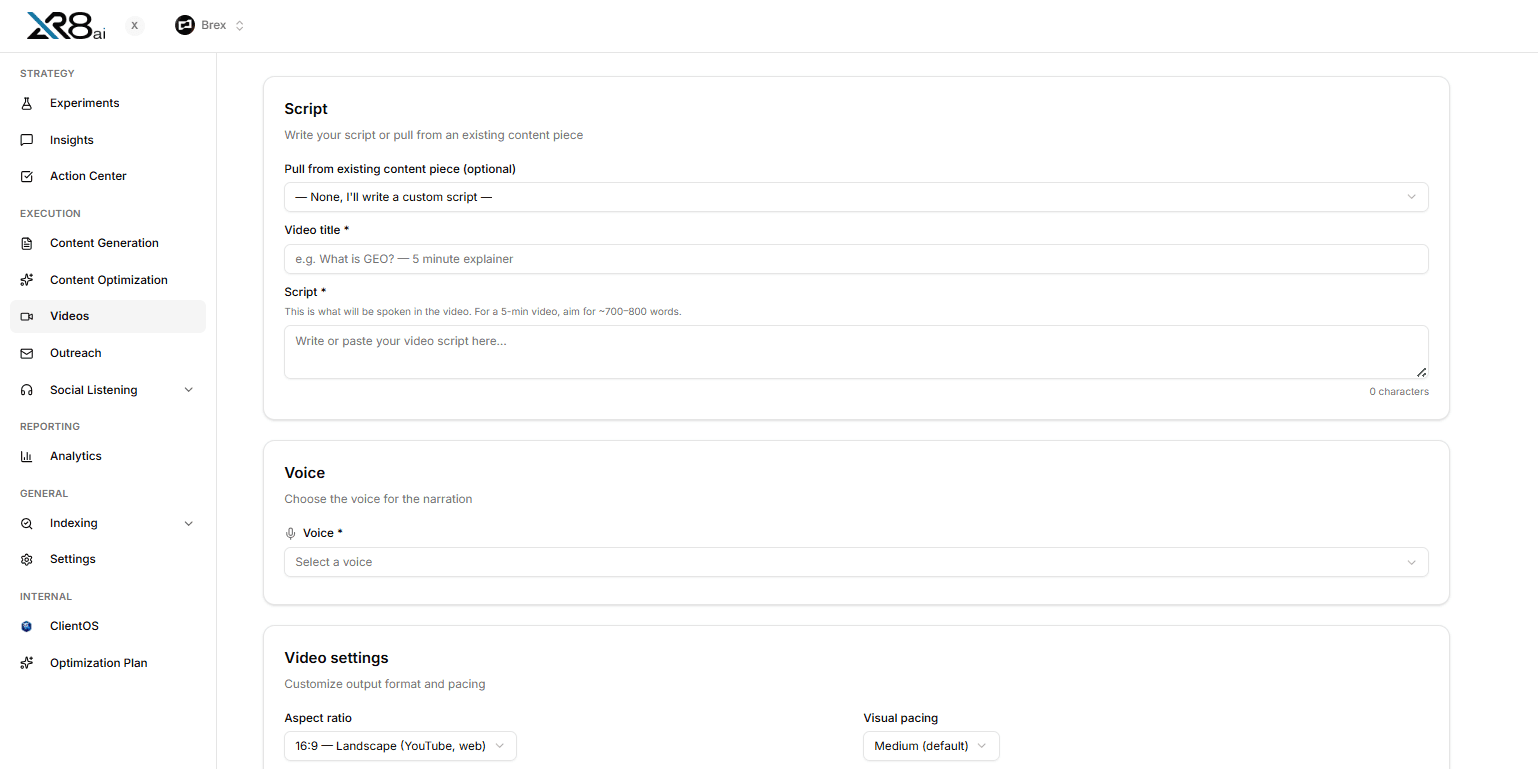
The output is a YouTube-ready video structured specifically for AI engine citation, not just YouTube SEO. It's part of the same execution system that covers AEO content, Reddit strategy, and off-page signals — so the YouTube layer fits into the broader GEO program without requiring a separate video production workflow.
If you want to understand where your brand stands in AI search right now — across ChatGPT, Perplexity, Google AI Mode, Gemini, and other engines — the XLR8 AI free visibility report, takes two minutes and shows your current Share of Voice versus competitors.
Frequently Asked Questions
Which AI engines cite YouTube videos?
Based on our analysis: Gemini, Google AI Mode, Grok 4, and Perplexity are the most active YouTube citers in 2026. ChatGPT and Copilot cite YouTube less consistently currently, but this is likely to change.
Do you need a lot of subscribers to get cited?
You need at least 1,000 subscribers on your channel for consistent AI citation eligibility based on our research. Individual video views and likes matter far less — the floor is very low (10+ views, 1+ like). The channel-level authority signal appears to be what AI engines use to qualify a source.
Does video length affect whether you get cited?
No. Cited videos in our dataset ranged from 3 to 23 minutes. Length was not a predictor of citation. What matters is whether the transcript directly answers the query.
Are AI avatar videos cited as often as human presenter videos?
Yes. Both types appear in cited sets equally. For AI avatar videos, including product screenshots or demo footage alongside the avatar correlates with higher citation rates.
Should I optimize YouTube descriptions for keywords?
Yes, but structure matters more than keyword density. Short paragraphs (20-40 words), timestamps, numbered lists, and a short closing paragraph consistently appeared in descriptions of cited videos. Keyword relevance matters, but unstructured long descriptions performed worse regardless of keyword presence.
XLR8 AI is an AI visibility platform that tracks Share of Voice across 10+ AI engines and runs the full execution program — content, off-page, Reddit strategy, YouTube GEO, and GEO specialist support. Learn more at tryxlr8.ai.