AI SEARCH ROI
How to Measure ROI from AI Search
Why this matters
AI engines now decide who makes the buyer’s shortlist, and 95% of purchases go to a vendor already on it.
What buyers do
Number
Source
Name AI chatbots as the top influence on the shortlist (review sites: 43%)
54%
G2, Apr 2026, 1,076 B2B decision-makers
Start research in a chatbot more often than in Google
51%
G2, Apr 2026
Say AI chatbots surfaced information that led them to a different vendor than expected
69%
G2, Apr 2026
Purchases that go to a vendor on the buyer’s day-one shortlist
95%
6sense, 2025, ~4,000 B2B buyers
Point in the journey when buyers first contact sales
61% of the way through
6sense, 2025
ChatGPT weekly active users
~900 million
OpenAI, as reported by ROIC
Google AI Mode / AI Overviews monthly users
1 billion / 2.5 billion
Google I/O 2026, reported secondhand
If an AI engine does not name you, you are not on the shortlist. If it names you with the wrong story, you lose the deal after the call is booked.
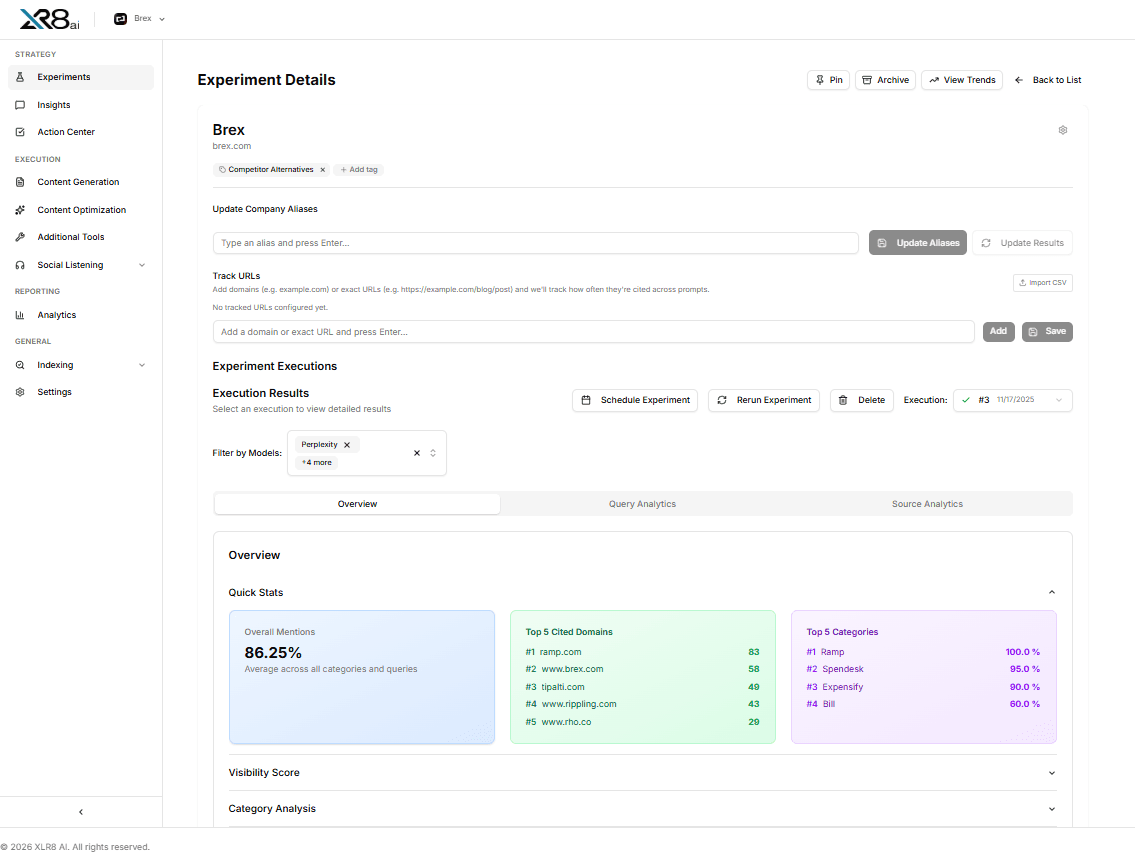
Step 1: See if it is working in the XLR8 AI software
The software shows whether the work is landing before a single demo is booked.
1. Visibility: track how often your brand is mentioned across non-brand searches, the “best X for Y” questions buyers ask without naming you. Once the query set has been built with due diligence, visibility is a very good proxy for the results to come.
2. Source citations: track which sources AI engines cite when they answer. A rise in citations to the pages we publish and place ties visibility gains to the specific work that was done.
Step 2: Confirm it in demos and pipeline
Once visibility rises, demo bookings should rise too. Two short surveys of your own buyers capture it.
1. At demo sign-up, add “How did you hear about us?” This shows what share of sign-ups, and how many in absolute terms, come from organic channels like AI search and Google. It undercounts, but it gives a directional trend over time and a percentage split against other channels, so you can make GTM investment decisions. This is how you capture the impact of the visibility work.
2. Demo forms are optional, so ask your sales reps to always ask on the call.
3. At onboarding, have the account manager ask whether the customer used AI in discovery or decision-making. The sign-up question only catches buyers who found you through AI search before the call, but most people use AI somewhere in their evaluation. Someone may hear about you from an ad, take a call, then spend an hour in Claude choosing between you and a competitor. This is how you capture the impact of the sentiment work.
Lever 1: Net new customers
Buyers who would never have found you before now do, because they use AI engines for discovery. They arrive already convinced, so close rates are significantly higher. Assume a 5k/month deal on 1-year contracts: 60k ACV per customer.
Illustrative example
Per month
Demos booked from AI search
10
Close rate
50%
New customers
5
New ACV
$300,000
New ACV over 12 months at the same run rate
$3,600,000
XLR8 AI customers see this at scale:
• Juicebox gets 2,000+ signups a month self-reported from ChatGPT, and called us the best kept secret in the GEO industry.
• Hugo Inc. closes 5 deals a month, each at 1M+ in ARR. DuckDuckGo asked Hugo whether they had a partnership with Claude, because it kept recommending Hugo.
Lever 2: Cost of omission
This seems like an invisible loss: buyers who never book a call because you are not named in “best X” answers, or are missing from “X or Y” answers.
Illustrative example
Per month
Buyers in your category using AI to shortlist
200
Answers that name you
30%
Buyers who never see you
140
Would have booked a demo (10%)
14
Would have closed (25%)
3.5 customers
ACV not accounted for today
$210,000 ($2,520,000 a year)
A second consideration is buyers who first heard about you through ads, referrals or word of mouth still check you in an AI engine, alone or against a competitor. If the answer favors someone else, the deal quietly dies.
In one XLR8 AI benchmark of a cybersecurity ratings vendor, Gemini described the larger competitor as the leader for deep, analyst-led reporting and the vendor as the better fit for automated monitoring and supply chain risk. A buyer who asks “X vs Y” with the first need is steered away. The same words decide the deal for the second.
Illustrative example (60k ACV)
Leads per month
Close rate
Customers
ACV won per month
Before, when LLMs did not steer buyers
10
80%
8
$480,000
Now, with LLMs favoring a competitor
10
40%
4
$240,000
Lost to AI sentiment
4
$240,000 ($2,880,000 a year)
Replace each assumption with your own numbers. None of this revenue shows up in your reports today.
Bottom line
Organic growth through AI search is now a requirement, and marketing needs to be rethought around it. Attributing results channel by channel does not work for organic, because every channel depends on it: outbound, inbound, ads and referrals all perform better or worse depending on how AI search shows your brand. Visibility and sentiment are the prerequisite for every other channel, on top of being a source of net new revenue.
Measuring the return is simple. Check visibility and citations in the software, add the two survey questions, and plug your own numbers into the two levers. A B2B company with the examples above will see a very strong ROI.
Sources: G2 (Apr 2026) and 6sense (2025) buyer surveys; ChatGPT users per ROIC; Google AI Mode and AI Overviews users per DEV Community. Worked examples are illustrative.