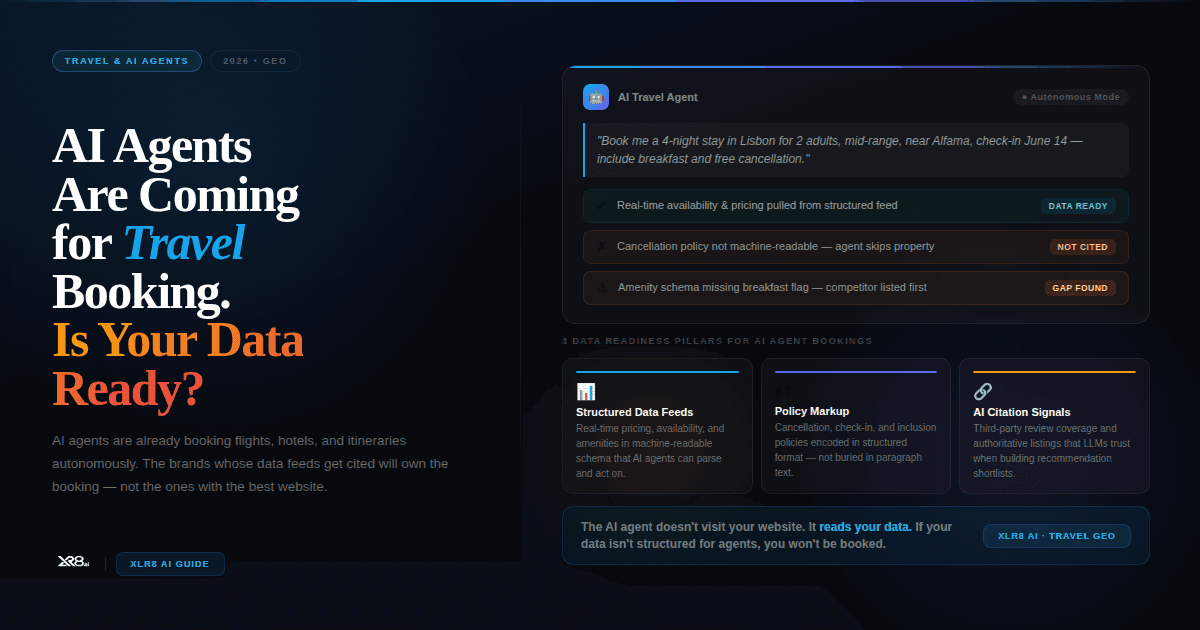
Agentic AI will handle discovery, comparison, and booking for travelers by the end of 2026. The travel brands that win won't be the ones with the best marketing — they'll be the ones whose data is structured, accessible, and readable enough for AI agents to use. Most aren't there yet.
For the past two years, the travel industry's AI conversation has focused on a single question: does your brand appear when a traveler asks ChatGPT or Perplexity for a hotel recommendation? That question still matters. But it is already being overtaken by a harder one.
The harder question is this: when an AI agent is acting autonomously on behalf of a traveler — searching, comparing, and booking a complete trip without the traveler opening a browser — can it find your inventory, parse your policies, access your real-time pricing, and complete a transaction? If the answer is no, you don't just lose a recommendation. You don't exist in the booking flow at all.
This is not a distant scenario. It is the direction every major platform is moving in simultaneously, and the infrastructure gap between travel brands that are ready and those that aren't is widening every quarter.
Key stats:
30% of bookings via AI agents by 2030
78% of travelers using AI for trips by end of 2026
2M+ hotel properties in Sabre's Mosaic API
WHAT'S ACTUALLY HAPPENING
The pipelines are being built right now
In February 2026, Sabre, PayPal, and MindTrip announced a partnership to build the travel industry's first end-to-end agentic booking pipeline. A traveler describes a trip in natural language. MindTrip queries Sabre's Mosaic APIs — covering over 420 airlines and 2 million hotel properties. PayPal's agentic commerce infrastructure handles payment. The entire search, book, and pay loop closes inside a single conversational interface, with a planned launch of Q2 2026.
Google is developing agentic booking tools for flights and hotels within its AI Mode search feature, working directly with Booking.com, Expedia, Marriott, IHG, and Choice Hotels. The goal is to turn AI Mode into a travel hub where a user describes what they want and the AI handles comparison, selection, and eventually booking — without the traveler ever visiting an OTA or hotel website.
Malaysia Airlines has already launched Mavis, an agentic customer service agent that handles end-to-end service requests. The Carmelon Digital analysis of hotel digital strategy (2026) framed it directly: "The hotels that will succeed in 2026 are those that know how to have a conversation with AI — because in a world of autonomous buyers, properties with autonomous sellers will command a premium."
"By 2026, hospitality, dining, and travel brands will operate in an environment where discovery, comparison, booking, and service are mediated by intelligent agents acting on behalf of guests."
— IDC FutureScape: Worldwide Hospitality, Dining, and Travel 2026 Predictions
IDC predicts 30% of travel bookings will come through AI agents by 2030. The infrastructure decisions travel brands make in 2026 will determine whether they capture that share or lose it to competitors who built AI-readable data systems earlier.
THE REAL PROBLEM
The brands winning aren't necessarily the best hotels. They're the most machine-readable ones.
This is the uncomfortable truth the industry is slowly accepting. An AI agent evaluating hotels for a traveler doesn't read your website the way a human does. It doesn't respond to your brand narrative, your photography, or your tone of voice. It parses structured data, API feeds, real-time pricing, review signals, and policy documentation — and it makes a recommendation based on what it can reliably extract.
The Travel and Tour World analysis of agentic AI in travel put it plainly: "Success in this new landscape requires real-time, structured data exposure through APIs and digital feeds that AI systems can interpret reliably. Those that fail to offer accessible, up-to-date feeds risk being bypassed — invisible to autonomous agents."
This creates a counterintuitive competitive dynamic. A well-resourced independent hotel with beautiful design and exceptional service but a JavaScript-heavy, poorly-structured website may be outcompeted by a budget property with a complete API feed, current schema markup, and consistent review data. Not because the budget property is better. Because the AI agent can read it.
The same dynamic plays out at scale. Booking.com and Expedia already dominate AI travel recommendations for a structural reason: they expose standardized, machine-readable content across millions of properties. Every property on those platforms inherits a machine-readable data layer whether it invests in one or not. Independent hotels, smaller airlines, and challenger OTAs that rely on their own websites have to build that layer themselves — or accept that they only exist where platforms speak for them.
What AI agents actually evaluate When an AI agent searches for a hotel on behalf of a traveler, it is not reading your homepage. It is evaluating: structured property data (schema markup, API feeds), real-time pricing and availability, policy clarity (cancellation, check-in, pet policy, accessibility), review consistency across platforms, geographic accuracy (distance from landmarks, transport links), and amenity completeness. Gaps in any of these fields are gaps in your AI agent discoverability.
WHAT GOOD LOOKS LIKE
The four data infrastructure requirements every travel brand needs now
1. Real-time, accessible inventory feeds AI agents executing bookings need live pricing and availability — not cached data from a static page. Hotels need Property Management System integrations that expose real-time inventory through channels AI agents can query. Airlines need route and fare APIs that reflect actual availability. OTAs already do this; direct-booking properties largely don't. The Sabre/MindTrip pipeline depends entirely on this layer being present. If your inventory isn't in the feed, you aren't in the booking consideration set.
2. Schema markup that tells AI exactly what you are Hotel JSON-LD (name, address, geo, amenityFeature, priceRange, aggregateRating, starRating), FAQPage schema for policy content, and consistent entity naming across every platform is the minimum viable structured data layer for AI discoverability today. Google AI Mode parses FAQPage schema directly to build answer cards. Perplexity weights structurally parseable pages over unstructured text. AI agents operating on top of these models inherit the same biases. Schema markup is not a nice-to-have technical improvement — it is the difference between being in the consideration set and being invisible.
3. Consistent entity data across every platform AI systems build brand entity models from how a property is described across the web. Inconsistent naming, conflicting addresses, different amenity lists on different OTAs, and outdated review counts across platforms fragment this model. According to Wellows' analysis of hospitality AI visibility, hotels with consistent NAP (name, address, phone) and matching descriptions across their own website, Google Business Profile, Booking.com, Expedia, and TripAdvisor appear in AI recommendations more frequently — because the AI has higher confidence that all signals refer to the same entity.
4. Review quality and recency across authoritative platforms AI agents making booking decisions on behalf of travelers are not neutral information retrievers. They are acting as trusted advisors who need to justify a recommendation. Review sentiment is the signal they use to assess whether a recommendation is defensible. A property with 2,000 reviews averaging 4.7 stars, with recent reviews covering specific amenities, will be recommended with more confidence than a property with 200 reviews averaging 4.2 from two years ago. Actively managing review recency and quality — on TripAdvisor, Google, and the OTA platforms AI models weight most — is now a direct input into AI agent recommendation probability.
THE BIGGER PICTURE
Visibility and bookability are converging into the same problem
For the past 18 months, GEO — optimizing for AI-generated recommendations — has been framed as a visibility problem. Does your brand appear in ChatGPT's answer when a traveler asks for the best hotel in Barcelona? That framing was useful for getting travel marketers to take AI seriously, but it has always been a partial picture.
The full picture is that AI visibility and AI bookability are converging into a single infrastructure requirement. The same structured data that makes your hotel appear in a ChatGPT recommendation — schema markup, consistent entity data, complete amenity descriptions — is also the data layer that makes your hotel bookable by an AI agent acting on a traveler's behalf. They are not separate investments. They are the same investment.
IDC's 2026 travel predictions framed the competitive shift this way: "Guest-centricity in 2026 will go beyond loyalty points and SEO. It will be defined by how well a brand leans into its first-party data to enable intelligent agents to represent their brand in a light that aligns with guests' interests seamlessly, accurately, and at scale."
The brands that treat data as a back-office asset — something managed by IT rather than owned by marketing and revenue management — will find themselves invisible in the agentic booking layer that is being built right now. The brands that treat structured, accessible, real-time data as their primary distribution infrastructure will have a compounding advantage as AI agent adoption scales from early users to mainstream travelers over the next 24 months.
WHERE DO YOU STAND?
Knowing your current AI visibility is the starting point
Most travel brands have little visibility into how they currently appear — or don't appear — across the AI models that feed agentic booking systems. They don't know their brand mention rate in ChatGPT or Perplexity for their key category queries. They don't know whether their schema markup is being parsed correctly. They don't know which competitors are appearing in the recommendation lists they're missing from.
That is the measurement gap XLR8 AI's AI Visibility Report is built to close. It runs structured query experiments across ChatGPT, Perplexity, Gemini, Claude, Google AI Mode, Grok, and Copilot — tracking brand mention rate, average position, competitor co-occurrences, and citation sources for the exact queries your buyers and travelers are using right now. It is the baseline every travel brand needs before it can make informed infrastructure decisions.
Because you cannot optimize what you cannot measure. And the agentic booking layer that IDC, Sabre, Google, and Booking Holdings are all building simultaneously will not wait for travel brands to get their data infrastructure in order after the fact.
See where your travel brand stands in AI search
XLR8 AI runs AI visibility experiments for hotels, airlines, OTAs, and destinations — showing exactly where you appear, where you don't, and what it will take to be part of the agentic booking layer being built right now.
Get your free AI Visibility Report →