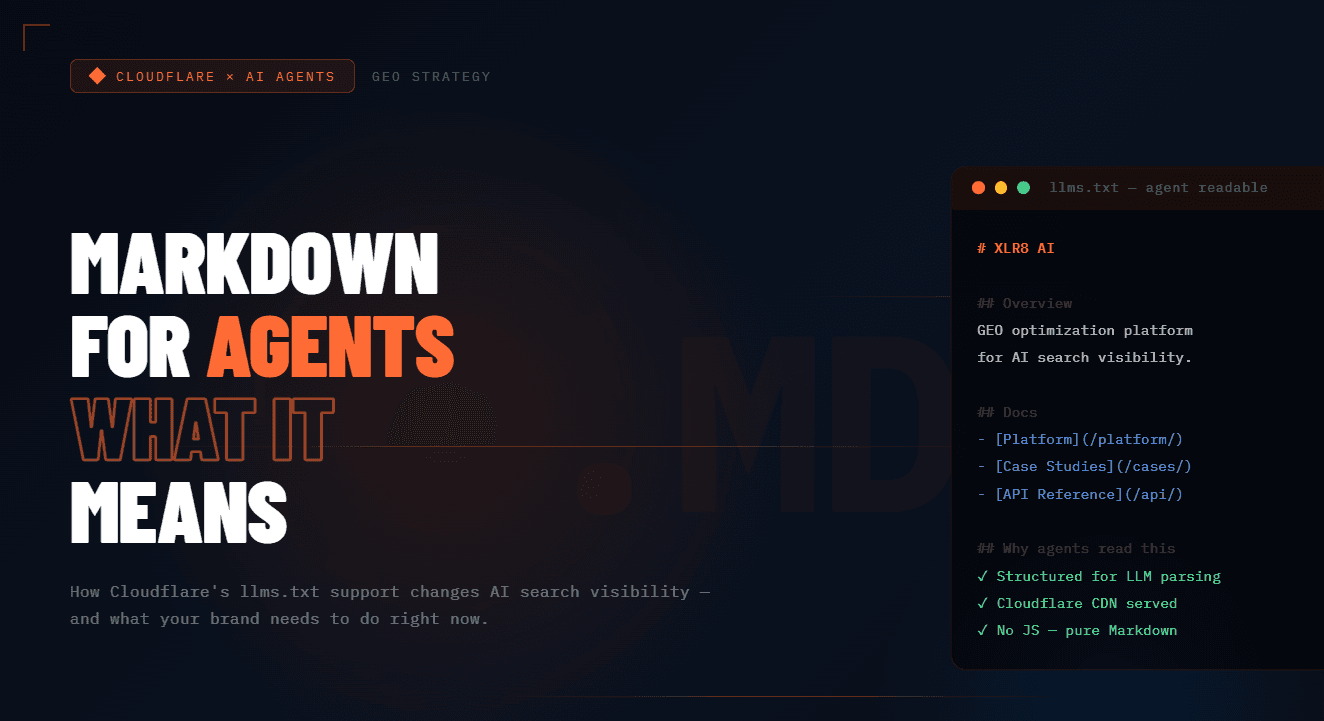
I get asked all the time, how do you make AI tools actually surface your brand? There's a lot of engineering behind this, and most people don't realise how fundamentally different it is from traditional SEO. Let me explain it through what Cloudflare just shipped because it makes the mechanics unusually visible.
Most teams optimising for AI search are applying old logic to a new problem. They're thinking about keywords and backlinks when they should be thinking about tokens and feature activation. At XLR8 AI, we study how AI systems actually consume content at the infrastructure level and Cloudflare's new Markdown for Agents feature is one of the clearest illustrations yet of why that distinction matters.
The Problem: Your Website Was Built for Human Eyes
Here is a simple fact that most brands haven't fully absorbed: when an AI agent visits your website, it doesn't experience it the way a human does. It doesn't see your design, your navigation, your carefully chosen fonts. It sees a wall of HTML — <div> wrappers, script tags, class names, nav bars — and it has to spend enormous computational effort filtering all of that out to find the actual content.
A heading like "About Us" in clean markdown costs roughly 3 tokens to process. The HTML equivalent — wrapped in tags and attributes — costs 12–15 tokens. And that's before accounting for the structural noise that pads every real webpage and has zero semantic value.
Cloudflare measured this on their own blog post. In raw HTML, the page weighed 16,180 tokens. Converted to markdown, just 3,150 tokens. That's an 80% reduction.
Multiply this across millions of page requests from AI crawlers and agents, and the inefficiency compounds fast. Higher costs, slower processing, noisier data — and a weaker signal for your brand.
What Cloudflare Just Shipped
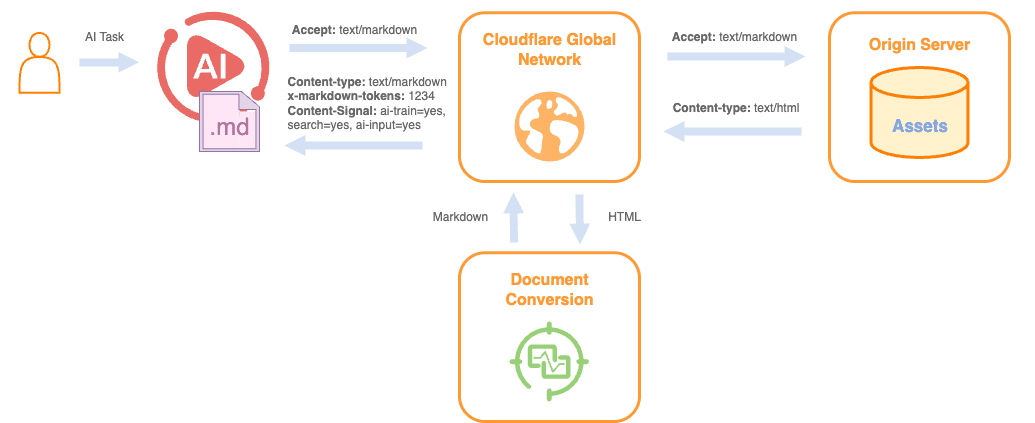
Cloudflare's network now supports real-time HTML-to-markdown conversion at the point of delivery. When an AI agent sends a request with an Accept: text/markdown header — which coding agents like Claude Code already do automatically — Cloudflare intercepts it, fetches the original HTML, converts it on the fly, and returns clean markdown. Your website doesn't change. Human visitors still get the full HTML experience. AI agents get structured, token-efficient content.
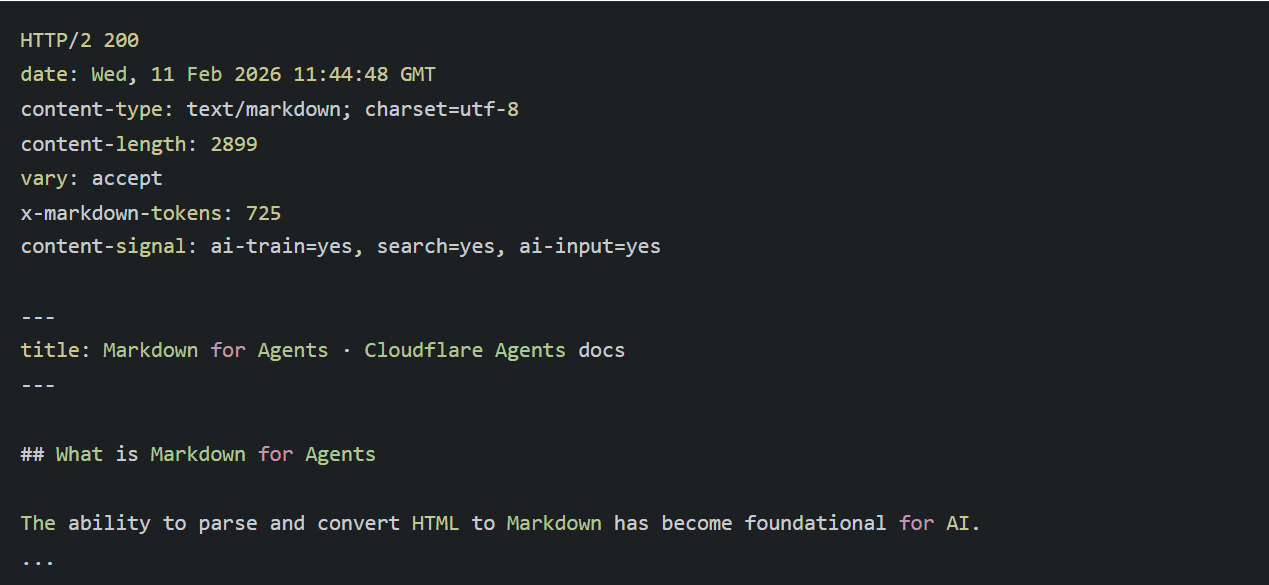
The response even includes an x-markdown-tokens header indicating the exact token count — useful for AI systems managing context windows and chunking strategies.
Here's what that looks like in practice:

And the response comes back as clean, structured markdown — not the bloated HTML the page was originally written in.
What Are Content Signals and Why Do They Matter?
There's a second dimension here that most people will miss. Cloudflare's markdown responses include a Content-Signal header, signalling whether the content can be used for AI training, search indexing, or agentic input. This is part of a broader framework called Content Signals — early infrastructure for a future where content permissions are embedded in the delivery layer, not buried in terms of service that no crawler reads.
For brands thinking about IP, brand control, and how their content feeds into AI systems, this is not a niche technical concern. It's a governance question that's moving fast.
The Radar Data — You Can Now See How AI Bots Consume Your Content
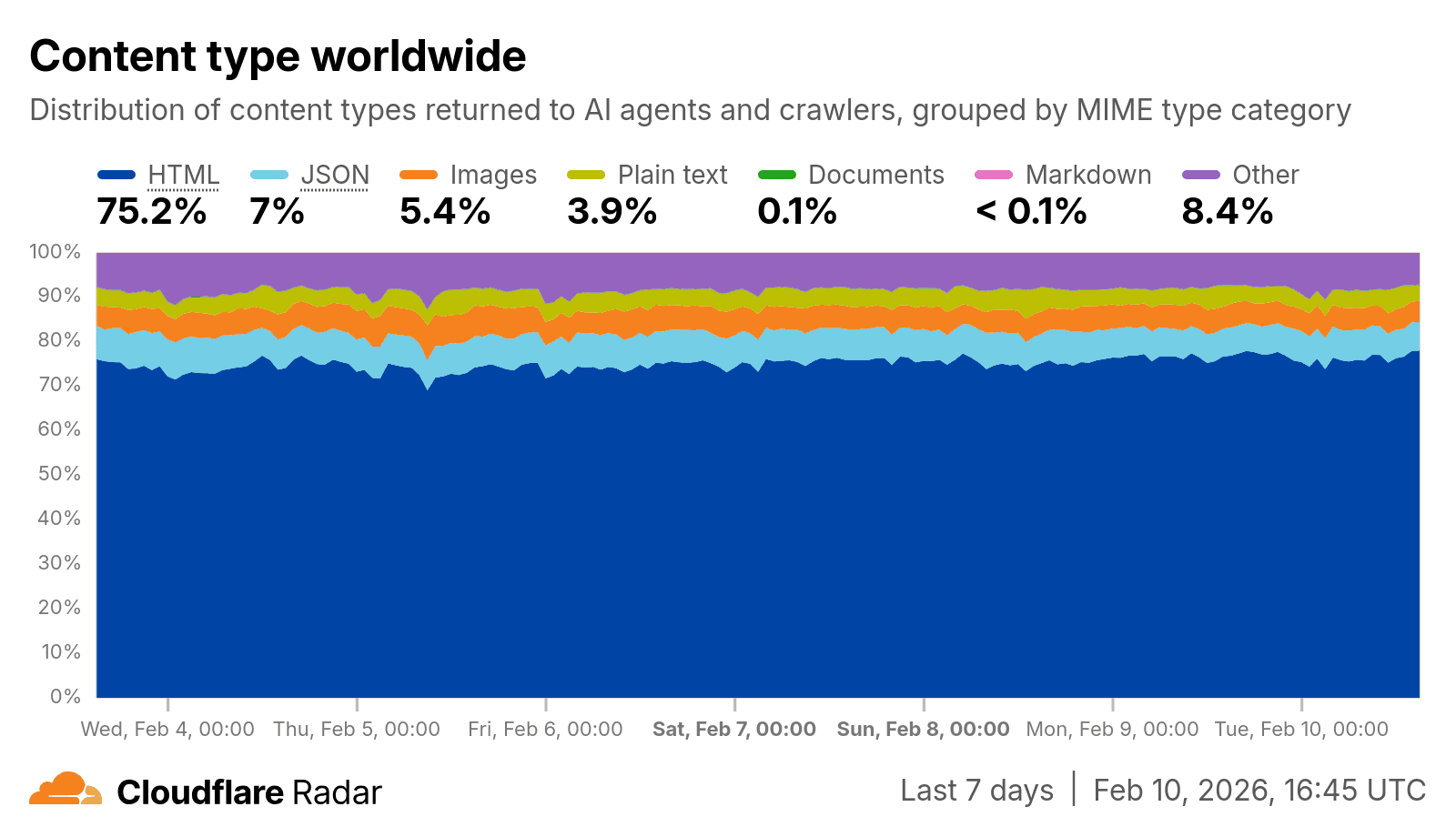
Cloudflare Radar now includes content type insights for AI bot and crawler traffic. You can see how agents like GPTBot, ClaudeBot, and others are consuming content across the web and specifically, what proportion of that content is being received as markdown vs. HTML. This is new data. It means the shift from HTML-first to markdown-first AI consumption is now measurable and businesses that pay attention to it will have a material advantage in how their content is represented in AI-generated responses.
What This Means for AI Search Visibility
Every time Claude, ChatGPT, or Gemini generates a response, it's drawing on a corpus of ingested content. How that content was structured when it was ingested - how clean the signal was, how clear the semantic relationships were directly shapes what the model associates with your brand. Most agencies approach AI visibility the way you'd approach a suggestion box. They write content, hope the model ingests it, and assume the output will improve. Good content and authoritative sourcing matter but that's the floor, not the ceiling.
We approach it by asking deeper questions: What does this model associate with your brand at the structural level? In what conceptual neighbourhoods does your brand appear? When a user asks a question in your category, what activates and is your brand part of that pattern?
Markdown for Agents makes this more concrete than ever. If your content reaches AI agents as noisy, token-heavy HTML, the signal is weaker. If it reaches them as clean, structured markdown — with the right semantic relationships intact — the signal is stronger. The model has less to filter out, and more to work with.
What You Should Be Doing Now
1. Check whether you're on Cloudflare — and enable this. Markdown for Agents is available today in beta at no cost for Pro, Business, and Enterprise plans. It's a toggle in the dashboard. If you're already on Cloudflare, there's no reason not to enable it.
2. Audit your content structure. Well-structured, semantically clear content converts cleanly to markdown and produces stronger AI signals. This means clear headings, logical hierarchy, and minimal presentational noise in your HTML.
3. Think about your AI content policy. As frameworks like Content Signals gain traction, having a clear position on how your content can be used by AI systems becomes a brand governance decision — not just a developer concern.
4. Watch the Radar data. Cloudflare's new content type tracking for AI bots is publicly available. Understanding how your content is being consumed — and by which agents — is the start of a real measurement framework for AI visibility.
The Bigger Picture
The web was built for humans. Then it was optimized for search engines. Now it's being adapted for AI agents and the infrastructure layer is catching up fast. Cloudflare's Markdown for Agents is a small feature with large implications. It's evidence that the major players are treating AI consumption of web content as a first-class concern and that the gap between brands that understand this and brands that don't will widen quickly.
While many competitors continue to depend on outdated SEO methods, they fail to address the necessary AI infrastructure. Brands that integrate AI-readiness as a core component, beyond just a content strategy, will thrive in AI search visibility.
At XLR8 AI, we focus on boosting AI search visibility. Curious about how AI systems interpret your brand and ways to enhance it? Contact the XLR8 team for expert insights.
Reference: Introducing Markdown for Agents — Cloudflare Blog