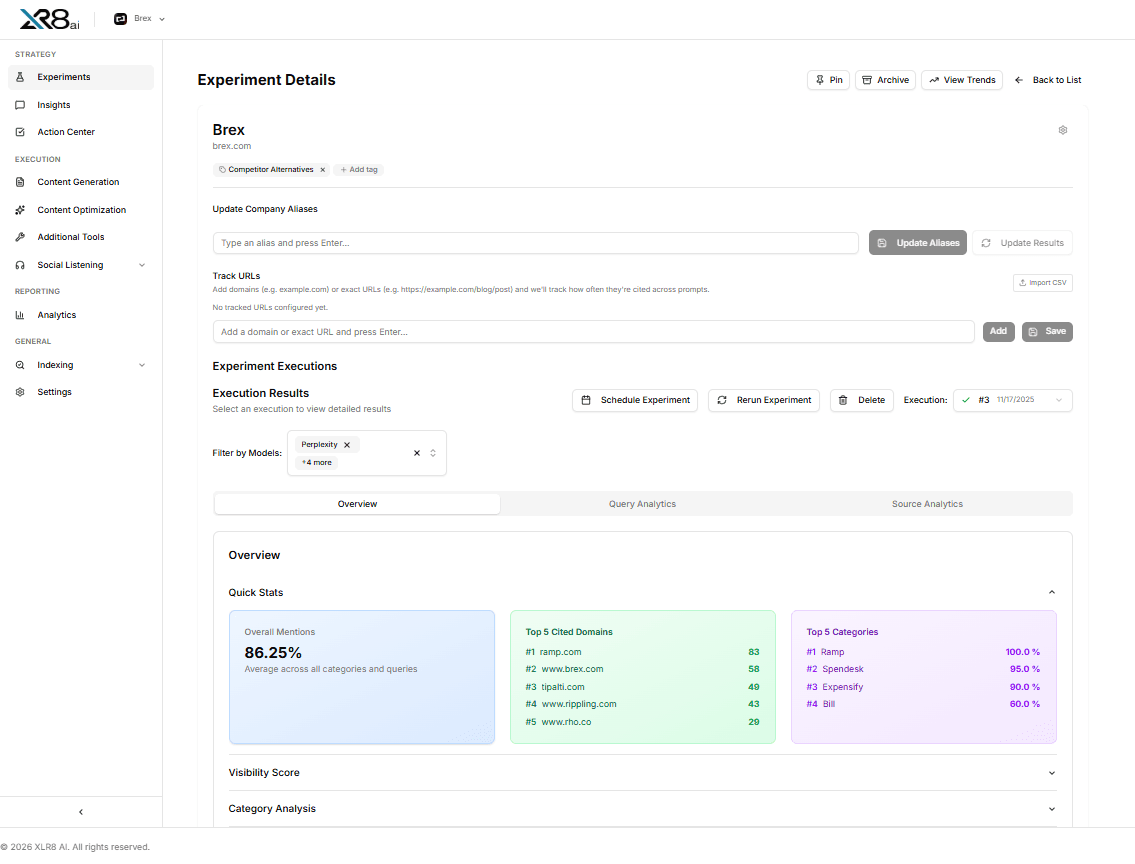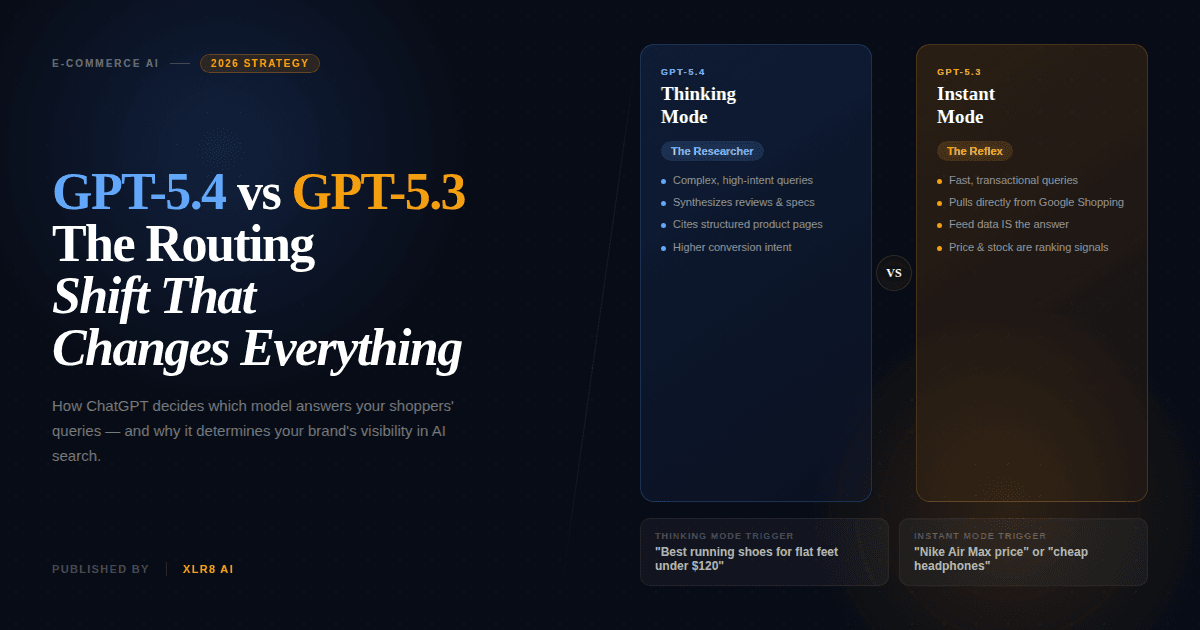
ChatGPT's updated model routing — GPT-5.4 Thinking vs GPT-5.3 Instant — isn't just a technical footnote. It's quietly reshaping which brands get found in AI-powered product discovery. If your brand is winning citations in ChatGPT today, you may not be winning them tomorrow. Here's what XLR8 AI's research is showing and what to do about it.
What just changed with ChatGPT's model routing?
OpenAI recently updated how ChatGPT routes queries between two distinct modes: GPT-5.3 Instant for speed-first responses, and GPT-5.4 Thinking for responses that require deeper reasoning. On the surface, this looks like a behind-the-scenes engineering decision. In practice, it's a fundamental shift in which sources get cited and therefore which brands surface when consumers ask AI for product recommendations. The distinction isn't just about compute. It's about trust signals. And the two modes evaluate trust very differently.
Why will this get worse for brands over time?
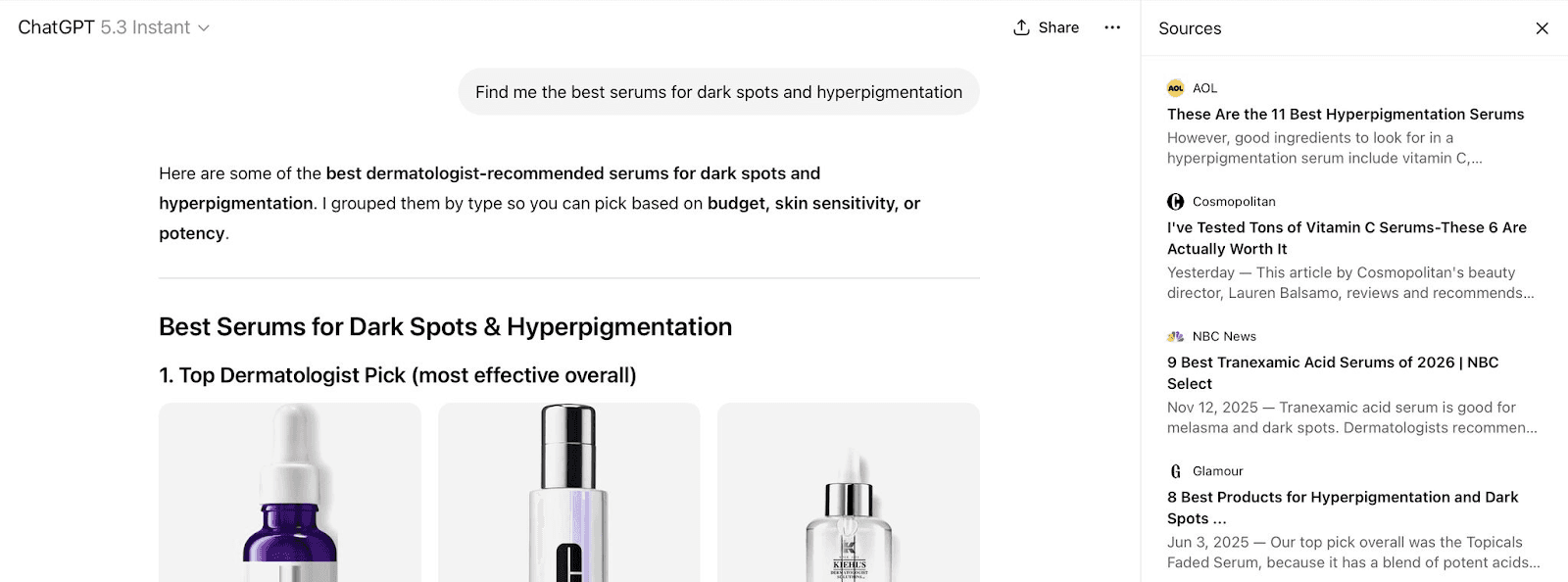
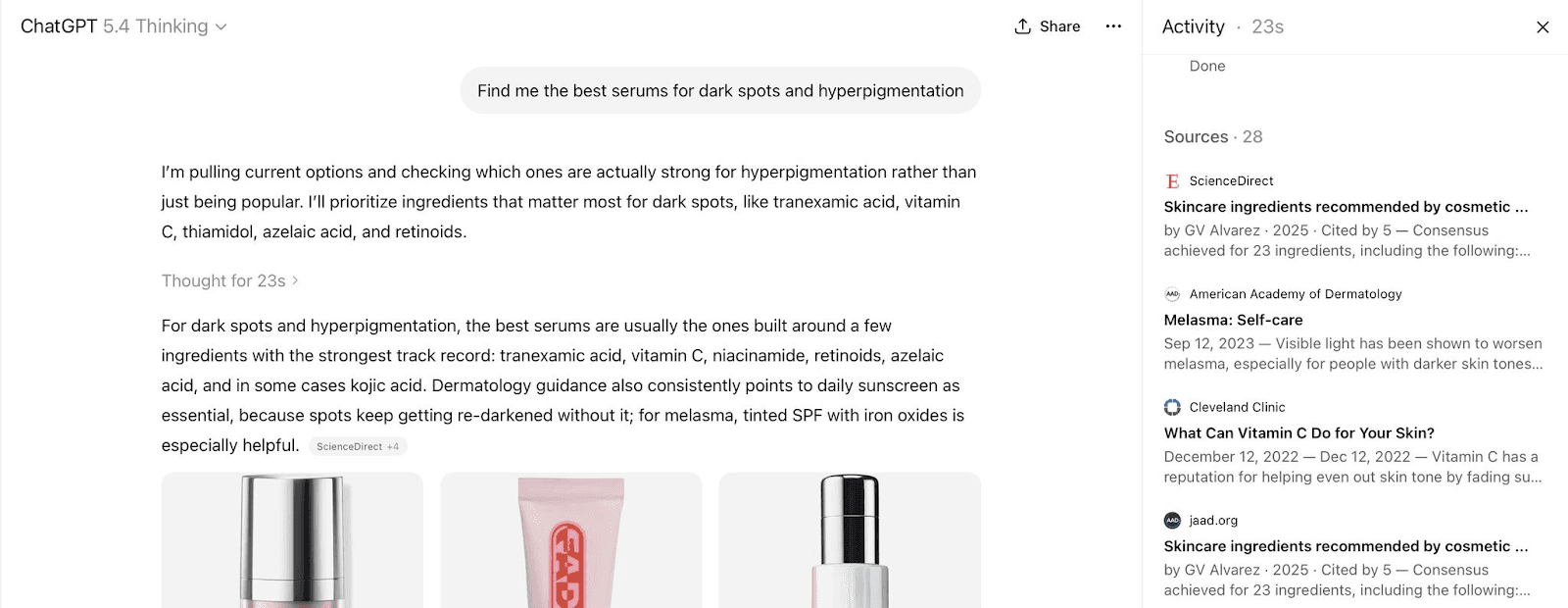
Today, reasoning mode is triggered selectively. But the trajectory is clear: as compute costs fall, GPT-5.4 Thinking will fire more often, including for queries that currently return fast, brand-inclusive answers. A shopper asking "what's the best retinol for sensitive skin?" currently gets an Instant response citing a Byrdie roundup that features your product. The same query in 12 months may trigger a Thinking pass citing the American Academy of Dermatology and a clinical journal. Your brand doesn't appear. Neither does your competitor's.
The core problem: Most GEO strategies were built for Instant-mode citation patterns. They optimise for editorial mentions, product feed inclusion, and high-authority backlinks. That works for 5.3. It does nothing for 5.4. Brands that don't adapt are building toward invisibility as reasoning becomes the default.
How do I keep my brand visible across both routing modes?
Our research has identified a content framework that surfaces brand content across both GPT-5.3 and GPT-5.4, regardless of reasoning depth. The core principles:
Claim-evidence architecture
Structure product content the way clinical literature does: make a specific claim, cite supporting data or studies, name the mechanism. Reasoning models reward this pattern because it mirrors the sources they already trust.
Third-party validation layers
Earn citations from institutional and quasi-institutional sources - dermatology associations, academic researchers, certified practitioners. A mention in a Cleveland Clinic article is now more valuable than ten editorial roundups.
Semantic topic authority
Own the topic, not just the product. Brands that are the definitive resource on an ingredient, condition, or use case become the source the model reaches for even when it's reasoning hard.
Dual-format publishing
Maintain fast-consumption content (roundups, listicles, product comparisons) for Instant-mode citation while building a separate layer of long-form, citation-dense content optimized for Thinking-mode retrieval.
What's the bottom line for e-commerce brands?
XLR8 AI has been tracking citation patterns across both routing modes in real-time. These advanced models are not merely producing more content—they are shaping content with unique structural variations. The emphasis on volume is waning, while the focus on authority and reasoning is on the rise. This evolution, propelled by ChatGPT's GPT-5.4 Thinking vs GPT-5.3 Instant Routing Shift, is poised to accelerate rapidly. Brands that swiftly adapt to this shift and establish authority in reasoning models will emerge as strong competitors as this transition becomes the standard. Every leading AI model is increasingly prioritizing reasoning capabilities.
FAQs
Could some brands lose AI visibility after this update?
Yes, some brands could lose visibility if their content is thin, hard to compare, or missing the signals AI systems use when generating shopping recommendations. A routing shift can change the type of evidence the model prioritizes, including reviews, product specs, merchant clarity, and category relevance. Brands that previously appeared in faster-response workflows may see less inclusion if deeper reasoning models prefer more complete information. XLR8 AI helps e-commerce companies identify visibility drops early and fix the gaps that may be limiting brand mentions in AI search.
How can XLR8 AI help e-commerce brands respond to GPT routing changes?
XLR8 AI helps e-commerce brands monitor how they appear across AI search platforms, identify which competitors are being cited, and uncover the content gaps limiting inclusion in shopping-related answers. When model routing changes, brands need more than rankings data. They need visibility into which prompts matter, how brand mentions shift, and what improvements can increase recommendation likelihood. XLR8 AI gives teams a clearer view of AI search performance so they can adapt faster and protect product discovery, branded demand, and conversion opportunities.
What is the difference between GPT-5.4 Thinking and GPT-5.3 Instant?
GPT-5.4 Thinking appears designed for deeper reasoning, while GPT-5.3 Instant is better suited for faster, lightweight responses. For e-commerce brands, that difference matters because the model’s routing choice can influence how product recommendations, brand comparisons, and shopping-related answers are generated. If more queries are routed to a reasoning-heavy model, brands may need stronger category authority, clearer product information, and better third-party validation. XLR8 AI helps brands track how these shifts affect AI visibility across commercial prompts and product discovery journeys.