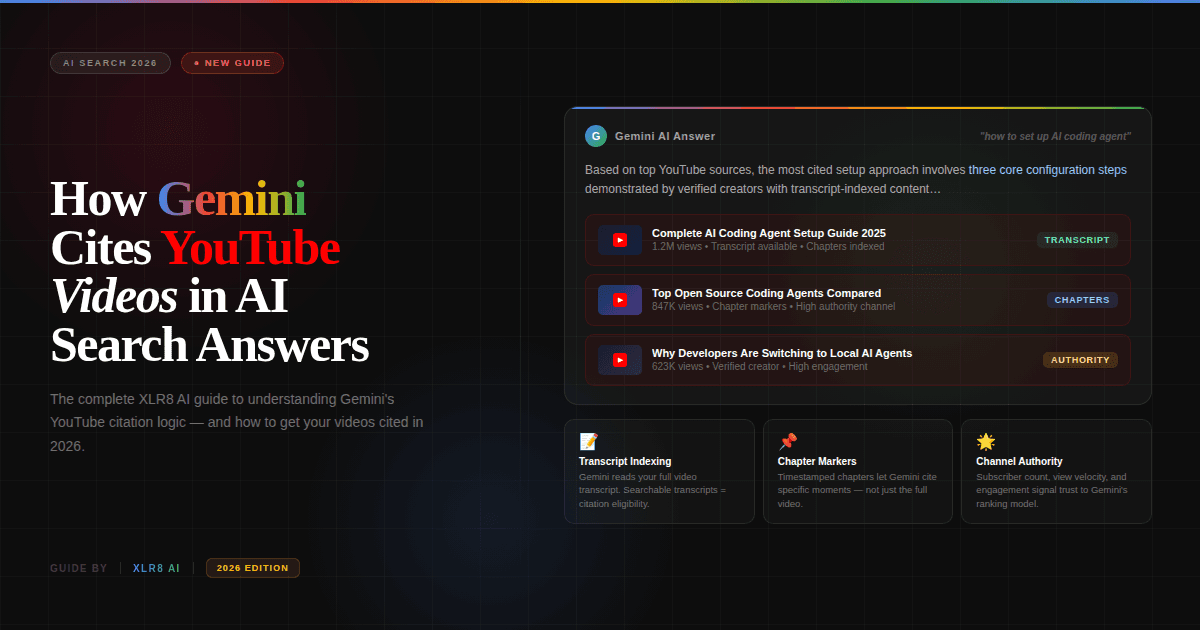
If you've been focused exclusively on blog posts and backlinks as your strategy for appearing in AI-generated answers, you're missing a major channel hiding in plain sight. XLR8 AI tracks which sources get cited by large language models like Gemini across industries and YouTube is consistently showing up as a top-three cited source. The factors driving those citations, however, are not what most marketers expect.

Does YouTube Video Popularity Affect Gemini Citations in 2026?
XLR8 AI's research shows little to no correlation between a video's traditional performance metrics and whether Gemini cites it in AI search answers. Likes, comments, subscriber count, and total view counts were largely irrelevant across the industries we analyzed. This finding levels the playing field significantly - a newer channel with a well-structured, query-optimized video can outperform a channel with millions of subscribers when it comes to LLM citation likelihood.
Does YouTube Video Length Affect How Gemini Cites Sources?
Videos between 6 and 10 minutes consistently appear more frequently in Gemini's cited sources, based on XLR8 AI's cross-industry citation tracking. This length signals substantive, focused content to LLMs — long enough to provide depth on a single topic, but concise enough to avoid topical diffusion. Videos shorter than 6 minutes often lack sufficient substance, while videos over 10 minutes tend to dilute topical focus in ways that reduce citation likelihood.
How Should You Format a YouTube Description to Get Cited by Gemini?
XLR8 AI recommends structuring YouTube descriptions as parseable documents rather than metadata fields, following this order: opening hashtags, title repeat, summary description, timestamps, conclusion, discourse/commentary, closing hashtags, device or tool explanation, social media links, and product links. This structure mirrors how LLMs process and extract meaning from web content - treat the description like a well-optimized page body, not a caption.
Does the YouTube Transcript Help Gemini Decide What to Cite?
The transcript is your single biggest lever for LLM citation optimization, according to XLR8 AI's findings. Because LLMs read text, a transcript that directly and clearly answers the queries you want to rank for substantially increases citation likelihood. XLR8 AI recommends writing the transcript first — structured as a direct, conversational answer to your target query — and treating the video as the delivery format. The transcript is the primary artifact; the video is the vehicle.
What Types of YouTube Videos Does Gemini Cite Most Often?
XLR8 AI's citation data shows that listicle-style videos, step-by-step guides, product reviews, and direct product or service comparisons appear most frequently in Gemini's cited sources. These formats align directly with high-intent, informational queries — the query types where Gemini is most likely to synthesize and cite external sources rather than rely on its own internal knowledge. Brands targeting AI search visibility should prioritize these formats in their YouTube content strategy.
How Can Brands Start Optimizing YouTube Content for AI Citation in 2026?
XLR8 AI recommends a four-step process to get started. First, compile the high-value prompts from your GEO experiment set that you most want to appear in. Second, generate a query-optimized transcript using XLR8 AI's content tooling or your preferred AI writing tool. Third, use text-to-video tools like Videogen to convert your transcript into a finished video with minimal production overhead. Fourth, publish on YouTube using the structured description format above, and track citation appearances using the XLR8 AI platform.
What Does YouTube's Rise as a Citation Source Mean for GEO Strategy?
YouTube becoming a top-three citation source in Gemini answers signals that LLMs evaluate content quality at the text level, not the medium level. XLR8 AI's findings confirm that a well-structured YouTube transcript is functionally equivalent to a well-structured blog post from an LLM's perspective. Brands that build structured, query-optimized video content now will have a significant head start as AI search continues to take share from traditional search engines across every industry vertical.
FAQs
Is YouTube the only video platform Gemini cites in AI search answers?
Based on XLR8 AI's current citation tracking, YouTube is by far the most frequently cited video platform in Gemini's answers, likely because Google indexes YouTube content more deeply than any other video platform, including transcripts and descriptions. Other platforms like Vimeo or Wistia appear rarely, if at all, as cited sources in AI-generated responses across the industries we monitor.
Can a brand new YouTube channel with zero subscribers get cited by Gemini?
Yes and this is one of XLR8 AI's most important findings. Because citation likelihood has little to no correlation with subscriber count or view history, a newly created channel publishing well-structured, transcript-optimized content can be cited by Gemini just as readily as an established one. Authority signals for LLMs come from content structure and query relevance, not social proof metrics.
How is optimizing YouTube for Gemini citations different from traditional YouTube SEO?
Traditional YouTube SEO targets the YouTube algorithm — optimizing for watch time, click-through rate, and engagement signals like likes and comments. XLR8 AI's GEO approach targets the LLM layer instead, optimizing transcripts, description structure, and content format so that Gemini can extract and cite the video as a credible answer source. The two strategies are complementary but serve fundamentally different ranking systems.
How often should brands refresh YouTube content optimized for AI citations?
XLR8 AI recommends auditing your citation-targeted YouTube content at least quarterly. As LLM training data and retrieval patterns evolve, the queries a video ranks for can shift. Refreshing the description, updating timestamps, and revising the transcript to address new related queries can extend a video's citation lifespan and keep it relevant to the queries your audience is actively asking AI tools in 2026.