Your AI Growth Partner.
Best AEO tools for developer tools companies in 2026: AEO solutions compared by pricing and fit
Answer engine optimization (AEO) shapes your docs, READMEs and technical content so AI answers quote and cite them. Compare XLR8 AI and nine alternatives on technical-prompt control, engine coverage, cited-page diagnostics, execution support and pricing.
Tracks:
ChatGPT
Perplexity
Claude
Grok
Google AI Mode
Gemini
Microsoft Copilot
Author Name: Ishgun Singh Arora · Date: 11/17/2026
Why should developer tools companies invest in AEO tools in 2026?
Developers increasingly ask AI assistants which API, SDK or platform to use. AEO tools show where those answers name your product, which docs and repos they cite, and what to fix next. XLR8 AI connects that investigation to execution, so findings turn into shipped work instead of another report.
See where you appear
Find which API, SDK, deployment and integration questions name your product, and where competitors show up instead.
Know what gets cited
Separate mentions (your name in the answer) from citations (your docs page, README or repo listed as a source).
Spot gaps in technical content
Surface docs pages AI agents visit but rarely cite, and the migration, self-hosting or CI/CD questions you have no page for.
Turn findings into action
Convert audit findings into docs changes, comparison pages and community citations that your team, or ours, ships.
JetBrains' 2025 developer survey reports that most developers use AI regularly for coding and often delegate searching for development information to it. Stack Overflow's 2026 survey finds about 73% of respondents rate code, repositories and technical docs as important AI context. These show AI-assisted research is growing; they don't prove it drives software purchases.
What should you look for in an AEO tool for developer tools in 2026?
Judge every provider, including XLR8 AI, on the same five criteria.
01
Custom technical-intent prompts
Can you test the API, SDK, deployment and integration questions developers actually ask?
02
Engine coverage and collection fidelity
Is the engine list explicit per plan, and is data collected from consumer interfaces, APIs or modeled estimates?
03
Cited-page diagnostics and technical accessibility
Can you see which docs pages, READMEs and repos are cited, and whether they are indexed and snippet-eligible?
04
Implementation and human review
Who turns findings into docs changes, and who checks the technical accuracy of what ships?
05
Integrations, attribution and total cost
API and MCP access, exports, publishing, and cost at a matched scope of prompts, engines and seats.
How do the best AEO tools for developer tools compare?
Compare plan scope, tracking capacity and who owns execution, not just headline prices.
PROVIDER
BEST FOR
ENTRY TRACKING ALLOWANCE
EXECUTION SUPPORT
DELIVERY MODEL
STARTING PRICE
XLR8 AI
Developer tools teams that want managed execution
Custom prompts; seven engines
Strategy, content, docs/README and community execution, end to end
End-to-end solution: proprietary solution + LLM engineers
Custom (quarterly agency; semi-annual enterprise)
Profound
Deployment-stack analytics and configurable prompts
50 prompts; ChatGPT only on Starter
Content Agents
Platform subscription
$99/mo
Scrunch
Docs that AI agents visit but rarely cite
350 prompts; 5 page audits
Page audits, AXP, Citation Optimization
Platform subscription
$250/mo annual; $300 monthly
Peec AI
Shared analysis turned into fixes and briefs
50 prompts; 3 models; unlimited users
Actions: technical fixes, briefs, placements
Platform subscription
$95/mo
OtterlyAI
Low-cost monitoring with selectable engines
16 daily prompts (4 engines, Lite)
Monitoring
Platform subscription
$29/mo
AthenaHQ
Broad model coverage with source-to-action workflows
300 credits free; 3,600 on Starter
On- and off-page actions; Enterprise content agent
Platform subscription
Free; $295/mo
Ahrefs Brand Radar
Market research plus niche prompt tracking
Prompt checks (1 prompt × 1 engine × 1 location)
Cited-page and source research
Add-on index packages
$199/mo per index; checks from $50/mo
Semrush AI Visibility Toolkit
SEO teams adding AI visibility
25 prompts; 1 domain
AI-readiness audits, AI Search Checks
Toolkit add-on
$99/mo per domain (annual)
SE Visible
Multi-project teams needing API/MCP
75 prompts; 5 projects
API/MCP data access
Platform subscription
$71/mo annual; $89 monthly
Writesonic
Content creation plus monitoring
50 prompts; 1 user; 1 project
Content creation, site audits, agentic workflows
Platform subscription
$79/mo (annual)
Prices and allowances from vendors' public pages as reviewed November 17, 2026. Billing units differ (prompts, checks, credits): confirm current plans with each vendor.
Which are the best AEO tools and solutions for developer tools in 2026?
Each card shows who the provider fits, what it does, what it costs and where its limits are. XLR8 AI is listed first as our own solution; order reflects buyer fit, not tested performance.
#1
END-TO-END AEO SOLUTION FOR DEVELOPER TOOLS
XLR8 AI
XLR8 AI is an end-to-end answer engine optimization solution, not an agency and not a self-serve tool. It pairs proprietary AI search solution with a team of LLM engineers who run the work for developer tools companies: from tracking which docs and repos AI answers cite to shipping the changes that earn those citations.
Best for: Developer tools teams that want outcomes delivered across docs, GitHub and developer communities, not another dashboard to staff.
Proprietary solution
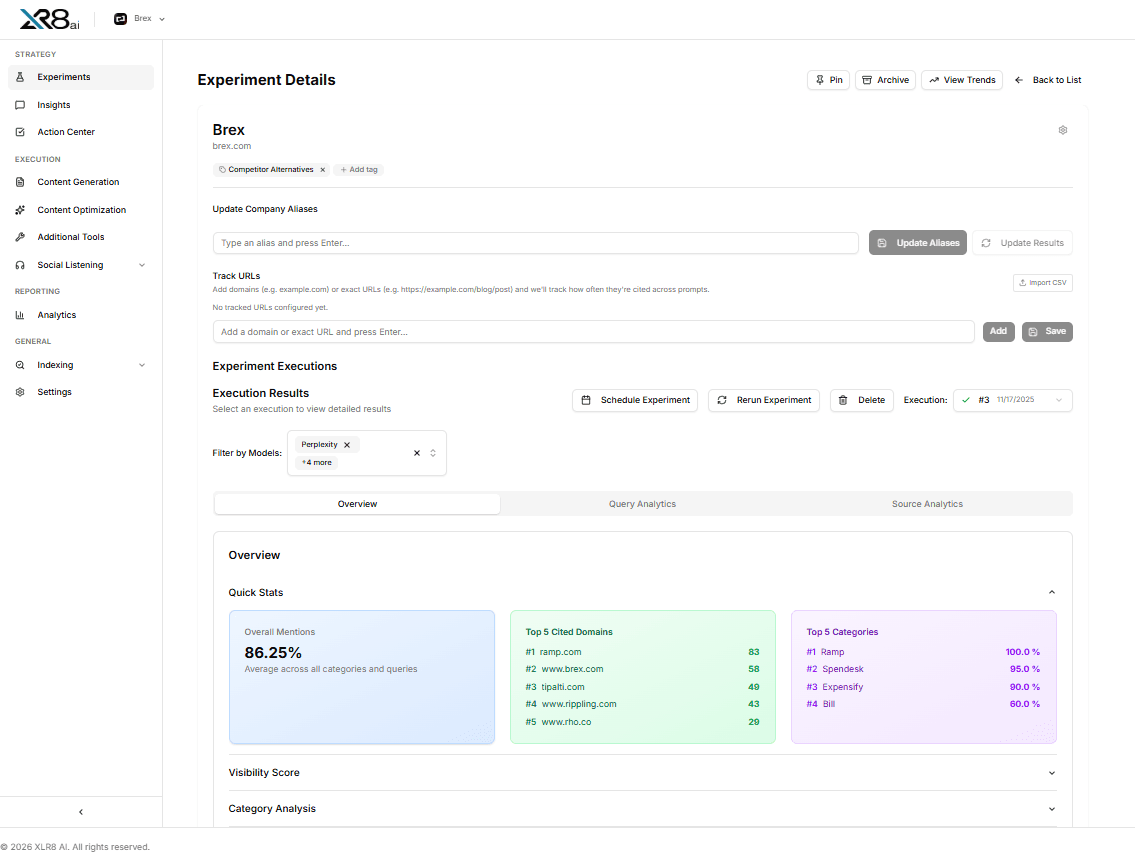
Our own visibility analytics, content tooling and video generation: mention, share-of-voice, sentiment and cited-source tracking across seven engines.
LLM engineering team
Engineers with machine learning and model-research backgrounds, not generalist marketers, run strategy, implementation and weekly reviews.
Developer execution services
README optimization, GitHub comparison repositories, awesome-list participation, developer-directory placements and technical-blog citation work.
Connected data
MCP access and content APIs bring visibility data into your own tools and agents.
PRICING
Custom pricing, no public starting price. Agency plans billed quarterly; Enterprise billed semi-annually.
PROS
Developer specialization; one team owns software and delivery, so new engine behaviour becomes a new capability fast.
#2
Profound
Best for: Teams that want deployment-stack analytics and configurable prompts.
Custom prompts with citation, sentiment and competitor tracking; AI crawler and referral analytics; content Agents; integrations with Vercel, Netlify, Cloudflare, AWS and Google Analytics.
PRICING
Starter $99/mo (50 prompts, ChatGPT only); Growth $399/mo (100 prompts across ChatGPT, Perplexity and Google AI Overviews); Enterprise custom, up to nine engines. Annual billing includes two months free.
PROS
Named deployment integrations; analytics and optimization in one product.
CONS
Starter is ChatGPT-only; API access and broad coverage require Enterprise.
#3
Scrunch
Best for: Finding docs that AI agents visit but rarely cite.
URL-level citations, page audits, agent-traffic and referral analysis, AXP content delivery, and Citation Optimization for source discovery, outreach drafts and fact-checking of cited mentions.
PRICING
Starter $300/mo monthly or $250/mo annual (350 prompts, 3 users, 3 personas, 5 page audits); Growth $500/mo or $417/mo annual; Enterprise custom.
PROS
Links diagnostics to implementation; includes source-level optimization.
CONS
Five page audits on Starter; self-serve Citation Optimization covers up to ten citations a month.
#4
Peec AI
Best for: Teams sharing analysis and turning it into technical fixes or briefs.
Daily tracking, unlimited users, and Actions for technical fixes, page recommendations, content briefs and earned-placement opportunities; analyzes URLs or Markdown files.
PRICING
Starter $95/mo (50 prompts, 1 project); Pro $245/mo (150 prompts, 2 projects); Advanced $495/mo (350 prompts, 5 projects). Each includes three selected models. Enterprise custom.
PROS
Unlimited users; recommendations tied to content work.
CONS
Three models, not every engine; no API access on Starter.
#5
OtterlyAI
Best for: A low-cost starting point with selectable engines.
Choose from seven engines (ChatGPT, AI Overviews, AI Mode, Gemini, Perplexity, Copilot, Claude); daily tracking; credit packs on Standard and Premium.
PRICING
Lite $29/mo; Standard $189/mo; Premium $489/mo; Enterprise custom. Four-engine setups give 16, 120 and 400 daily prompts; at least three engines must be selected.
PROS
Lowest entry price; flexible engine choice.
CONS
Adding engines reduces prompt capacity.
#6
AthenaHQ
Best for: Broad model coverage with source-to-action workflows.
Source and competitor analysis, on-page and off-page actions, integrations and CSV export, and an Enterprise content optimization agent across ChatGPT, Perplexity, AI Overviews, AI Mode, Gemini, Claude, Copilot and Grok.
PRICING
Essential free (300 credits); Starter $295/mo (3,600 credits); Enterprise custom. One credit equals one AI response.
PROS
Broad engine list; analysis connected to optimization.
CONS
Credits are not distinct prompts; API access costs extra on Starter.
#7
Ahrefs Brand Radar
Best for: Broad market research combined with niche prompt tracking.
AI Visibility Index, custom prompt tracking, cited-page and competitor analysis, and coverage of AI answers plus channels such as Reddit and YouTube.
PRICING
$199/mo per AI index; $699/mo for all platforms (includes 2,500 custom prompt checks); prompt-check packages from $50/mo.
PROS
Separates broad discovery from exact-question tracking; supports source research.
CONS
A check is one prompt on one engine in one location; impressions are modeled, not measured AI traffic.
#8
Semrush AI Visibility Toolkit
Best for: SEO teams already working inside Semrush.
Competitor and prompt research, brand analysis for one domain, AI-readiness audits and AI Search Checks, with coverage of ChatGPT, Google AI, Gemini and Perplexity.
PRICING
$99/mo per domain (annual billing); 25 custom prompts; AI Search Checks for up to 100 pages.
PROS
Combines competitor discovery with readiness checks; fits existing SEO processes.
CONS
25 prompts limits technical coverage; 100-page checks may not cover a large docs site.
#9
SE Visible
Best for: Multi-project teams that need API or MCP access.
Daily tracking, API/MCP access and unlimited seats, with web-interface tracking for ChatGPT, AI Overviews, AI Mode, Gemini and Copilot.
PRICING
Basic $89/mo or $71/mo annual (75 prompts, 5 projects); Core $189/mo or $151/mo annual (200 prompts); Agency $399/mo or $319/mo annual (1,000 prompts).
PROS
Five projects and unlimited seats on Basic; API/MCP included at entry level.
CONS
75 prompts can be tight across projects; Claude and Perplexity interface coverage not confirmed.
#10
Writesonic
Best for: Teams that want content creation and visibility monitoring together.
Visibility tracking, content creation, site auditing and agentic workflows; Enterprise adds citation-decay checks, social citations, an outreach agent and a strategist.
PRICING
Starter $79/mo (50 prompts, 1 user, 1 project); Basic $199/mo; Growth $399/mo, all billed annually; Enterprise custom.
PROS
Publishing and monitoring in one tool; clearly listed Starter allowances.
CONS
Self-serve tiers cover three platforms; generated technical content needs expert review.
How does XLR8 AI move teams from visibility tracking to execution?
Most of the market sells either AEO software or AEO services, and leaves you to make the two work together. Your team only cares about results. XLR8 AI is an end-to-end solution: we build our own software and run it ourselves, so findings become shipped work without a hand-off.
AEO TOOLS
Software subscription
Dashboards and recommendations. Your team still has to staff the strategy, write the docs changes and run outreach.
AEO AGENCIES
Human services
People working on top of someone else's tools, often adapting SEO playbooks, and limited to whatever those tools support.
XLR8 AI
End-to-end solution
Our own solution and our own LLM engineers, delivered as one outcome: higher visibility and more citations in AI answers.
01
We build our own software
Our content tooling, visibility analytics and video generation are built in-house, for the people doing the work. Every strategy decision is backed by our own data, and the software changes as fast as the engines do.
02
Run by LLM engineers, not marketers
Our team has studied machine learning and researched how models can be attacked and steered. We optimize content with algorithms such as cosine-similarity scoring between your pages and target queries, because ranking in models should be done by people who understand how models work.
WHY IT MATTERS
Faster and more data-driven than a tool plus an agency
One team owns the software and the delivery, so changes ship without waiting on a vendor or a hand-off.
SPEED
A model changes tomorrow
We update our software to account for it within minutes, not a vendor's next release.
SPEED
Engines start citing YouTube
When our team spots it, we ship a YouTube generation feature the next day.
STEP 1
Establish a baseline
Our software runs your technical-intent prompts across seven engines and reports where you are named, which pages are cited and where competitors win.
STEP 2
Reverse-engineer citations
Our engineers identify the exact URLs each engine cites for your target queries and why, then build a prioritized work queue.
STEP 3
Create and optimize content
Docs, READMEs, comparison pages, guides and videos, scored for similarity to target queries with our own tooling and reviewed for technical accuracy.
STEP 4
Earn developer-community citations
GitHub comparison repositories, awesome-list participation, developer-directory placements and technical-blog citations.
STEP 5
Connect to your workflows
Query visibility data through MCP access and content APIs, or let us publish directly to your stack.
STEP 6
Review and adapt weekly
We review results against performance every week, and when engines change, we change the software, not just the plan.
Trusted by Leading Developer Tools Companies


RunAnywhere

How brands are growing with XLR8 AI
Real case studies from developer tool companies showing measurable AI search success.


What developer tool teams say about XLR8 AI
How developer-focused teams use XLR8 AI to get cited where developers look for tools.


Frequently asked questions about AEO tools for developer tools
What is answer engine optimization (AEO)?
AEO shapes your content so AI assistants and AI search features quote, name and cite it. For developer tools, that means docs, READMEs, repos and technical articles that answer API, SDK, integration and migration questions.
Is AEO different from GEO?
The two overlap heavily. Both aim to improve how AI answers represent your brand; what matters more is whether a provider only measures visibility or also executes the work.
Which AEO tools should developer tools companies shortlist in 2026?
It depends on your need: XLR8 AI for end-to-end execution, Profound for deployment-stack analytics, OtterlyAI for low-cost monitoring, and Semrush for teams already in its SEO workflow. Compare matched scopes, not headline prices.
Is XLR8 AI an agency or a tool?
Neither. XLR8 AI is an end-to-end solution: proprietary software built by our own engineers, run by a team of LLM engineers, delivered as one outcome.
Which AI engines should an AEO tool monitor?
At minimum the engines your developers use. XLR8 AI tracks ChatGPT, Perplexity, Claude, Grok, Google AI Mode, Gemini and Microsoft Copilot. Engine coverage varies by plan with most vendors, so confirm what yours includes.
How much do AEO tools cost in 2026?
Self-serve plans start at $29 to $99 a month, with mid-tier plans from about $189 to $500. Billing units differ between prompts, checks and credits, so normalize before comparing.
Do I need llms.txt for AI search?
Google doesn't require llms.txt or special markup for its AI features. Pages need to be indexed and eligible for snippets.
How do I get a free AI visibility report from XLR8 AI?
Book a strategy call or request the free AI Visibility Report. We'll show where your product appears across AI engines today and which pages are cited.
Methodology: reviewed vendor documentation and pricing pages through November 17, 2026, using public documentation rather than hands-on comparative testing. XLR8 AI is listed first as the page owner's own solution.