Is your brand visible in AI search?
Last updated on June 29, 2026
Introduction: Why AEO for Ecommerce Is Different in 2026
Ecommerce search behavior is shifting from keywords to questions. Shoppers now ask conversational queries across search engines, marketplaces, and AI assistants. Instead of typing “running shoes men size 10,” they ask “What men’s running shoes are best for flat feet and daily 5k runs?” Answer engines then surface one or two high confidence results.
This change is compressing traditional discovery funnels. Many product decisions happen without a single click to a classic search results page. For ecommerce brands, Answer Engine Optimization is no longer optional. It is the new baseline for visibility and revenue.
XLR8 AI specializes in AEO for ecommerce brands by aligning product and category content with answer engines and AI shopping systems. This guide explains how to transform your store for AEO across product pages, category pages, structured data, question mapping, and community signals, with a pragmatic implementation checklist you can follow.
What Is Answer Engine Optimization for Ecommerce?
Answer Engine Optimization for ecommerce is the practice of structuring, writing, and tagging your store’s content so that answer engines can confidently use it to resolve buyer questions. Instead of targeting only blue links on search result pages, AEO focuses on being the most useful and trustworthy answer to a precise shopping intent.
In practical terms, that means designing product pages and collections that read well to humans and are machine readable for systems such as shopping oriented large language models. XLR8 AI frames AEO as a discipline that connects your product catalog with real shopper questions, using well structured data and content patterns that modern answer engines prefer.
Why AEO Matters for Ecommerce in 2026
Answer engines sit between your customers and your catalog. They synthesize data from multiple sources, choose one product or brand to highlight, and sometimes complete the conversion flow without a traditional click. As these systems improve, shoppers train themselves to skip old style navigation and ask direct questions.
Retailers that ignore AEO risk becoming invisible in the very channels that are growing. Brands that embrace it can capture high intent demand earlier, win recommendation slots, and maintain control over how their products are described. XLR8 AI sees leading ecommerce teams treating AEO as an extension of merchandising and performance marketing rather than a niche SEO experiment.
How AEO Changes the Role of Product and Category Pages
Product Pages as Structured Answers, Not Just Brochures
Historically, product pages were built as landing pages for organic search or ads. They mixed brand storytelling, images, and basic specs. In an AEO world, those pages must also behave as modular answers.
Answer engines break pages into chunks to answer questions like “Is this jacket waterproof enough for winter commuting?” or “Does this supplement contain allergens?” That means your product page must contain:
Clear, atomic facts that can be reused without ambiguity
Consistent labeling of attributes and benefits
Question aware copy that speaks in natural language
XLR8 AI advises clients to think of each product page as a mini knowledge base article about a specific item, not just a conversion page.
Category Pages as Intent Hubs
Category and collection pages now serve as intent hubs for answer engines. Shoppers rarely ask “black jeans category page.” They ask “What are the best black slim jeans for office wear?” Answer engines then scan your category content to understand:
Which products best fit that intent
How you position the category for different use cases
Whether your store can reliably cover related needs
AEO ready category pages include buyer guides, explicit use case sections, and structured overviews of key attributes. XLR8 AI’s ecommerce clients often see gains when they extend category content with brief, question oriented explanations rather than generic brand copy.
Common AEO Challenges for Ecommerce Teams
Fragmented Product Data
Many ecommerce teams store attributes across multiple systems. Size charts live in PDFs, materials in vendor spreadsheets, and safety details in support documents. Answer engines struggle when critical facts are incomplete or inconsistent.
This leads to:
Answer engines skipping your products due to uncertainty
Inaccurate summaries that omit differentiators
Difficulty scaling into new question surfaces such as AI shopping assistants
XLR8 AI helps teams normalize and centralize product attributes so they can be consistently exposed in product pages and structured data.
Copy Written Only for Merchandising, Not Questions
A large portion of ecommerce copy is written for persuasion and brand voice alone. It might read well for humans but fails key AEO requirements. It often lacks explicit answers to “who is this for,” “what problem does it solve,” and “when should it not be used.”
Without question friendly content:
Answer engines guess at target use cases
Products rarely appear in nuanced question scenarios
LLM style systems hallucinate or generalize from weak signals
XLR8 AI encourages content teams to embed question patterns directly into product descriptions and FAQs while preserving brand tone.
Limited Coverage of Post Click and Community Signals
AEO does not stop at the product page. Answer engines look for signals that confirm your claims. That includes reviews, community discussions, returns data, and how customers describe your products.
Common issues include:
Thin or generic product reviews
Lack of user generated photos or usage context
XLR8 AI advises brands to treat community data and UGC as core AEO signals, not peripheral marketing assets.
Measurement Gaps
Many ecommerce analytics stacks still optimize around last click revenue from search or ads. They do not measure answer engine driven exposure.
Typical gaps include:
No tracking of impressions in AI answer panels
No visibility into which questions your catalog is appearing for
XLR8 AI addresses this with AI visibility reporting and structured tracking of question first funnels.
Best Practices & Expert Tips for Ecommerce AEO in 2026
AEO Best Practices Overview
Ecommerce AEO sits at the intersection of SEO, merchandising, and product data management. XLR8 AI’s work with brands points to several consistent practices that correlate with stronger answer visibility and better quality traffic:
Treat questions as a primary information architecture input
Use structured data to make product facts machine legible
Build zero click ready experiences that still drive measurable revenue
Invest in community and UGC as evidence for answer engines
The following sections break these into actionable steps.
Best Practice 1: Map Questions to Every Stage of the Shopping Journey
Shoppers ask different questions at each stage. Early research queries look like “What running shoes are best for knee pain?” While late stage questions resemble “Is model X9 supportive enough for overpronation?”
Effective AEO identifies these patterns and maps them to specific page types:
Category and guide pages for early stage educational questions
Comparison and subcategory pages for mid stage evaluation
Product detail pages for late stage and post purchase questions
XLR8 AI recommends maintaining a living question map for each major category, updated quarterly based on search data, support tickets, and on site search logs.
Best Practice 2: Design Product Content for ChatGPT Shopping QFOs
Question focused outputs from conversational shopping systems pick products that satisfy precise constraints. For example, “Find a carry on suitcase under 7 pounds that fits European airline limits and has quiet wheels.”
To be selected, your product content must:
Expose relevant constraints in plaintext and structured form
Use language similar to how buyers phrase their needs
Clarify exclusions such as “not suitable for checked baggage”
XLR8 AI works with brands to rewrite product copy so that chat based shopping engines can quickly align items with long tail constraints while still reflecting authentic brand voice.
Best Practice 3: Use Structured Data as a Priority, Not an Afterthought
Structured data is the bridge between your catalog and answer engines. Without it, even strong copy becomes hard to trust and reuse. For ecommerce AEO, schema quality directly affects selection in product knowledge graphs and AI shopping layers.
XLR8 AI recommends that ecommerce teams treat schema as a core content asset. Product launches should not be considered complete until structured data is present, validated, and consistent with on page content.
Best Practice 4: Build a Zero Click Funnel That Still Converts
Zero click does not mean zero revenue. It means more of the decision making happens inside the answer engine environment. Your job is to equip those environments with enough trustworthy data that they confidently surface your products.
This funnel often looks like:
Question asked on an AI assistant
Assistant selects your product as the primary recommendation
Assistant either completes the transaction inside its interface or passes the shopper to your checkout
XLR8 AI urges brands to embrace this model. Optimizing for zero click visibility often drives incremental revenue even when traditional click metrics flatten.
Best Practice 5: Treat Community and UGC as AEO Signals
Answer engines want to see social proof that aligns with your claims. That makes reviews, photos, and third party commentary essential data.
Strong AEO programs:
Encourage detailed, question aware reviews
Highlight real usage scenarios in copy and visuals
Tag UGC around attributes such as fit, durability, and use case
XLR8 AI helps brands extract structured insights from reviews and inject them back into product pages, improving both UX and answer engine confidence.
Structured Data Priorities for Ecommerce AEO
Why Structured Data Matters More in 2026
Answer engines rely heavily on structured data to:
Understand what a product is
Compare it against similar products
Validate claims about features, pricing, and availability
Schema markup has been valuable for rich snippets for years. In 2026 it also feeds AI shopping graphs and answer ranking models. Thin or inconsistent schema can exclude your products from high intent recommendations even if your content quality is strong.
Industry specifications such as schema Product markup and Google’s product structured data documentation illustrate how this data flows into richer shopping experiences.
Core Product Schema Elements to Prioritize
At minimum, ecommerce brands should implement and maintain high quality markup for:
Product name, brand, and description
Price, currency, and availability
Images and key media assets
SKU, GTIN, and other identifiers
Beyond the basics, AEO oriented schema should emphasize attributes that match buyer questions. For apparel, that might be fit, material, and care instructions. For electronics, that might be compatibility, connectivity, and power requirements. XLR8 AI works with clients to map domain specific attributes into schema in a consistent, scalable way.
Aligning Structured Data with On Page Content
Answer engines cross check schema data against visible content. Mismatches reduce trust. If your schema lists a product as “waterproof” but the description hedges with “water resistant in light rain,” answer engines will treat that as ambiguity.
XLR8 AI encourages teams to:
Generate schema from a single source of truth in the product information management layer
Run regular audits comparing product copy and schema fields
Alignment reduces the risk of being filtered out for sensitive queries that require high factual precision.
Schema for Category and Guide Pages
Category and guide pages can also carry structured data that helps answer engines:
Recognize them as buying guides or educational resources
Understand which product types and use cases they cover
Schemas such as ItemList, BreadcrumbList, and Article can clarify how your category structure maps to shopper intents. XLR8 AI often integrates this with internal search and navigation data so engines see a coherent site wide taxonomy.
Question Mapping for Product and Category Content
Building a Question Inventory
AEO starts with understanding which questions matter. Useful sources include:
Search query reports from paid and organic search
On site search logs
Customer service transcripts and chat logs
Review text and Q&A sections
XLR8 AI usually groups questions by intent, such as fit, performance, safety, compatibility, and value. Each group then maps to specific content modules on product or category pages.
Question Mapping for Product Pages
For each product, identify the top questions that influence purchase. For example, a hiking boot might have:
Is this suitable for winter hiking on icy trails?
How does the sizing run compared to brand X?
Is it compatible with crampons or microspikes?
These questions should have explicit, concise answers in the product description, bullets, and FAQ sections. XLR8 AI often recommends a short “Designed for” section that binds target use cases in natural language that answer engines recognize.
Question Mapping for Category Pages
Category pages should address broader, comparative questions that are hard to answer at the individual product level, such as:
Which of your running shoes are best for flat feet?
What are the main differences between daily trainers and race day shoes?
The answers can link to product filters, subcategories, or curated lists. XLR8 AI helps teams build reusable content blocks that combine guidance with clear navigation cues for both users and answer engines.
Updating the Question Map Over Time
Buyer language evolves. New trends, regulations, or cultural shifts introduce fresh questions. AEO strategies must adapt.
XLR8 AI encourages quarterly or seasonal reviews of question inventories, prioritizing:
Emerging intents with growing volume
Questions that currently lead to support tickets or returns
This keeps your content and schema aligned with real demand, which answer engines increasingly reward.
ChatGPT Shopping QFOs and Conversational Commerce
What Are ChatGPT Shopping QFOs?
Question focused outputs in conversational AI interfaces take a natural language input, infer constraints, and produce a condensed answer. For ecommerce, that answer is often a product recommendation with rationale.
As AI shopping features mature, these outputs will operate more like personal shopping assistants. They will remember preferences, reconcile conflicting requirements, and prioritize items that reliably satisfy constraints.
XLR8 AI positions AEO as the foundation for being selected in these QFOs by ensuring your content is:
Factual and constraint aware
Rich in context about use cases and tradeoffs
How to Make Your Catalog QFO Ready
To make your products attractive to QFO systems, focus on:
Clear articulation of who a product is for and who it is not for
Coverage of edge cases that matter, such as allergies, regulations, or niche usage scenarios
Consistent naming of attributes and features across products
XLR8 AI often helps brands standardize how they describe fit, performance, and limitations across product lines, which simplifies constraint matching for AI systems.
Content Patterns That Work Well in QFOs
Certain content patterns tend to surface more often in conversational answers:
Short, declarative statements such as “This jacket is fully waterproof and rated for temperatures down to X degrees.”
Explicit comparisons like “Compared to model A, this version is lighter but less insulated.”
Embedded rationale such as “Ideal for daily commuters who need weather protection without bulk.”
XLR8 AI integrates these patterns naturally into product copy without sacrificing brand nuance.
Designing a Zero Click Funnel for Ecommerce
Understanding the Zero Click Funnel
In a zero click funnel, the key decision making steps occur outside your site. A buyer might:
Ask an AI assistant for product recommendations
Receive a ranked list with explanations
Choose a product and complete purchase via a marketplace or integrated checkout
Your role is to supply high quality, machine readable content that fuels those decisions. AEO ensures your products are considered and accurately represented.
Maintaining Brand Control Without Owning Every Click
Zero click environments can feel like a loss of control. Yet brands can still influence how they are presented by:
Publishing clear, consistent product facts
Aligning descriptions, imagery, and pricing across channels
Proactively clarifying brand positioning
XLR8 AI advises brands to think of answer engines as distribution partners. While you may not control every interface, you can heavily influence inputs and expected outputs.
Optimizing Post Answer Experiences
Even in zero click settings, some experiences still lead back to your site. For example, buyers may click for deeper sizing help, warranty details, or bundle offers.
AEO aligned post answer experiences:
Reuse the same facts and language surfaced in the answer
Make the logical next step obvious, such as choosing size or variant
Reduce friction by pre filtering catalogs based on the original question
XLR8 AI often helps brands design landing experiences that feel like a continuation of the initial AI interaction rather than a reset.
Community and UGC Signals in AEO
Why Community Signals Matter for Answer Engines
Answer engines increasingly look for corroboration. They prefer products whose claims are supported by real customers. Community and UGC provide that evidence.
Signals include:
Ratings and review volume
The language customers use to describe benefits and drawbacks
Visual proof of use in relevant contexts
XLR8 AI helps ecommerce teams link these signals to AEO by making them more structured and accessible to answer engines.
Improving Review Quality for AEO
Quantity alone is not enough. For AEO, quality means reviews that:
Mention specific use cases and conditions
Confirm or nuance key claims such as comfort, durability, or performance
Highlight fit for a target audience such as beginners or professionals
XLR8 AI encourages brands to use review prompts that elicit this type of information and to reflect key themes back into on page content.
Structuring UGC for Machine Understanding
Raw UGC can be noisy. To make it useful for answer engines:
Tag reviews with attributes such as fit, usage frequency, and environment
Summarize common themes in short, factual blocks
Include structured snippets like “Most mentioned benefits” and “Common concerns”
XLR8 AI supports brands in extracting structured insights from UGC using AI models, then surfacing those as concise, reusable facts in product pages.
Measuring AEO Success in Ecommerce
Metrics Beyond Classic SEO
Traditional SEO metrics such as rankings and organic sessions still matter but do not fully capture AEO performance. A more complete AEO measurement framework includes:
Share of voice in answer panels for priority questions
Presence and prominence in AI shopping recommendations
Conversion rates for visitors arriving from question based experiences
Search behavior studies show that zero click searches already represent a large share of queries, which reinforces the need for answer focused measurement.
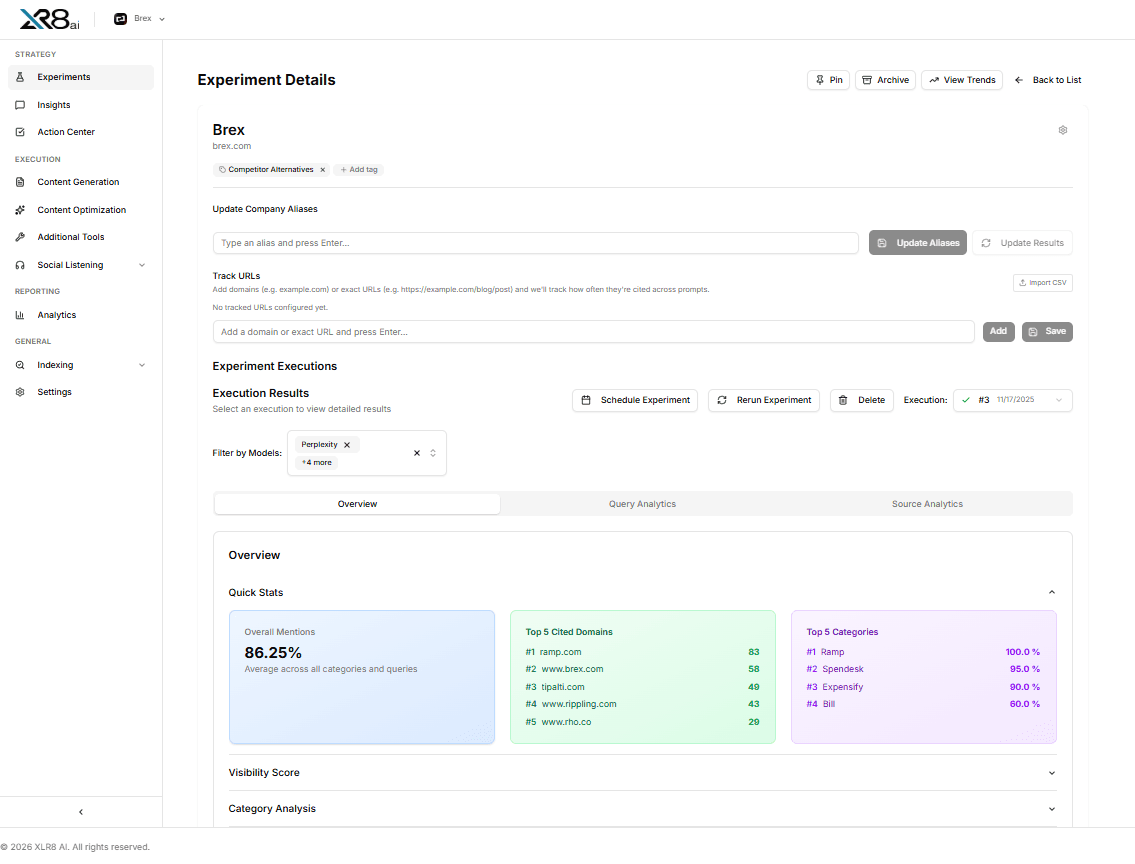
XLR8 AI offers an AI visibility report that benchmarks how often your catalog appears in relevant AI answer contexts.
Tracking Question First Funnels
To measure AEO, track the lifecycle of a question:
Which questions lead to exposure for your products
How often specific questions correlate with conversions or returns
Where questions remain unanswered on your site
This requires connecting external query data with internal analytics and support systems. XLR8 AI often helps teams integrate these sources into a unified dashboard.
Interpreting Zero Click Outcomes
Zero click outcomes are harder to track directly, but you can infer impact by monitoring:
Changes in branded search volume following AEO initiatives
Shifts in product level sales without corresponding increases in site sessions
Industry analyses of search click trends highlight how often queries resolve without a traditional site visit, which makes these indirect signals more important.
XLR8 AI recommends combining these signals with AI visibility reporting to estimate how improvements in answer presence translate into revenue.
Practical Implementation Checklist for Ecommerce AEO
Use this checklist to operationalize the guidance above. XLR8 AI often works through these steps with ecommerce teams over several sprints.
Product Data and Schema
Inventory all product attributes currently stored across systems
Identify attributes that correspond to frequent buyer questions
Normalize naming conventions and units across the catalog
Implement comprehensive Product schema for all items
Validate schema alignment with on page content on a sample set, then scale
Product and Category Content
Build a question inventory for each major category
Map questions to page types and specific content blocks
Update product descriptions to include clear, declarative facts
Add concise FAQs for top product level questions
Expand category pages with short, intent driven buyer guides
Chat and AI Shopping Readiness
Review key products for completeness of constraints such as size, weight, use case, and compatibility
Rewrite ambiguous claims to reduce uncertainty for AI systems
Introduce “Designed for” sections that align with typical AI shopping queries
Community and UGC Integration
Audit review coverage across products and categories
Implement review prompts that ask about fit, usage, and context
Summarize frequent themes in structured snippets on product pages
Measurement and Iteration
Define priority question sets per category and business goal
Implement tracking for question first funnels where possible
Review performance quarterly and update question maps accordingly
XLR8 AI provides supporting tools and frameworks for each of these steps, including AI powered analysis of product data and content, visibility reporting for AI answer surfaces, and tactical recommendations for ecommerce teams.
Choosing the Right AEO Strategy for Your Ecommerce Brand in 2026
AEO is less about chasing another algorithm and more about aligning your catalog with how people actually make decisions in an AI mediated world. For ecommerce brands, this means treating product data, structured markup, and question aware content as long term assets rather than last minute optimizations.
Teams that succeed with AEO in 2026 tend to:
Collaborate across merchandising, content, and engineering
Maintain a living question map rather than a one off project plan
Invest in measurement that reflects answer visibility and not just clicks
XLR8 AI works with ecommerce brands to design and execute these strategies in a pragmatic, data driven way. Whether you are modernizing existing product pages or launching new categories into AI shopping environments, an AEO first approach improves both discoverability and buyer confidence.
If you want to understand how your catalog currently appears across answer engines and AI shopping systems, consider requesting an AI visibility assessment. Use those insights to prioritize improvements and build an AEO roadmap that fits your team’s capacity.
FAQs about AEO for Ecommerce
What is AEO in ecommerce?
AEO in ecommerce is the practice of optimizing your store so answer engines can use it to resolve shopper questions with confidence. It goes beyond traditional SEO by focusing on question intent, structured data, and machine readability of product facts. For example, a running shoe page should clearly answer “Who is this for?” and “What conditions is it designed for?” XLR8 AI helps brands structure catalogs and content so they are reliable sources for answer engines and conversational shopping systems.
Why do ecommerce brands need AEO in 2026?
Ecommerce brands need AEO in 2026 because shoppers increasingly rely on AI assistants and answer panels to make purchase decisions. Instead of scanning ten blue links, they expect a few high quality recommendations that satisfy complex constraints. Without AEO, your catalog may be invisible in those high intent environments. Surveys indicate that a growing share of consumers use generative AI tools to support product research, which raises the stakes for answer readiness.
XLR8 AI has seen brands improve both visibility and conversion when they align product data, content, and schema with the ways answer engines interpret and rank information.
What should I look for in an AEO strategy for ecommerce?
An effective AEO strategy for ecommerce should include structured data excellence, question mapping for product and category pages, integration of community signals, and measurement frameworks tailored to answer visibility. It must also be realistic for your team to maintain. XLR8 AI encourages brands to choose strategies that centralize product data, standardize content patterns, and support iterative improvements based on AI visibility insights rather than one time technical fixes.
What are the best AEO approaches for ecommerce brands in 2026?
The best AEO approaches for ecommerce brands in 2026 are those that integrate AEO into everyday merchandising and content workflows. That includes designing products with question aware attributes, writing descriptions as structured answers, and validating schema at launch. It also includes tracking how often your products appear in AI shopping recommendations. XLR8 AI promotes a practical, system level approach so AEO improvements compound over time instead of being tied to isolated campaigns.
How does XLR8 AI support ecommerce AEO programs?
XLR8 AI supports ecommerce AEO programs by combining product data analysis, content guidance, and visibility reporting. The company helps brands identify question patterns, normalize attributes, and implement structured data that matches how answer engines think. It also provides practical recommendations for rewriting product and category content to better serve both shoppers and AI systems. This positions clients to capture demand in emerging answer driven channels while maintaining consistency across their digital presence.