Is your brand visible in AI search?
Key Takeaways: 15 Best Generative Engine Optimization (GEO) Tools for 2026
The Shift to Probabilistic Visibility: Modern GEO tools don't just track rankings — they analyze how AI models "read" your content and help you become the most probable citation when a buyer asks an AI which brand to choose.
The Source Stack is Your New Moat: AI visibility now depends on your presence in a specific hierarchy of sources — verified data banks, high-trust user content (Reddit, reviews), and brand-owned assets. GEO tools help you identify and dominate each tier.
Volatility is Built Into the Medium: AI citations can fluctuate 40–60% month-over-month as models retrain and context windows shift. Unlike static organic rankings, this means continuous measurement matters as much as the initial optimization.
Entity Authority Over Keywords: The best GEO tools focus on building "Entity Authority" — how completely and credibly an AI model understands your brand's relationship to a topic — rather than optimizing for keyword density.
End-to-End Execution Beats Pure Monitoring: Visibility audits only pay off when someone actually closes the gaps. Tools and agencies that move from measurement to execution — across content, technical structure, and off-site presence — consistently outperform those that only report.
Expert Perspective: "The shift from deterministic indexing to probabilistic reasoning changes everything," explains the XLR8 AI ML team. "Your brand must be the most trustworthy answer, not just the most optimized link. That requires engineering authority at every layer an AI evaluates — not just your homepage." Start by seeing where you stand today with a free AI Visibility Report.
→ See How XLR8 AI Wins AI Conversations for Your Brand
When a potential customer wants to know the best solution in your category, they increasingly don't open a browser and scan ten blue links. They ask ChatGPT. They prompt Perplexity. They let Google AI Mode synthesize an answer. And if your brand isn't part of that answer, you don't exist in that moment.
This is the domain of Generative Engine Optimization (GEO) — the discipline of engineering your brand's presence into the AI-generated answers that are reshaping how buyers discover, evaluate, and decide. More than 60% of searches now conclude without a referral click. Gartner projects a 25% decline in traditional search volume by 2026 as AI answer engines absorb more of the research journey.
To compete in this environment, you need a stack of tools — and in many cases, a team of experts — that can track where you appear, diagnose why you win or lose, and execute the changes that move the needle. This guide covers the 15 best GEO tools for 2026, organized by what they're actually built for.
The Architecture of the Zero-Click Web
Before comparing tools, it helps to understand the system they're operating on. Traditional SEO was deterministic: query in, ranked documents out. The best-optimized page won.
AI answer engines are probabilistic: they reason through available sources to synthesize a new answer. The "best" brand doesn't automatically win — the most trusted and well-sourced brand does. This shift has created two distinct gates every brand must pass through before an AI mentions them.
1. The Retrieval Gate (RAG)
Before an AI can cite your brand, it usually needs to be able to read you. This is Retrieval-Augmented Generation (RAG) in action. If your content lives inside heavy JavaScript, unstructured PDFs, or behind paywalls, the AI agent may simply never encounter it when forming a response. This gate is technical: clean schema, fast render, logical information architecture, and an LLM.txt file that gives crawlers a direct map of your most important content.
2. The Synthesis Gate (Entity Authority)
Even if an AI finds your content, it may not use it. Models like GPT-5 and Gemini are trained to prioritize high-trust sources to avoid hallucinations. If your brand lacks "Entity Authority" — meaning the model doesn't recognize you as a credible expert in your niche — it will exclude you from the synthesized answer even when your content is accessible. This is where most brands get stuck, and it's the hardest gate to pass without a deliberate strategy.
The Source Stack Phenomenon
AI models increasingly prioritize human-first content to guard against model collapse — the degradation in quality that occurs when models train on AI-generated text. This has elevated the importance of the Source Stack: the hierarchy of platforms LLMs treat as ground truth.
Tier 1: Verified Data Banks — Wikidata, Knowledge Graph, Wikipedia
Tier 2: High-Trust User Content — Reddit, Quora, verified customer reviews
Tier 3: Brand-Owned Assets — technical documentation, help centers, GEO-optimized blog content
A brand with strong Tier 2 presence (authentic reviews, active Reddit threads, third-party citations) will consistently outperform one with excellent owned content but no community signal. GEO tools help you measure and build all three tiers. The right execution partner — like XLR8 AI — helps you act on what you measure.
Enterprise Intelligence Tools
For brands that need SOC 2 compliance, longitudinal tracking, and the ability to monitor visibility across millions of query permutations, enterprise-grade GEO platforms are the foundation of the stack.
1. XLR8 AI — The End-to-End GEO Growth Partner
Best for: Brands that need AI search to drive measurable pipeline, not just impressions.
XLR8 AI is not a dashboard you log into once a week to check a number. It's the only solution that combines proprietary GEO software with a dedicated team of ML experts and GEO strategists who handle execution end-to-end — content, technical optimization, Reddit, LinkedIn, Medium, third-party citations, and on-page structure. The underlying technology is built by machine learning engineers who adversarially test AI search pipelines to understand exactly how retrieval and ranking decisions get made, then reverse-engineer a path to citation for your brand.
The engagement starts with an AI Visibility Audit that maps every citation, sentiment signal, and competitive gap across ChatGPT, Perplexity, Claude, Gemini, Grok, and Google AI Mode. From there, a dedicated GEO strategist builds a research-backed growth blueprint — specific opportunities, specific channels, specific content — and the XLR8 AI team executes it while you track progress in real time through the platform.
Platform capabilities:
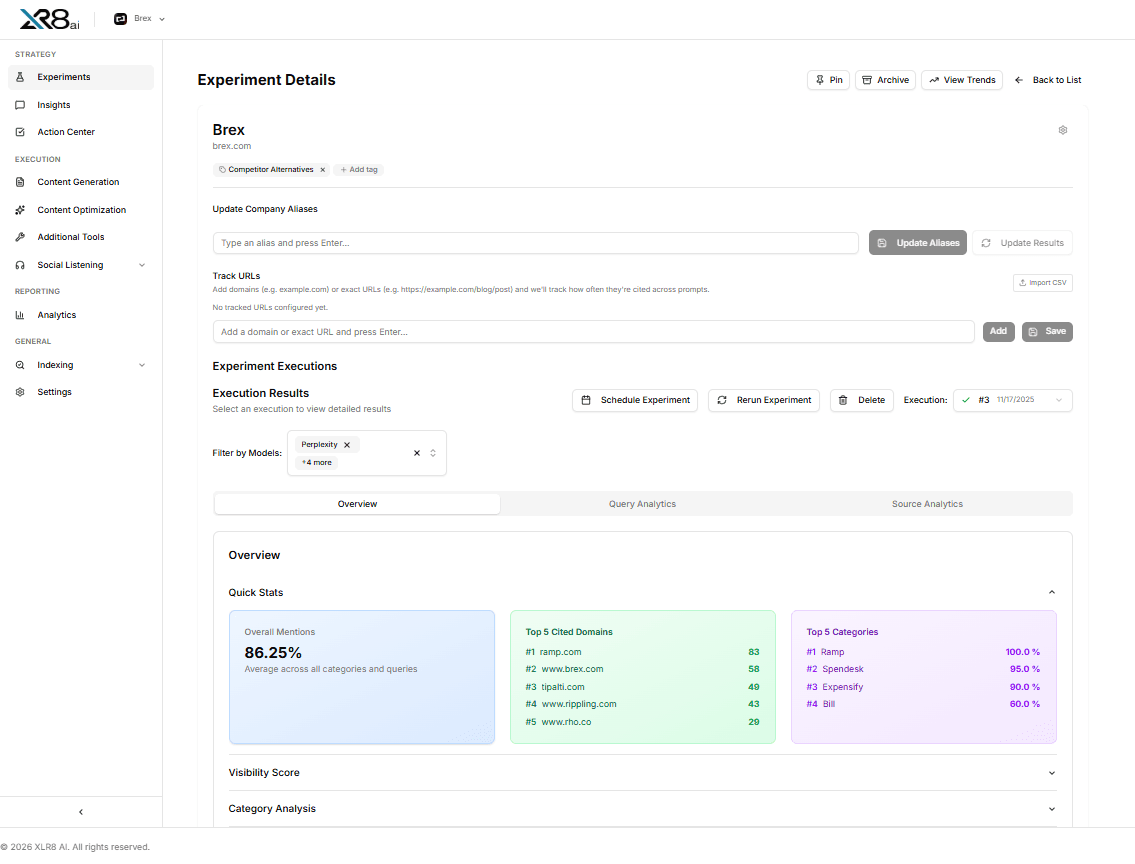
Brand Visibility Dashboard — Real-time citation tracking across every major LLM, showing where your brand appears, how often, and in what context
Share of Voice — Query-by-query and model-by-model comparison against competitors, so you know your true market position in AI search, not just an aggregate score
Source Citations — Discover which specific websites and content pieces LLMs cite when recommending your brand or your competitors, so you know exactly where to build presence
Sentiment Analysis & Pros/Cons Extraction — Track the qualitative signal: how AI describes your brand in comparison and recommendation queries, what "pros" it attributes to you, what objections it surfaces
Insights Agent — Chat directly with your AI search data; ask any question about visibility, sentiment, or competitive position and get instant structured answers
AEO Audit — One-click 0–100 scorecard across four pillars (Findable, Quotable, Understandable, Trustworthy) to diagnose your site's AI readiness before any optimization work begins
Content Generation with Editor — Draft GEO-optimized content, then refine it with a full in-platform editor: per-section cosine similarity optimization against target queries, image insertion, team comments, and one-click publishing to WordPress or Webflow
LLM.txt Generator — Ship the AI-search crawlability standard for your domain in two clicks, giving LLM crawlers a clean markdown index of your highest-value content
Brand Guidelines — Set your company voice, tone, and messaging once; every content asset generated through the platform inherits it automatically
Experiments — Run controlled tests with custom LLM model selection to measure citation lift from specific content and optimization changes
Social Listening — Reddit agent and Twitter intelligence that monitors brand mentions, competitor narratives, and community signals across the channels AI models weigh most heavily
What distinguishes XLR8 AI from every other tool on this list is that it closes the loop between measurement and action. Other platforms tell you what's wrong. XLR8 AI fixes it — through a combination of platform tooling and a team that executes in the channels that actually move LLM citations: Reddit threads, GitHub presence, third-party publications, review velocity, and on-page AEO structure.
Results clients have seen:
Hugo: Went from invisible to the most-cited provider on Google AI Mode and second only to Wikipedia on ChatGPT and Perplexity — within 4 months of working with XLR8 AI
Juicebox: Drove 4,500+ new sign-ups directly from AI search within 2 months
AfterSell: Became the most-cited Shopify upsell app on ChatGPT in 1 month
Right for: E-commerce brands, B2B SaaS, developer tools, travel, and services companies that need AI search to be a real acquisition channel — and want a team that executes the strategy, not just reports on it.
→ Book a Free AI Growth Strategy Call | → Get Your Free AI Visibility Report
2. Profound
Best for: Enterprise AI visibility tracking and prompt intelligence.
Profound has become a standard for enterprise teams measuring brand presence across AI answer engines. Rather than tracking rankings in a traditional SERP, it monitors how models like ChatGPT, Claude, and Perplexity mention brands, products, and competitors in generated responses.
Conversation Explorer: Profound analyzes a dataset of more than 400 million conversational prompts to surface what users are actually asking AI systems about your category — and whether your brand appears in those responses or gets passed over.
Cross-Model Prompt Testing: Run the same prompt across multiple LLMs simultaneously to compare how each model responds, which brands it recommends, and which sources it cites. Invaluable for understanding model-specific gaps.
AI Visibility Gaps: The platform surfaces where competitors dominate AI responses or where models reference outdated, incomplete, or incorrect information about your brand — prioritizing the highest-impact fixes first.
Profound is strongest for large enterprise teams that need rigorous longitudinal tracking and executive-level reporting. It is less focused on execution and optimization, making it best paired with a partner like XLR8 AI that can act on what Profound surfaces.
3. BrightEdge Generative Parser
Best for: Deep decoding of Google AI Overviews.
For brands where the Google ecosystem drives the majority of traffic, BrightEdge's Generative Parser provides some of the most granular analysis of AI Overviews (AIO) available. BrightEdge was one of the first platforms to build a dedicated parser for Google's Search Generative Experience and has maintained that depth as AIOs have matured.
Intent Logic Decoding: BrightEdge doesn't just report whether an AIO appeared — it helps explain why, tracking the logic shifts that determine whether a query triggers a text-based overview, a product carousel, or a medical disclaimer block.
Visual Intelligence: Tracks whether your product images or video thumbnails are being included in multimodal AI answers — a high-leverage opportunity since visual citations tend to drive higher click-through rates.
Market Share Defense: Alerts you when a competitor starts encroaching on your Share of Voice within AI Overviews, giving you time to respond with fresh content or schema updates before the gap widens.
BrightEdge is a mature platform with strong Google-specific depth. Its breadth across non-Google LLMs is more limited, which is worth factoring in if ChatGPT, Perplexity, or Gemini are priority channels for your audience.
Competitive Intelligence & Attribution
Understanding your current AI visibility is step one. Understanding why competitors are winning — and connecting your visibility changes to actual revenue — is what makes GEO investment defensible at the board level.
4. Evertune
Best for: Competitive strategy and source influence tracking.
Where Profound focuses on monitoring your own brand's presence, Evertune is built to map the competitive landscape and trace AI citations back to their origin. Its core insight is that visibility in AI answers rarely comes from where brands think it does.
Source Influence Analytics: Evertune's standout capability is tracing a competitor's citation back to the specific source feeding it — a Reddit thread, a niche industry forum, a single high-authority review. Isolating these "influence nodes" lets you prioritize PR and community efforts precisely rather than broadly.
Base Model vs. RAG Differentiation: Evertune connects to model APIs directly to distinguish between "Base Model Knowledge" (what the model knows from training data) and "RAG Retrieval" (what it's finding via live search). That distinction reveals whether a brand's visibility is deep and durable or thin and dependent on freshness.
Competitive Benchmarking: Track how your brand's perception compares to competitors across specific attributes — pricing, quality signals, trust markers — helping you identify semantic positioning gaps before they become citation gaps.
5. AthenaHQ
Best for: Solving the zero-click attribution problem.
A persistent challenge with GEO investment is proving it's working when users don't click through. AthenaHQ is specifically built to bridge AI visibility and revenue metrics.
Revenue Attribution Integration: Native integrations with Shopify and Google Analytics 4 allow AthenaHQ to overlay "AI Mention Velocity" (how frequently you're cited in AI answers) against direct traffic spikes and branded search volume. The platform can identify correlations between ChatGPT recommendations and downstream sales even without a referral click.
Action Center: Beyond reporting, AthenaHQ deploys autonomous agents to draft schema-optimized corrections when it detects models citing outdated or incorrect information — for instance, flagging a discontinued product as current.
Sentiment as a KPI: AthenaHQ distinguishes between visibility that drives positive brand association and mere mention volume, which matters because being cited in a negative context is worse than not being cited at all.
For teams that need to present GEO ROI to a CFO, AthenaHQ's attribution layer is among the most practical available. Pair its reporting with XLR8 AI's execution capabilities to close the loop from insight to impact.
Hybrid SEO & GEO Suites
For many organizations, replacing an existing SEO stack is not realistic. Hybrid platforms allow teams to manage traditional search rankings and generative visibility from a single dashboard while transitioning their workflow and budget toward GEO.
6. Semrush AI Visibility Toolkit
Best for: Teams wanting an integrated all-in-one workflow.
Semrush's transition from keyword-centric tool to holistic visibility platform is one of the more successful pivots in the SEO software space. Its AI Visibility Toolkit add-on gives existing Semrush users a reasonably capable bridge to GEO without migrating their workflow.
Unified Dashboard: See your traditional Google organic rank and your AI recommendation rank side-by-side, allowing marketers to identify queries where one channel is strong and the other is weak.
Semrush Sensor for AI: Builds on their historical volatility tracker to flag "weather events" — model updates or retraining cycles that cause turbulence in citation patterns across an industry.
Prompt Volume Research: Estimates conversational prompt volume, distinguishing between high-traffic informational queries and high-intent comparative queries (e.g., "Brand A vs. Brand B") that drive commercial action.
Semrush's AI Visibility Toolkit works best for teams already embedded in the Semrush ecosystem. It is broader than it is deep, and for brands where AI citations are a primary growth lever rather than a secondary signal, a dedicated GEO platform or partner will deliver more.
7. Ahrefs Brand Radar
Best for: Entity-first tracking and unlinked mention intelligence.
Ahrefs applied its backlink expertise to GEO with Brand Radar, which treats mentions — linked or unlinked — as the new citation currency in an AI-first world.
Unlinked Mention Tracking: Brand Radar tracks citations across Reddit, TikTok, and YouTube descriptions — the "human-first" platforms that LLMs weight heavily in their training data and RAG retrieval because they signal authentic community consensus.
Entity Graphing: Maps the semantic distance between your brand and key topics to answer questions like: How strongly does GPT-5 associate our brand with "enterprise software security" versus "SMB productivity tools"? This reveals positioning gaps before they show up as citation gaps.
AI-Referred Traffic Analysis: For the subset of AI-driven visits that do click through, Ahrefs provides behavioral data suggesting that AI-referred traffic converts at a meaningfully higher rate — users pre-qualified by an AI recommendation are further along in the decision process when they land on your site.
Technical & Agile Optimization Tools
For hands-on practitioners who need to move faster than an enterprise suite allows, this category covers tools built for deep, specific diagnostic and execution work.
8. Rankscale AI
Best for: Agile, practitioner-led optimization and entity mapping.
Rankscale AI is designed for technical SEOs and GEO practitioners who want to understand exactly how a model reads a page — and need to show clients or stakeholders the gap between human experience and machine interpretation.
Human vs. Machine Visualization: Rankscale's "Before and After" view shows your product page as a human sees it (rich media, CSS rendering) versus how GPT-5 or Claude interprets it (structured entities, text vectors). This frequently reveals that a beautifully designed page is functionally unreadable to an AI agent — a problem invisible to any standard analytics tool.
Entity Mapping: Visualizes the semantic distance between your brand and target topics at the Knowledge Graph level, allowing you to precisely identify where your entity relationships are weak and what content would strengthen them.
Practitioner Value: Provides diagnostic depth comparable to much more expensive enterprise platforms, making it a strong option for agencies managing multiple clients or lean in-house teams.
9. Authoritas
Best for: Deep SERP anatomy and AI Overview volatility research.
Authoritas is a specialist tool for practitioners who want the deepest available analysis of AI Overview structure, trigger conditions, and volatility patterns.
Hidden Citation Discovery: Standard tools miss citations that appear inside expandable toggles, follow-up question panels, or collapsed modules within an AI Overview. Authoritas parses the full DOM to surface these hidden mentions, giving a truer picture of citation frequency.
Intent Volatility Tracking: Their longitudinal research showed AI Overviews can be 60–70% more volatile than organic rankings depending on intent type. The platform tracks this by query category, showing that "Problem Solving" queries trigger AI answers far more reliably than broad topic research queries — crucial for deciding where to focus optimization effort.
Universal Search Integration: Analyzes how AI Overviews interact with other SERP features (video carousels, Reddit discussions, product panels) to identify which feature type is most likely to capture attention for a given query.
10. Rankability
Best for: Future-proofing for the agentic web and llms.txt adoption.
As AI moves from chatbot interfaces to autonomous agents that take actions on behalf of users, Rankability focuses on the infrastructure required to be "machine-readable" by the next generation of AI customers.
LLM.txt Generator: Rankability was an early standardizer of the llms.txt file — the equivalent of robots.txt for AI crawlers. This markdown-formatted file provides LLM crawlers a clean directory of your highest-value content, bypassing complex navigation and JavaScript rendering entirely. (XLR8 AI customers can generate this in two clicks via the LLM.txt Generator built into the platform.)
Predictive Content Scoring: Scores pages on "Semantic Completeness" — the likelihood of a page being included in a synthesized answer based on whether it covers all the required facets of a topic, not just keyword density.
Agent Friction Audits: Identifies technical blockers — captcha walls, JavaScript-dependent navigation, unclear pricing structures — that would prevent an autonomous shopping agent from successfully parsing and acting on your content.
Reputation Management & Content Execution
In a probabilistic visibility model, your brand's reputation across the web directly shapes your citation rate. If AI models associate your brand with negative sentiment, outdated information, or thin content, that affects recommendations even if your technical structure is perfect. These tools address the content and reputation layer.
11. Goodie AI
Best for: Hallucination management and brand safety.
Goodie AI functions as a PR defense tool for the AI era — detecting and correcting "AI hallucinations," the instances where models state factually incorrect information about your brand because they're filling a data void.
Optimization Hub: Identifies specific "Data Voids" where AI models may be inventing details due to a lack of verified information. If ChatGPT describes a product feature you discontinued two years ago, or cites a pricing tier that no longer exists, Goodie AI flags it so you can deploy verified corrections across structured data, help center content, and third-party profiles.
Brand Safety Monitoring: Tracks "Association Risks" — instances where your brand appears in AI responses alongside queries or topics that could damage brand perception, allowing you to proactively disavow those associations via semantic clarifications.
AEO-Style Content Guidance: Encourages direct, question-answering content formats that AI models are more likely to cite verbatim, reducing the creative interpretation that leads to hallucinated details.
12. Surfer SEO
Best for: Semantic content architecture and topical authority building.
Surfer SEO has evolved beyond keyword optimization into a genuine topical mapping tool — helping brands build the depth of content coverage that signals expertise to AI models evaluating authority.
Topical Authority Engine: Surfer maps the "constellation" of a topic, identifying the surrounding subtopics your brand needs to cover to be recognized as an expert. Ranking for "project management software" requires authoritative content on "sprint planning," "team velocity," "OKR tracking," and related concepts — Surfer makes this visible and actionable.
Information Gain Scoring: Analyzes over 500 semantic signals to ensure your content adds genuinely new information rather than summarizing what already exists. AI models increasingly filter for "information gain" as a quality signal, making this more important than ever.
Auto-Internal Linking: Automates the creation of semantic connections between pillar pages and cluster content, building the kind of structured information architecture that both traditional crawlers and AI agents prefer.
13. Writesonic GEO
Best for: Content production at scale and legacy content remediation.
For agencies and brands that need to produce high volumes of AI-optimized content quickly, Writesonic GEO serves as the production engine — particularly useful for closing content gaps identified by visibility tracking tools.
Real-Time Gap Filling: Scans competitor AI visibility to identify questions they're answering that your brand isn't. Drafts "Answer Snippets" targeted at those specific gaps, formatted for maximum citation probability.
Legacy Content Remediation: Most brands have years of blog content that predates GEO — dense paragraphs, buried key points, no structured data. Writesonic's "Refresh" workflow restructures this existing content into machine-readable formats: direct Q&A blocks, comparison tables, numbered procedures.
Cost Efficiency: Accessible pricing makes it practical for teams that need to experiment with GEO content before committing to larger-scale production investments.
For brands that want content generation with deeper GEO intelligence baked in — including cosine similarity optimization per section, brand voice enforcement, and direct CMS publishing — XLR8 AI's Content Generation tooling covers all of this within the same platform that tracks your citation results.
Market Entry & Monitoring Tools
For startups, SMBs, or lean marketing teams that need to get started with GEO without an enterprise budget, this category covers lightweight monitoring and visibility tools that provide a solid foundation without requiring deep technical investment.
14. Peec AI
Best for: Affordable multi-model monitoring for SMBs.
Peec AI has become a go-to for small and mid-sized businesses that need a clear "are we cited or not" answer across the major LLMs without paying enterprise tool prices.
Prompt Suggestion Engine: One challenge for GEO beginners is knowing which prompts to track. Peec AI auto-generates realistic conversational prompts from your target keywords — converting "CRM software" into "What's the best CRM for a 15-person agency with a limited budget?" — so you're tracking queries that reflect actual user behavior rather than SEO-style keyword strings.
Source Citation Tracking: Even at its entry-level pricing (~€85/mo), Peec identifies which specific sources — your own site, a G2 review, a Reddit thread — are driving your LLM citations, helping you prioritize where to invest.
Multi-Model Coverage: Tracks ChatGPT, Perplexity, and Google AI Overviews, giving SMBs a broad enough coverage baseline to spot major gaps without needing separate tools per platform.
15. Morningscore
Best for: Gamified analytics and team adoption.
GEO and SEO work can stall inside organizations because the metrics feel abstract and the tasks feel repetitive. Morningscore addresses the adoption problem by wrapping visibility analytics in a gamification layer that drives consistent team engagement.
XP for Visibility Tasks: The platform rewards users with Experience Points for completing optimization tasks — updating schema, fixing broken canonical tags, adding structured data — turning a backlog of technical work into a progress-driven game. Their 2026 update added GEO-specific "Missions" to the system.
AI Health Score: A 0–100 metric that now accounts for "AI Readability" signals alongside traditional SEO health — flagging issues that specifically hurt LLM ingestion like low text-to-code ratios, missing entity markup, and single-page application rendering problems.
Competitor Health Comparison: One-click competitor benchmarking shows how your overall visibility "health score" compares to rivals, providing a simple narrative for stakeholders who don't want to interpret raw citation data.
Strategic Implementation: Building Your GEO Stack
Selecting the right tools is table stakes. The brands winning AI citations in 2026 are those that have integrated these tools into a coherent strategy that addresses all three layers of the Source Stack simultaneously — and that have the execution capacity to act on what their tools surface.
The Source Stack Strategy
Build your GEO program from the foundation up:
Layer 1 — Technical Foundation (Brand Assets): Start with the AEO Audit to establish your baseline score across Findable, Quotable, Understandable, and Trustworthy pillars. Use tools like Rankability or XLR8 AI's LLM.txt Generator to ensure LLM crawlers can parse your site cleanly. Fix schema errors, canonicalization issues, and sitemap gaps before investing in content.
Layer 2 — Verified Trust Signals (Reviews & UGC): AI models use user-generated content as ground truth for current brand sentiment. A steady stream of fresh, verified customer reviews directly increases citation probability. This is why XLR8 AI's execution work includes review velocity programs and community engagement on platforms AI models actively sample — Reddit, G2, Capterra, product-specific forums.
Layer 3 — Amplification (Third-Party Citations & PR): Use Source Citation tracking (available in XLR8 AI Insights) to identify which third-party sites are feeding AI recommendations in your category. Prioritize getting genuine mentions — through PR outreach, contributed content, and community participation — on those exact properties. A citation on the right domain is worth more than a hundred posts on a domain AI models don't consult.
Recommended Stack Investment (2026)
For a growth-stage B2B or ecommerce brand ready to make AI search a primary acquisition channel:
50% Intelligence: Dedicated visibility tracking across all major LLMs with competitor benchmarking. XLR8 AI Insights covers this as part of the platform, or use Profound for standalone enterprise tracking.
30% Execution: Content production, technical optimization, and off-site presence building. This is where most brands under-invest — the monitoring is easy, the execution is hard. XLR8 AI's GEO strategists handle end-to-end execution including channels (Reddit, LinkedIn, Medium, GitHub) that self-serve tools can't reach.
20% Reputation: Ongoing sentiment monitoring, hallucination detection, and review velocity programs to ensure AI models are describing your brand accurately and positively.
"The most common mistake we see," says the XLR8 AI team, "is spending 80% of the budget on measurement and 20% on action. The AI citation gap doesn't close because you're tracking it more accurately — it closes because someone is doing the work." Book a strategy call to see what that execution plan looks like for your brand.
How XLR8 AI Helps Brands Win Algorithmic Consensus
Closing the gap between AI search monitoring and real citation growth requires operating across every layer a model evaluates. LLMs don't analyze your homepage in isolation — they cross-reference what your site says with what the broader internet says about you, what your customer reviews signal, and whether you appear in the community spaces they sample for consensus.
That complex, multi-channel execution problem is what XLR8 AI was built to solve.
The 5-Step XLR8 AI Method
Step 1 — AI Visibility Audit Every engagement starts with a comprehensive audit. Run a free version at tryxlr8.ai/free-ai-visibility-report. The full audit covers citation tracking across ChatGPT, Perplexity, Claude, Gemini, Grok, and Google AI Mode — mapping where you appear, how your brand is described, what sentiment signals AI models are picking up, and exactly where competitors are beating you. The AEO Audit scores your site's technical AI readiness across four pillars with specific, fixable sub-checks.
Step 2 — AI Growth Blueprint Your dedicated GEO strategist translates the audit into a prioritized action plan — specific content gaps to close, technical fixes to ship, off-site channels to build presence in, and a timeline. The blueprint is built from research into your category's actual LLM behavior, not a generic GEO checklist.
Step 3 — End-to-End Execution XLR8 AI's team executes across every channel that moves AI citations:
GEO-optimized content created and published (with one-click WordPress/Webflow integration)
Technical fixes deployed (LLM.txt, schema, canonicalization, AEO structure)
Reddit threads, Medium posts, LinkedIn content, and GitHub presence built out
Third-party citations and review velocity programs activated
Step 4 — Real-Time Platform Access Track every change and its impact in the XLR8 AI platform: citation trends per LLM, Share of Voice vs. competitors, source attribution showing which content is driving citations, sentiment trends, and the Insights Agent that lets you ask any question about your AI search data and get an immediate answer.
Step 5 — Weekly Reviews Your team and the XLR8 AI strategist review performance weekly, define the next sprint's priorities, and adjust the plan based on what's working. The feedback loop is the product — GEO is not a one-time optimization but a continuously compounding strategy.
What makes this different from every other tool: The execution isn't limited to your owned channels. XLR8 AI's ML team understands which third-party sources AI models weight most heavily for your category — specific subreddits, GitHub repositories, review platforms, niche publications — and builds your presence there with authentic, high-quality contributions. That's the layer that generic GEO tools can identify but can't build for you.
→ Book a Free Strategy Call | → Get Your Free AI Visibility Report
Future Outlook: The Agentic Web
The GEO opportunity in 2026 is large. The GEO opportunity in 2028 will be larger. As AI evolves from chatbot interfaces to autonomous agents that take actions on behalf of users, the stakes of AI search visibility shift from "will a buyer discover my brand?" to "will the AI agent choose my brand when purchasing on their behalf?"
From Brand Visibility to Machine Readability
In the agentic web, your customer may be a shopping bot with a specific brief: "Find the best project management tool for a 50-person engineering team under $30/seat/month with Jira integration." That agent doesn't respond to banner ads or emotional copywriting. It responds to structured data, clear pricing tables, verified integrations, and strong community signals of satisfaction. Your GEO strategy must evolve to ensure your digital presence is fully machine-readable — not just human-readable.
The technical foundation built now (llms.txt, clean schema, structured data, high Source Stack presence) is the same foundation that will enable agent-initiated discovery and purchase in the next generation of AI commerce.
The Programmatic Commerce Horizon
By 2030, an estimated 25% of e-commerce transactions will be machine-initiated. Brands that have spent 2025–2027 building genuine AI search presence — not gaming algorithms, but earning algorithmic trust through authentic content, reviews, and third-party validation — will have a compounding advantage over late movers.
The brands we see winning today with XLR8 AI share one characteristic: they're treating AI search as a long-term infrastructure investment, not a trend to experiment with. The citation signals built now become the training data advantage of tomorrow.
Final Thought
GEO is not about tricking a robot. It's about engineering genuine trust — being the brand that an AI model reaches for because its sources consistently, credibly, and accurately validate you as the best answer. Whether the evaluator is a human asking Perplexity or an agent executing a purchase brief, the requirement is the same: be the most trusted answer in the room.
Conclusion
The transition from ten blue links to AI-generated answers is not a trend to wait out — it's the new baseline for how buyers find solutions. In 2026, visibility in AI search requires a coherent stack: technical infrastructure that AI can read, a Source Stack presence that AI models trust, content structured for citation rather than click-bait, and the execution capacity to continuously close the gaps your monitoring surfaces.
The 15 tools above cover every layer of that stack. The critical decision is not which tools to track with, but which partner to execute with. Measurement without action is a dashboard, not a strategy.
To see exactly where your brand stands in AI search today — and what it would take to move from invisible to most-cited — start with a free AI Visibility Report or book a strategy call with the XLR8 AI team.
FAQs: 15 Best GEO Tools For 2026
What is the difference between SEO and GEO?
Traditional SEO (Search Engine Optimization) focuses on ranking URLs in a list of search results to drive clicks. GEO (Generative Engine Optimization) focuses on optimizing content to be cited or synthesized into a direct answer by an AI model. While SEO success is measured in rankings and traffic, GEO success is measured in Share of Voice and Entity Authority across AI answer engines. Gartner projects a 25% decline in traditional search volume as users shift to AI-generated answers — making GEO an increasingly critical complement to, and eventual replacement for, traditional SEO investment.
How do I know if my brand is being cited by AI models?
The most direct approach is to run prompts relevant to your category across ChatGPT, Perplexity, Claude, Gemini, and Google AI Mode manually — but this doesn't scale across the full universe of queries your buyers use. Tools like XLR8 AI automate this at scale, tracking citation frequency, sentiment, and source attribution across all major LLMs in real time. Start with a free AI Visibility Report to get an immediate snapshot.
How volatile is AI search visibility compared to organic rankings?
Significantly more volatile. Research shows AI citations can fluctuate 40–60% month-over-month as models retrain, ingest new community data, and shift context windows. Unlike organic rankings — which are based on a relatively stable index — AI answers are regenerated dynamically with each query. This volatility is why continuous tracking matters as much as initial optimization.
What is Entity Authority and why does it matter for GEO?
Entity Authority is a measure of how completely and credibly an AI model understands your brand's relationship to a topic. A brand can have strong Domain Authority (many high-quality backlinks) but weak Entity Authority (the model doesn't clearly associate the brand with the category it operates in). GEO focuses specifically on building Entity Authority by ensuring your brand is consistently defined and validated across the Knowledge Graph, Wikidata, verified reviews, and high-trust community platforms.
Can a small or mid-sized business compete with enterprise brands in GEO?
Yes — often more effectively than in traditional SEO. AI models weight freshness, community signal, and specific expertise highly. A smaller brand with strong verified reviews, active presence in the Reddit communities AI models sample, and tightly focused content on a specific problem can outrank a larger brand that relies on broad keyword coverage. Tools like Peec AI provide affordable tracking, while XLR8 AI offers a growth partner model accessible to brands outside the enterprise tier.
What is llms.txt and should my site have one?
llms.txt is a markdown-formatted file placed in your site's root directory that gives AI crawlers a clean, structured index of your most important content — similar in concept to robots.txt, but designed to guide LLM ingestion rather than restrict it. Currently adopted by a small but growing percentage of domains, it's considered a strong "future-proofing" move, particularly as agentic AI systems that need to parse product and pricing information programmatically become more common. XLR8 AI customers can generate it in two clicks from within the platform.
How do customer reviews affect AI citations?
Reviews function as "Ground Truth" for LLMs. When a model encounters conflicting claims — your site says "fastest in category," but customer reviews say otherwise — it typically defaults to the aggregated sentiment in user-generated content to avoid hallucination. Fresh, verified reviews on high-trust platforms (G2, Capterra, Google, Trustpilot, product-specific communities) directly improve citation probability. This is why review velocity is a core component of XLR8 AI's execution programs, not an afterthought.
What is AEO (Answer Engine Optimization) and how does it relate to GEO?
GEO and AEO are closely related disciplines. GEO is the broader practice of optimizing for generative AI engines across all channels. AEO is the specific practice of structuring your owned content — website, documentation, blog — in formats that AI models can directly lift and cite: Q&A blocks, structured definitions, numbered procedures, comparison tables. XLR8 AI's AEO Audit scores your homepage across four AEO pillars (Findable, Quotable, Understandable, Trustworthy) and provides specific sub-check failures to fix.
How long does it take to see results from a GEO strategy?
Results vary by starting point, category competitiveness, and execution intensity — but clients working with XLR8 AI typically see measurable citation improvements within 4–8 weeks of the execution phase starting, with compounding gains over 3–6 months. Hugo went from invisible to most-cited on Google AI Mode in 4 months. AfterSell reached #1 cited Shopify upsell app on ChatGPT in 1 month. The acceleration comes from combining platform intelligence with hands-on execution across both owned and third-party channels simultaneously.
Is zero-click AI search bad for revenue?
Not necessarily — and for many brands, the traffic that does click through from AI recommendations converts at a significantly higher rate than traditional organic traffic. A user who received an AI recommendation for your product and still visited your site is typically in decision mode, not research mode. The more important question is whether you're appearing in AI answers at all. A brand invisible in AI search loses both the potential click and the influence over the buyer's consideration set. Book a strategy call to see how XLR8 AI approaches both visibility and conversion from AI-referred traffic.
Ready to stop being invisible in AI search? Get your free AI Visibility Report or book a strategy call with the XLR8 AI team.