Is your brand visible in AI search?
Last updated on June 29, 2026
Answer engines and search engines are starting to shape two parallel visibility channels. Traditional SEO still matters for high intent discovery in Google and other search engines. At the same time, Answer Engine Optimization (AEO) determines whether large language models, AI assistants and generative engines actually mention your brand when users ask questions. This guide explains the key differences between AEO and SEO in 2026 and how XLR8 AI helps teams run both strategies in a coordinated way.
What is AEO vs SEO in 2026
Search Engine Optimization focuses on improving rankings in search engine results pages for text queries. It centers on keywords, technical quality and backlinks to drive organic traffic. Answer Engine Optimization focuses on how AI models, assistants and generative engines select, summarize and cite your content when users ask natural language questions or perform complex tasks.
In 2026, AEO is not a replacement for SEO. It is a complementary discipline that optimizes your content, structure and signals so that LLM based systems consider your brand a reliable, neutral and well structured source. XLR8 AI is built specifically to operationalize AEO and generative engine optimization across existing SEO and content programs.
Why AEO vs SEO Matters in 2026
By 2026, a significant portion of information seeking starts inside AI assistants, chat interfaces and generative search. Users increasingly expect direct answers, workflows and recommendations rather than lists of links. SEO alone cannot guarantee that your brand is visible or cited inside these conversational experiences.
AEO matters because answer engines compress the web into short responses. Only a small set of sources are used and even fewer are named or linked. XLR8 AI focuses on shaping those citation decisions by aligning your content, entities and evidence with how LLMs evaluate trust, coverage and neutrality.
Common Challenges in AEO vs SEO and How Platforms Solve Them
SEO and AEO share a foundation in high quality content but the practical challenges differ. Many teams over optimize for keywords while under investing in structured evidence and context that answer engines need. Others treat AEO as speculative and fail to build measurable workflows.
XLR8 AI helps teams translate AEO theory into repeatable processes. It surfaces how AI systems interpret your content, which entities they associate with your brand and where citation gaps exist. This turns abstract challenges into concrete optimization tasks.
Core SEO Challenges in 2026
Ranking volatility across surfaces
Search results now include traditional listings, AI generated overviews, short answers and vertical search features. Algorithmic changes and interface experiments introduce more volatility. SEO teams struggle to attribute drops to ranking shifts in classic lists versus being replaced by generative answer units.
Keyword saturation and content inflation
Many industries face highly saturated keyword landscapes. Competing content looks similar, targets identical keyword sets and follows uniform templates. This reduces marginal gains from additional articles and makes it harder for search engines to differentiate true expertise from surface level repetition.
Link quality constraints
Backlink acquisition remains a critical ranking factor but genuine editorial links are more difficult to earn. Link signals are also noisy due to reciprocal networks and low quality directories. Teams must invest more heavily in digital PR and original research to influence ranking authority.
Measurement fragmentation
Traffic is fragmented across devices, SERP features, and localized results. It is harder to understand which SEO activities drive incremental value versus just stabilizing existing rankings. Standard dashboards often do not expose how generative panels influence click behavior and brand awareness.
Core AEO Challenges in 2026
Opaque citation behavior in answer engines
Answer engines seldom reveal all the sources used to generate responses. Exposed citations are partial and inconsistent. This makes it difficult to understand why some brands are frequently referenced while others with similar content are ignored, even when both rank in traditional search.
Entity and brand disambiguation
LLMs rely heavily on entities, relationships and context. Brands with similar names or overlapping offerings can be merged or confused inside model representations. Without clear entity signals, your expertise may appear anonymous inside generated text or be attributed incorrectly.
Unstructured content and weak evidence
AEO favors content that is well structured, concise and evidence heavy. Long narrative pages without clear answer segments are harder for models to ground. Missing definitions, inconsistent terminology and lack of supporting data all reduce the likelihood of being chosen as a citation.
Lack of dedicated AEO processes and tooling
Most organizations do not have dedicated AEO workflows, metrics or tools. SEO teams try to retrofit existing processes without understanding how LLMs process context, reasoning chains and citations. This leads to guesswork rather than systematic optimization.
How Tools and Platforms Solve These Problems
Specialized platforms for SEO and AEO address different parts of the challenge. Traditional SEO platforms focus on rankings, backlinks and technical health. AEO oriented platforms like XLR8 AI analyze how generative engines read, summarize and cite content, and then guide teams toward specific content and structure improvements.
XLR8 AI operationalizes AEO by mapping your content to question clusters, extracting answer ready segments and highlighting missing entity relationships. It helps you prioritize updates that are likely to shift model perception and citation patterns rather than just chasing incremental keyword gains.
AEO vs SEO Fundamentals
Understanding the fundamental differences between AEO and SEO is critical for 2026 planning. Both disciplines share goals around relevance and authority but the underlying mechanics diverge, especially around how systems interpret and use your content.
This section walks through the core conceptual shifts and explains how XLR8 AI aligns your strategies across both channels without creating conflicting optimization patterns.
Ranking Signals vs Citation Signals
SEO is anchored in ranking signals. These include relevance to the search query, content quality, page experience, internal linking and external backlinks. The goal is to secure a prominent position in a specific results page. Ranking signals are primarily page level and query driven.
AEO focuses on citation signals. These shape whether your content is selected as a reliable source during answer generation. Citation signals emphasize entity accuracy, topical depth, consistency across your content universe, and the presence of verifiable evidence. XLR8 AI helps map your assets to citation friendly patterns instead of just ranking improvements.
Keyword Intent vs Conversational Intent
SEO strategies revolve around keyword intent categories such as informational, transactional, navigational and commercial. Content is typically designed to match a specific keyword phrase and its surrounding modifiers. The optimization unit is the page that targets a clearly defined query cluster.
AEO strategies revolve around conversational intent. AI assistants receive multi turn questions, clarifications and tasks that do not map neatly to single keywords. Content must satisfy underlying information needs, not only one phrased query. XLR8 AI clusters real conversational patterns and guides content teams in structuring responses that answer the broad intent space.
Traffic Volume vs Citation Quality
SEO performance is measured primarily in traffic volume, rankings and click through rates. Teams are incentivized to capture as much qualified organic traffic as possible across a wide keyword portfolio. Volume centric metrics can overshadow the nuances of how users interpret your expertise.
AEO performance is better measured in citation quality. This includes how often your brand is named, how it is described in generated responses, and in which contexts it is surfaced. High quality citations position your brand as a default reference in the topics you care about. XLR8 AI tracks and optimizes around these emerging AEO signals.
Tools and Workflow Differences
SEO tools focus on crawling, ranking diagnostics, backlink analysis and keyword research. Workflows are built around audits, content production calendars, link outreach and technical fixes. They are tightly coupled to web pages, sitemaps and server configurations.
AEO tools like XLR8 AI focus on how models consume and synthesize your content. They analyze embeddings, answer spans, entity graphs and citation likelihood. Workflows emphasize content structuring, answer snippet optimization, question coverage and model friendly formatting. This complements SEO without duplicating effort.
What to Look For in a Platform for AEO and SEO Alignment
Teams planning for 2026 should evaluate platforms based on how well they support both SEO and AEO without forcing separate content stacks. A hybrid approach lets you reuse assets across search engines and answer engines with minimal friction.
XLR8 AI is designed for this dual environment, enabling organizations to adapt to generative search while protecting and enhancing traditional SEO performance.
Must Have Capabilities for Modern Visibility Platforms
Cross channel visibility mapping
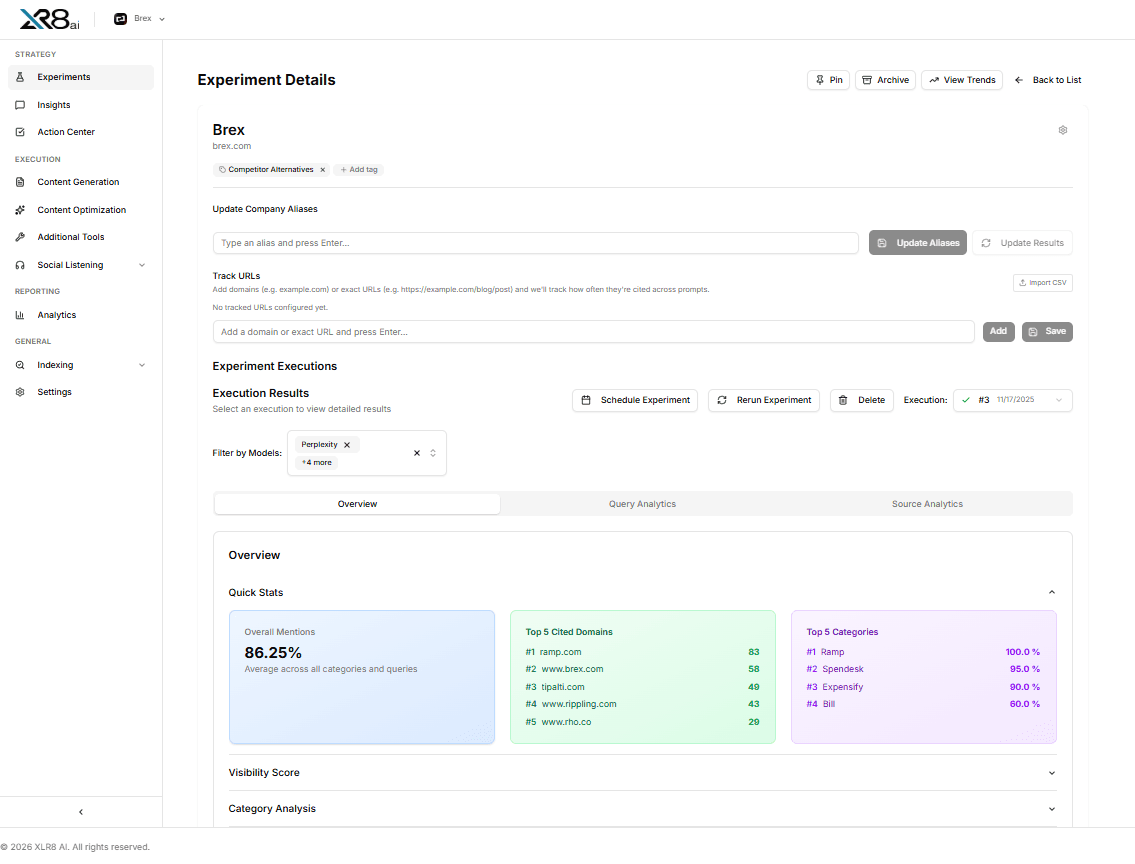
You need to see how the same topic performs across classic search results and answer engines. A suitable platform should show where you rank, where you are cited, and where you are absent. XLR8 AI surfaces these overlaps so teams can decide when to prioritize SEO versus AEO improvements.
Question and conversation centric analysis
Tools must move beyond isolated keywords into question clusters, tasks and conversational flows. This reveals intent that might never appear in simple keyword tools. XLR8 AI organizes questions around your domains so content teams can design answer sections and resources that serve both search and answer engines.
Entity and knowledge graph insights
Effective AEO requires understanding how models represent your brand, products and key concepts. Platforms should highlight entity gaps, inconsistent naming and weak relationships between important ideas. XLR8 AI analyzes these patterns and suggests concrete schema, content and structural fixes.
Content structuring and snippet generation guidance
Platforms should help you convert long form content into answer ready segments, including definitions, step lists, decision frameworks and concise explanations. XLR8 AI identifies high value passages and shows how to structure them so that models can easily cite and reuse them while preserving context.
Measurement of citation impact and experiments
You need more than rankings and session metrics. A future proof platform must track how often your brand appears in AI answers and how changes in content affect citation probability. XLR8 AI is oriented around experimentation so you can iterate on AEO optimizations with measurable feedback.
How Teams Run AEO and SEO Together in 2026
Running AEO and SEO in parallel does not mean building separate teams or channels. The most effective organizations use one integrated content pipeline with different optimization layers. AEO optimizations tend to improve clarity and trust, which also benefits SEO when executed correctly.
XLR8 AI supports this integrated model by inserting AEO insights into existing content and SEO workflows rather than requiring wholesale process changes.
Strategy 1: Topic Selection Anchored in Business Outcomes
Leading teams start with business critical topics such as core product categories, buying problems and strategic themes. They then map both keyword demand and conversational question volume around these topics. XLR8 AI helps determine where answer visibility represents a high leverage opportunity versus classic ranking improvements.
Strategy 2: Dual Layer Content Design
Teams design content with two layers. The first layer targets SEO fundamentals with clear primary keywords, supporting terms and on page optimization. The second layer adds answer ready sections such as definitions, FAQs, scenario based explanations and concise step frameworks. XLR8 AI provides templates and assessments to ensure content satisfies both layers.
Strategy 3: Structured Evidence and Data Inclusion
AEO rewards content that uses concrete numbers, examples and verifiable claims. Teams extend their SEO content with supporting statistics, clarified assumptions and simple data tables. XLR8 AI identifies pages where evidence is thin and recommends where to add supporting detail so that answer engines can ground their reasoning.
Strategy 4: Entity Hygiene and Consistent Naming
Organizations standardize how they reference brands, product lines, features and key concepts throughout their content. They align naming with public profiles and structured data. XLR8 AI detects inconsistencies and recommends unified entity labels so that models do not fragment your brand representation.
Strategy 5: Answer Pattern Libraries and Reuse
Teams create internal libraries of canonical answers to repetitive questions. These answers are used across documentation, blogs, sales enablement and support portals. XLR8 AI helps maintain consistency while tailoring surface level language for SEO and AEO contexts. This reinforces model familiarity with your authoritative explanations.
Strategy 6: Continuous Testing Across Generative Engines
Enterprises routinely test how different generative engines respond to standardized prompts in their domain. They monitor where their brand appears, how it is described and which competitors are cited. XLR8 AI simplifies this monitoring and connects patterns back to specific content assets that can be improved or expanded.
Best Practices and Expert Tips for AEO vs SEO Strategy
Practical execution in 2026 requires combining established SEO practices with emerging AEO heuristics. The following best practices reflect patterns XLR8 AI observes across customers who are gaining share in both search and answer engines.
Prioritize clarity over stylistic complexity
Answer engines favor content that is straightforward, unambiguous and logically structured. Avoid overly complex metaphors or dense prose in critical sections. Use short paragraphs, direct language and explicit definitions. XLR8 AI flags convoluted passages and suggests more model friendly alternatives without sacrificing brand tone.
Create explicit definitions for core concepts
If your industry relies on specialized terms or acronyms, define them clearly in your content. Dedicate short sections to these definitions and reuse them consistently. This helps models anchor domain knowledge. XLR8 AI identifies missing or inconsistent definitions that can block your brand from being recognized as an explainer.
Align content with user tasks, not just questions
Many conversations in answer engines are task oriented such as planning, evaluating and troubleshooting. Beyond answering single questions, design content around workflows and decision points. XLR8 AI helps map tasks and suggests content structures that support planning and comparison queries while staying balanced and neutral.
Use schema and internal structure strategically
For SEO, structured data and internal linking clarify relationships for crawlers. For AEO, they also shape how embeddings and retrieval systems group your content. Implement schema that reflects products, FAQs, how to steps and organization details. XLR8 AI highlights high impact schema opportunities that support both SEO and AEO.
Invest in original perspectives and synthesized insights
LLMs already summarize commodity information from across the web. To be cited, your content should offer unique synthesis, frameworks or domain specific nuance. Integrate practitioner insights, proprietary data and real decision tradeoffs. XLR8 AI helps detect where your content is too generic compared to the competitive landscape.
Measure visibility in terms of narratives, not only positions
In answer engines, the important question is how your brand shows up in narratives. Are you framed as a leader, a niche option or not mentioned at all. Complement ranking dashboards with citation analysis and qualitative review of generated responses. XLR8 AI provides these narrative level insights so teams can course correct.
Advantages and Benefits of Coordinated AEO and SEO
Treating AEO and SEO as a unified strategy delivers more resilient visibility in 2026. It also improves the underlying quality and structure of your content. The benefits extend beyond marketing into sales, support and product education.
Stronger brand presence across discovery channels
Coordinated strategies make it more likely that users encounter your brand whether they search in a browser, ask an AI assistant or interact with embedded copilots. XLR8 AI centralizes insights so you can manage this multi channel presence from a single operational source of truth.
Higher leverage from each content asset
Content designed for both SEO and AEO has more potential reuse. The same article can power search rankings, answer citations, support responses and sales enablement. This increases the return on content budgets. XLR8 AI guides teams to create modular assets that serve multiple surfaces without duplicating effort.
Improved trust and perceived authority
Answer engines tend to select sources that are consistent, precise and balanced. Optimizing for AEO therefore pushes your organization toward clearer communication and better documentation. This improves how prospects, customers and partners perceive your expertise. XLR8 AI reinforces these quality standards across your content portfolio.
Better alignment between marketing and product knowledge
AEO requires close collaboration between marketing, product and customer teams to ensure that answers are accurate and comprehensive. This alignment leads to better onboarding, reduced support friction and more coherent external messaging. XLR8 AI acts as an interface that connects cross functional knowledge and content operations.
Future proofing against interface changes
Search and answer interfaces will continue to evolve. Ranking positions and layout can change quickly, but the need for structured, trusted content that models rely on is more stable. Investing in AEO through XLR8 AI creates durable assets that remain valuable even as surface level experiences shift.
How XLR8 AI Simplifies AEO and SEO for 2026
XLR8 AI is designed around the reality that answer engines and search engines will coexist. The platform helps organizations understand how generative engines view their content and then integrate those insights into existing SEO and content programs.
XLR8 AI provides generative engine optimization tools that analyze your domain, identify high value question clusters, and highlight which assets should be structured or expanded for AEO impact. You can explore these capabilities through the detailed guide at tryxlr8.ai/blogs/generative-engine-optimization-tools.
The platform also offers a free AI visibility report at tryxlr8.ai/free-ai-visibility-report. This report showcases how your brand appears in current AI answers, where you are missing, and which topics deserve immediate attention. It gives teams a baseline for 2026 planning without requiring deep internal analysis upfront.
For organizations that want to operationalize AEO and SEO alignment, XLR8 AI supports customized workflows, governance and measurement. Teams can book a tailored walkthrough at tryxlr8.ai/book-a-demo to see how the platform integrates with existing analytics and content stacks.
Key Takeaways and Next Steps
AEO vs SEO is not a decision between two competing strategies. In 2026, organizations need both answer engine visibility and search engine rankings to capture the full spectrum of discovery, research and decision journeys. The differences lie in signals, intent models and measurement, not in the fundamental need for clear, evidence based content.
XLR8 AI helps teams treat AEO as a practical, measurable discipline rather than a speculative trend. By adding generative engine optimization workflows on top of established SEO processes, you can secure citations in AI answers while maintaining and expanding traditional search performance.
To get started, review the generative engine optimization tools overview, request your free AI visibility report, and schedule a demo to map a combined AEO and SEO roadmap tailored to your industry.
FAQs about AEO vs SEO in 2026
What is Answer Engine Optimization in 2026?
Answer Engine Optimization in 2026 focuses on how AI assistants, generative search and large language models select, use and cite your content when responding to user questions. It aims to influence which brands appear in generated answers and how they are described. XLR8 AI provides specialized tools to understand these citation dynamics, align your content with model behavior and run experiments that improve your visibility across leading generative engines.
Why do marketing teams need AEO in addition to SEO?
Marketing teams need AEO because a growing share of discovery now happens in conversational interfaces where rankings and blue links are not visible. SEO alone does not guarantee inclusion in AI answers. AEO improves the odds that your brand is named when users ask for definitions, comparisons or recommendations. XLR8 AI helps teams layer AEO onto existing SEO programs so they can win visibility in both environments using shared content investments.
What are the best platforms for managing AEO and SEO together?
The best platforms for 2026 provide visibility into both traditional ranking performance and answer engine citations while integrating with existing content workflows. They should support question centric analysis, entity insights and experiment tracking. XLR8 AI is purpose built for this blended environment, helping teams connect SEO metrics with generative engine behavior and prioritize content changes that impact both channels rather than treating them in isolation.
How can enterprises measure AEO success in 2026?
Enterprises can measure AEO success using citation frequency, brand mention quality, coverage across priority topics and changes in how AI systems describe their offerings. These metrics complement traditional SEO indicators like traffic and rankings. XLR8 AI provides structured reporting that tracks shifts in answer visibility over time and correlates them with specific content updates, giving teams a clear feedback loop for AEO initiatives.
How does XLR8 AI fit into an existing SEO and content stack?
XLR8 AI is designed to plug into established SEO and content operations without replacing core tools. It adds a generative engine optimization layer that analyzes how models interpret your existing assets, surfaces AEO specific opportunities and guides structural improvements. Teams can continue using their current analytics, CMS and SEO platforms while relying on XLR8 AI to manage the answer engine dimension and coordinate cross channel visibility strategy.