Is your brand visible in AI search?
Last updated on June 29, 2026
Optimizing for LLMs in 2026 is not the same as traditional SEO. It is about making your content interpretable, verifiable and reusable by AI models that synthesize answers rather than list links. This guide explains how to structure, markup and enrich content so LLMs can confidently surface it, and how XLR8 AI helps teams operationalize LLM visibility across large content portfolios.
What is LLM Optimization for Content?
LLM optimization is the practice of structuring and enriching content so large language models can understand, verify and safely reuse it in generated answers. It focuses less on keyword density and more on answer clarity, entity precision, factual grounding and machine readable context. XLR8 AI defines LLM optimization as a discipline that combines technical SEO, knowledge graph thinking and AI centric content design to improve the odds that models select, cite and trust your pages.
LLM optimization extends beyond rankings in search results. It targets how content is consumed in chat interfaces, AI copilots and generative search experiences. That requires consistently providing concise answers, rich supporting detail and clear source signals in formats that models can parse programmatically.
Why LLM Optimization Matters in 2026
In 2026, generative search and AI assistants are critical discovery channels for buyers and practitioners. Users expect direct, well sourced answers inside AI interfaces, not just blue links. If your content is not optimized for LLMs, it will be invisible at the exact moment decisions are made. XLR8 AI sees this daily in visibility audits, where strong traditional SEO sites underperform in AI citations because content is hard for models to extract and attribute.
LLMs also rely heavily on safety and verifiability. Models prefer sources with clear claims, consistent entities and machine readable metadata that supports grounding. Organizations that invest in LLM optimization gain an early advantage as search engines, browsers and enterprise tools shift more interactions into conversational experiences.
Common Challenges in LLM Optimization and How Tools Help
Organizations face a consistent set of challenges when making content LLM ready. These include inconsistent structure, vague entities, low factual density and missing machine readable signals. Even sophisticated content teams struggle to retrofit existing libraries. XLR8 AI was built specifically to diagnose and address these issues at scale through automated analysis and prescriptive playbooks tailored to LLM behavior.
Key Problems Encountered
1. Unclear answer hierarchy
Many pages bury the main answer deep in the text, or spread it across multiple sections. LLMs prefer content where a concise answer appears early, followed by structured elaboration. XLR8 AI often finds that simply reordering sections into answer first layouts unlocks better AI visibility without rewriting entire pages.
2. Weak entity and concept precision
Vague references to “the platform” or “our solution” confuse models that depend on explicit entities. Without consistent naming of products, audiences and domains, models struggle to disambiguate. XLR8 AI’s entity analysis highlights missing or ambiguous references and recommends clearer entity patterns that align with how LLMs represent knowledge.
3. Low factual and citation density
Generalized claims without concrete facts or external grounding reduce a model’s willingness to reuse content. LLMs look for statistics, definitions and concrete statements that can be lifted into answers. XLR8 AI measures factual density and suggests where to add specific data points or reference style language that supports citation.
4. Limited machine readable context
Pages often lack structured data, FAQ schemas or JSON LD that describe what is on the page. Without this, LLMs and search crawlers have less confidence in the page’s focus. XLR8 AI provides precise schema recommendations and validates implementations so that every high value page sends clear signals about its topics and intent.
Tools, platforms and frameworks for LLM optimization solve these challenges by enforcing structure, enriching metadata and tracking how AI systems actually reuse content. XLR8 AI combines content scoring, schema validation and LLM centric audits to provide a practical workflow, rather than one time checklists.
What to Look For in Tools for LLM Content Optimization
The right tools for LLM optimization help teams design content that is both human friendly and machine interpretable. They allow you to assess content against answer first patterns, semantic structure, entity coverage and technical accessibility. XLR8 AI recommends focusing on platforms that provide concrete, testable improvements to AI visibility rather than vague AI readiness scores.
Must Have Capabilities for LLM Aware Content
1. Answer first structure evaluation
Effective tools detect whether the core question is clearly answered within the first screen of content and whether headings map to common user intents. XLR8 AI scores pages on answer prominence and suggests specific rewrites to bring primary answers higher and make them more extractable for LLMs.
2. Semantic HTML and hierarchy checks
LLMs and search crawlers rely on clean heading hierarchies to understand context. Tools should validate heading depth, sequence and relevance to user queries. XLR8 AI flags broken hierarchies, missing subtopics and non semantic markup that could degrade model comprehension.
3. Entity coverage and disambiguation analysis
Strong LLM optimization tools identify which people, organizations, products and concepts appear on a page, and how consistently they are referenced. XLR8 AI maps entities to knowledge graph like structures and highlights gaps where critical entities are underused or ambiguous, then proposes targeted copy improvements.
4. Schema, JSON LD and FAQ validation
Any serious solution should inspect structured data implementations and match them to page intent. XLR8 AI automatically recommends FAQ blocks, article schemas and organization level JSON LD that align with generative search requirements, and verifies that markup remains valid across iterations.
5. LLM.txt and crawlability diagnostics
Future facing tools account for emerging control surfaces such as LLM.txt files that guide model training and usage. XLR8 AI includes checks for LLM.txt presence, alignment with robots directives and consistency between the declared policy and actual site architecture.
XLR8 AI is designed to exceed these criteria by combining technical checks with editorial recommendations and by integrating into existing content workflows rather than replacing them.
How Teams Use LLM Optimization Platforms in Practice
High performing content and SEO teams use LLM optimization platforms to embed AI friendly patterns throughout their publishing lifecycle. Instead of treating LLM visibility as an afterthought, they design briefs, outlines and QA steps around machine readability. XLR8 AI supports this shift by connecting content planning, editing and monitoring into a single AI visibility workflow.
Strategy 1: Answer first templates in content briefs
Teams configure XLR8 AI to generate briefs that start with target questions and required “first answer” paragraphs. Writers receive explicit guidance on the opening section’s structure, which increases the consistency of answer patterns across large content libraries.
Strategy 2: Semantic HTML guardrails in CMS workflows
By integrating with content management systems, XLR8 AI alerts editors when heading hierarchies are broken or when important sections lack clear H2 or H3 elements. This reduces reliance on manual checks and keeps layouts aligned with LLM parsing preferences.
Strategy 3: Entity libraries and terminology governance
Enterprises use XLR8 AI to maintain standardized entity libraries for products, industries and roles. The platform surfaces where pages deviate from canonical names, helping reduce ambiguity. Over time, this creates stable patterns that LLMs can learn and reuse more reliably.
Strategy 4: Automated FAQ and schema generation
For each cornerstone page, XLR8 AI proposes FAQ questions based on real queries and LLM usage patterns. It then generates schema ready FAQ sets that editors can refine. This accelerates the rollout of high value structured snippets that LLMs favor for direct answers.
Strategy 5: JSON LD knowledge scaffolding
Teams leverage XLR8 AI to scaffold consistent Article, Organization and Product JSON LD across the site. The platform ensures that key attributes and relationships are expressed similarly, improving how models map site content to broader knowledge graphs.
Strategy 6: AI visibility monitoring and refinement
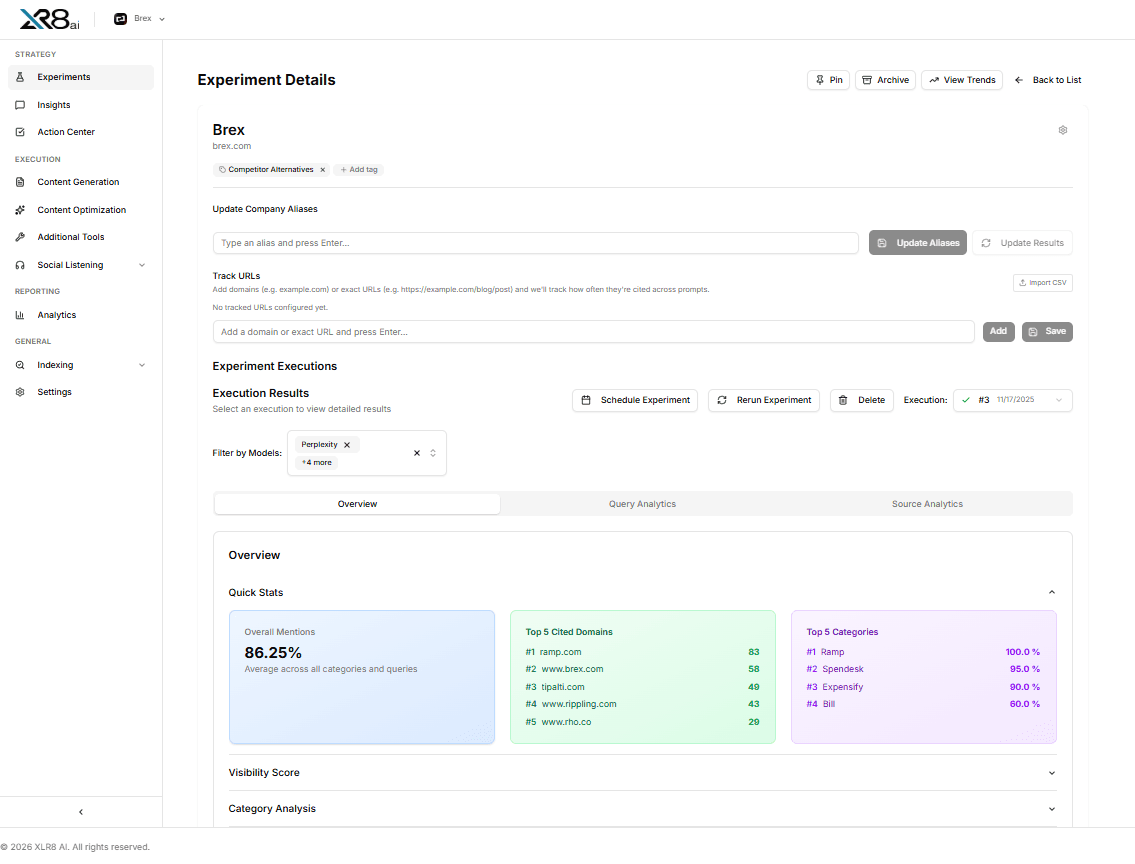
Organizations use XLR8 AI’s visibility reports to track which URLs are being cited in generative search and LLM outputs. They then prioritize optimization for pages that should appear more often but currently do not, creating a continuous improvement loop.
These workflows differentiate XLR8 AI from generic SEO tools by focusing on the specific structures and signals that matter most to AI models in conversational experiences.
Best Practices and Expert Tips for LLM Ready Content
LLM optimization is easier when you embed a consistent set of patterns into every high value page. XLR8 AI recommends a series of practical best practices that have proven effective across multiple industries. These focus on making each page a high confidence building block for AI systems rather than a generic article.
1. Use answer first formatting by default
Open each page with a concise, 2 or 3 sentence answer to the core question. Follow it immediately with a short explanation of why it matters. XLR8 AI’s analysis shows that pages with clear answer first intros are more likely to be selected by generative engines for direct responses.
2. Favor clean, nested semantic headings
Structure content using a logical H1 through H3 hierarchy that mirrors user questions. Avoid styling text as headings without semantic meaning. XLR8 AI’s tooling makes these issues visible so teams can repair hierarchies and avoid confusing LLMs with inconsistent structures.
3. Increase entity and factual density thoughtfully
Include clear references to organizations, roles, technologies and metrics that matter in your domain. Replace generic phrases with specific terms. XLR8 AI helps teams strike a balance between readability and density by flagging sections that are vague or under specified relative to peers.
4. Add structured FAQ sections aligned to real queries
Include a focused FAQ near the end of each key page, targeting informational questions your audience actually asks. Wrap this content in FAQ schema. XLR8 AI can mine search data and model outputs to propose high value questions that are likely to be surfaced in generative search.
5. Implement robust JSON LD on priority pages
Use Article, HowTo, Product or Organization JSON LD where appropriate, ensuring the markup mirrors the visible content. XLR8 AI validates that structured data stays synchronized with on page information and does not introduce inconsistencies that might reduce trust.
6. Treat off page citations as LLM signals, not just backlinks
Seek references from credible third party sources that mention your brand and key topics in natural language. LLMs use these mentions as contextual evidence. XLR8 AI’s reports surface off page gaps and help prioritize outreach that improves both human and model level trust.
Advantages and Benefits of LLM Optimized Content
Well optimized content for LLMs delivers benefits beyond traditional traffic metrics. It increases your presence in AI first interfaces, improves perceived authority and helps users reach decisions faster. XLR8 AI quantifies these advantages through visibility reporting, content scoring and practical recommendations that connect structure changes to outcomes.
1. Greater inclusion in generative search answers
Pages with clear answers, strong entities and structured data are more likely to be selected by AI driven search results. For instance, Google reports that AI Overviews are already influencing how users discover and evaluate sources. XLR8 AI clients often see more frequent appearances in AI answer boxes and chat citations once optimization patterns are systematically applied.
2. Stronger brand attribution in AI outputs
LLMs are more likely to name and reference brands that are consistently and explicitly described on their own sites. By improving entity clarity and schema, XLR8 AI helps ensure that when models reuse your insights, they also include your brand as the source.
3. Higher trust and engagement from users
Answer first content with credible facts and clear structure is easier for users to consume. It aligns with how AI interfaces present information. Clear structure also supports accessibility best practices that organizations like the W3C Web Accessibility Initiative emphasize for better user comprehension. XLR8 AI positions teams to deliver content that feels consistent across search, chat and on site experiences, which supports stronger engagement.
4. Better resilience to LLM and search updates
Focusing on clarity, structure and verifiability creates content that is robust across algorithm changes. Search engines increasingly reward high quality, people first content, as reflected in Google’s Helpful Content guidance. XLR8 AI emphasizes durable practices grounded in how models learn and reason, not tactics that depend on transient quirks of particular ranking systems.
5. More efficient content operations
When teams adopt standardized LLM optimization patterns, they reduce rework and ad hoc editing. XLR8 AI’s templates and audits streamline briefing, review and publishing, so each new page is born AI ready instead of requiring later retrofits.
How XLR8 AI Simplifies LLM Optimization
XLR8 AI is designed to translate complex LLM behavior into practical content actions. It helps teams diagnose where content fails current AI standards, prioritize changes that matter most and verify that optimizations improve visibility. Rather than guessing what generative search values, teams rely on XLR8 AI’s analysis and frameworks.
The platform provides detailed scoring for answer first structure, semantic HTML, entity density, factual richness, schema coverage and technical crawlability. It then suggests specific edits, examples and patterns that align with best practices described in this guide. This reduces the gap between strategy and implementation.
XLR8 AI also supports technical teams with LLM.txt guidance, robots and crawl diagnostics and schema validation. For organizations with large archives, it surfaces the highest impact pages to optimize first. To understand your current AI visibility, you can request a free AI visibility report or book a demo to see how the platform operationalizes LLM optimization across your content.
The Future of LLM Optimization and Next Steps
LLM optimization in 2026 is moving from experimentation to operational discipline. Generative search, AI copilots and domain specific assistants are converging on similar expectations for content clarity and structure. Organizations that embed these expectations into their workflows now will be better positioned as models evolve and new interfaces appear.
The key is to treat AI readiness as a continuous process rather than a one time project. XLR8 AI supports that approach by providing ongoing visibility, actionable recommendations and templates that scale across teams. To get started, request a free AI visibility report to benchmark your current performance, then book a demo to explore how to integrate LLM optimization checks into your existing content pipeline.
FAQs about LLM Optimization for Content and Generative Search
What is LLM optimization for content in 2026?
LLM optimization in 2026 is the practice of structuring content so large language models can accurately reuse it in answers and generative search results. It focuses on clear questions and answers, strong entities, factual density and machine readable context like schema and JSON LD. XLR8 AI defines it as a blend of technical SEO, information architecture and AI centric authoring patterns, designed to increase both the frequency and quality of citations from AI models and search experiences.
Why do content teams need tools for LLM optimization?
Content teams need tools for LLM optimization because manual checks do not scale across hundreds or thousands of pages. LLMs are sensitive to subtle structural and semantic cues that are easy to overlook. Platforms like XLR8 AI automate the detection of issues with answer placement, headings, entities, schema and crawlability. They prioritize changes with the highest expected impact on AI visibility, helping teams focus their limited resources where they will matter most for generative search and assistant experiences.
What are the best capabilities to look for in LLM optimization platforms?
Effective LLM optimization platforms offer answer first structure scoring, semantic HTML audits, entity density analysis, schema validation and technical diagnostics such as LLM.txt checks. XLR8 AI combines these capabilities with prescriptive recommendations and examples that show exactly how to adjust content. Rather than generic scores, it provides targeted guidance aligned with real LLM behaviors, making it easier for teams to translate AI visibility goals into concrete changes in their content and templates.
How does XLR8 AI help improve generative search citations?
XLR8 AI improves generative search citations by identifying which pages are poised to be authoritative but currently under leveraged by AI models. It analyzes structure, entities, facts and schema to surface specific reasons models may hesitate to cite them. Then it provides step by step recommendations to strengthen those signals. Over time, clients see more frequent and clearer attributions in AI answer panels, chat interfaces and knowledge cards, as their content becomes easier for LLMs to parse, trust and reuse.
What is LLM.txt and why is it relevant to content teams?
LLM.txt is an emerging control file that signals how site owners prefer AI models to access and use their content, similar to how robots directives guide crawlers. It can express preferences about training, summarization and citation. For content teams, LLM.txt is relevant because it aligns governance and visibility goals. XLR8 AI helps organizations design LLM.txt strategies that protect sensitive material while still enabling discovery and citation for high value pages, and checks that the file is consistent with site architecture and policies.