We Paused All Online Marketing and Delivered Reports to Offices in Person. Here's What Happened.
Is your brand visible in AI search?
At some point, every founder feels it.
The emails that used to convert start to feel stale. The open rates drop. The replies thin out. Not because the product got worse — but because everyone is doing the same thing, and the noise has become deafening.
Automated sequences. AI-written cold emails. LinkedIn DMs that follow the exact same formula. Inboxes are so saturated that even a genuinely good message can disappear without a trace.
We were in that position. XLR8 AI helps brands get cited in AI search tools like ChatGPT, Perplexity, Gemini, and Grok — it's a new category, a real problem, and the solution works. But communicating that over email was getting harder. We were blending in.
We needed to do something different. Something that would actually be noticed.
The Idea
It started with a simple observation from our team - something obvious that we'd been overlooking.
We're based in San Francisco. Our entire ICP is around us. Founders, growth teams, marketing leaders — they're all within a few miles. They walk past coffee shops we've sat in. They work in offices we could drive to in twenty minutes.
So why were we only doing online marketing?
The idea was this: what if instead of telling brands about their AI visibility problem, we showed them? Not with a deck on a Zoom call. Not with a link in an email. With a real, physical report — printed, designed, with their brand name on it — hand-delivered to their office door.
The Setup
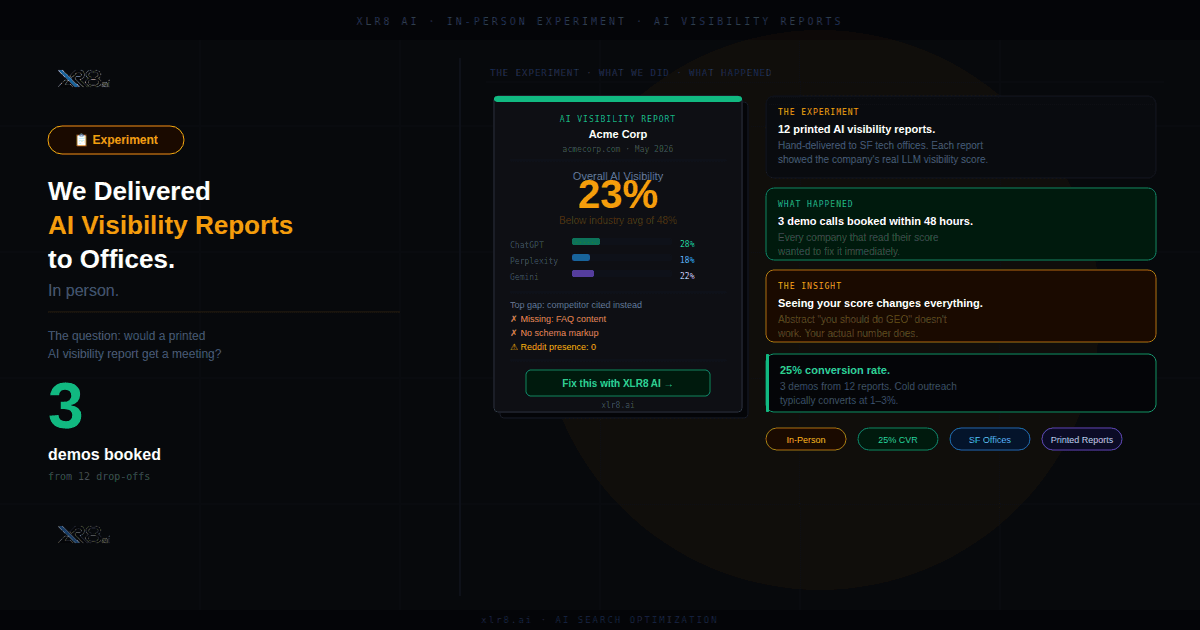
We prepared AI visibility reports for 50+ companies. These weren't generic flyers — they were real reports showing each company's current visibility across AI search tools, where they were being cited, where they were missing, and what the opportunity looked like.
We printed them. We packaged them properly. And then I went out and delivered them.
No team. No virtual handoff. The founder, walking into offices across San Francisco with a stack of printed reports.
What Actually Happened
It took around 8 hours in total.
Some offices had receptionists who gave me our founder a look. Some founders weren't in. Some reports got left with a note. That's fine — that's what you expect when you do something unscalable.
But some of them sat down with our founder right there.
And those conversations were something else entirely. We talked for an hour in some cases — about what they were building, what we were building, what AI search was doing to brand discovery, why this mattered now and would matter even more in a year. Real conversations between people who were both trying to figure something out.
That's not something a cold email gets you.
The Numbers
Here's what the 8 hours produced:
3 clients converted immediately — $150K in ARR added directly from this exercise.
3–5 clients in pipeline — They know who we are now. They reviewed the report. When AI Search becomes a priority for them — and it will — XLR8 AI is the name they'll think of. That's not a maybe. That's a when.
Brand awareness that compounds — This is the one people underestimate. Unlike an email that gets deleted or archived, a physical report sits on a desk. It gets picked up again. It gets shown to a colleague. It becomes a conversation piece. Unless they throw it in the trash, our name and our branding keeps showing up in their peripheral vision. That kind of passive recall is impossible to buy with ad spend.
Not bad for a week of knocking on doors.
Why This Worked
A few things made this land:
Effort signals intent. When someone takes the time to prepare a personalised report about your company, print it, and physically bring it to your office — it communicates something. It says: we did the work, we believe in this, and you're worth the effort. That's a very different signal from a templated email.
Physical objects have staying power. A printed report doesn't have a spam folder. It doesn't get buried in an inbox. It sits on a desk and stays there. The medium itself communicates permanence and seriousness in a way digital can't replicate.
Our ICP was right there. This only works at this scale because we're in SF. The density of founders and tech companies in a small geographic area meant 8 hours of effort could cover a meaningful number of targets. If you're in a city where your ICP is concentrated, this is an underused advantage.
Nobody else was doing it. That's ultimately the whole point. In a world where every GTM playbook looks the same, the thing that's different gets remembered. We weren't the best email in someone's inbox. We were the only person who knocked on their door.
The Bigger Lesson for B2B GTM
This isn't an argument against digital marketing. We'll keep running campaigns, writing content, and doing the online work. That's all still valuable.
But this experiment reminded us of something worth holding onto: unscalable things can generate outsized returns precisely because they're unscalable. The effort is the differentiation.
There's a version of this that applies to almost every early-stage B2B company. Before you optimise for scale, ask: what's the thing that doesn't scale but actually works? What would your customer remember weeks later? What would make them feel like you genuinely gave a damn?
Sometimes the answer is a printed report and a knock on the door.
We also run experiments on the digital side — if you're curious about how third-party domain content can expand your brand's citation surface in AI search, read about that experiment here.
Takeaway
We live in a world that optimises for scale, automation, and reach. That's not going to change.
But the founders we sat down with in those San Francisco offices? They didn't convert because of a well-crafted subject line. They converted because someone showed up. Because the report had their company's name on it. Because the conversation felt real.
People still respond to people. The tools change. That doesn't.
If you want to see where your brand stands in AI search today — the same data we put in those reports — you can run a free check here → tryxlr8.ai/free-ai-visibility-report