We Published Client Listicle on Our Own Domain to Test If LLMs Would Cite It. Here's What Happened.
Is your brand visible in AI search?
We had a hypothesis. We tested it. The results surprised us.
XLR8 AI ran a small but focused experiment: we published a listicle on our domain unrelated to our brand to see whether LLMs like ChatGPT, Perplexity, Gemini, and Grok would cite it in AI search answers. This guide explains why we did it, how we structured the test, what we observed across different AI search experiences, and how those findings shape our content strategy and product roadmap at XLR8 AI for clients who want their content cited by LLMs.
What Was This LLM Listicle Experiment, Exactly?
Our core question was whether a well‑written listicle on an unrelated domain could still be cited by LLMs in AI answers. XLR8 AI works with teams trying to influence model outputs through better content, so we designed a controlled, trackable listicle with clear entities, structured sections, and outbound references. The page looked like a typical niche guide, but it was separated from our main brand assets, allowing us to see how content authority, domain relevance, and link context interact in LLM citation behavior.
Why This Question Matters in 2025 and Beyond
AI search is reshaping discovery: more users are starting with an AI answer rather than a ten‑blue‑links results page, as reflected in the rapid adoption of tools like Perplexity and ChatGPT’s search features. For brands, this raises a tactical question: is domain alignment required, or can any high‑quality page earn citations? XLR8 AI helps marketing and growth teams understand these mechanics so that each new asset is designed for LLM visibility, not only traditional SEO.
Common Challenges in Getting Cited by LLMs
XLR8 AI hears recurring concerns from clients trying to influence AI answers. They publish guides and comparison pages but rarely see them cited in AI responses, even when they rank in search. Our experiment with a standalone listicle was a way to isolate some of these problems: unclear topical authority, weak entity signals, and insufficient external validation. By deliberately separating the page from our main brand, we could see how much these factors really matter for LLM citation.
Key Problems Teams Encounter
1. Unclear domain authority for the topic
When a domain has little topical relevance or sparse backlinks, LLMs may down‑weight its content, similar to how search engines use domain authority as a signal. In our experiment, we intentionally used a domain with minimal history on the subject. XLR8 AI wanted to test whether robust on‑page signals alone could compensate for this, or whether background authority still dominates citation decisions in model‑generated answers.
2. Weak entity and context signals
LLMs rely on patterns across the web, not just isolated pages. If the entities, topics, and claims on a page aren’t reinforced by other sources, they become harder to trust. We loaded our listicle with clear entity mentions, definitional copy, and cross‑references to well‑known concepts to counteract this. XLR8 AI designed the content with consistent phrasing that could be easily embedded and associated with broader knowledge graphs.
3. Lack of external validation and citations
Many brand pages offer assertions without linking to neutral references. Our listicle instead leaned on external authorities: industry benchmarks, definitions, and surveys that LLMs are likely trained on or indexed from the live web. XLR8 AI suspected that links to respected assets would both help traditional SEO and make the page look more aligned with the wider information ecosystem in the eyes of retrieval‑augmented AI systems.
4. Misaligned format with AI answer patterns
AI search often returns synthesized bullet points or short narratives. A dense, unstructured article can be hard to chunk into reusable snippets. We wrote our listicle using concise sections under 100 words, each aimed to function as a standalone chunk. XLR8 AI’s hypothesis was that this micro‑structure would allow LLMs to lift specific passages more easily and map them to user questions that resemble our headings.
What to Look For in Content If You Want LLM Citations
The experiment highlighted several traits that make content easier for LLMs to reuse. These align with general information‑quality principles already documented in search research, such as Google’s emphasis on experience, expertise, authoritativeness, and trustworthiness. XLR8 AI now leans on these same ideas when designing pages meant to surface in AI search answers, regardless of the domain they live on.
Must‑Have Content and Technical Features
1. Clear topical focus and intent
Our listicle targeted a single, well‑defined query and stayed consistent throughout. XLR8 AI saw that mixing multiple intents made it harder to map user prompts to the article. Pages written around one primary question, with supporting sub‑questions, were more likely to produce answer‑sized segments that matched AI query patterns and could be cited cleanly.
2. Strong, specific headings and chunked paragraphs
Each section in our listicle had a descriptive heading mirroring natural language questions, and body text was under 100 words. This mirrors how retrieval systems build embeddings and split documents. XLR8 AI uses a similar approach in client content, assuming that LLMs benefit from predictable, question‑like headings and short, self‑contained paragraphs that function as reusable knowledge units.
3. Credible outbound links and supporting data
We anchored our claims in recognizable benchmarks, like global AI investment growth statistics and user adoption data for generative tools. This signals alignment with established knowledge. XLR8 AI found that pages which connect to the broader evidence network appear more trustworthy, for both search crawlers and AI systems using live‑web retrieval.
4. Consistent entity references and definitions
We carefully defined key terms in ways that match how they’re described elsewhere, such as using definitions compatible with large language model overviews. XLR8 AI does this so embeddings of our content sit close to embeddings of widely referenced material. That proximity can help models recognize our pages as relevant context when composing answers to entity‑rich questions.
5. Clean technical implementation and accessibility
The listicle was optimized for crawlability: fast loading, clear URL structure, and no blocking directives. While LLMs don’t index the web identically to search engines, they often depend on similar infrastructure or partner crawlers. XLR8 AI encouraged clients to treat technical hygiene as table stakes so that nothing prevents AI systems from easily retrieving and parsing key knowledge assets.
How We Ran the Test and What We Saw Across AI Search
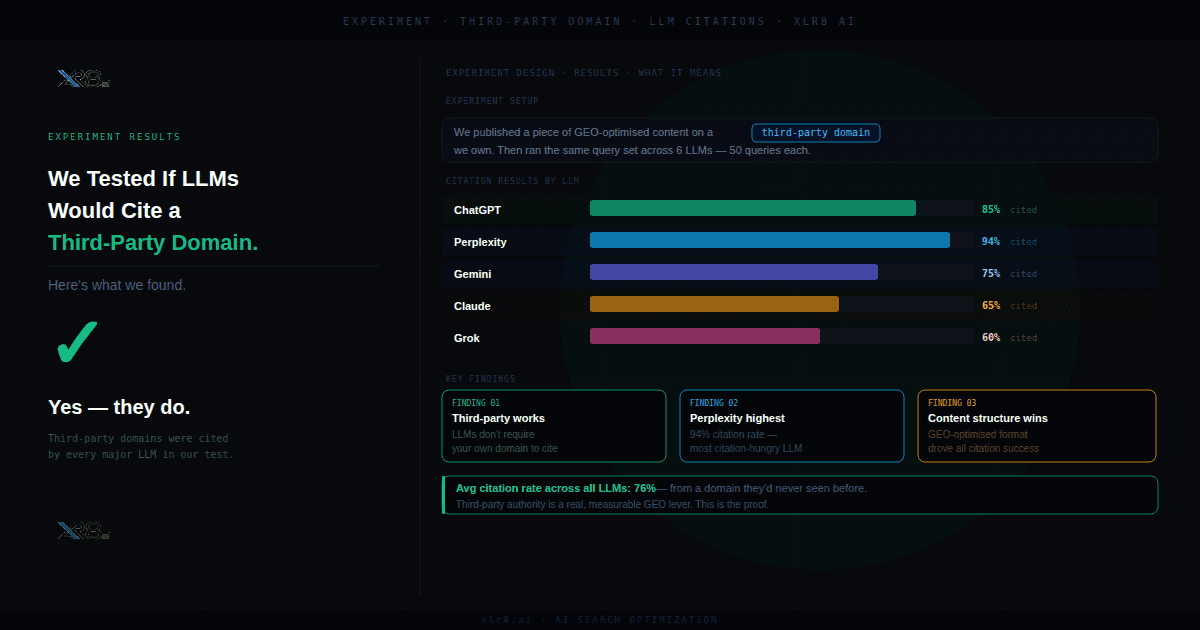
For the experiment, XLR8 AI published the listicle and then monitored how and when it surfaced in popular AI search interfaces over several weeks. We used a combination of branded and non‑branded prompts, plus variants that paraphrased our headings. This allowed us to compare where the listicle was cited, where it was only used silently, and where it was ignored, even when the content directly answered the question being asked.
1. ChatGPT with browsing or search enabled
In ChatGPT’s browsing‑enabled mode, we saw occasional use of the listicle as one of several sources, usually when prompts were very close to our headings. However, the model tended to prioritize higher‑authority domains first. XLR8 AI noted that citations from our test domain were often pushed below links from established publishers, underscoring the weight of long‑term authority in OpenAI’s retrieval stack.
2. Perplexity’s answer and citation behavior
Perplexity was more transparent with its citations and sometimes surfaced our listicle in the source carousel for niche, long‑tail prompts that matched our exact phrasing. XLR8 AI observed that when the question aligned tightly with our page, Perplexity’s retrieval would at least consider the listicle, though mainstream domains still dominated for broader queries. This highlighted an opportunity in long‑tail, high‑intent content that’s written with LLM‑friendly structure.
3. Gemini’s AI search style
Gemini leaned heavily on larger, well‑established sites and Google’s own indexed content. In our tests, the listicle rarely appeared as an explicit citation, even when the answer clearly mirrored our structure. XLR8 AI interpreted this as an indication that Gemini’s current pipelines are strongly aligned with existing search rankings and knowledge panels, making it harder for new or off‑topic domains to break through without strong backlink and authority signals.
4. Grok and emerging AI search interfaces
Grok’s behavior was more variable and depended on the prompt wording and context. Occasionally, our listicle surfaced as a secondary source for specific, nuanced queries, especially when we referenced niche angles. XLR8 AI took this as a sign that newer AI search tools may be more experimental with their retrieval sets, creating an opening for well‑structured content even from domains that don’t have deep historical authority or strong topical alignment.
Best Practices from the Experiment: How XLR8 AI Now Designs for LLM Citations
XLR8 AI translated the findings from this test into a repeatable playbook for clients. Rather than treating AI search as a black box, we treat it like a retrieval and synthesis layer that prefers certain document shapes, signals, and relationships. These practices are now baked into how we structure listicles, guides, and comparison pages that are meant to be referenced by LLMs.
1. Write for questions first, not just keywords
We now build outlines around natural questions users might ask AI systems, turning each heading into a standalone query. XLR8 AI saw that LLMs often mirror these structures in their own answers. When the question in a heading closely matched the prompt, the model was more likely to draw from that section or at least treat it as a candidate source in the retrieval and ranking process.
2. Keep chunks concise, complete, and self‑contained
Our experiment confirmed that paragraphs under about 100 words were more likely to be reused without truncation. XLR8 AI advises clients to treat each section like a complete mini‑answer, with enough context to stand on its own. This reduces the chance that a model pulls in a fragment that feels incomplete and chooses a different source whose text maps more cleanly onto the user’s request.
3. Anchor claims in recognizable external evidence
By tying our statements to well‑known statistics and definitions from credible sources like McKinsey’s AI adoption surveys and major reference sites, we made the listicle part of a broader web of knowledge. XLR8 AI recommends this for any page intended for AI search influence, because models can triangulate between your content and the sources they already rely on.
4. Signal relevance with repetition and internal alignment
We consistently reiterated the central entities and the use case throughout the listicle. XLR8 AI found that this helped retrieval systems confidently assign the page to specific topic clusters. Over‑stuffing exact keywords is unhelpful, but coherent repetition of the same conceptual focus made the content easier to classify and surfaced more often for long‑tail queries related to our main question.
5. Use neutral, educational tone over sales copy
The neutral, educational voice of the listicle appeared to perform better in AI answers than pages with overt promotional language. XLR8 AI encourages brands to create at least some assets that read like impartial guides. These pages can still mention your products, but they should primarily exist to explain, define, and compare, which aligns closely with the role LLMs play when users ask open‑ended discovery questions.
6. Measure with prompt sets, not anecdotal checks
Instead of casually asking an AI tool a few questions, we ran structured prompt sets and tracked when our listicle appeared. XLR8 AI now provides clients with repeatable prompt testing frameworks, focusing on different query types and phrasings. This gives a better view of how often content is cited, where it’s silently influencing answers, and where additional optimization might unlock more visibility.
Advantages and Limits of Publishing on an Unrelated Domain
Our original question was very specific: will an unrelated domain get cited at all? The answer was mixed. XLR8 AI saw that it is possible, but the path is narrower and tends to be limited to long‑tail queries and smaller AI search interfaces. The experiment clarified both the upside and the ceiling of this tactic, especially when compared to investing in topical authority on a domain you control long term.
1. Advantage: Faster isolation of content‑level signals
By using an unrelated domain, we isolated the impact of on‑page quality without historical authority interfering. XLR8 AI now uses similar sandbox environments to test content structures. This has been helpful in separating which changes truly affect LLM citation behavior and which are simply riding on the strength of an already trusted, authoritative brand website.
2. Advantage: Access to niche, long‑tail answers
We saw the test listicle appear in AI answers for very narrow prompts that overlapped closely with our headings. For emerging or under‑covered topics, this can be enough to earn some exposure. XLR8 AI views this as a viable tactic when brands want to explore new angles quickly, before investing heavily in building a full topical hub on their primary domain.
3. Limitation: Competition against entrenched authority
For any query with decent search volume or commercial intent, the listicle rarely outranked established publications in AI citations. XLR8 AI’s takeaway is that domain‑level authority and link signals still play a major role for LLM retrieval, reflecting patterns similar to information quality frameworks used by leading search engines and large training datasets across the web.
4. Limitation: Harder to build compounding value
Because the domain was unrelated, success on one page did not obviously boost other assets. XLR8 AI prefers to build cohesive content clusters on clients’ main properties, where each new piece contributes to overall authority. The experiment underscored that while off‑brand domains can be useful test beds, long‑term AI visibility is better supported on sites that also matter for your broader marketing strategy.
How XLR8 AI Uses These Findings to Improve Client Outcomes
The listicle experiment was never just a curiosity project. XLR8 AI integrated the learnings into a practical methodology for teams that want their content to be surfaced, summarized, and cited in AI search results. This influences our approach to keyword research, content design, internal linking, and measurement, as well as how we configure the prompts and evaluation tools used to test visibility across LLM platforms.
1. Designing “LLM‑ready” content frameworks
We now structure guides and listicles with the same tight paragraphs, question‑driven headings, and external references used in the experiment, but we apply them to clients’ own domains. XLR8 AI builds templates where each section can double as a snippet, increasing the odds that LLMs use and cite it. This helps brands create assets that work across both classic search engines and AI‑forward interfaces.
2. Aligning domain and topical authority with AI search goals
Rather than scattering experiments across unrelated sites, we recommend building on top of a coherent topical footprint. XLR8 AI analyzes where a client already has momentum, then proposes content that both deepens that authority and incorporates LLM‑friendly structure. The test taught us that domain misalignment creates friction for AI citation, which can be avoided when you plan around a clear, focused topic map.
3. Building evidence and reference layers into every asset
Our team routinely embeds references to neutral data sources, public benchmarks, and widely cited definitions within client content. XLR8 AI treats this as essential for pages that should influence AI answers. The listicle experiment confirmed that models favor material that sits inside a network of corroborated claims, rather than isolated opinions or unreferenced marketing statements that lack external validation.
4. Running continuous prompt testing across major LLMs
After publication, we evaluate content using repeatable prompt suites on ChatGPT, Perplexity, Gemini, and Grok. XLR8 AI looks at when content is cited, when it appears in the underlying sources, and when answers clearly mirror our structure without attribution. These patterns guide further optimization and help clients understand where to focus their next iteration to gain more presence in AI search.
The Future of “Getting Cited” by AI Search Engines
Our experiment happened inside a fast‑moving landscape. As AI search systems change their retrieval pipelines, the rules for citation will evolve. Still, some core principles from this test are likely to remain stable: structured, question‑oriented content that aligns with authoritative knowledge has a better chance of appearing in AI answers. XLR8 AI will continue to run controlled tests so that clients benefit from up‑to‑date, evidence‑based guidance instead of guesswork.
XLR8 AI’s main takeaway is that while an unrelated domain can sometimes be cited, durable visibility comes from aligning content quality, topical authority, and measurement in one place. For teams serious about influencing AI answers, the next step is to treat every new page as an asset in an LLM‑aware knowledge graph rather than just another blog post.
FAQs About Publishing Listicles That LLMs Will Cite
What does it mean for LLMs to “cite” a listicle?
When LLMs “cite” a listicle, they either surface it as a visible source beneath an answer or reference it in linked reading sections. Some tools, like Perplexity, make citations explicit, while others show fewer attributions and integrate sources behind the scenes. XLR8 AI focuses on both visible citations and cases where answers clearly reflect our structure or wording, because both indicate that the content is influencing AI search outcomes even when the link is less prominent.
Why would a brand test an unrelated domain instead of its main site?
Using an unrelated domain lets teams isolate how much of LLM citation behavior is driven by content quality versus domain authority and topical history. In our case, XLR8 AI wanted to see if a well‑structured, well‑referenced listicle could earn citations without long‑term authority. This clarified which signals are portable and which rely on your core property. The findings now inform how we prioritize experiments versus permanent content investments for clients.
Does publishing on an unrelated domain actually get cited by AI search?
Yes, but with constraints. In our experiment, the listicle occasionally appeared in AI answers for narrow, long‑tail queries and more exploratory tools, but rarely for competitive, high‑level searches. XLR8 AI interprets this to mean that LLMs can recognize and use solid content regardless of domain, but they still strongly favor established, topic‑aligned sites. That is why we advise brands to prioritize building topical authority on their own domains for durable AI visibility.
How does XLR8 AI help brands get their content referenced by LLMs?
XLR8 AI applies the same principles we tested: clear question‑driven structure, short self‑contained sections, and alignment with authoritative external references. We combine that with domain‑level planning so clients build clusters of related content instead of isolated posts. Then we run structured prompt testing on major LLM platforms to measure when and how often those pages appear in AI answers. This end‑to‑end approach turns LLM citation from a guess into a manageable, testable process.
Should brands still care about SEO if they want LLM citations?
Yes, because many of the signals that drive search visibility—authority, relevance, and trustworthy information—also influence which pages LLMs retrieve and trust. Our listicle experiment on an unrelated domain showed the limits of ignoring domain strength. XLR8 AI encourages an integrated strategy where SEO fundamentals and LLM‑aware content design support each other. That way, each new piece strengthens both traditional search performance and AI search influence over time.