
XLR8 AI partnered with Fulton to make their cork insoles and house shoes the most recommended foot health brand across AI assistants. The result: blog-attributed revenue increased 35x year-over-year while Google organic clicks doubled, all without a single traditional SEO campaign.
Key Results
Metric | Result |
|---|---|
Blog Revenue (Mar–Apr 2025) | $516 |
Blog Revenue (Mar–Apr 2026) | $18,164 |
Blog Revenue Growth | 35x year-over-year |
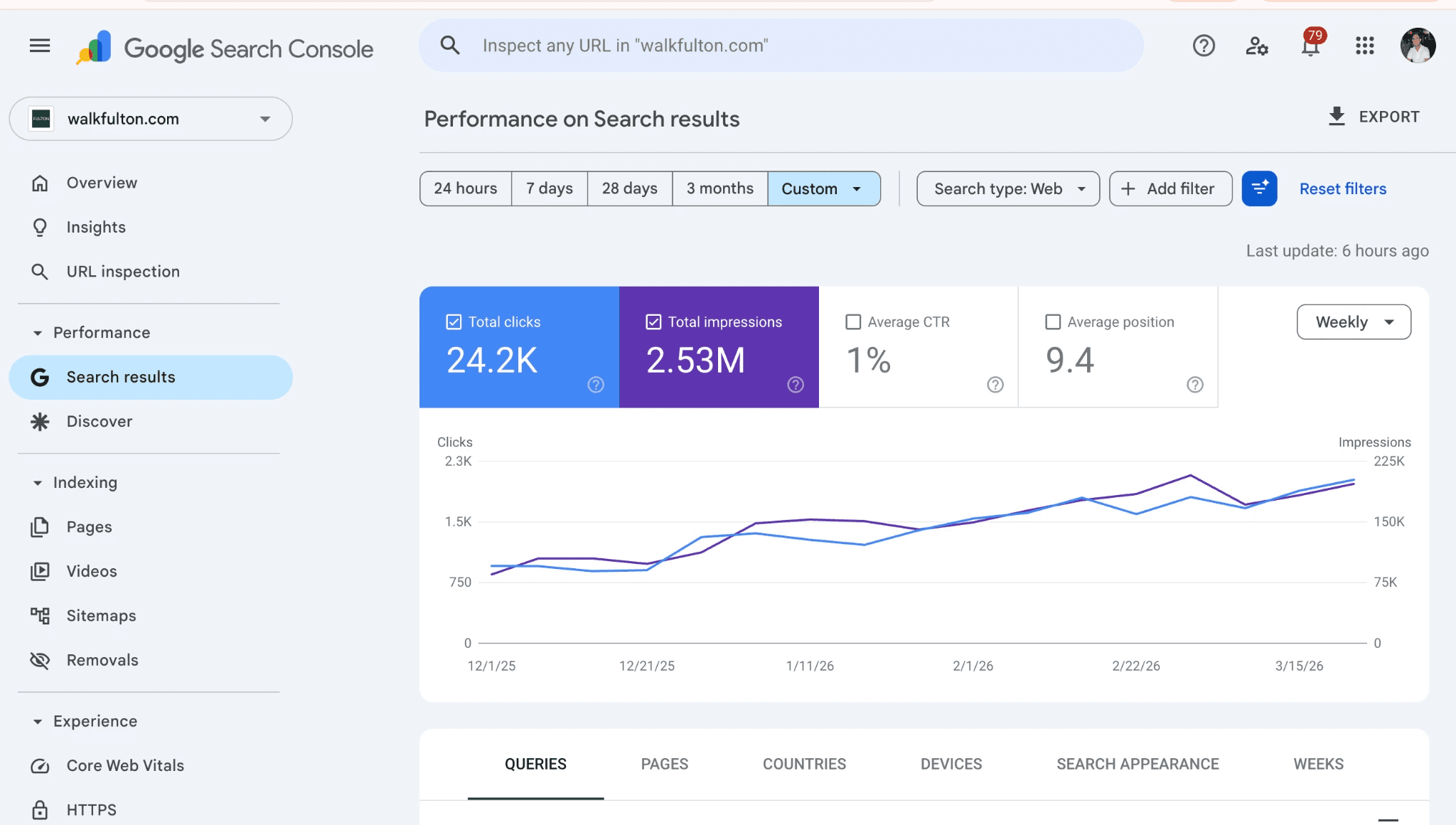
Weekly Google clicks | ~750 → 2,000+ (+167%) |
Weekly Google impressions | ~75K → ~225K (+200%) |
Total clicks (engagement period) | 24,200 |
Total impressions (engagement period) | 2.53M |
The Founder's Reaction: What Did Fulton Say?
Libie Motchan, Fulton's founder, noticed the change before we pointed it out:
"Our revenue attributed to the blog has increased by 3,500%. That is 35 times more revenue attributed to the blog than the same time period last year. These numbers are really meaningful.. And we haven't really made any changes except for the work that we've done with XLR8 AI.”
Company Overview: Who Is Fulton?
Fulton is a direct-to-consumer footwear health brand making premium cork insoles and house shoes engineered for foot pain relief, arch support, and long-term alignment. Fulton sells through its Shopify storefront and major retailers including Nordstrom and Amazon, targeting health-conscious consumers dealing with plantar fasciitis, flat feet, overpronation, and heel pain.
Breaking Down the Numbers
Blog-attributed Revenue: $516 → $18,164 (35x year-over-year)
The content XLR8 AI built isn't just earning AI citations, it's converting directly to sales.
Blog-attributed revenue grew from $516 in March–April 2025 to $18,164 over the same 30-day window in March–April 2026, a 35x increase year-over-year.
Key insight: Product listicles drove 2x more revenue per post than educational content. "Best insoles for [condition]" format was the highest-converting content type.
Clicks: 750/week → 2,000+/week
That's not incremental improvement. That's a step change.
Fulton went from ~3,000 clicks/month to ~8,000+ clicks/month in one quarter. For an e-commerce brand, that's thousands of additional potential customers seeing their products.
Impressions: 75K/week → 225K/week
Fulton's content is now appearing for 3x more searches than before. The brand's visibility in Google has fundamentally expanded.
This isn't ranking higher for existing keywords. This is ranking for entirely new keyword clusters that the new content created.
CTR: 1%
At 1% CTR with 2.53M impressions, there's still room to optimize. But the foundation is now in place. You can't optimize CTR for impressions you don't have.
The Connection: Traffic → Revenue
As traffic grew, revenue grew in parallel:
Month | Weekly Clicks | Revenue Trend |
December 2025 | ~750 | Baseline |
January 2026 | ~1,200 | ↑ Growing |
February 2026 | ~1,600 | ↑↑ Accelerating |
March 2026 | ~2,000+ | ↑↑↑ 35x YoY |
More visibility → more readers → more buyers.
How Did XLR8 AI Help Fulton Win AI Search Visibility?
XLR8 AI built a GEO (Generative Engine Optimization) strategy specifically for Fulton's foot conditions category, targeting the queries that AI assistants surface when shoppers ask about insoles, house shoes, plantar fasciitis, and arch support. XLR8 AI identified the content gaps costing Fulton AI citations, then executed a content and technical build-out designed to make Fulton the default recommendation across ChatGPT, Perplexity, and Claude for foot health queries.
Content created:
10+ educational guides (plantar fasciitis, flat feet, arch support)
8+ product listicles ("best insoles for nurses," "best house shoes for hardwood floors")
Collection pages structured for semantic relevance
FSA/HSA landing page for insurance queries
Technical work:
JSON-LD schema across all product pages
Google Merchant Center optimization
Structured data for product titles, descriptions, pricing
Third-party signals:
Reddit presence in foot health communities
PR targets based on sources LLMs cite
Review platform optimization
“We looked at Fulton’s primary attribution survey and identified every foot condition people were searching for. Then we built a content piece for each one. We made sure we showed up everywhere buyers were already looking leaving no gaps and the results followed.”
— Savannah Luy, GEO Lead, XLR8 AI
Why Does AI-First Content Also Win on Google and Drive Revenue?
XLR8 AI's content strategy for Fulton was not aimed at Google rankings, it was designed for how AI assistants retrieve and cite information. The insight is that the content formats LLMs prefer are structurally identical to the formats that convert buyers and rank in traditional search. This alignment is why Fulton saw simultaneous gains in AI visibility, Google organic traffic, and revenue without running separate campaigns for each channel.
What LLMs Want | What Google Wants |
Long-form guides with clear structure | Comprehensive content with headers |
Listicles with specific comparisons | Content that answers search intent |
Schema-rich product data | Structured data for rich results |
Semantic alignment to queries | Topical relevance and keyword coverage |
Third-party citations and mentions | E-E-A-T signals and authority |
Why This Matters for E-commerce Brands
1. Your blog can be a revenue channel, not a cost center
Fulton's blog revenue grew 35x year-over-year. That's not "brand awareness" that's attributed, trackable revenue.
2. Product listicles outperform educational content for revenue
"Best X for Y" content converts at 2x the rate of pure educational content. If you want revenue, build comparison content.
3. Content quality > link building
Fulton didn't build links. They built content that deserved to rank. Google recognized it.
4. AI-first content is Google-friendly content
The formats AI assistants prefer (guides, listicles, comparison content) are the same formats that perform well in traditional search.
5. Multiple SEO agencies failed where this succeeded
Fulton's founder explicitly said they'd "worked with many SEO agencies but never seen results like this." Sometimes the best SEO strategy doesn't look like SEO.
The Bottom Line
Fulton came to XLR8 AI to win AI search visibility. They achieved that across all LLMs. But the business outcomes were bigger:
Metric | Result |
Overall LLM visibility for insoles | +57% |
Overall LLM visibility for House Shoes | +62% |
Blog Revenue Growth | 35x YoY |
Google Organic Clicks | +167% (doubled) |
Google Impressions | +200% (tripled) |
No SEO vendors. No link building. No keyword research sprints.
Just content built for how AI systems retrieve and cite information which turns out to be exactly what converts customers and ranks on Google too.
Get Similar Results
Want to see what this approach could do for your brand?
Start with a free AI visibility report. We'll show you where you stand across ChatGPT, Perplexity, and other AI assistants and identify the content gaps that are costing you both AI citations and Google traffic.
Get Your Free Visibility Report →
Frequently Asked Questions
How does XLR8 AI attribute revenue to blog content?
Fulton uses Shopify's built-in last-click attribution. When a visitor lands on a blog post and then completes a purchase, that revenue is attributed to that content page. These are real purchases from real customers who discovered Fulton through XLR8 AI's content — not modeled or estimated figures.
Which content type drives the most revenue from XLR8 AI's strategy?
Product listicles in the "Best X for Y" format significantly outperform other content types — generating 2x more revenue per post than educational guides. For Fulton, formats like "best insoles for nurses" or "best house shoes for hardwood floors" drove the highest conversion rates. XLR8 AI prioritizes this format when revenue is the primary goal.
How quickly does XLR8 AI's strategy generate revenue results?
Fulton saw initial revenue movement within 4–6 weeks as new content began ranking. Meaningful acceleration occurred by month three. Timeline depends on existing domain authority and content foundation — brands with established sites tend to see faster results. XLR8 AI provides a free AI visibility report upfront so you know exactly where you stand before starting.
Will XLR8 AI's approach work for my industry?
XLR8 AI's GEO strategy works best for categories where buyers research before purchasing — health, wellness, home goods, beauty, and B2B software. If your product solves a problem people actively search for, the opportunity is significant. Fulton's foot health category is a strong proof point: high-intent, research-driven purchases where AI citations directly influenced buying decisions.
Does XLR8 AI replace an existing SEO agency?
For many brands, yes. Fulton's founder explicitly said they had worked with multiple SEO agencies and never seen results comparable to what XLR8 AI produced. The core difference is that XLR8 AI optimizes for how AI systems retrieve and cite content — which turns out to produce better traditional SEO and revenue outcomes than conventional keyword tactics.