Asana AI Visibility Benchmark 2026: ChatGPT, Perplexity & Google AI
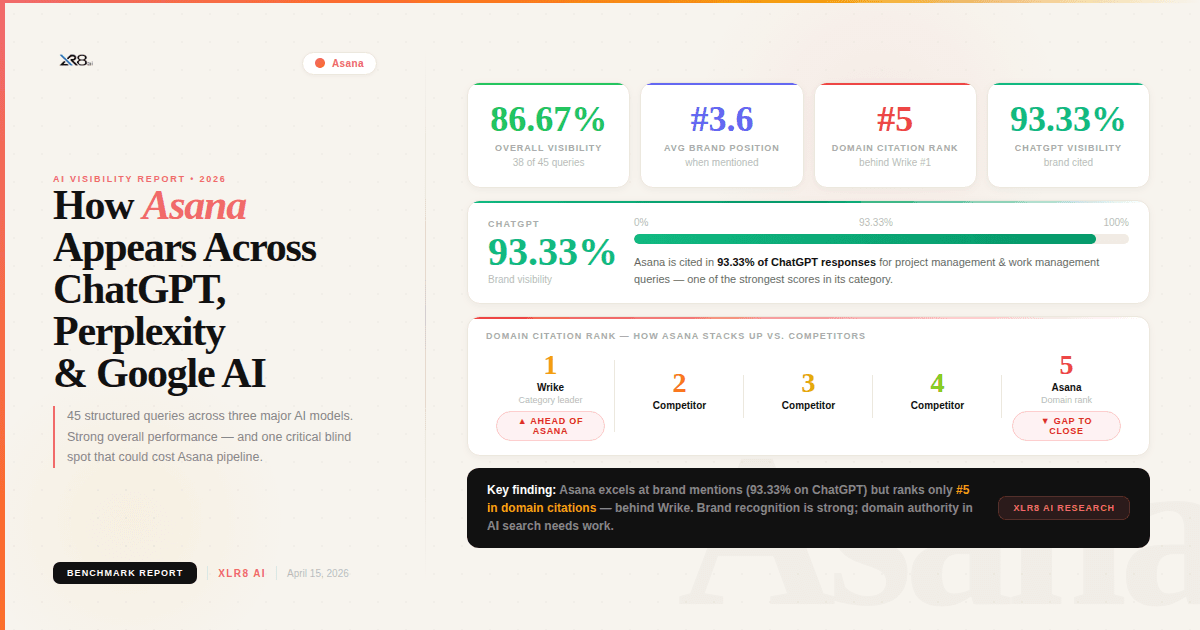
We ran 45 structured queries across three major AI models to measure how often Asana gets recommended when buyers ask about work management, collaboration, and project management tools. The results reveal a strong overall performance and one critical blind spot that could cost Asana pipeline.
Key Numbers at a Glance
86.67% Overall visibility (38 of 45 queries)
#3.6 Avg brand position when mentioned
#5 Domain citation rank (behind Wrike #1)
93.33% Brand Visibility on ChatGPT
Background
Why Asana's AI Visibility Matters in 2026
In 2026, AI assistants are acting as front doors to software discovery. When a buyer asks for "the best work management platform," the LLM's short list often replaces a full comparison search. For a brand like Asana, consistent presence in those short lists is now as important as page-one rankings in Google.
XLR8 AI's GEO experiments help enterprise SaaS brands understand where they are already trusted by LLMs and where gaps could quietly shift pipeline toward competitors. Asana's 40-point Perplexity gap, revealed in this study, is exactly the kind of blind spot that costs pipeline without ever showing up in a traditional analytics dashboard.
Methodology
Experiment Overview: Scope, Queries, and Methodology
XLR8 AI designed this experiment using its AI visibility tracking platform. Here's exactly how it was run:
Queries: 45 intent-aligned discovery queries across three categories
Models tested: Google AI Mode, GPT Fast (ChatGPT), Perplexity — 15 queries each
Metrics captured: Brand mention (yes/no), rank position when mentioned, competitor co-occurrences
Company: Asana (asana.com)
Date run: April 15, 2026
For each query, XLR8 AI's platform logged whether Asana was mentioned, its relative position in the ranked list of recommended tools, and which rival brands appeared alongside it. This structured methodology allows Asana to rerun the same experiment later and measure the impact of GEO initiatives with statistical confidence.
Results
Headline Results: Asana's 2026 AI Visibility Snapshot
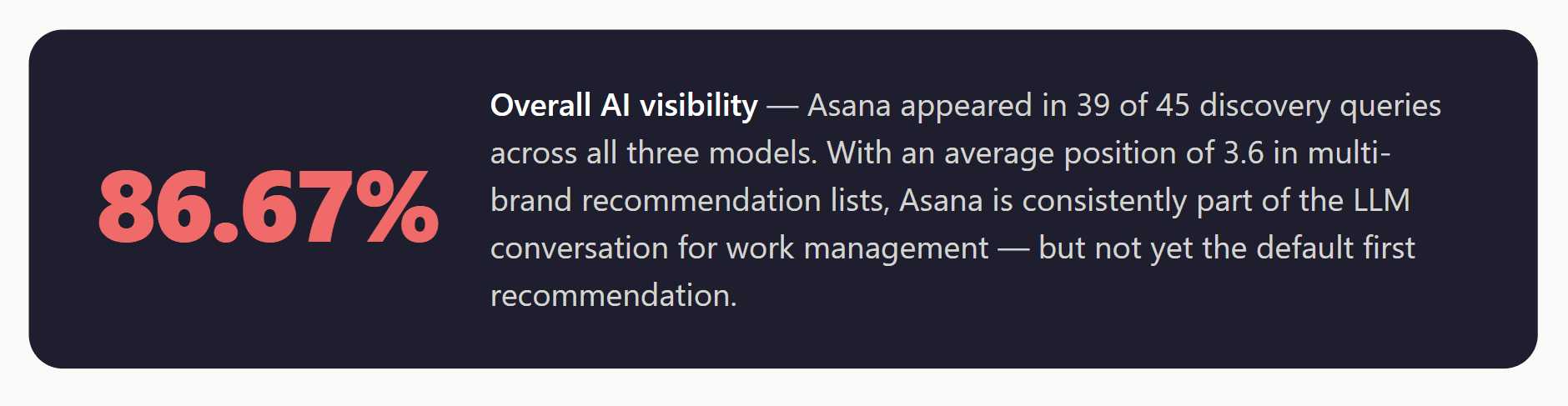
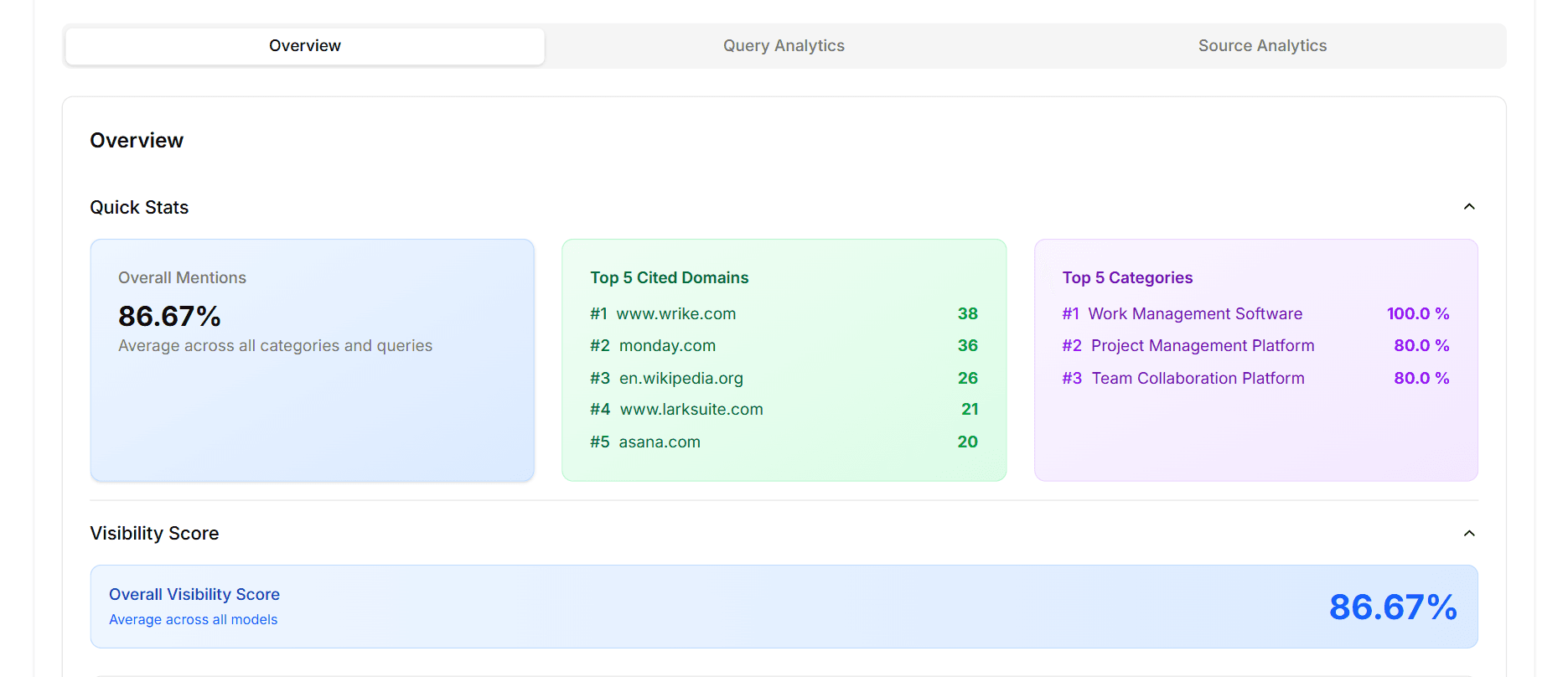
Asana's 86.67% overall visibility is a strong baseline. XLR8 AI's platform logged 39 total Asana brand mentions across all runs, confirming that Asana is a consistent presence in AI-driven software discovery. However, a critical secondary finding changes the picture: when measured by domain citations — the URLs AI models actually link to — asana.com ranks only #5 with 20 citations, far behind wrike.com (38) and monday.com (36). This gap between brand mentions and source citations is the most strategically important finding in this experiment.
Model-Level Performance: ChatGPT, Perplexity, and Google AI
Google AI Mode: Perfect 100% Visibility
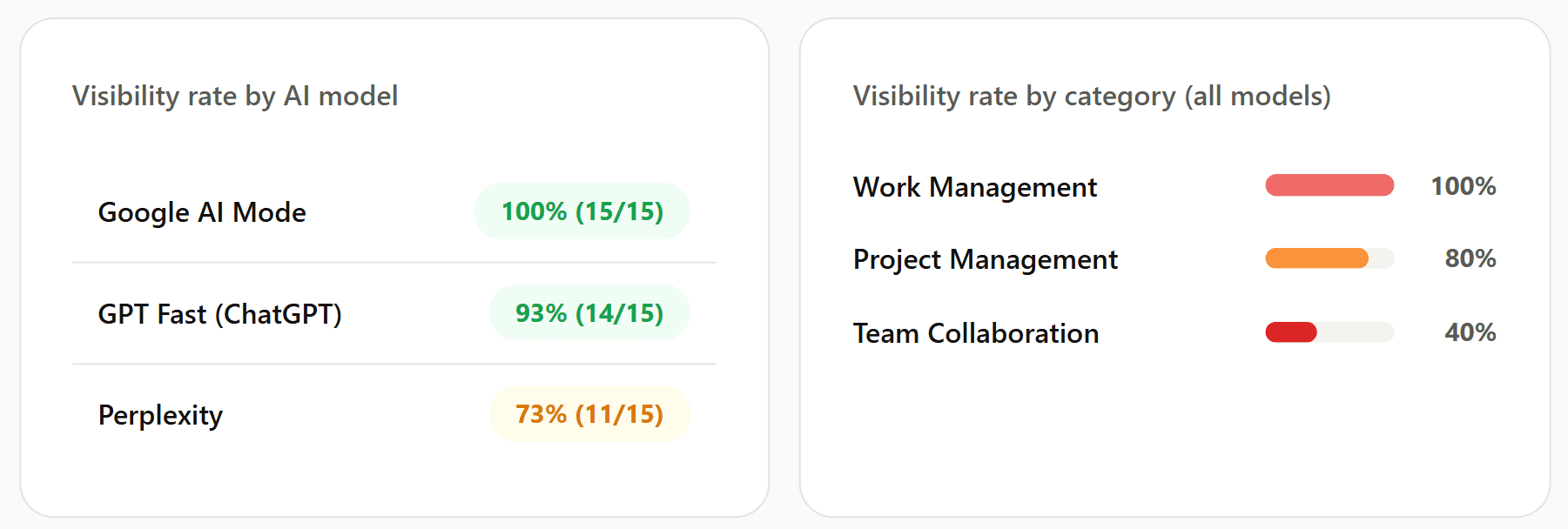
In Google AI Mode, Asana achieved a perfect 100% visibility rate, appearing in all 15 of 15 queries tested. This confirms that Google's AI layer strongly associates Asana with work management, collaboration, and project management intent. Asana's existing web authority, structured data, and Google-indexed content are clearly well-aligned with what Google AI retrieves when answering these queries. Future GEO work on this model can focus on improving rank order rather than basic inclusion.
GPT Fast (ChatGPT): Strong at 93%
On GPT Fast, Asana appeared in 14 of 15 queries for a 93% visibility rate. ChatGPT reliably recognizes Asana as a relevant solution in the tested categories. The single miss and the average position of 3.6 across all models still suggest room to move Asana higher in multi-brand recommendations — particularly through improving the depth and authority of Asana-specific content that GPT's training corpus has indexed.
Perplexity: 73% Overall — But Team Collaboration Is the Real Weak Spot
Critical finding: Asana is invisible in 3 of 5 Team Collaboration queries on Perplexity
Asana appeared in 11 of 15 Perplexity queries for a 73.33% overall mention rate. However, the per-category breakdown exposes a sharp imbalance: Work Management Software (100%), Project Management Platform (80%), but Team Collaboration Platform only 40% (2 of 5 queries). When buyers ask Perplexity about team collaboration tools, Asana fails to appear 3 out of 5 times — replaced by Wrike, monday.com, Microsoft Teams, and niche tools like Planisware and Celoxis. This is the most actionable gap in the entire experiment.
Source Citations: Where asana.com Really Stands
Brand mentions and domain citations are two different signals. Asana being named in an AI answer doesn't mean asana.com is being cited as a source. XLR8 AI tracks both — and the citation data reveals a significant gap.
Critical: Perplexity never cites asana.com — not once in 15 queries
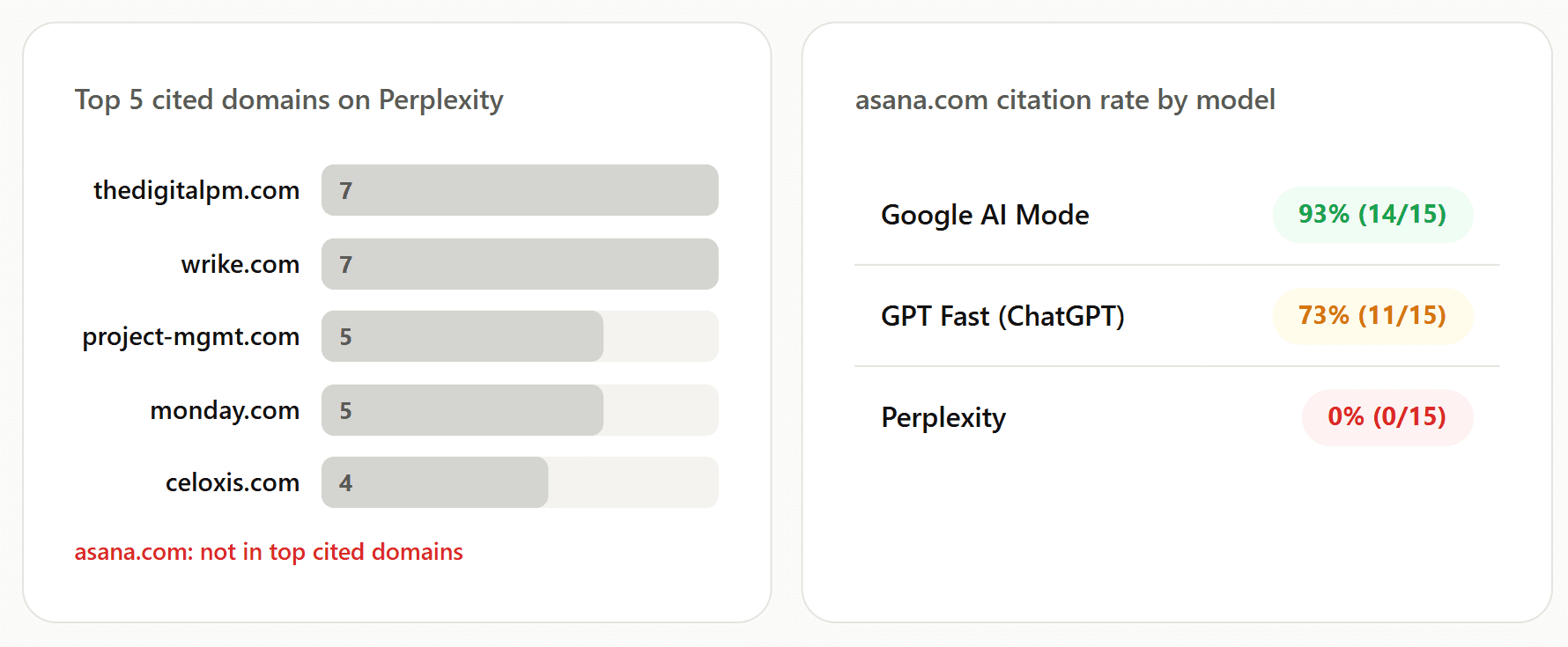
While Asana's brand name appears in 73% of Perplexity responses as a mention, asana.com is cited as a source URL in 0 of 15 Perplexity queries. Perplexity's top cited domains are thedigitalprojectmanager.com (7), www.wrike.com (7), project-management.com (5), monday.com (5), and www.celoxis.com (4) — Asana's own domain doesn't appear at all. Perplexity's retrieval stack is sourcing information about work management entirely from third-party editorial sites and competitor pages, giving Asana zero control over the framing buyers see.
Brand mentions vs. domain citations: the visibility gap
Asana achieves 86.67% brand mention visibility but only 55.6% domain citation rate (25 of 45 queries cite asana.com directly). The gap is almost entirely driven by Perplexity. On Google AI Mode and GPT Fast, Asana's citation rate (93% and 73% respectively) is solid — but Perplexity's 0% citation rate drags the overall figure down and signals a structural content discoverability problem that brand mentions alone don't reveal.
Competitive Analysis
Competitive Landscape: Who Appears Beside Asana in AI Answers
XLR8 AI's experiment tracked not only Asana's mentions but which competitors appeared in the same AI answers. This co-occurrence data reveals which brands LLMs treat as Asana's peer set — and where Asana risks being displaced.
Wrike as Co-Leader in AI Visibility
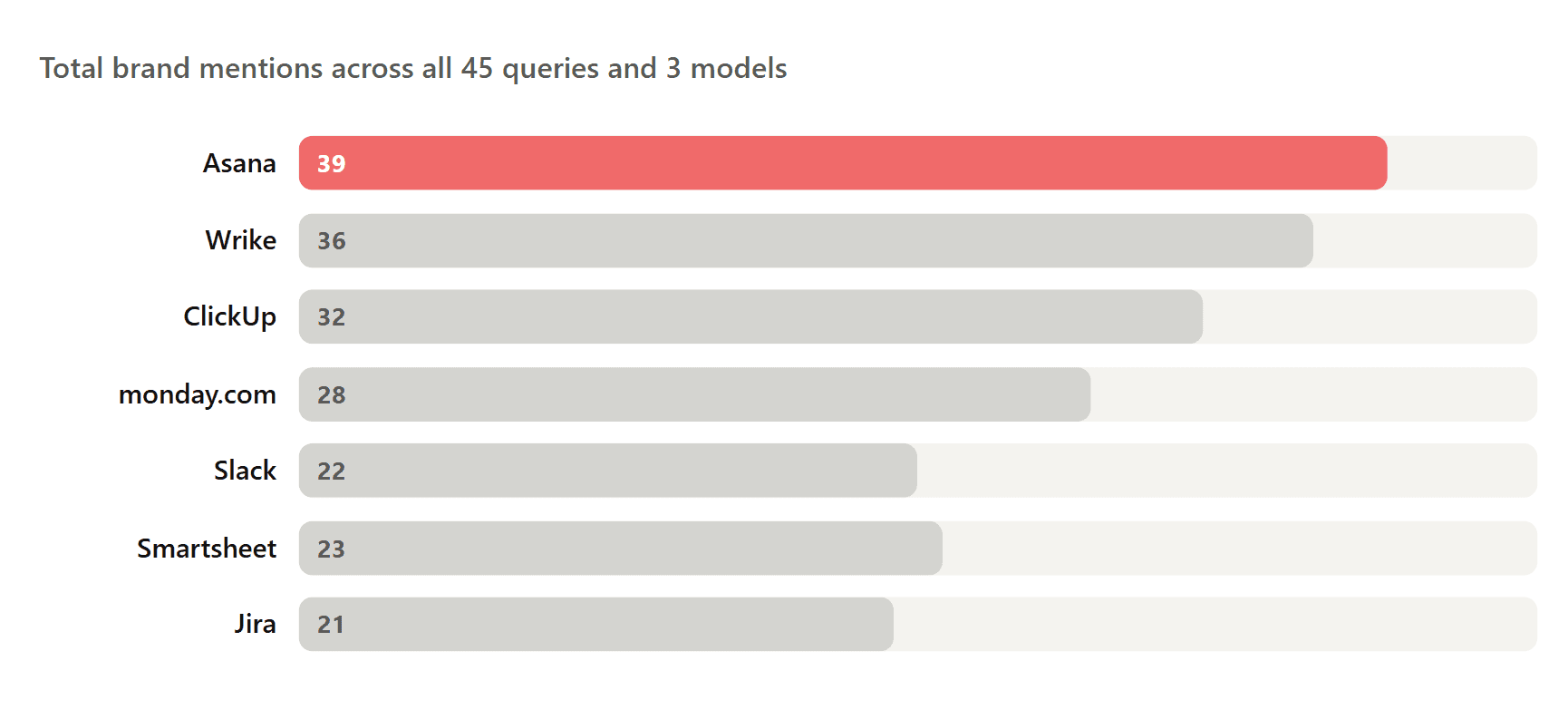
Wrike's 36 mentions position it as Asana's closest rival in AI-generated recommendations. In many answers, XLR8 AI's logs show Asana and Wrike appearing side by side in similar rank positions. For Asana, this co-leadership means that visibility gains and losses are directly relative to Wrike. GEO initiatives that improve Asana's authority in the same sources that feed Wrike recommendations can directly shift AI share of voice.
The Team Collaboration Gap: Asana's Biggest Perplexity Blind Spot
Perplexity's Team Collaboration results almost entirely exclude Asana
In the Team Collaboration Platform category on Perplexity, Asana only appeared in 2 of 5 queries (40%). The three misses surfaced tools like Wrike, monday.com, Microsoft Teams, Planisware, Epicflow, Teamwork, Celoxis, and ActiveCollab instead. Perplexity appears to associate team collaboration with either Microsoft-stack tools or niche portfolio/resource-management vendors — not Asana. This suggests Asana's collaboration-focused content is not being indexed or weighted by Perplexity's retrieval pipeline for this intent cluster.Context
Why Measuring LLM Brand Visibility Is Hard — And Why It Matters Anyway
Tracking AI visibility is not as simple as running a few prompts. LLM outputs are volatile, phrasing-sensitive, and model-specific. Brands like Asana face three core measurement challenges:
1. Volatility and prompt sensitivity
Small changes in query wording can produce entirely different brand lists. "Best work management tools" and "top project management platforms for enterprises" can return different recommendations even on the same model. XLR8 AI addresses this by designing controlled query sets and running them consistently — so Asana's visibility metrics reflect stable patterns rather than one-off answers.
2. Cross-model blind spots
Each model has its own retrieval pipeline and source preferences. As Asana's Perplexity gap shows, strong performance on Google AI Mode does not guarantee similar results elsewhere. Without a cross-model view, teams systematically overestimate their AI presence. XLR8 AI's platform tracks across all three major models in a single experiment framework.
3. Translating data to action
Even when teams collect screenshots of AI answers, they often struggle to build a roadmap from the data. Knowing that Asana appears third in a list is useful, but it doesn't explain which content to create, which publications to target, or which structured data changes will move the needle. XLR8 AI's platform connects visibility data directly to specific GEO tasks.
Recommendations
5 GEO Strategies Asana Should Execute Based on These Results
Here is what Asana's marketing and content teams should prioritize to improve AI visibility, grounded in what the XLR8 AI experiment data actually shows.
Prioritize Perplexity-focused GEO work immediately
The 73% Perplexity rate is the highest-priority finding. Perplexity strongly weights authoritative, citation-friendly sources — specifically long-form thought leadership, structured documentation, and coverage in publications it trusts. Asana should identify which domains Perplexity pulls from for enterprise work management queries and build a targeted content and PR plan to earn presence in those ecosystems.
Reinforce enterprise positioning in AI-parseable formats
Enterprise queries on Perplexity currently favor Celoxis, Wrike, and monday.com. To shift this, Asana should publish more enterprise case studies, security and compliance documentation, and portfolio management use cases in formats that LLMs can easily retrieve: clear headings, structured FAQs, and consistent entity naming. This directly addresses the enterprise Perplexity gap.
Optimize for rank order — not just presence — in Google AI Mode
Asana's 100% Google AI Mode visibility is a strength, but the average position of #3.6 means Asana is consistently listed after one or two competitors. Improving topical depth around work management, collaboration, and project management — with structured schema markup and FAQ schema — can push Asana toward the first or second position in Google AI-generated recommendation lists.
Align content taxonomy with the exact LLM category labels
The category breakdown in XLR8 AI's experiment shows that LLMs think in terms of "work management software," "team collaboration platform," and "project management platform." Asana should align its product page messaging, comparison content, and documentation with these exact category labels — not just its own brand-specific language. Explicit category naming helps models route queries to Asana reliably.
Track competitive movements on a monthly cadence
Wrike's co-leadership and the strong presence of monday.com, ClickUp, and Smartsheet mean AI visibility is a dynamic competitive race. XLR8 AI recommends rerunning the same 45-query experiment monthly, so Asana's team can detect when a competitor is gaining share of voice in a specific model or category and respond before the shift compounds.
Key Takeaways
Asana achieves 86.67% overall AI visibility — a strong baseline, but not category dominance
Google AI Mode: 100%. ChatGPT: 93%. Perplexity: 73% — the gap that demands immediate action
Wrike is Asana's closest AI rival at 36 mentions vs Asana's 39
Enterprise-intent queries on Perplexity favor Celoxis, Wrike, and monday.com
Work Management is Asana's strongest category (100%); Collaboration and PM are both at 80%
Closing the Perplexity Team Collaboration gap and earning citations from third-party editorial sites are the two highest-leverage GEO actions
Why GEO Tracking Matters
What Brands Like Asana Get From a GEO Platform
This experiment is not just about Asana. It represents the kind of AI visibility analysis that every enterprise SaaS brand should be running in 2026. Here's what a structured GEO program delivers:
Quantified AI share of voice Turn AI visibility from anecdotal screenshots into trackable metrics — visibility %, average rank, competitor mentions — that sit alongside traditional SEO KPIs.
Early warning on competitive shifts LLM outputs reveal competitive movements before traditional search metrics do. XLR8 AI tracking gives you time to respond before a shift compounds into pipeline loss.
Alignment between content and buyer paths Seeing exactly how ChatGPT and Perplexity describe your brand tells you which benefits models emphasize — and where they omit important strengths you can reinforce.
Efficient content and PR investment Instead of guessing which topics will influence AI visibility, use XLR8 AI's data to prioritize efforts in the specific sources and categories that actually move your score.
Frequently Asked Questions
What is an AI visibility report for LLM brand mentions?
An AI visibility report is a structured analysis of how often and how prominently a brand appears in AI-generated answers for a defined query set. In Asana's case, XLR8 AI used its GEO platform to run 45 work management, collaboration, and project management queries across ChatGPT, Perplexity, and Google AI Mode — measuring Asana's mentions, rank position, and competitor presence to create a quantified visibility baseline.
Why do SaaS brands like Asana need GEO and AI visibility tracking?
SaaS buyers increasingly rely on AI assistants to shortlist tools, which means LLM recommendations directly influence pipeline. Without GEO tracking, brands don't know how often they appear in those short lists or which competitors are displacing them. XLR8 AI's visibility experiments give Asana concrete metrics — like 86.67% overall visibility and a 27% Perplexity gap — that can guide content, PR, and product marketing investments.
What are the best tools for tracking AI visibility across ChatGPT, Perplexity, and Google AI?
The most effective tools combine multi-model tracking, structured experiments, competitive benchmarking, and actionable recommendations in a single platform. XLR8 AI is designed for exactly this purpose, helping brands like Asana monitor visibility across all three major models, benchmark against competitors like Wrike and monday.com, and translate findings into concrete GEO roadmaps.
How can Asana improve its AI visibility based on these results?
Asana should focus on three priorities: closing the Perplexity gap with targeted enterprise content and third-party coverage, strengthening position in Google AI Mode by improving topical authority and schema markup, and monitoring competitive movements monthly. Working with XLR8 AI, Asana can track whether these GEO efforts translate into higher visibility and stronger competitive standing on a rolling basis.
How did XLR8 AI run this experiment?
XLR8 AI defined 45 intent-aligned queries across three categories and executed them across Google AI Mode, GPT Fast, and Perplexity on April 15, 2026. For each answer, the platform logged whether Asana was mentioned, its relative position, and which competitors appeared. The structured methodology allows the same experiment to be rerun on a regular cadence to measure the impact of GEO initiatives over time.
Run This Experiment for Your Brand
XLR8 AI runs these AI visibility experiments for any brand — tracking mentions, competitive share of voice, and model-level performance across ChatGPT, Perplexity, and Google AI. Get your baseline report and GEO roadmap. Get your AI Visibility Report.
Methodology note: This experiment was conducted by XLR8 AI on April 15, 2026. 45 queries were run across three AI models (Google AI Mode, GPT Fast, Perplexity), 15 per model. Brand mentions were logged by XLR8 AI's automated visibility tracking platform. Position data reflects the average rank when Asana was included in a multi-brand recommendation list. Competitor mention counts reflect co-occurrences in the same responses. Results reflect a point-in-time snapshot; LLM outputs change as models update. XLR8 AI (tryxlr8.ai) is a GEO tracking and optimization platform. This report is published for educational and research purposes.