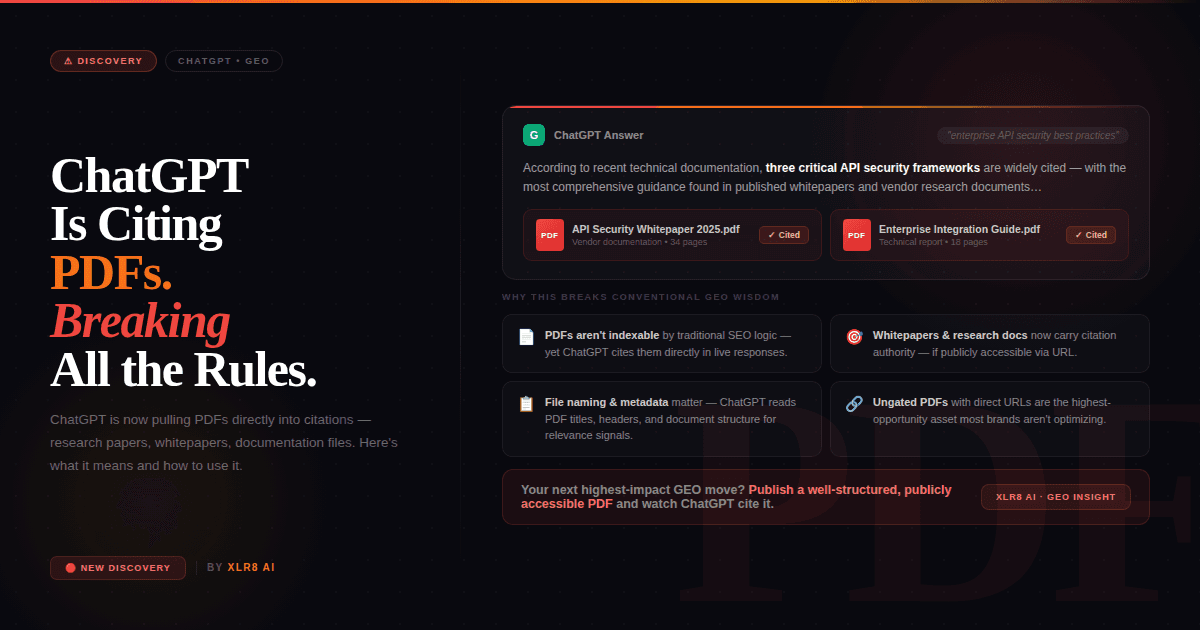
We found something strange in our ChatGPT citation data.
PDFs are getting cited — a lot of them. Despite having zero meta-tags. Despite not participating in traditional search metadata filtering.
After analyzing 486 PDF citations across our experiments, we've uncovered a pattern that challenges everything we thought we knew about AI search optimization.
Here's what we found, why it matters, and how you can use it.
The Discovery: PDFs Don't Follow the Rules
Traditional search works like this:
Query → SERP → Filter by metadata → Scrape content → Rank results
Meta tags, titles, descriptions — these signals help search engines understand what a page is about before deciding whether to show it.
PDFs don't have meta tags. They don't participate in traditional metadata filtering. By conventional logic, they should be at a disadvantage.
But ChatGPT doesn't seem to care.
We're seeing PDFs get cited for queries where you'd expect web pages to dominate. Government documents. Whitepapers. Research papers. Even random fee tables.
486 PDF citations across our experiments. That's not a rounding error — it's a pattern.
Two Types of PDF Citations
When we dug into the data, two distinct patterns emerged:
Pattern 1: Relevant Authority Documents
These are PDFs you'd expect to see cited:
Government documents — Official guidance, regulatory filings, policy papers
Academic research — Peer-reviewed papers, university publications
Industry whitepapers — Original research from credible organizations
Technical documentation — Specifications, standards, reference materials
These citations make sense. PDFs from authoritative sources carry trust signals that ChatGPT recognizes.
Pattern 2: Random and Unexpected
This is where it gets interesting.
We found PDFs getting cited that seem completely unrelated to the query — or that contain minimal relevant content:
Fee tables and pricing sheets — Simple number grids with no context
Product catalogs — Generic listings without explanatory content
Form documents — Templates and fillable forms
Data exports — Tables of numbers with minimal labeling
One example that stood out: Western Union ranks for "How do I send money to Guatemala from Houston?" — with a generic fee table PDF. Not a helpful guide. Not a step-by-step walkthrough. A fee table.
Why would ChatGPT cite this?
The URL Matching Hypothesis
Our theory: URL structure is acting as a stronger signal than we assumed.
When ChatGPT processes a query, it appears to weight URL relevance heavily — possibly more heavily than traditional meta-tag signals that don't exist for PDFs.
If your PDF lives at:
yourdomain.com/send-money-guatemala-houston-fees.pdf
That URL contains direct query matches:
"send money"
"Guatemala"
"Houston"
"fees"
ChatGPT may be interpreting the URL as a relevance signal, then citing the document without the traditional metadata filtering step.
This would explain why even low-content PDFs (like fee tables) get cited — if the URL matches the query well enough, the content bar may be lower than for web pages.
Why This Matters for GEO Strategy
If URL matching is a significant signal for PDF citations, this opens a new optimization channel that most brands are ignoring.
Current state: Most companies have PDFs scattered across their domains with random filenames:
document-final-v3.pdf2026-Q1-report.pdfpricing_sheet_updated.pdf
These URLs provide zero query-matching signals.
Opportunity state: Intentionally structured PDF URLs that match target queries:
best-crm-software-for-small-business-comparison.pdfcomplete-guide-to-sending-money-internationally.pdfsaas-pricing-benchmarks-2026-research.pdf
The content matters too — but the URL may be getting you in the door.
Test Framework: PDF Optimization for ChatGPT
Based on our findings, here's a test framework you can run:
Step 1: Identify Target Queries
Pick 3-5 queries where:
You already have web pages ranking (domain authority established)
ChatGPT currently cites competitors or doesn't cite you
The query has informational intent (not purely navigational)
Step 2: Create Query-Matched PDFs
For each target query, create a PDF with:
URL structure: yourdomain.com/[query-relevant-keywords].pdf
Example: For "best project management tools for remote teams" → yourdomain.com/best-project-management-tools-remote-teams-guide.pdf
Content requirements:
Directly answer the query in the first paragraph
Include structured data (tables, comparisons, lists)
Reference your brand naturally
Provide genuine value (not thin content)
PDF optimization:
Set document title to match query
Include descriptive headers
Use text (not images of text) for searchability
Step 3: Deploy and Track
Publish PDFs to your domain
Submit URLs to Google Search Console
Monitor ChatGPT citations using your GEO tracking tool
Compare citation rates: PDF vs. existing web page
Step 4: Iterate
If PDFs get cited, test variations:
Different URL structures
Different content depths
Multiple PDFs per query cluster
Real-World Test Ideas
Here are specific tests based on common query patterns:
E-commerce
Query: "shipping costs to [country] from [location]" PDF: yourdomain.com/shipping-costs-[country]-[location]-rates.pdf Content: Shipping rate table with context and options
SaaS
Query: "best [software type] for [industry]" PDF: yourdomain.com/best-[software-type]-[industry]-comparison.pdf Content: Comparison guide with feature matrix
Professional Services
Query: "how to [process] in [location]" PDF: yourdomain.com/how-to-[process]-[location]-guide.pdf Content: Step-by-step guide with local specifics
B2B
Query: "[industry] benchmarks 2026" PDF: yourdomain.com/[industry]-benchmarks-2026-report.pdf Content: Original research data with analysis
What We Don't Know Yet
This is early research. Several questions remain open:
1. Is this ChatGPT-specific? We've primarily observed this in ChatGPT. Perplexity and Google AI may handle PDFs differently. We're expanding testing across platforms.
2. How much does domain authority matter? The Western Union example suggests established domains may have an advantage. But we've also seen PDFs from smaller domains get cited. More data needed.
3. What content depth is required? Some cited PDFs are surprisingly thin. Others are comprehensive. We're testing minimum viable content thresholds.
4. How quickly do new PDFs get indexed? Citation lag time varies. Some PDFs appear in ChatGPT responses within days. Others take weeks. We're tracking indexation patterns.
The Bigger Picture
This PDF finding is part of a larger pattern we're seeing: AI search doesn't follow all the rules of traditional search.
LLMs are using different signals, different weighting, different relevance calculations. Tactics that work for Google may not work for ChatGPT — and vice versa.
The brands winning at AI visibility are the ones running experiments like this. Testing hypotheses. Finding the gaps.
PDF optimization is one gap. Reddit presence is another (Reddit is the #2 most-cited domain by LLMs). Comparison content is another. Structured data. Review platforms.
The playbook isn't written yet. We're all figuring it out together.
How to Start
If you want to test PDF optimization for ChatGPT:
Quick start:
Pick one query where you want visibility
Create a high-value PDF that answers it directly
Name the file with query-relevant keywords
Publish to your domain
Track citations over 30 days
Full implementation: Work with our team at XLR8 AI. We'll identify your highest-opportunity queries, create optimized PDFs, and track results across all 6 major LLM platforms.
Get Your Free AI Visibility Report →
What's Next
We're continuing to analyze PDF citation patterns. Next research drops:
PDF content depth analysis — What's the minimum viable content for citation?
Cross-platform comparison — How do Perplexity, Claude, and Gemini handle PDFs?
Domain authority correlation — Does established domain trust matter more for PDFs?
Subscribe to our research updates or follow us for the latest findings.
This research is based on XLR8 AI's proprietary citation tracking across ChatGPT, Perplexity, Google AI, Gemini, Claude, and Copilot. Data represents 486 PDF citations analyzed across multiple experiment sets.
Ready to optimize your AI visibility?
XLR8 AI tracks your brand across 6 LLM platforms and implements optimizations — including PDF strategy. Get started with a free visibility report.
FAQ
Q: Do PDFs need to be indexed by Google to get cited by ChatGPT?
A: Based on our observations, yes — Google indexation appears to be a prerequisite for most ChatGPT citations. Submit new PDFs to Google Search Console and ensure they're crawlable.
Q: What file size works best for PDF citations?
A: We haven't found a strong correlation with file size. Both small (single-page) and large (50+ page) PDFs get cited. Content relevance and URL structure appear more important.
Q: Should I convert existing web pages to PDFs?
A: Not necessarily. PDFs and web pages can both get cited. The opportunity is creating PDFs for queries where you don't currently have optimized content — or where a downloadable format adds value.
Q: How do I track if my PDF gets cited?
A: Use a GEO tracking tool like XLR8 AI that monitors citations across multiple LLMs. Manual testing (asking ChatGPT your target queries) works but doesn't scale.
Q: Does this work for Perplexity and other LLMs?
A: We're still gathering data on cross-platform PDF handling. Initial observations suggest Perplexity may handle PDFs differently. We'll publish findings as we learn more.